
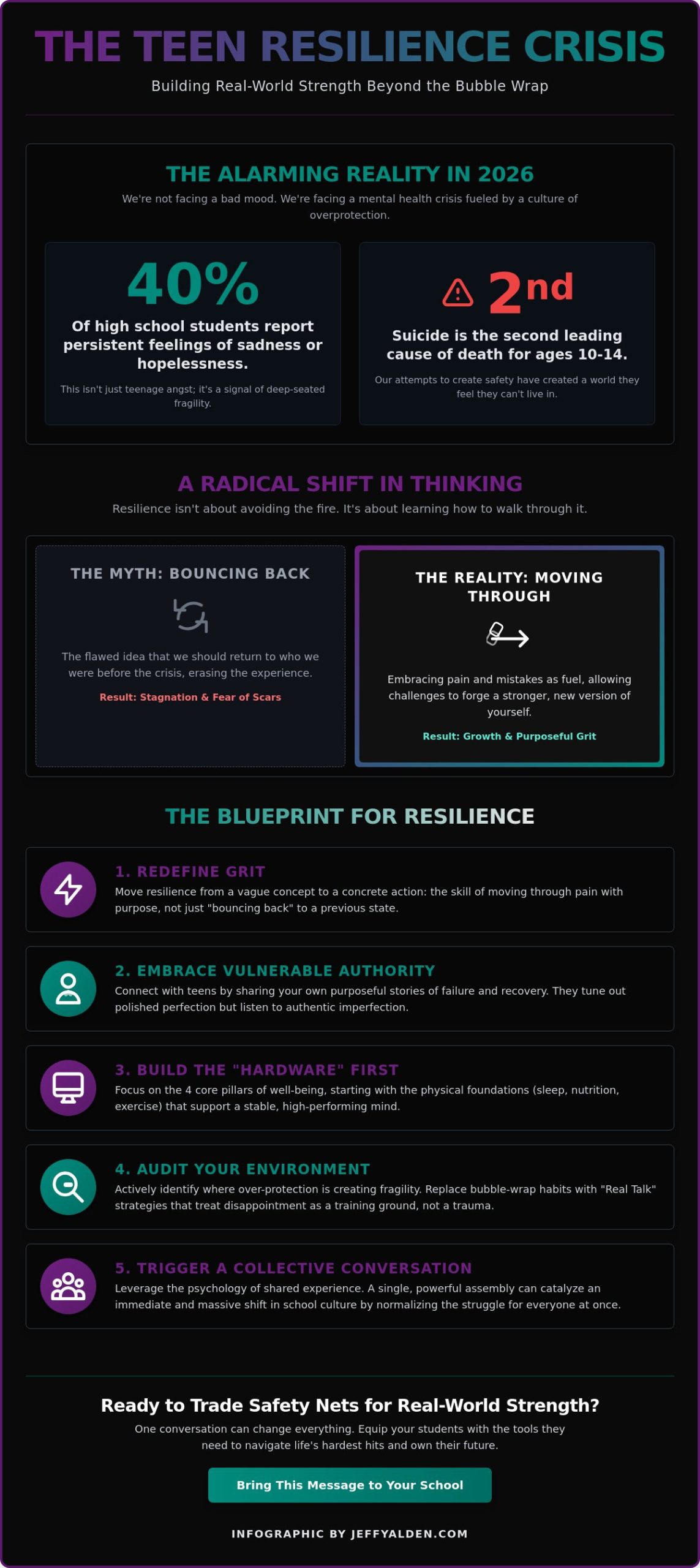
We’ve spent years trying to protect our kids from the world, but we’ve accidentally made them too fragile to live in it. The “bubble-wrap” culture is failing. Right now, in 2026, about 40% of high school students report persistent feelings of sadness or hopelessness. We aren’t just facing a bad mood; we’re facing a crisis where suicide is the second leading cause of death for those aged 10 to 14. Building resilience in teens isn’t about avoiding the fire. It’s about teaching them how to walk through it without turning to ash.
You’re likely tired of seeing students paralyzed by the fear of failure. You feel the weight of every mental health crisis that hits your hallways and feel helpless to stop the slide. I’m here to show you how to trade the safety nets for raw, real-world strength. You’ll discover how to move beyond temporary fixes to equip teens with the tools they need to own their mistakes and navigate life’s hardest hits. We’re diving into a new era of school culture that prioritizes mental wellness over perfection, starting with the radical truth about what it actually takes to bounce back.
Key Takeaways
- Redefine resilience as the grit to move through pain with purpose rather than just trying to bounce back to the way things were.
- Embrace the concept of “Vulnerable Authority” to connect with students who tune out polished perfection but hunger for real, lived-experience guides.
- Unlock the 4 core pillars for building resilience in teens, starting with the physical “hardware” that supports a stable, high-performing mind.
- Audit your environment to identify where over-protection is accidentally causing fragility and replace those habits with “Real Talk” strategies.
- Understand the psychology of the shared experience and why a collective conversation can trigger a massive, immediate shift in your school culture.
Beyond the Bubble Wrap: What Resilience Actually Means for Teens Today
We’ve been lied to. For decades, we’ve been told that our job as parents and educators is to protect our kids from every sharp edge and cold wind. We’ve bubble-wrapped their lives. We’ve sanitized their failures. We’ve made their world so safe that they’ve become terrified of living in it. But here is the raw truth: you can’t build a diamond without pressure. By removing the struggle, we’ve removed the strength. Building resilience in teens isn’t about making them “bounce back” to who they were before a crisis. It’s about teaching them to move through the fire and come out forged on the other side.
The clinical world often defines psychological resilience as a process of adapting well in the face of adversity. That’s fine for a textbook. It’s safe. It’s clinical. But in the real world, the “Jeff Yalden Reality” is much messier and far more urgent. Resilience isn’t about being perfect. It’s about being real. It’s about looking at your mess, your trauma, and your mistakes, and refusing to let them be the end of your story. Resilience is the intersection of radical self-honesty and relentless forward motion.
Consider the difference between what we’ve been told and what actually works in the lives of our students:
- The Lie: Resilience is about never getting knocked down.
- The Truth: Resilience is about how you act while you’re on the floor.
- The Lie: we should protect teens from disappointment to save their self-esteem.
- The Truth: Disappointment is the essential training ground for future success.
The Myth of the Stress-Free Life
We need to stop teaching teens to avoid stress. Stress is an inevitable part of the human condition. When we promise them a life of constant happiness, we’re actually destroying their mental health. We’re setting them up for a total collapse the moment they face a real-world challenge. There’s a massive difference between toxic stress, which is sustained and unsupported, and growth-oriented challenge, which stretches their capabilities. If they never face the weight, they’ll never develop the muscle. We don’t need less stress; we need better tools to manage it.
Resilience vs. Invulnerability
Don’t mistake “toughness” for resilience. Being invulnerable is just a mask. It’s a wall we build to keep the world out, but it also keeps us trapped inside. True building resilience in teens happens when they stop pretending they’re okay and start being honest about their struggles. Vulnerability isn’t a weakness. It is the absolute foundation of character. The most resilient kids I’ve ever met aren’t the ones who never cry or never fail. They’re the ones who are honest about their pain, own their mistakes, and keep moving anyway. That is where real-world strength is born.
The Power of Vulnerable Authority: Leading Teens by Example
Building resilience in teens starts with you. You are the blueprint they’re using to build their own lives. If you pretend you’ve never failed, you’re teaching them that failure is something to be ashamed of. That’s a lie. Teens today have a high-definition “BS meter.” They tune out polished perfection. They tune in to authentic imperfection. This is what I call Vulnerable Authority. It’s when an adult leads by showing their scars, not just their trophies. We can’t ask them to be brave if we’re playing it safe.
When you share your own failures, do it with purpose. Don’t dump your trauma on them. That’s a burden. Instead, show them the process. Tell them, “I messed up, I felt like quitting, and here is how I got back up.” This creates the “Mirror Effect.” Teens naturally reflect the emotional regulation of the adults around them. If you can stay grounded in your own mess, they learn that they can stay grounded in theirs too. If you’re looking for a way to bring this message to your community, a Teen Motivational Speaker can bridge that gap between adult authority and student reality.
Radical Transparency in the Classroom and at Home
Teachers, this starts with professional development that prioritizes the human over the curriculum. Normalize the struggle. When a lesson fails or you make a mistake in front of the class, don’t hide it. Use it. Say, “I don’t know” or “I blew that one.” These three words build more trust than a thousand lectures ever could. You move from being a distant “Expert” to a relatable “Guide.” This transparency is the cornerstone of building resilience in teens within an academic setting.
Resilience in the Wake of Crisis: The Postvention Mindset
Resilience is most critical when the world stops making sense. After a school tragedy or a community loss, the atmosphere is heavy. Most people ask “Why did this happen?” but that question often has no answer. A Postvention mindset shifts the focus to “How do we take care of each other now?” This isn’t about moving on. It’s about moving forward together. In these moments, an outside voice can be the catalyst for healing. A specialist who understands the Postvention process can jumpstart the resilience cycle. They provide a safe space for students to process the collective weight of the crisis. It’s about turning a tragedy into a turning point for character and community strength.
While professional postvention is a critical first step, some may also find comfort in spiritual or intuitive support to help process their grief. Third Eye Kentucky offers mediumship and psychic services that can provide a sense of connection and peace for those navigating the aftermath of a significant loss.
The 4 Core Pillars of the Resilient Teen Mindset
Building resilience in teens isn’t a mystery. It’s a construction project. If you want a teen who can stand tall when life gets heavy, you have to build on solid ground. We stop guessing and start building on four specific pillars. These aren’t just ideas. They are survival skills. Look me in the eye when I tell you this: if the foundation is cracked, it doesn’t matter how much you talk about “mindset.” The house will fall.
- Pillar 1: Physical Wellness. This is the hardware. If a teen is getting zero sleep and spending 4.8 hours a day on social media, their brain is literally short-circuiting. Resilience is biological. You can’t think your way out of a crisis if your hardware is broken.
- Pillar 2: Emotional Intelligence. I call this naming the monsters. When we teach kids to identify exactly what they’re feeling, whether it is fear, shame, or inadequacy, they gain control. Once you name the monster, it loses its power to hide in the shadows and run the show.
- Pillar 3: Mental Agility. This is about reframing. It’s the ability to look at a disaster and see data instead of destiny. A bad grade or a lost game isn’t a sign they are a failure. It’s just information telling them that their current strategy needs to change.
- Pillar 4: Connection. This is the safety net. When the other three pillars fail, and they will, connection is what catches them. We are social creatures. Isolation is the enemy of resilience.
Reframing Failure: The “Not Yet” Philosophy
We have to change how we talk about “can’t.” In my work as a Youth Motivational Speaker, I see kids who give up the moment they hit a wall. We need to teach them to add one simple word: “yet.” I can’t do this yet. This shift moves them from a fixed mindset to a growth mindset. To help them process the sting, we use the 24-Hour Rule. They get 24 hours to grieve, cry, or be angry about a failure. Once that clock stops, they have to switch to Solution Mode. Remember this: failure is just the tuition you pay for the success you’re about to earn.
The Connection Safety Net
Every teen needs a One Significant Adult. This is an OSA. It’s a person who isn’t their parent but who they trust implicitly. Research shows that having just one supportive adult can be the difference between a teen spiraling or surviving. This is why school assemblies are so vital. They create a shared language. When 500 students hear the same message, they start talking to each other. They realize they aren’t alone. Building resilience in teens requires a community where everyone knows they are part of something bigger than themselves. It’s about creating a culture where it is okay to not be okay, as long as we keep moving forward together.
Radical Strategies for Schools and Parents in 2026
Stop waiting for a crisis to build the wall. You build it now. It’s 2026. The world is faster. The pressure is higher. We can’t use 1990s strategies for 2026 problems. Building resilience in teens requires a radical audit of our own behavior as adults. If we keep smoothing the road for them, they’ll never learn how to drive. We have to be brave enough to let them struggle while we stand by as a lighthouse, not a helicopter.
Transformation doesn’t happen by accident. It happens through intentional, radical shifts in how we show up. Follow these steps to start moving the needle today:
- Step 1: Audit your “Bubble Wrap.” Ask yourself: Am I doing for my teen what they can do for themselves? If you’re still calling the teacher about a late assignment, you’re weakening them. Stop it.
- Step 2: Implement “Real Talk.” Move past the surface. Whether it’s at the dinner table or in homeroom, create space for raw honesty. If things are hard, say they’re hard.
- Step 3: Normalize proactive wellness. Don’t wait for a breakdown. Normalize mental health days and proactive wellness checks. Treat the mind with the same urgency as a broken leg.
- Step 4: Bring in outside voices. By age 14, parents and teachers often become “background noise.” A High School Speaker can break that frequency and deliver the same message in a way that actually lands. When evaluating your options, exploring the best social emotional learning speakers for high school can help you find someone who goes beyond a generic lecture to create a raw, lasting connection with your students.
- Step 5: Prioritize Character over Content. A 4.0 GPA is worthless if a student collapses the first time a boss tells them “no.” We must value life skills as much as academic scores.
For Educators: Building a Resilient Campus Culture
Social-Emotional Learning (SEL) shouldn’t be “one more thing” on your plate. It should be the plate. It’s the air your school breathes. You can’t teach building resilience in teens if your staff is drowning. Prioritize teacher professional development that focuses on their own wellness. You can’t pour from an empty cup. Use the “Assembly Catalyst” to jumpstart this. One 60-minute program can shift the entire energy of a campus, giving students and staff a shared language to begin the work of culture change.
For Parents: The Youth Life Coach Approach
There comes a point where you have to stop “Parenting” and start “Coaching.” Parents of small children manage their lives. Coaches of teens prepare them to manage their own. When your teen faces a hit, stop trying to fix it. Ask one question: “How can I support you?” This shifts the power back to them. It tells them you believe they are capable of handling the weight. Set high expectations for their character, but provide the high support they need to reach them. That’s how you build a victor, not a victim. For teens who are stepping into leadership roles, pairing this coaching mindset with the right motivational speaker for student leaders can accelerate their growth and give them the emotional tools to lead with both confidence and authenticity.
The Assembly Catalyst: Why One Conversation Can Change Everything
You can talk until you’re blue in the face. You can give the best advice in the world. But to a teenager, sometimes the person closest to them is the one they hear the least. It’s the “Parent/Teacher noise.” They’ve heard your voice a thousand times. They’ve categorized it as “safe” or “predictable.” Building resilience in teens often requires a pattern interrupt. It needs a voice that doesn’t sound like the usual authority. It needs someone who speaks their language, understands their pain, and isn’t afraid to be raw about their own scars.
This is the power of the shared experience. When 500 students sit in a gymnasium and hear the same message at the same time, something shifts. The “embarrassment barrier” starts to crumble. They look to their left and right and realize their peers are feeling the same weight. It’s no longer a private struggle; it’s a community conversation. This collective moment of impact creates a cultural reset that can’t happen in a one on one counseling session. It’s the spark that makes building resilience in teens a school-wide mission rather than a solo battle. Jeff Yalden’s “Real and Raw” approach breaks through the teen “BS filter” because he doesn’t talk at them. He talks with them. Learn how high school assemblies built on radical transparency can move beyond surface-level hype to create the kind of culture shift where students finally feel seen and heard.
Beyond the High School Assembly
A great assembly is a catalyst, but a “motivational high” is not a strategy. If the conversation stops when the students walk out of the gym, we’ve failed. Resilience requires a sustained effort. That’s why my model focuses on three stages: Normalize, Educate, and Empower. We normalize the struggle so they stop hiding. We educate them on the tools like the 4 Pillars we discussed earlier. Finally, we empower them to take ownership of their future. This work must continue in the classroom and at the dinner table through sustained coaching and parent seminars that keep the momentum moving forward.
Taking the Next Step for Your Students
When you evaluate a speaker for your 2026 school year, look for more than just a good story. Look for a guide who has been in the trenches. The ROI of a resilience-focused culture is measurable. You’ll see it in better attendance. You’ll see it in higher engagement. Most importantly, you’ll see it in lives saved. We are in a mental health crisis. Playing it safe isn’t working. It’s time for a radical approach that prioritizes character as much as curriculum. If you are ready to change the energy of your campus and give your students the raw strength they need to survive and thrive, you can Book Jeff Yalden for your next High School Assembly. Let’s stop bubble-wrapping our kids and start building them to last.
Stop Protecting, Start Preparing
The bubble wrap has to go. We’ve seen that true building resilience in teens isn’t about avoiding the hits; it’s about having the hardware and the heart to handle them. You now have the blueprint. You know the four pillars. You understand why your vulnerability is your greatest tool for connection. But information without action is just noise. Your students are waiting for a leader who is real, not perfect. They’re waiting for a culture that values their character as much as their grades.
I’ve spent over 30 years in youth mental health, specializing in suicide prevention and crisis postvention. I’ve been trusted by thousands of high schools worldwide to break through the silence and spark real change. Don’t wait for the next crisis to start building the foundation. It’s time to move from “fixing” to “coaching.”
Bring Jeff Yalden to your school for a life-changing assembly and let’s start this transformation together. You’ve got this, and more importantly, they’ve got this. Let’s get to work.
Frequently Asked Questions
How do I know if my teen is just stressed or lacks resilience?
You can tell the difference by looking at their recovery time. Stress is a temporary reaction to a heavy load, like a big exam or a social conflict. It’s normal. Lack of resilience shows up when a teen stays stuck in a victim mindset for days or weeks after the event has passed. If they can’t find a way to move forward or learn from the setback, they need more support to build their grit.
Can resilience be learned, or are you born with it?
Resilience is a muscle you build, not a gift you’re born with. While some kids might have a naturally calmer temperament, building resilience in teens is entirely possible through intentional practice. It’s about learning specific coping strategies and reframing how they view failure. Just like hitting the gym, the more they face managed challenges and work through them, the stronger their resilience muscle becomes over time.
What is the “7 Cs” model of resilience and does it still work?
The 7 Cs model, which includes competence, confidence, connection, character, contribution, coping, and control, remains a solid framework for development. It still works because it covers the holistic needs of a young person. However, in 2026, we have to apply these concepts with radical transparency. It isn’t enough to just have these skills on paper. Teens need to see those skills modeled by the adults in their lives during actual moments of crisis.
How do I talk to my teen about resilience without sounding like I am lecturing?
Stop giving advice and start asking better questions. Instead of telling them how to fix a problem, ask, “How do you think you want to handle this?” or “What’s the hardest part of this for you right now?” Sharing your own past failures also breaks the lecture barrier. When you show them that you’ve struggled and survived, you become a guide they actually want to listen to rather than a distant authority figure.
Why are high school assemblies effective for building resilience?
High school assemblies work because they are a massive pattern interrupt. They pull students out of their daily routine and create a high-impact, shared experience. When an outside speaker shares a raw, honest message, it cuts through the daily noise that teens usually ignore. It creates a safe space where 500 students can realize they aren’t alone in their struggles, which is the first step toward collective growth and character building.
What should a school do immediately after a student crisis to build resilience?
Schools must move immediately into a postvention mindset. This means normalizing the heavy emotions students are feeling and providing a clear path for support. Don’t rush back to “business as usual” too quickly. Instead, host a community session or bring in a specialist to facilitate honest conversations. The goal is to move from the “why” of the tragedy to the “how” of taking care of each other as a community.
How can teachers support student resilience without burning out themselves?
You can’t pour from an empty cup, so your own wellness has to come first. Teachers support building resilience in teens best when they model healthy boundaries and emotional regulation. Don’t feel like you have to be their therapist. Your job is to be a consistent, supportive presence. When you prioritize your own mental health, you’re teaching your students that self-care is a vital part of being a resilient and successful adult.
What is the difference between a teen life coach and a therapist?
A therapist generally focuses on healing past trauma and managing clinical mental health conditions. They look backward to understand the “why.” A teen life coach is more action-oriented and future-focused. They work with teens to set goals, build habits, and develop the “how” for navigating life’s challenges. Both are valuable, but they serve different purposes in a teen’s journey toward total mental wellness and proactive character development. To access specialized support for your family, visit WJW Counselling & Mediation.
