
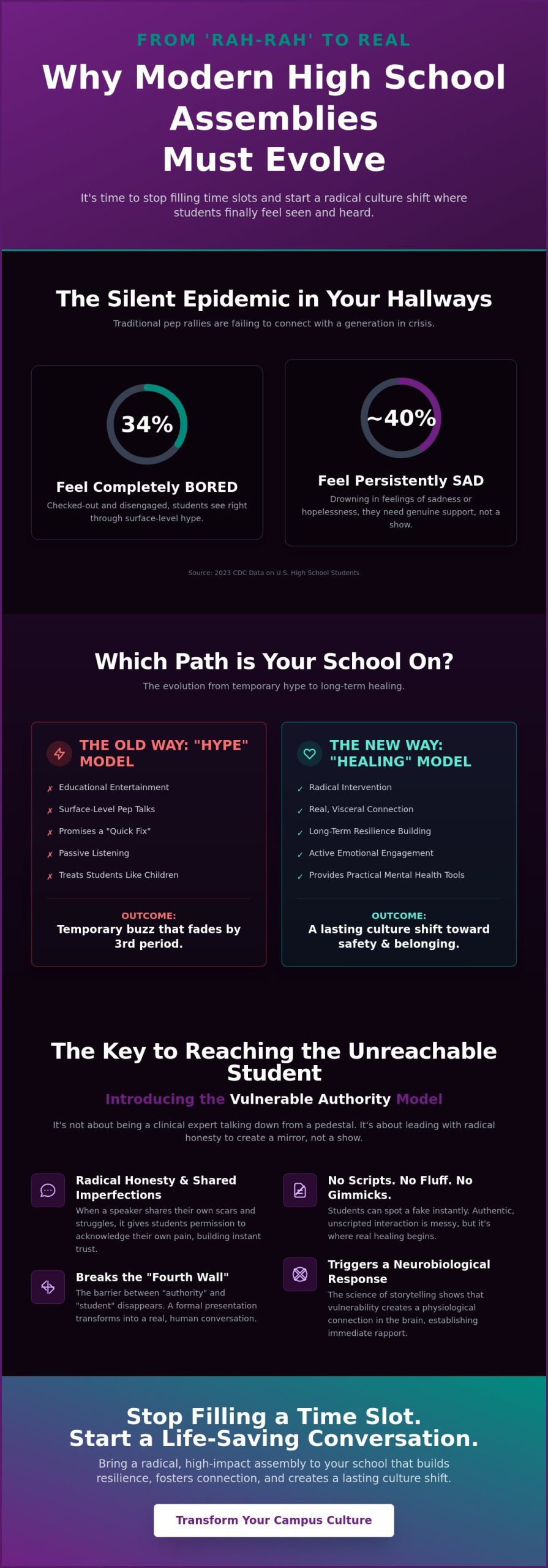
If 34% of your students are sitting in the bleachers feeling completely bored while nearly 40% are drowning in persistent feelings of sadness, a “rah-rah” pep rally is a dangerous waste of time. You see the checked-out looks. You feel the weight of the mental health crisis hitting your hallways every single day. You want to help, but you’re terrified of bringing in a speaker who is out of touch or just another “expert” talking down to them.
It’s time to stop filling time slots and start saving lives. You can host High School Assemblies that move beyond surface-level hype to create a radical culture shift where students finally feel seen and heard. I’ve been in those trenches; I know that real change only happens when we drop the act and get raw. You don’t need more entertainment. You need a connection that sticks long after the lights go up.
In this guide, you’ll discover how to trade the generic fluff for radical transparency. We’re going to explore how to transform your campus into a powerhouse of resilience by giving your student body the practical mental health tools they’re actually starving for.
Key Takeaways
- Learn why modern High School Assemblies must ditch the “rah-rah” hype to bridge the gap between struggling students and the support they desperately need.
- Discover the “Vulnerable Authority” model, a powerful way to break the fourth wall and connect with even the most cynical students through radical honesty.
- Evaluate your campus climate to determine if your school needs a “hype” year for morale or a “healing” year focused on mental health awareness.
- Master a leadership roadmap for planning your event, ensuring both staff and students are emotionally prepared for a lasting culture shift.
- See how 30 years of experience in the trenches can transform a standard program into a life-saving intervention with no scripts and no fluff.
Beyond ‘Educational Entertainment’: Why High School Assemblies Matter in 2026
The old model of “educational entertainment” is failing your kids. For decades, school assemblies were treated like a break from the “real” work of academics. They were variety shows, magic acts, or generic pep talks designed to fill a 45 minute gap in the schedule. But look at your students in 2026. They are smarter, more cynical, and more digitally connected than any generation before them. They can smell a fake from the back of the gym. If you bring in a speaker who treats them like children or offers surface level “rah-rah” hype, they will check out before the first slide.
High School Assemblies today have to be a radical intervention. We are seeing a massive shift from passive listening to active emotional engagement. It’s not about being entertained; it’s about being understood. When you move past the novelty of a “field trip in the gym,” you start addressing the real world struggles that keep your students up at night. The ROI of a high impact assembly isn’t just a fun day. It’s measured in improved attendance, a safer campus culture, and students who finally feel like they belong.
The Crisis of Connection on Modern Campuses
The gap between student mental health needs and available school resources is wider than ever. According to 2023 CDC data, nearly 40% of U.S. high school students have experienced persistent feelings of sadness or hopelessness. A single assembly won’t fix a clinical diagnosis, but it can act as a massive catalyst for campus wide vulnerability. It breaks the silence. Radical transparency is the key to student trust; it is the intentional act of a leader showing their own scars so students feel safe enough to acknowledge their own. When I stand on that stage and get real about my own imperfections, the wall between the “authority” and the “student” disappears.
From ‘Rah-Rah’ to Real: The Evolution of School Motivation
Traditional motivational speeches fail because they promise a “quick fix” that doesn’t exist. You can’t “positive think” your way out of a mental health crisis. Students don’t need temporary hype that fades by third period. They need long term resilience building. This means establishing the assembly as a safe space for difficult conversations about stress, burnout, and loneliness. We are moving from a “hype” model to a “healing” model. It’s about giving them practical tools to navigate life when it gets messy. That’s how you build a culture that lasts.
The Psychology of Student Engagement: How to Reach the ‘Unreachable’ Student
You know that student. The one in the back row with the hoodie pulled low and arms crossed tight. To most, they’re “unreachable.” To me, they are the only person in the room who matters. If I can’t reach that one kid, the assembly is a failure. Most High School Assemblies try to win students over with high production values or flashy gimmicks. They use magic tricks or loud music to mask a lack of substance. It doesn’t work. Students see right through the “educational entertainment” facade. They don’t want a show; they want a mirror.
Reaching the unreachable requires the “Vulnerable Authority” model. This isn’t about being a clinical expert who talks down from a pedestal. It’s about leading by sharing personal imperfections. When I talk about my own struggles with mental health or the times I’ve fallen flat on my face, something happens in the room. The neurobiology of storytelling kicks in. Vulnerability triggers a physiological response in the brain, creating immediate rapport. It breaks the “fourth wall” of the traditional presentation. Suddenly, it’s not a speech. It’s a conversation.
Vulnerability as a Leadership Superpower
When a speaker is willing to be raw, it gives students permission to do the same. It creates an “I see you” moment that validates their pain without sounding like a textbook. Scripted interactions feel safe for the speaker but useless for the student. A real interaction might be messy. It might involve tears or uncomfortable silence. But that’s where the healing starts. If you want a Teen Mental Health Speaker who understands this dynamic, you have to look for someone who leads with their heart, not just a slide deck.
Creating a Visceral Connection in 60 Minutes
The rhythm of a high intensity assembly is like a heartbeat. You build tension by sharing the hard truths. You provide release through humor or shared understanding. Finally, you offer resolution through hope. I use direct address to speak to that one kid in the back. I want them to feel like I’m sitting right next to them in the bleachers. Students don’t listen to experts who claim to have all the answers; they listen to survivors who aren’t afraid to ask the same hard questions. This connection is what transforms a simple gathering into a life saving event.
Mental Health vs. Motivation: Choosing the Right Theme for Your Campus
Your school has a distinct pulse. You can feel it in the hallways between periods. Some years, your students are riding high and just need a spark to keep their momentum going. Other years, the air feels heavy. Maybe you’ve faced a recent tragedy, or perhaps the collective anxiety is just bubbling under the surface. Choosing between a “hype” year and a “healing” year is the most critical decision you’ll make when booking High School Assemblies. If you pick a high energy motivational theme when your students are actually mourning or burnt out, you’ll lose them instantly. You have to meet them exactly where they are, not where you wish they were.
Effective programming requires matching the message to the dirt on the ground. Are you seeing an explosion in vaping? Is social media fueled cyberbullying tearing apart friend groups? According to a 2025 report from Mental Health America, 60% of American youth who suffer from a major depressive episode do not receive any mental health treatment. That is a staggering gap. Your assembly theme shouldn’t just be a “nice to have” topic. It needs to be a targeted response to the data. Whether you focus on Character Education, Resilience, or Mental Health Awareness, the goal is to provide a bridge between the student’s struggle and the school’s support systems. Before you finalize your booking, make sure you know the critical questions to ask a school assembly speaker to ensure the message truly matches your campus needs.
When Motivation Isn’t Enough: The Case for Mental Health Assemblies
Sometimes, “trying harder” is the worst advice a kid can hear. When 39.7% of U.S. high school students report persistent feelings of sadness or hopelessness (CDC, 2023), they don’t need a cheerleader. They need a Mental Health Speaker who can normalize the conversation. We have to strip away the stigma of these labels. A successful assembly gives students the “language of struggle.” It empowers them to walk into a counselor’s office and say, “I’m not okay,” without feeling like a failure. This is the heart of a suicide prevention strategy that actually works.
Resilience and Character: Building the Foundation
Teaching students how to fail forward is a life skill that academics often miss. In a high pressure world, kids are terrified of making mistakes. We can integrate Social Emotional Learning (SEL) into a one hour presentation by focusing on the “Victor” mentality. This isn’t about ignoring pain; it’s about moving from victimhood to personal empowerment. We show them that their past doesn’t define their future. It’s about building resilience in teens that helps them navigate the stress of 2026 and beyond.
Planning Your High School Assembly for Lasting Impact: A Leadership Roadmap
Most people think the work starts when the speaker walks on stage. They’re wrong. The success of High School Assemblies is determined weeks before the first student walks into the gym. If you treat this like a one-off event to fill a Friday afternoon, you are wasting your budget and your students’ time. A real assembly is a three-phase operation. It requires a leadership roadmap that moves from preparation to execution and, finally, to the critical “postvention” phase. This is where we bridge the gap between a temporary emotional high and a permanent culture shift. If you’re looking for fresh concepts and a step-by-step approach on how to plan a school assembly that truly resonates with today’s students, exploring proven ideas and frameworks can make all the difference.
Budgeting for impact means recognizing that a specialized speaker is an investment in your campus safety plan. In 2026, school leaders are dealing with complex mandates, from cell phone restrictions to new fentanyl education requirements. You can’t just hire a “variety show.” You need a professional who can integrate with your current goals. I’ve found that the best results happen when we pair a student event with Teacher Professional Development. If your staff isn’t equipped to handle the conversations that follow the assembly, the momentum will die in the classroom. We have to get the adults “ready to hear” before we can expect the students to speak. Part of that preparation means knowing the right questions to ask a school assembly speaker during the vetting process so you hire someone who can truly deliver.
Setting the Stage for Emotional Safety
When we dive into heavy topics like resilience and mental health, emotional safety is non-negotiable. Counselors shouldn’t just be in the room; they need to be visible and approachable. I always recommend creating a designated “cool-down” space for students who might be triggered by raw stories. This isn’t about coddling. It’s about providing a safety net. You also need to communicate with parents early. Tell them what’s coming. Give them the tools to continue the conversation at the dinner table that night. Transparency builds trust with the community.
The Post-Assembly Culture Shift
The “day after” is when the real work begins. I’ve seen too many schools lose the spark because they didn’t have a plan for the following Monday. Use student-led leadership groups to keep the message alive. Integrate the assembly themes into your daily check-ins or advisory periods. Success isn’t just a round of applause at the end of the hour. It’s measured by an increase in counselor visits, better student feedback surveys, and a palpable shift in how kids treat one another. If you’re ready to bring this level of intentionality to your campus, let’s talk about booking a Teen Motivational Speaker who can guide your team through this entire roadmap.
The Jeff Yalden Difference: A Radical Approach to School Assemblies
I don’t do scripts. I don’t do fluff. And I certainly don’t do “educational entertainment.” After 30 years in the trenches with high school students, I’ve learned one thing: you can’t fake a connection. Students in 2026 are under more pressure than any generation before them. They are navigating a world of smartphone bans, cyberbullying, and a mental health crisis that feels overwhelming. My approach to High School Assemblies is built on a foundation of radical transparency. I stand on that stage as a lived-experience guide. I’m not a distant expert. I’m a survivor who is still doing the work every single day.
When you bring me to your campus, you’re getting more than a speech. You’re getting a holistic intervention. Real change doesn’t happen in a vacuum. It requires a campus-wide commitment. That’s why I offer a comprehensive model that includes High School Assembly Programs for students, high-intensity Teacher Professional Development, and parent seminars that bridge the gap between school and home. I specialize in the high-stakes areas where most speakers fear to tread: suicide prevention and postvention crisis intervention. I’ve walked through the fire with schools during their darkest moments. I know how to lead them back to hope.
A Veteran Voice for a New Generation
Traditional counseling is vital, but sometimes a student needs a different entry point. My “vulnerable first” mantra is what earns their respect. I don’t ask them to open up until I’ve shown them my own scars. This creates an immediate shift in the room. The cynicism melts away. The hoodies come down. School leaders consistently report an immediate culture change following my visit. They see an uptick in students seeking help and a new level of honesty in the hallways. It’s about being a “vulnerable authority” who leads by example, showing every kid in that gym that their struggle doesn’t have to be their end.
Booking Your 2026 Assembly Strategy
Your campus has its own unique pulse. Maybe you’re focused on building resilience in teens in the face of academic burnout. Perhaps you’re dealing with the fallout of social media conflict. We don’t use a one-size-fits-all deck. We customize the message to meet your students exactly where they are right now. The booking process is designed to be seamless because I know how much you already have on your plate. From our first conversation to the final standing ovation, we are partners in this mission. It’s time to move beyond generic motivation and start a movement on your campus. Bring Jeff Yalden to your campus and start the conversation today.
Transform Your Campus Culture Today
It’s time to stop checking boxes and start changing lives. Your students don’t need another lecture; they need a connection. We’ve seen that the most impactful High School Assemblies are those that trade scripts for raw truth and clinical distance for radical transparency. You have the tools now to identify whether your campus needs a year of hype or a year of healing. You have the leadership roadmap to ensure the impact lasts long after the final bell rings. Success isn’t a one-hour event. It’s a sustained movement.
I’ve spent over 30 years in the trenches as a specialist in suicide prevention and postvention. You may have seen my work on MTV’s “Made” or “The Jeff Yalden Show,” but my mission is always local and personal. I lead with my own imperfections so your students feel safe enough to own theirs. We can transform your campus culture together by giving your student body the language of struggle and the hope of resilience. Don’t wait for a crisis to act. Start building a foundation of grit right now.
Book Jeff Yalden for Your Next High School Assembly and bring a veteran voice to your students. You aren’t just hosting an event. You’re starting a movement of resilience. Let’s get to work.
Frequently Asked Questions
How much does a high school assembly speaker typically cost?
Fees for professional speakers vary widely based on their experience level, travel requirements, and the specific needs of your program. Most speakers offer different rates for single events versus full-day engagements that include teacher training or parent seminars. Instead of looking for the lowest price, focus on the return on investment for your school’s safety and culture. You should contact the speaker directly to get a quote tailored to your campus goals and schedule.
What are the most effective high school assembly topics for 2026?
In 2026, the most impactful topics address the high-stakes realities students face every day, including resilience, mental health awareness, and digital wellness. With new regulations regarding smartphone use and cyberbullying, students need practical strategies to manage their emotional lives. Effective High School Assemblies also tackle critical issues like fentanyl education and social-emotional learning. Reaching modern teenagers requires addressing the stress and burnout that many report feeling at least three days a week.
How do we handle students who might be triggered by mental health topics?
Emotional safety must be your top priority. You should have counselors visible and available throughout the entire event to provide immediate support if a student needs to step out. Create a designated “cool-down” space where students can process their feelings in a quiet, supervised environment. It is about providing a safety net so that vulnerability leads to healing rather than distress. Always communicate with parents before the event so they can support their children at home.
Can a one-hour assembly really change a school’s culture?
A single hour won’t fix every problem, but it acts as a massive catalyst for change by breaking the silence on campus. It gives students permission to be real about their struggles and creates a shared language for the entire student body. The assembly is the spark that starts the fire. To see a lasting culture shift, you must follow up with classroom discussions and student-led initiatives. It is the beginning of a vital conversation that must continue daily.
What is the difference between a motivational speaker and a mental health speaker?
A motivational speaker typically focuses on high energy, hype, and the idea of “trying harder” to succeed. A mental health speaker dives into the “why” behind the struggle, offering long-term resilience and coping strategies. While motivation can provide a temporary boost, mental health programming provides the tools needed for survival and growth. You need someone who can balance both, using lived experience to lead students from a place of pain toward a proactive, empowered future.
How do we prepare our staff for a high-intensity student assembly?
Preparation starts with getting your teachers “ready to hear” before the students ever enter the gym. Host a professional development session to equip staff with the language they will need for follow-up conversations in the classroom. Teachers are on the front lines; they need to know how to validate a student’s vulnerability without feeling like they must be clinical experts. When the adults are prepared and supported, the entire campus becomes a safer space for students to speak up.
How can we fund a high school assembly if our budget is tight?
Many schools successfully fund High School Assemblies through Title IV grants or state funds earmarked for mental health and school safety. You can also partner with local community organizations, parent-teacher associations, or businesses that want to invest in student well-being. Think of the assembly as a preventative safety measure rather than an extra expense. Investing in your students’ mental health now prevents much higher costs later in crisis intervention and lost engagement.
What should we do immediately after an assembly to support students?
The “postvention” phase is critical for maintaining momentum. Immediately after the speaker leaves, ensure your counseling office is open for walk-in visits and that staff are extra visible in the hallways. Teachers should lead brief, low-pressure check-ins during the next class period to gauge student reactions and answer questions. Use feedback surveys to understand what resonated most. Keeping the conversation alive through student leadership groups ensures the radical transparency shared during the assembly translates into a permanent shift.
