
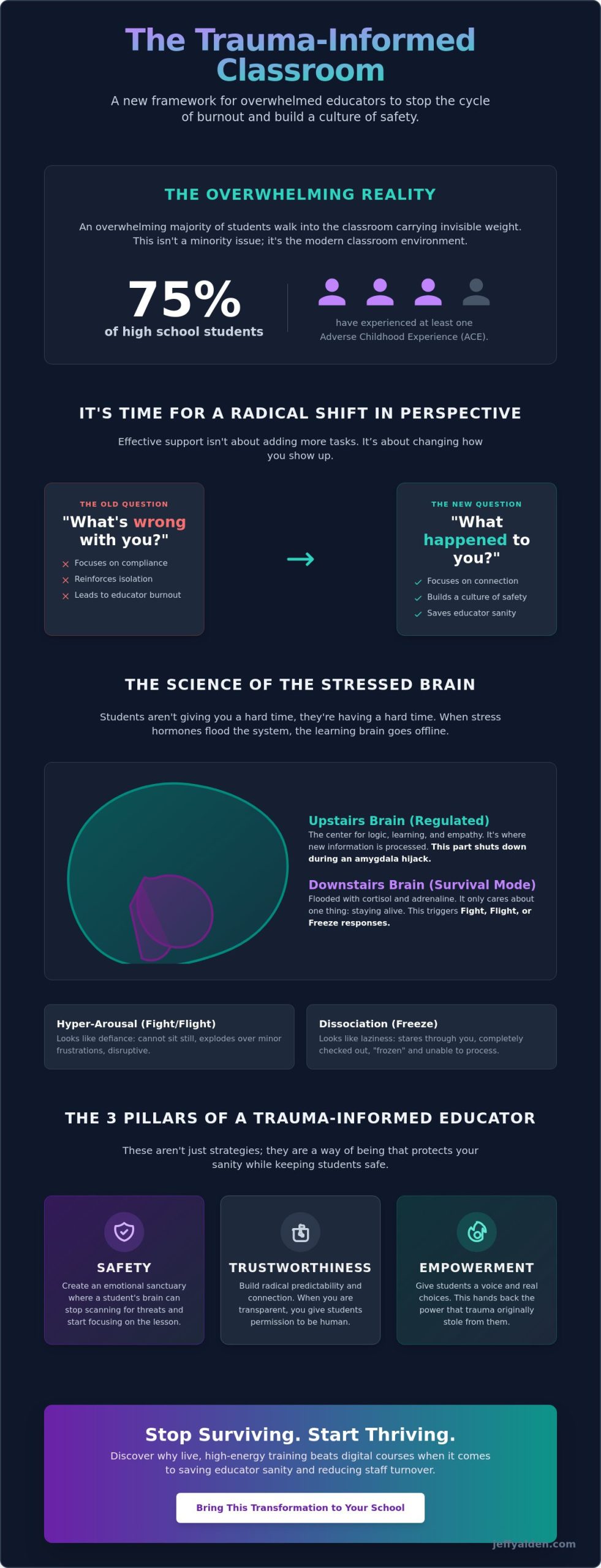
Three out of four high school students have experienced at least one Adverse Childhood Experience (ACE) before they even walk through your door. That is a staggering 75% of your classroom carrying invisible weight that clinical jargon just cannot fix. You are likely exhausted. You are tired of feeling like a first responder in a war zone instead of a teacher. You want to help, but your plate is already overflowing with mandates and paperwork. You need tools that work when a student is dysregulated, not just theories that look good on a slideshow.
It is time for a radical shift. Effective trauma-informed teaching professional development isn’t about adding more tasks to your day; it is about changing how you show up. We are diving into a heart-centered approach that prioritizes your resilience as much as student regulation. You will discover how to trade “what is wrong with you” for “what happened to you” without losing your mind in the process. This approach saves educator sanity by building a culture of safety rather than a culture of compliance.
We are going to look at practical de-escalation tools that work in real time, the power of radical connection, and how these shifts can finally stop the cycle of staff burnout. Let’s move from survival mode into a space where both you and your students can actually breathe again.
Key Takeaways
- Stop mislabeling “frozen” students as “lazy” by understanding how cortisol and adrenaline physically block the brain’s ability to process new information.
- Transform your school culture with trauma-informed teaching professional development that focuses on “being” rather than just another “doing” item on your to-do list.
- Learn the power of “Vulnerable Authority” to bridge the gap between clinical frameworks and the real, raw reality of a modern classroom.
- Build a foundation of radical predictability and emotional regulation to model the calm your students need to see before they can feel safe.
- Discover why live, high-energy training beats self-paced digital courses when it comes to saving educator sanity and reducing staff turnover.
What is Trauma-Informed Teaching Professional Development?
Trauma-informed teaching professional development is not a binder that sits on a shelf collecting dust. It is not a three-hour seminar in a stuffy cafeteria where you check your watch every ten minutes. It is a radical, bone-deep commitment to changing the very DNA of your school culture. For too long, we’ve treated trauma as a clinical “issue” for counselors to handle in a quiet office. That’s a lie. Trauma lives in your hallways. It sits in the third row of your algebra class. It boils over in the cafeteria line. In 2026, with two-thirds of our students carrying at least one Adverse Childhood Experience, every single classroom is a trauma-impacted classroom. You are on the front lines.
This shift isn’t about learning how to be a therapist. It’s about moving beyond the “what happened to you?” question and into an actionable, heart-centered presence. While the foundational Trauma-Informed Approaches in Education provide the necessary structural framework, the real transformation happens when you trade clinical jargon for radical connection. You don’t need more “strategies” that feel like chores. You need a way of being that protects your own sanity while keeping your students safe. This is the difference between checking a box and changing a life.
The Core Pillars of a Trauma-Informed Educator
- Safety: This goes beyond locks on doors. It is about creating an emotional sanctuary where a student’s “downstairs brain” can finally stop scanning for threats and start focusing on the lesson.
- Trustworthiness: Connection is built on radical transparency. When you are real about your own imperfections, you give students permission to be human too.
- Empowerment: You aren’t just a teacher; you’re a guide. By giving students a voice and real choices, you hand back the power that trauma originally stole from them.
Why Traditional Discipline is Failing the Modern Student
The 2026 school year demands a move from compliance to connection. Traditional, punitive discipline relies on a student having a regulated brain that can process consequences. But a traumatized student is often in survival mode. Suspensions and office referrals don’t teach regulation; they reinforce isolation. Effective trauma-informed teaching professional development helps you move toward restorative, brain-aligned responses. When you stop fighting for control and start fighting for the relationship, suspension rates drop and your classroom finally begins to breathe again. It’s about trading the “power over” mentality for a “power with” partnership.
The Science of the “Stressed Brain” in the Classroom
Your students aren’t giving you a hard time; they are having a hard time. When a child’s brain is flooded with cortisol and adrenaline, logic is a luxury they cannot afford. Think of the brain in two parts. The upstairs brain is where learning, empathy, and decision-making happen. The downstairs brain is the survival basement. It only cares about one thing: staying alive. When trauma is present, that downstairs brain takes over. It is a total hijack. This is why a student who seems lazy or defiant is actually just frozen or fighting for their life in their own head. Effective trauma-informed teaching professional development helps you move from frustration to fascination with how these survival mechanisms work.
The good news is neuroplasticity. The brain is plastic. It can change. It can heal. Every time you respond with calm instead of chaos, you are helping a student rewire their nervous system. You are a brain-builder. In a crowded 2026 classroom, hyper-arousal looks like the kid who cannot sit still or explodes over a minor frustration. Dissociation is the one who stares through you, completely checked out. Both are survival strategies. Understanding Teaching Through Trauma means recognizing that these behaviors are biological alarm systems that won’t shut off without a sense of safety.
The Amygdala Hijack: When Learning Stops
You cannot teach a child who does not feel safe. Period. The window of tolerance is the optimal zone of arousal where a student’s brain is regulated enough to absorb new concepts while remaining emotionally stable. When a student flips their lid, the connection to the upstairs brain is severed. You need practical brain breaks that actually reset the nervous system, like rhythmic breathing or heavy work, to bring them back. If you are looking for a youth motivational speaker who can explain these concepts to your staff with heart and humor, it might be the spark your team needs.
ACEs and Their Impact on Academic Performance
Trauma is a thief. It steals memory, focus, and the ability to plan ahead. Adverse Childhood Experiences (ACEs) are a predictor of struggle, but they are not a life sentence. A national survey found that nearly 1 in 5 high school students have experienced four or more ACEs. This directly impacts executive functioning and classroom engagement. We can support building resilience in teens by providing the consistent, regulated adult presence they missed out on earlier. Investing in trauma-informed teaching professional development ensures your staff has the tools to be that buffer against the long-term effects of childhood stress.
Moving from Clinical Frameworks to Radical Connection
You’ve seen the clinical checklists. You’ve heard the technical terms. But a checklist never de-escalated a screaming teenager. A human being did. Most trauma-informed teaching professional development stops at the biology. It tells you what is happening in the brain but leaves you hanging on what to do with your heart. That is where the “Vulnerable Authority” model changes the game. It is the missing link. It’s about being an expert who is not afraid to be human. You are the guide who has “been there” and now leads with a “victor” mentality. You aren’t a distant observer; you’re a lived-experience mentor.
Stop trying to be the distant, perfect authority figure. Your students don’t need a robot; they need a safe harbor. In 2026, authenticity is the only currency that matters. When you show up as your real, raw self, you give your students permission to do the same. This isn’t about oversharing or losing control of your professional boundaries. It’s about leading through example. It is about showing them that you have navigated life’s challenges and come out stronger. This transparency is what builds the “radical connection” that clinical frameworks often miss. It creates an immediate and visceral connection that makes learning possible again.
Vulnerability as a Teaching Superpower
Sharing your own struggles builds a bridge that academic authority alone cannot cross. When you admit you are having a tough day or that you’ve failed in the past, you create instant buy-in. You move from controlling behavior to mentoring hearts. Students in 2026 are experts at spotting fakes. They crave the “real.” Your vulnerability becomes their safety. It signals that your classroom is a place where mistakes are allowed and healing is possible. It turns you from a distant expert into a trusted peer in their shared mission of growth. This is how you win their hearts and their minds.
The Radical Transparency Framework
Radical transparency is your best de-escalation tool. When tensions rise, drop the “because I said so” act. Be honest. Tell them why you’re concerned. Acknowledge the energy in the room. This framework builds a culture where it is okay not to be okay. It turns a potential explosion into a teaching moment. To really move the needle, schools are integrating this approach into high school assemblies to create a unified message across the entire campus. When the assembly matches the classroom, the culture shifts fast. This is the heart of what real trauma-informed teaching professional development should look like. It is fast-paced, direct, and deeply supportive of both the student and the educator.
5 Pillars of Trauma-Informed Classroom Management
You are exhausted. I see you. You are pouring your heart into a classroom that feels like a pressure cooker. Traditional management tells you to double down on rules when things get messy. But you can’t punish a stress response out of a child. Real trauma-informed teaching professional development focuses on five pillars that actually work in the heat of the moment. First, predictability. For a child whose home life is a storm, your consistent routine is their anchor. Second, emotional regulation. You must be the thermostat that sets the temperature, not the thermometer that just reacts to the heat. Third, relationship-first instruction. If you don’t have the heart, you won’t reach the head. Fourth, staff wellness. We have to talk about the secondary traumatic stress you carry home every night. Finally, collaborative problem solving. Stop doing “to” your students and start doing “with” them.
The connection is the curriculum. If a student doesn’t feel a bond with you, they won’t take the academic risks you’re asking of them. In 2026, students are more guarded than ever. They need to know you are a “vulnerable authority” who sees them as a human being first and a test score second. When you prioritize the relationship, you aren’t “losing” instructional time. You are creating the only environment where instruction can actually take root. This is how we save educator sanity and transform the classroom from a place of conflict into a place of cooperation. School counselors play a critical role in this shift, and investing in professional development for school counselors ensures the entire support team is equipped to lead with the same heart-centered approach.
Teacher Self-Care: The Foundation of Trauma-Informed PD
We need to get real about the “empty cup” syndrome. Most training ignores the fact that you are absorbing the trauma of thirty kids every single day. That is secondary traumatic stress. It is heavy. It leads to the burnout that is stripping our schools of their best talent. You cannot be a safe harbor if your own ship is sinking. This is why implementing teacher self-care professional development is the non-negotiable first step. You need daily “resilience resets” to purge that secondary stress. This isn’t just about bubble baths; it’s about setting boundaries and protecting your peace so you can show up for the kids who need you most. If you are serious about staying in this profession for the long haul, understanding how to prevent teacher burnout before it strips you of your passion is the most important investment you can make in yourself.
Practical De-escalation for the 2026 Classroom
When a student explodes, your instinct is to match their volume. Don’t. Use the “Low-and-Slow” technique. Keep your voice low and your pace slow. It signals to their amygdala that there is no fight to be had. You have to look for the “need” behind the “deed.” That outburst isn’t defiance; it’s a cry for help or a shield against fear. Create a “Calm Down Corner” that isn’t a “time-out” spot. Make it a place they actually want to go to regulate and breathe. If your school is ready to stop the cycle of burnout and start building a culture of resilience, it is time to book a teacher professional development workshop that actually understands the grit of the classroom.
Why Your Staff Needs a High-Energy Trauma-Informed Workshop
Let’s be honest. Your teachers are tired of clicking through “self-paced” modules that feel more like a chore than a resource. Online courses are fine for compliance, but they do nothing for the soul of your school. In a year like 2026, where the emotional stakes are higher than ever, a digital certificate won’t help a teacher handle a crisis in the cafeteria. You need more than information; you need a shared experience that creates a common language for your entire team. Real trauma-informed teaching professional development happens when a group of adults gets real, gets raw, and decides to move from simple compliance to a deep, heart-centered commitment.
When you bring in a motivational speaker for high school staff, you aren’t just filling a day on the calendar. You are re-igniting the passion that brought your educators into this profession in the first place. A live workshop breaks down the walls of isolation. It allows staff to see that they aren’t alone in their struggles with secondary traumatic stress. This collective energy is what transforms a building from a place of work into a community of healing. It is about creating a culture where every adult is equipped to be the “safe harbor” we discussed earlier.
The ROI of a Live Professional Development Event
The return on investment for a live event is measured in the atmosphere of your hallways the next morning. You see an immediate boost in staff morale because your team feels seen and supported. We use the power of collective storytelling and shared vulnerability to bridge the gaps between departments. This isn’t a one-size-fits-all presentation. A high-energy workshop is customized to the specific 2026 challenges your district is facing, whether that is rising student dysregulation or community-wide stress. It provides the grit and the tools to handle the “real” that happens after the bell rings.
Booking Jeff Yalden for Your Next PD Day
Expect energy. Expect transparency. Most of all, expect actionable heart-work that your staff can use immediately. We don’t do boring. We don’t do clinical jargon that stays in the textbook. We dive deep into the reality of the classroom and provide a roadmap for resilience. Many schools choose to maximize this impact by integrating teen suicide prevention programs into their overall staff training. This ensures your team is not only trauma-informed but also life-saving. Taking the first step is simple. Reach out today, and let’s start a radical transformation that saves your educators’ sanity and changes your students’ lives. Your staff is waiting for someone to be real with them. Let’s give them that.
It Is Time to Lead with Heart and Radical Connection
You’ve seen the science behind the stressed brain. You know that traditional discipline is failing the kids who need us most. It is time to trade the clinical checklists for a way of being that actually saves educator sanity. Real trauma-informed teaching professional development isn’t just another mandate; it is the key to reclaiming your passion for this work. By prioritizing your own resilience and building a safe harbor in your classroom, you aren’t just teaching a subject. You are rewriting a student’s future. You are becoming the buffer against the storm.
Don’t let your staff settle for another boring, self-paced module that disappears from memory by Monday morning. Your educators deserve a real and raw experience that honors their struggle and provides immediate tools for the 2026 classroom. With over 30 years of experience in high schools and deep expertise in suicide postvention and crisis intervention, Jeff Yalden brings a high-energy delivery that teachers actually enjoy. Bring Jeff Yalden to your school for a radical PD experience! You have the power to change the energy in your building. Your students are waiting for that connection. Let’s get to work.
Frequently Asked Questions
What is the most important part of trauma-informed teaching?
The most important part is the shift from asking “what is wrong with you” to “what happened to you.” It is about prioritizing radical connection over compliance. You cannot reach a student’s head until you have captured their heart. When you build a safe harbor in your classroom, you create the only environment where a traumatized brain can actually settle down and learn.
How does trauma-informed PD help with teacher burnout?
It saves your sanity by giving you a shield against the chaos. When you understand the biology of a stress response, you stop taking student outbursts personally. You learn to regulate your own nervous system so you don’t drown in the secondary stress of your classroom. This approach turns you from a first responder into a mentor who knows how to protect their own peace. Pairing this mindset with a concrete plan for how to prevent teacher burnout gives you both the “why” and the “how” to stay energized and effective for the long haul.
Can trauma-informed strategies work with high school students?
Absolutely, because high schoolers crave authenticity more than any other group. They are experts at spotting fakes. When you use trauma-informed teaching professional development tailored for secondary education, you focus on mutual respect and transparency. These students don’t want a distant expert; they want a “vulnerable authority” who treats them like the young adults they are becoming.
Is trauma-informed teaching just “being easy” on students?
No, it is about being effective. You can’t hold a student accountable if their brain is in a total amygdala hijack. High expectations are still vital, but you have to get the student regulated before they can process a consequence. It is about being smart enough to wait for the “upstairs brain” to come back online so the lesson actually sticks.
How do we get staff buy-in for a trauma-informed approach?
You get buy-in by addressing the staff’s pain first. Show them that this isn’t “one more thing” on their plate; it is the thing that makes the rest of the plate manageable. When teachers see that these tools reduce office referrals and save their own energy, they stop seeing it as a mandate and start seeing it as a lifeline. This same message resonates deeply when it is part of a comprehensive professional development for school counselors program that aligns the entire support staff around a shared, heart-centered vision.
What is secondary traumatic stress in educators?
It is the emotional duress that comes from being on the front lines of student pain. It is the weight you carry home after a kid tells you something heartbreaking. This is the “cost of caring” that leads to the massive turnover we see in schools today. Recognizing this stress is the first step toward building the resilience you need to stay in the game.
How long does it take to see results from trauma-informed PD?
You will see small wins in de-escalation almost immediately. When you change how you react, the student’s response changes too. However, a total shift in school culture is a marathon. It typically takes three to five years of consistent, heart-centered commitment to see a complete transformation in how the entire building breathes and functions together.
What are the 6 principles of trauma-informed care in schools?
The six principles are safety, trustworthiness and transparency, peer support, collaboration and mutuality, empowerment and choice, and cultural issues. These aren’t just buzzwords. They are the bedrock of any trauma-informed teaching professional development program. When these six pillars are strong, you create a school where both students and staff can move from survival mode into true growth.
