
What if the silence we use to protect our students is actually the loudest danger in the building? You’re likely feeling the weight of rising anxiety in your hallways every single day. You worry that talking openly about suicide might trigger the very thing you’re trying to prevent, all while your staff is running on empty. It’s exhausting. It’s terrifying. You need teen suicide prevention programs that do more than just check a clinical box. You need a strategy that changes the heartbeat of your campus.
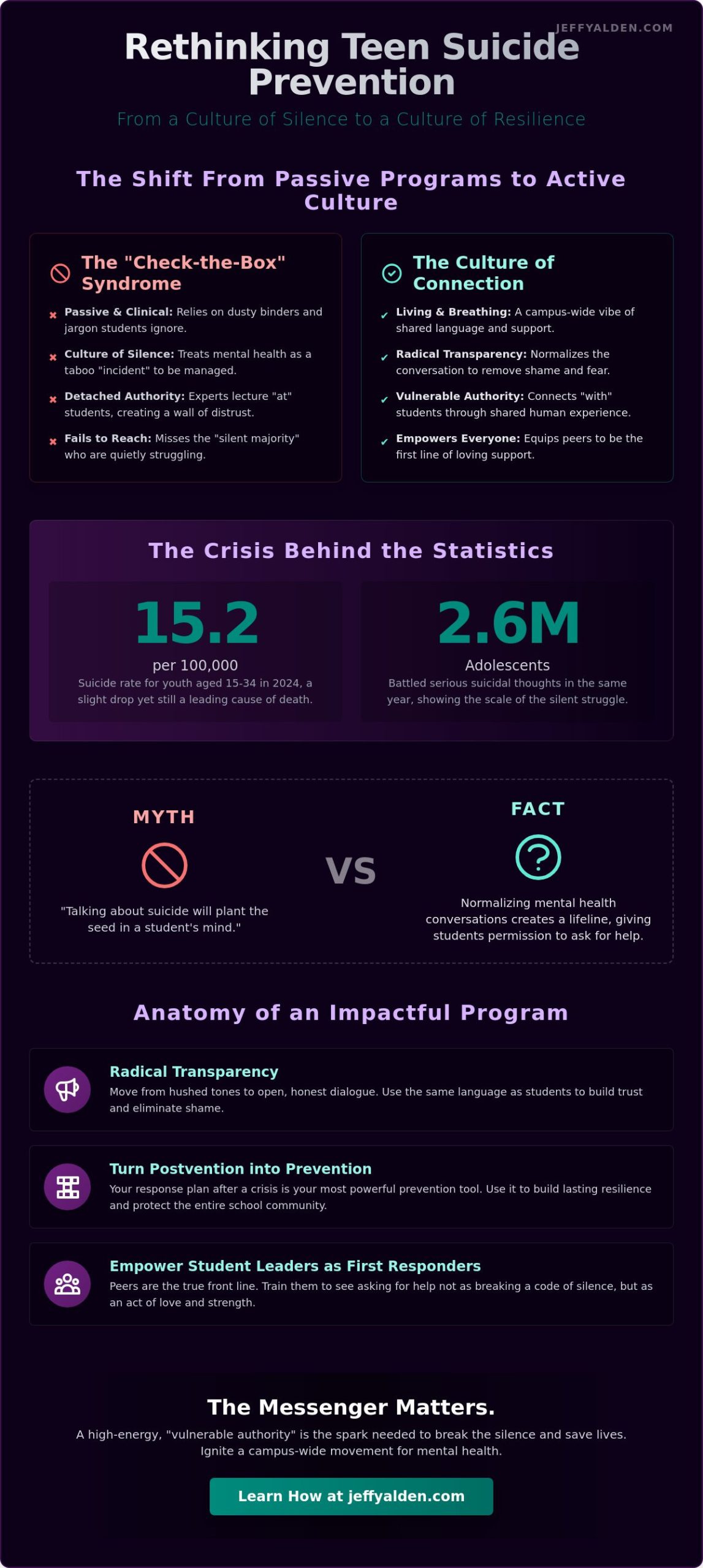
I’ve been in those trenches. I know the fear is real. While suicide rates for youth aged 15 to 34 dropped to 15.2 per 100,000 in 2024, the fact remains that 2.6 million adolescents still battled serious suicidal thoughts that same year. We can’t afford to stay quiet. This article reveals why radical transparency and a dual focus on prevention and postvention are the keys to effective school-based mental health. We’ll explore a roadmap to replace the culture of silence with a culture of resilience, ensuring your students feel safe coming forward before a crisis hits.
Key Takeaways
- Move beyond the “check-the-box” syndrome. Learn why passive programs fail and how to build a culture where students feel safe coming forward before a crisis hits.
- Unlock the power of radical transparency. See how teen suicide prevention programs succeed when students, staff, and parents all speak the same honest, life-saving language.
- Debunk the dangerous myth that talking about suicide “plants the seed” in a student’s mind. Understand the critical difference between glorifying a tragedy and normalizing mental health support.
- Turn your postvention plan into your strongest prevention tool. Discover the specific steps to take after a crisis to build lasting resilience and protect your school’s future.
- Identify the right voice to ignite a campus-wide movement. Learn why a high-energy, “vulnerable authority” approach is the spark needed to break the silence and save lives.
The Crisis Behind the Statistics: Why Traditional Prevention Programs Fail
Statistics tell us that suicide remains a leading cause of death for young people. But numbers don’t capture the heavy air in a high school hallway after a loss. Genuine teen suicide prevention programs aren’t just a poster in the guidance office or a mandatory yearly assembly that students sleep through. They are living, breathing cultures of connection. Most schools suffer from “Check-the-Box” syndrome. They buy a curriculum, show a video, and call it a day. It’s passive. It’s safe. And it’s failing our kids. We’re treating a heart problem with a spreadsheet solution. It doesn’t work.
Looking at youth suicide statistics, we see the scale of the crisis, but we often miss the soul of it. In 2026, the crisis has evolved. Digital isolation isn’t just about screen time. It’s about the relentless, 24/7 social pressure that follows a student into their bedroom at 2:00 AM. There’s a massive disconnect between the clinical language used by adults and the raw, vibrating pain of a teenager. When we use clinical jargon, we build a wall. We need to break that wall down with radical transparency. We need to stop being clinical and start being real.
The Failure of the Clinical Approach
Students tune out the second an adult starts speaking from a place of detached authority. They don’t need a lecture on brain chemistry or a list of warning signs that feel like a homework assignment. They need to see a human being. They need someone who has been through the fire and came out the other side. Lived experience is the currency of trust in a high school. When we move from “talking at” students to “connecting with” them, the message actually sticks. It’s about being a “vulnerable authority” instead of a distant expert. If they don’t feel you, they won’t hear you.
Identifying the Gaps in Your Current Campus Culture
You have to audit your school’s current mental health climate. It’s not about what the handbook says. It’s about what happens in the cafeteria and the locker rooms. Signs that your students don’t feel safe asking for help include a reliance on “hustle culture” and a fear of being labeled as “weak.” Pay attention to the “silent majority.” These are the students who aren’t in the office every day but are quietly drowning in expectations. If your culture values silence over transparency, your teen suicide prevention programs will never reach the kids who need them most. We must build a culture of resilience, not a culture of silence.
The Anatomy of an Impactful Teen Suicide Prevention Program
Stop thinking about suicide prevention as a dusty binder sitting on a shelf in the guidance office. It’s a pulse. It’s a vibe. It’s the way we look each other in the eye in the hallway. Effective teen suicide prevention programs in 2026 require every single person in the building to speak the same language. If the students are talking about “spiraling” and the teachers are only talking about “clinical indicators,” we’ve already lost. We need a multi-layered strategy where the cafeteria workers, the varsity captains, and the parents in the car line are all operating from the same playbook.
It starts with radical transparency. No more hushed tones in the teacher’s lounge. No more referring to a crisis as “the incident.” we call it what it is. When we normalize the conversation, we take away the shame that keeps students trapped in the dark. This isn’t just about awareness. It’s about immediate, visceral action. What does a student do in the first 60 seconds when a friend says they don’t want to be here anymore? They don’t need a 10-step clinical manual. They need one person they trust and one clear move to make. We must integrate resilience training into the core curriculum. It’s not an “add-on” for a random Tuesday. It’s the foundation of how we navigate life together.
Empowering Student Leaders as First Responders
Peers are the real front line. They see the DMs. They see the private stories. They know who is hurting long before an adult even suspects a problem. We have to train these student leaders safely. We teach them that breaking the “code of silence” isn’t a betrayal of a secret. It’s the ultimate act of love. We’re building a “referral culture” where asking for help is seen as the loudest sign of strength a student can show. It’s about moving from “I’ve got your back” to “I’m getting you help.” When students lead the charge, the culture shifts from the bottom up.
Engaging Parents and the Community
We can’t leave parents out in the cold. They are terrified. They want to help, but they don’t have the tools or the vocabulary. We give them the “vulnerable authority” to have the hard talks without needing to be “the expert.” You can host a parent seminar on teen mental health to bridge that home-school gap. When the language at the dinner table matches the language in the classroom, the safety net becomes unbreakable. If you’re ready to spark this change, bringing in a teen mental health speaker who has lived it can be the catalyst your community needs to move from silence to strength.
Breaking the Silence: Overcoming the Fear of Talking About Suicide
The biggest lie in education is that talking about suicide “plants the seed” in a student’s mind. It’s a myth born out of pure fear. It keeps administrators awake at night and keeps school boards paralyzed. But here is the raw truth: you cannot give someone the idea to end their life just by asking about it. In fact, the silence is what is lethal. When we refuse to say the word, we validate the student’s belief that their pain is too dark to share. Effective teen suicide prevention programs don’t dance around the subject. They lean into it. Silence fuels the crisis by increasing isolation, making a struggling kid feel like they are on a deserted island. We have to give them a bridge back to us.
We must understand the massive difference between glorifying a tragedy and normalizing the struggle. Glorifying is about the “how” and the drama; normalizing is about the “why” and the help. We aren’t here to make suicide look like an option. We are here to make mental health support look like the only path forward. Safe messaging is the balance between radical honesty about the pain and unwavering hope for the future. When we strike that balance, we create an environment where students can breathe again.
Busting the ‘Contagion’ Myth with Evidence
Research consistently shows that direct questioning doesn’t increase suicidal ideation. It actually reduces it. It provides an immediate release valve for a student who feels like they are exploding inside. You have to be able to look a kid in the eye and ask, “Are you thinking about killing yourself?” without flinching. It is a heavy question. It is a hard question. But it is the question that saves lives. This level of directness works best when paired with building resilience in teens, giving them the emotional armor to bounce back before they reach that breaking point.
Training Staff for Radical Transparency
Your teachers are terrified. They are managing extreme burnout and worrying they will say the wrong thing and trigger a crisis. We need to move them past that discomfort. This is where the “Vulnerable Authority” model changes the game. Educators don’t need to be clinical experts. They just need to be real. It is okay for a teacher to say, “I don’t have all the answers, but I am here with you.” This transparency builds a bridge that a clinical checklist never could. To keep this sustainable, we must build staff support networks to prevent secondary trauma. We can’t ask our teachers to hold the students’ pain if no one is holding theirs. Equipping your educators with trauma-informed teaching professional development gives them the heart-centered tools to show up for struggling students without burning out themselves. When the staff feels supported, they can lead teen suicide prevention programs with heart instead of hesitation.
From Prevention to Postvention: Building a Complete School Safety Net
Prevention is the goal we all strive for. It is the heartbeat of every school leader. But we have to talk about the “after.” Postvention is the organized response following a suicide or a major mental health crisis on campus. It is raw. It is heavy. And it is absolutely critical. Your postvention plan is actually your most effective prevention tool for the future. Why? Because the “ripple effect” is real. Without a clear strategy, the trauma can spread through a student body like wildfire, increasing the risk of cluster suicides. We don’t just react; we lead with radical transparency to stop the cycle before it starts.
In 2026, grief has gone digital. You aren’t just managing the mood in the hallways; you are managing the narrative on Snapchat and Instagram. Social media memorials can unintentionally glorify a tragedy if they aren’t handled with care. We have to guide students through digital grief without letting the online conversation spiral into a dangerous obsession. This is where teen suicide prevention programs must evolve. They have to move beyond the school day and into the digital lives of our kids. We need to be the anchor in the storm.
The Immediate Crisis Response: The First 48 Hours
The first two days after a tragedy are the most volatile. Leadership must move with speed and heart. You can refer to this how to handle a crisis at school guide for specific leadership steps. Communication is everything. You must speak to students with honesty that doesn’t cause further trauma. Often, the staff is too close to the pain to be the primary messengers. Bringing in an outside postvention speaker for schools provides a neutral, authoritative voice that can say the things your team might be too heartbroken to utter. It allows your staff to focus on being present for the kids.
Long-term Healing and Resilience Building
The healing process doesn’t end after the funeral. We have to navigate the transition from “crisis mode” back to “learning mode” while still honoring the loss. It’s a delicate balance. You must monitor high-risk students in the weeks and months that follow. These are the friends, the teammates, and the “silent” kids who were already struggling. Use this experience to audit your current teen suicide prevention programs. What worked? Where were the gaps? Every crisis is a painful opportunity to make your safety net even stronger. Don’t wait for the next storm to test your foundation. Bring in a High School Speaker who can help you bridge the gap between prevention and postvention today.
The Messenger Matters: Transforming Your Campus with Jeff Yalden
The messenger is the message. You can have the best clinical curriculum in the world, but if the person delivering it doesn’t have a pulse, the kids will smell the “fake” from a mile away. A high-energy, raw assembly is the spark that starts the fire. It’s the moment the air in the room changes. Jeff Yalden doesn’t just show up and talk. He brings 30 years of experience and a level of radical transparency that most adults are too afraid to touch. He’s a lived-experience guide. He’s been in the dark, and he’s found the way out. This isn’t a performance; it’s a connection.
Total school transformation means going beyond the students. Jeff works with your staff and your parents to ensure the safety net is solid. We have to embrace vulnerability as a leadership tool. When teachers show their own imperfections, they give students permission to do the same. This is the heart of teen suicide prevention programs that actually work. We’re building a “Victors, Not Victims” mentality. We’re empowering students to take ownership of their own mental health and to look out for their brothers and sisters in the hallways. It’s about creating a culture where resilience is the standard, not the exception.
What to Expect from a Jeff Yalden Program
The emotional arc of a Jeff Yalden assembly is a journey. It starts by acknowledging the raw pain and the “real” of being a teenager in 2026. It ends with a peak of hope and empowerment. Students don’t just walk out feeling “inspired.” They walk out with practical tools they can use the very second they leave the auditorium. Schools across the country report an immediate shift in campus culture. They see more students coming forward. They see more kindness in the cafeteria. They see a community that is finally ready to speak the truth. It is a visceral, high-impact experience that leaves a lasting mark.
Ready to Protect Your Students?
The urgency of this mission cannot be overstated. Don’t wait for a crisis to implement teen suicide prevention programs. Don’t wait for a tragedy to realize your culture needs to change. You can customize a prevention strategy that fits your school’s specific needs, whether you need a Youth Motivational Speaker for a kick-off or deep-dive teacher professional development. The safety of your students is the only thing that matters. It’s time to choose resilience over silence. You have the power to change the narrative. Book Jeff Yalden for your next high school assembly and start the transformation today.
Choose Resilience Over Silence Today
The time for passive posters and clinical checklists is over. Your students are fighting a battle that requires a new kind of leadership. You now have the roadmap to move beyond “check-the-box” syndrome and build a culture of radical transparency. By integrating postvention into your core strategy and empowering student leaders, you create a safety net that actually holds. Effective teen suicide prevention programs aren’t just about avoiding a tragedy; they’re about building a campus where every student feels seen, heard, and valued.
Jeff Yalden is ready to help you spark this transformation. With over 30 years of experience in high school mental health, Jeff is a specialist in crisis postvention and radical transparency. You might recognize him from MTV’s “Made” or his powerful TEDx talks. He doesn’t just speak; he connects. He leads as a vulnerable authority who knows exactly how to reach the kids who feel unreachable. Book Jeff Yalden to bring a life-saving message to your school today. You don’t have to navigate this path alone. Let’s build a culture of victors together.
Frequently Asked Questions
What are the most effective teen suicide prevention programs for high schools?
The most effective programs are those that move beyond clinical checklists and embrace radical transparency. You need a multi-layered strategy that involves students, staff, and parents speaking the same honest language. Look for programs that prioritize peer-to-peer engagement and resilience training, as students are often the real front line in identifying a friend in crisis.
How do I know if my school needs a suicide prevention program?
Every school needs a proactive strategy because mental health challenges don’t discriminate by zip code or GPA. If you notice rising anxiety, digital isolation, or a “culture of silence” where students are afraid to speak up, your campus is at risk. Implementing teen suicide prevention programs before a tragedy occurs is the only way to build a truly resilient community.
Can talking about suicide actually cause ‘suicide contagion’ among students?
No, this is a dangerous myth that keeps schools paralyzed in silence. Research shows that direct, honest questioning actually reduces suicidal ideation and provides a life-saving release valve for struggling students. Contagion is fueled by the glorification of death or a lack of support, not by having a real, raw conversation about mental health.
What is the difference between suicide prevention and postvention?
Prevention is the proactive work we do to stop a crisis from happening, while postvention is the organized response after a suicide occurs. Postvention is actually a critical form of future prevention. It helps manage the “ripple effect” on campus and provides the support necessary to prevent cluster suicides and further trauma within the student body.
How much do teen suicide prevention speakers typically cost?
Speaker fees vary widely based on the professional’s experience, the length of the assembly, and whether the program includes staff development or parent seminars. You should reach out to speakers directly to discuss your school’s specific needs and budget. Investing in an experienced messenger is often the spark that finally breaks the silence on your campus.
What are the early warning signs of teen suicide that teachers often miss?
Teachers often miss the “silent” signs, such as a student who suddenly withdraws or a high-achiever who becomes obsessed with perfection. While we look for obvious cries for help, the most dangerous signs are often subtle shifts in personality or a quiet disappearance from social circles. We must train staff to look for these changes in the “silent majority.” Equipping yourself with a deeper understanding of teen suicide warning signs beyond the standard clinical list can help educators and parents catch the red flags that most resources miss.
How can we engage parents in our school’s mental health initiatives?
Host interactive seminars that give parents the “vulnerable authority” to have hard conversations at the dinner table. Parents are often terrified and just need the right vocabulary to reach their kids. When the language used at home matches the language used in the classroom, you create an unbreakable safety net for every student.
What steps should a school take immediately after a student suicide?
Activate your crisis response plan within the first 24 hours by providing honest, safe messaging to the entire school community. Focus on identifying and monitoring high-risk students who were close to the individual. It is often best to bring in an outside voice to lead assemblies, allowing your heartbroken staff to focus on supporting the kids and themselves.
