
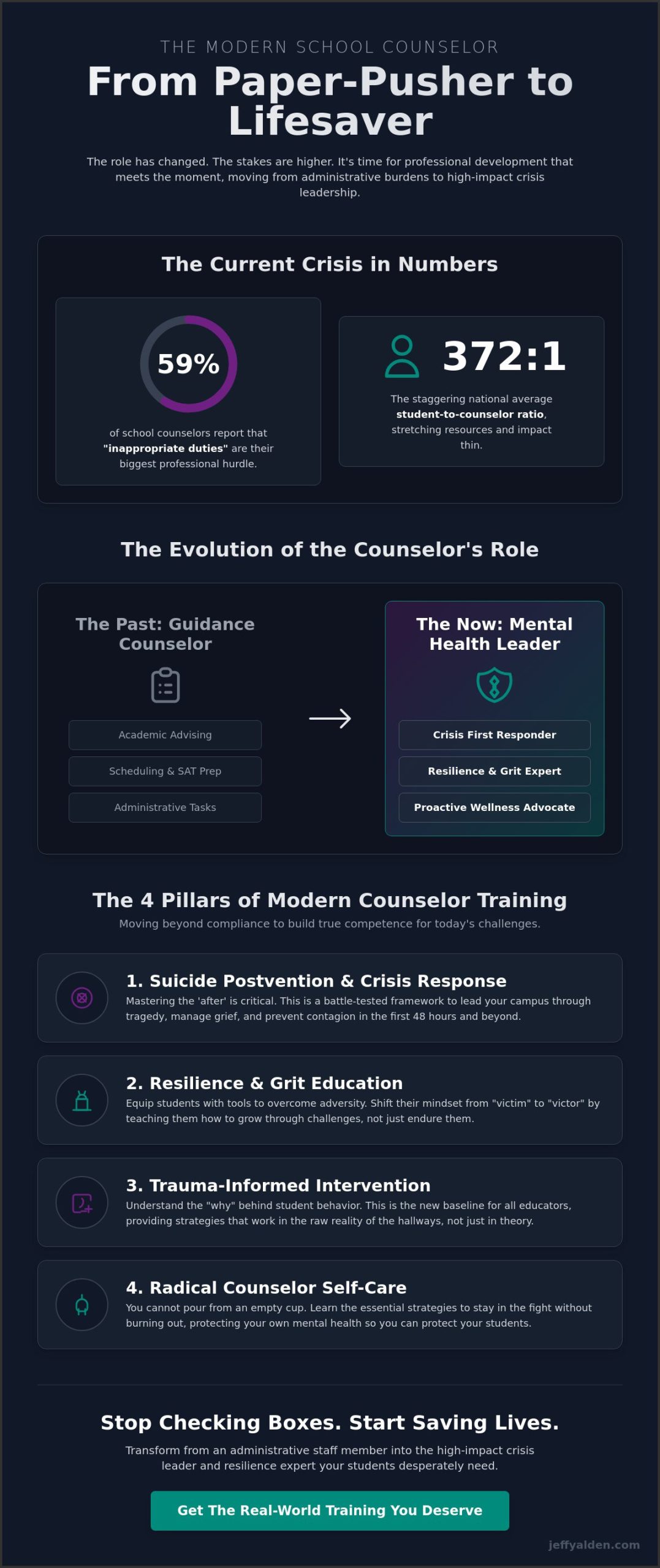
You didn’t spend years in grad school to become a glorified data entry clerk. Yet, with 59% of school counselors reporting that “inappropriate duties” are their biggest hurdle, that’s exactly what’s happening. It’s frustrating. It’s exhausting. You’re searching for professional development for school counselors that actually meets the moment, but you’re often met with outdated theories. You’re watching the student-to-counselor ratio hit 372:1 nationally, and you’re feeling the weight of a teen suicide epidemic that your old textbooks never prepared you for. You’re tired of being the “paper-pusher” when you know you were meant to be a lifesaver.
I get it because I’ve been in those trenches. It’s time to stop just surviving and start leading. I promise that modern, radical training can transform you from an administrative staff member into a high-impact crisis leader and resilience expert. In this guide, we’ll dive into actionable suicide postvention strategies, tools to build student grit, and the radical self-care you need to stay in the fight without losing your soul. You’re not alone in this. Let’s get to work on the real-world training you actually deserve.
Key Takeaways
- Stop checking boxes and start saving lives by shifting your focus from administrative tasks to high-impact crisis leadership.
- Master the radical steps of suicide postvention to lead your campus through tragedy with confidence, heart, and a clear plan.
- Discover why traditional professional development for school counselors often fails and how to bridge the gap between state compliance and true emotional connection.
- Build a customized 2026 roadmap that prioritizes experiential learning and the specific, raw mental health needs of your student population.
- Learn how to use “vulnerable authority” to reconnect with your professional purpose and become the resilient guide your students need.
What is High-Impact Professional Development for School Counselors?
High-impact training isn’t about sitting in a fluorescent-lit room collecting hours while you scroll through your emails. It’s about transformation. It’s about the tools that allow you to walk into a room with a student who is falling apart and actually lead them back to solid ground. In 2026, professional development for school counselors has shifted from administrative compliance to radical, trauma-informed leadership. We aren’t just managing schedules anymore. We are building cultures of resilience. This isn’t just a career update; it’s a mission-critical upgrade for your soul and your school.
With the national student-to-counselor ratio still hovering around 372:1, you don’t have time for fluff. You need strategies that scale. You need to know how to move students from a “victim” mentality to a “victor” mindset. Effective training must balance clinical knowledge with radical transparency and lived experience. If the person leading your workshop hasn’t been in the trenches, they can’t show you how to survive them. We are looking for the “real” and the “raw” because that’s what our students are facing every single day.
The Evolution from Academic Advisor to Mental Health Leader
The old “guidance counselor” model is dead. It’s gone. If you’re still being treated like a glorified clerk who only cares about SAT scores and class ranks, your school is failing you. For a comprehensive overview of the school counselor role, you can see how the profession has historically been defined, but the reality on the ground in 2026 is much more intense. You are the heartbeat of campus safety. You are the proactive advocate who spots the warning signs before a tragedy occurs. This shift toward proactive mental health advocacy means you are the first responder in a teen mental health crisis. You are the leader who shifts the entire school culture toward wellness.
Why Credits Don’t Equal Competence
There is a dangerous trap in our profession: the “box-checking” mentality. You need your CEUs. You need to hit your state requirements. But let’s be honest; those credits don’t always give you the competence to handle a suicide postvention or a student in a full-blown panic attack. Professional development for school counselors must provide immediate, actionable strategies that work in the raw reality of the hallways. You need more than theory. You need “experiential” training that involves storytelling and emotional work. This is why trauma-informed teaching professional development has become the new baseline for every educator on your campus. If the training doesn’t feel real, it won’t work when things get real. We have to move beyond the clinical disconnect and start leading with vulnerable authority.
The 4 Pillars of Counselor Training in the Post-Pandemic Era
The world changed. Our students changed. The way we approach professional development for school counselors has to change too. We can’t keep using 2010 solutions for 2026 problems. The post-pandemic reality is heavy. Our kids are dealing with a shattered sense of safety and a digital world that never sleeps. To lead them through this, your training needs to stand on four radical pillars: Suicide Postvention, Resilience Education, Trauma-Informed Intervention, and Counselor Self-Care. These aren’t just topics for a seminar. They are the essential tools for staying in the game without losing your mind.
While you can find practical professional development opportunities that cover the basics of college readiness and academic tracking, those are just the floor. The ceiling is where the real life-saving work happens. You need to be a crisis leader who knows how to de-escalate with heart and transparency. You need to be a resilience expert who moves students from “why is this happening to me” to “how can I grow from this.”
Mastering Suicide Postvention and Crisis Response
Most of us have been trained in prevention. We know the warning signs. But what happens after the unthinkable occurs? Suicide postvention is the radical, immediate response required after a campus tragedy. The first 48 hours are pure chaos. You need a battle-tested framework to manage the grief, prevent contagion, and stabilize the student body. This is where clinical theory meets the raw, bleeding edge of reality. Implementing high-impact teen suicide prevention programs is vital, but mastering the “after” is what protects your community from further loss. It’s about being the steady hand in the middle of a storm.
Cultivating Student Resilience and Character
Motivation is a spark, but resilience is the fuel. We have to stop treating students like fragile glass and start helping them find their inner steel. This means teaching them the radical truth about bouncing back. It isn’t about avoiding pain; it’s about walking through it. By building resilience in teens, you give them a “victor” mentality that lasts longer than a single counseling session. We are talking about sustainable character education that helps them navigate a world that doesn’t always play fair. When you empower a student to own their story, you change their entire trajectory.
Finally, we have to talk about you. You absorb the trauma of hundreds of kids every single day. Secondary traumatic stress is a silent killer in our profession. High-impact professional development for school counselors must include strategies for protecting the protector. If you’re running on empty, you can’t be the light for anyone else. If your team is feeling the weight of burnout, it might be time to bring in a mental health speaker who can help you reconnect with your “why” and find the strength to keep leading.
Compliance vs. Connection: The Gap in Traditional Counselor PD
State-mandated training is often a joke. It’s a series of “evaluation modules” and archived webinars that feel like they were written by someone who hasn’t stepped foot in a high school since 1995. When you’re sitting across from a student who is contemplating the unthinkable, a webinar on data tracking isn’t going to save them. This is the “clinical disconnect.” It’s where academic theory hits the brick wall of raw human pain. We need professional development for school counselors that acknowledges the heavy, emotional weight you carry every single day. If the training doesn’t address the gut-wrenching reality of your office, it’s just noise.
Radical transparency is the only way to bridge this gap. We have to stop pretending that being a “professional” means being a robot. Students can smell a fake from a mile away. They don’t want a clinical analysis; they want a human connection. When you bring your real self to the table, you build a bridge of trust that no administrative checklist can replicate. This isn’t about lowering your standards. It’s about raising your impact by being real, raw, and present in the moments that matter most.
The Limits of the ASCA National Model
The ASCA National Model is a solid foundation. It gives us a map, but a map isn’t the journey. You can have the best data-informed structure in the country and still miss the kid who is drowning in the back row because you were too busy checking boxes. We have to balance those structures with high-energy engagement. In life-or-death situations, human connection will always outrank administrative compliance. We need to move beyond the “model” and start meeting the “moment” with everything we’ve got.
The Power of Lived Experience in Training
Academic lectures have their place, but they don’t change hearts. Hearing from someone who has “been there” carries a weight that a PhD alone can’t provide. This is the essence of “vulnerable authority.” It means leading by example and showing your students that resilience isn’t a theory; it’s a practice. When you transition from a distant expert to a trusted guide, your influence skyrockets. You become a living example of what it looks like to face the fire and come out stronger on the other side. That is the kind of professional development for school counselors that actually moves the needle.
Stop settling for training that ignores your humanity. You are more than a processor of paperwork. You are a life-changer. It’s time your training reflected that reality.
How to Build Your 2026 Professional Development Roadmap
A roadmap isn’t just a list of dates on a calendar. It’s a battle plan. If you want to stop feeling like a paper-pusher and start acting like a crisis leader, you have to audit your current skills against the raw, urgent needs of your students. What are they facing right now? Is it fentanyl? Is it isolation? Is it a total lack of purpose? Your professional development for school counselors must be as specific as the problems walking into your office every morning. Don’t settle for generic slides. Seek out experiential training that involves role-playing, storytelling, and the deep emotional work that actually changes how you show up in a crisis.
You have to build this roadmap on a foundation of wellness. If you are crumbling, your students have no one to lean on. That’s why prioritizing teacher self-care professional development isn’t a luxury; it’s a survival requirement. Once you’ve secured your own mental health, identify mentors and speakers who don’t just agree with you. Find the ones who challenge your perspective and push for radical change. Finally, implement a post-PD action plan. If the new strategies don’t reach the students within 72 hours, the training was just a waste of time.
Finding the Right Training for Your District
Choosing the right voice for your staff is a high-stakes decision. When hiring a motivational speaker for high school staff, ask the hard questions. Do they have lived experience? Can they handle the “real and raw” conversations? Watch out for red flags like “one-size-fits-all” approaches or fluff-filled presentations that lack actionable steps. For trauma-informed shifts to actually stick, you need district-wide buy-in. It can’t just be the counselors; the whole building has to move together in the same direction.
Combating Compassion Fatigue and Burnout
Secondary traumatic stress is real. You are absorbing the pain of others, and it will eat you alive if you don’t have a plan. Use your professional development for school counselors as a tool for personal renewal. It should be a time to breathe and reconnect with your “why.” Learning how to prevent teacher burnout is just as important as learning how to counsel a student. Set radical boundaries. Protect your peace. If you are ready to bring a high-impact, transformative experience to your school, book a professional development workshop with Jeff Yalden today and start the transformation.
The Jeff Yalden Approach: Radical PD for School Counselors
Jeff Yalden doesn’t do boring. He doesn’t do “clinical.” When you bring Jeff in for professional development for school counselors, you aren’t getting a lecture on theory. You’re getting a lived-experience guide who leads with “vulnerable authority.” Jeff shares his own imperfections to show you how to do the same with your students. This is the radical transparency that breaks down walls. It’s about reconnecting you with the “why” that brought you into this profession in the first place. If you’ve lost that spark under a mountain of paperwork, Jeff’s high-energy storytelling is the jolt you need to find it again.
His approach is built on the “real and raw” reality of the 2026 teen mental health crisis. We’ve already looked at the student-to-counselor ratio hitting 372:1 nationally, but Jeff focuses on the human impact behind those numbers. His postvention framework isn’t just a checklist; it’s a safety net for schools in the middle of their darkest hours. By transforming staff culture through emotionally resonant stories, Jeff helps you build a community where everyone feels seen, heard, and valued. This isn’t just about a one-day event. It’s about a permanent shift in how your school breathes and functions.
Customized Workshops for Staff and Community
Transformation doesn’t happen in a vacuum. It requires deep-dive sessions that go far beyond a standard assembly. Jeff’s workshops for educators and counselors focus on normalizing the conversation around mental health right in the faculty lounge. We have to stop hiding our own struggles if we expect our students to share theirs. These sessions provide the “heart and soul” that traditional professional development for school counselors often misses. It’s about creating a space where “it’s okay not to be okay” applies to the staff just as much as the students. When the faculty is healthy, the school is healthy.
Booking Your Next Transformative PD Session
The 2026-2027 school year is already booking up fast. If you’re ready to bring radical transparency to your district, now is the time to act. The long-term benefits of an inspired, empowered, and resilient counseling team are immeasurable. You’ll see fewer cases of burnout and a more connected student body. You’ll move from managing schedules to saving lives. This is your chance to take the first step toward a school culture that doesn’t just talk about wellness but lives it every day. Reach out and let’s start the work of building a campus that truly protects its own.
Take Command of Your Campus Culture in 2026
You’ve spent too long feeling like a paper-pusher in a world that’s on fire. It’s time to reclaim your purpose. By shifting your focus from administrative compliance to radical, heart-centered connection, you become the crisis leader your students desperately need. We’ve explored how to build a roadmap that prioritizes your own wellness and why mastering the raw reality of suicide postvention is non-negotiable. These aren’t just skills. They are the foundation of a campus where students move from victim to victor.
When you’re ready to stop checking boxes and start transforming lives, you need a guide who has been in the trenches. Jeff Yalden has been a force in this space since 1992, bringing over 30 years of experience as a specialist in teen suicide prevention and crisis postvention. Voted the top youth motivational speaker for high schools, Jeff delivers the kind of professional development for school counselors that sticks because it’s real, raw, and deeply human.
Don’t wait for the next crisis to wish you had better training. Bring Jeff Yalden’s Radical PD to Your School Counselors Today and start building a culture that actually saves lives. You already have the heart for this mission. Now, get the tools to match it. You’ve got this.
Frequently Asked Questions
What are the best professional development topics for school counselors in 2026?
Focus on crisis leadership, student resilience, and trauma-informed intervention. In 2026, you need skills that address the teen mental health crisis head-on. This means moving beyond scheduling to master suicide postvention and emotional regulation. Training that builds a “victor” mindset in students is the gold standard. You need tools that work in the raw reality of the hallways, not just on paper.
How can school counselors earn CEUs through motivational workshops?
You can earn CEUs if the workshop is provided by an accredited organization or if your district pre-approves the hours. Many high-impact speakers partner with educational agencies to ensure their sessions meet state requirements. Always check with your state’s department of education or licensing board first. High-energy training is often more effective than dry lectures, but the paperwork must align with your specific certification needs.
Is there professional development specifically for suicide postvention?
Specialized training exists that focuses specifically on the aftermath of a campus tragedy. This type of professional development for school counselors is critical for stabilizing a school community in the first 48 hours after a loss. It covers grief management, preventing contagion, and establishing long-term support systems. It’s about being the steady hand in the storm when your students and staff are most vulnerable.
How do I find trauma-informed PD that isn’t just theory-based?
Look for experiential training that uses role-playing and real-world storytelling. You need to see the strategies in action, not just read them on a slide. Seek out trainers who have lived experience in the trenches of student mental health. If the training doesn’t involve emotional work or practical de-escalation techniques, it won’t help you when a student is in a full-blown crisis.
Can a motivational speaker provide valid professional development for staff?
Absolutely, as long as they possess deep expertise in mental health or education. A speaker who specializes in teacher professional development can offer a “real and raw” perspective that academic modules often lack. They provide the emotional weight and “vulnerable authority” needed to transform school culture. It’s about moving from compliance to connection, which is where the real life-saving work happens.
How often should school counselors participate in mental health-focused PD?
You should engage in mental health training at least once a quarter to stay sharp and prevent burnout. The landscape of teen mental health shifts rapidly, and your skills need to keep pace. Regular training acts as a “reset” for your own mental health while providing new tools for student support. Waiting for your license renewal cycle is too long when lives are on the line.
What is the difference between counselor PD and general teacher PD?
Counselor PD focuses on clinical intervention and crisis leadership, while teacher PD often centers on classroom management. You need professional development for school counselors that addresses secondary traumatic stress and high-stakes emotional support. While teachers need to be trauma-informed, you are the first responder who handles the deepest crises on campus. Your training must reflect that specialized, high-intensity role.
How can I get my district to fund high-impact mental health training?
Present a data-driven case that links high-impact training to improved student safety and reduced staff burnout. Show your administration the national student-to-counselor ratio of 372:1 and explain how radical training increases your efficiency. Highlight the long-term cost savings of preventing crises through better resilience education. When you frame it as a campus safety necessity, districts are much more likely to find the budget.