
What if the “self-care” your district is pushing is actually making the burnout worse? We’ve all sat through those sessions where we’re told to breathe while our to-do lists grow by the second. It’s time to stop the toxic positivity. True teacher self-care professional development isn’t a yoga mat or a scented candle. It’s a radical, gut-level strategy to manage the secondary traumatic stress that comes from loving kids who are hurting. You’re exhausted because you care, not because you’re weak.
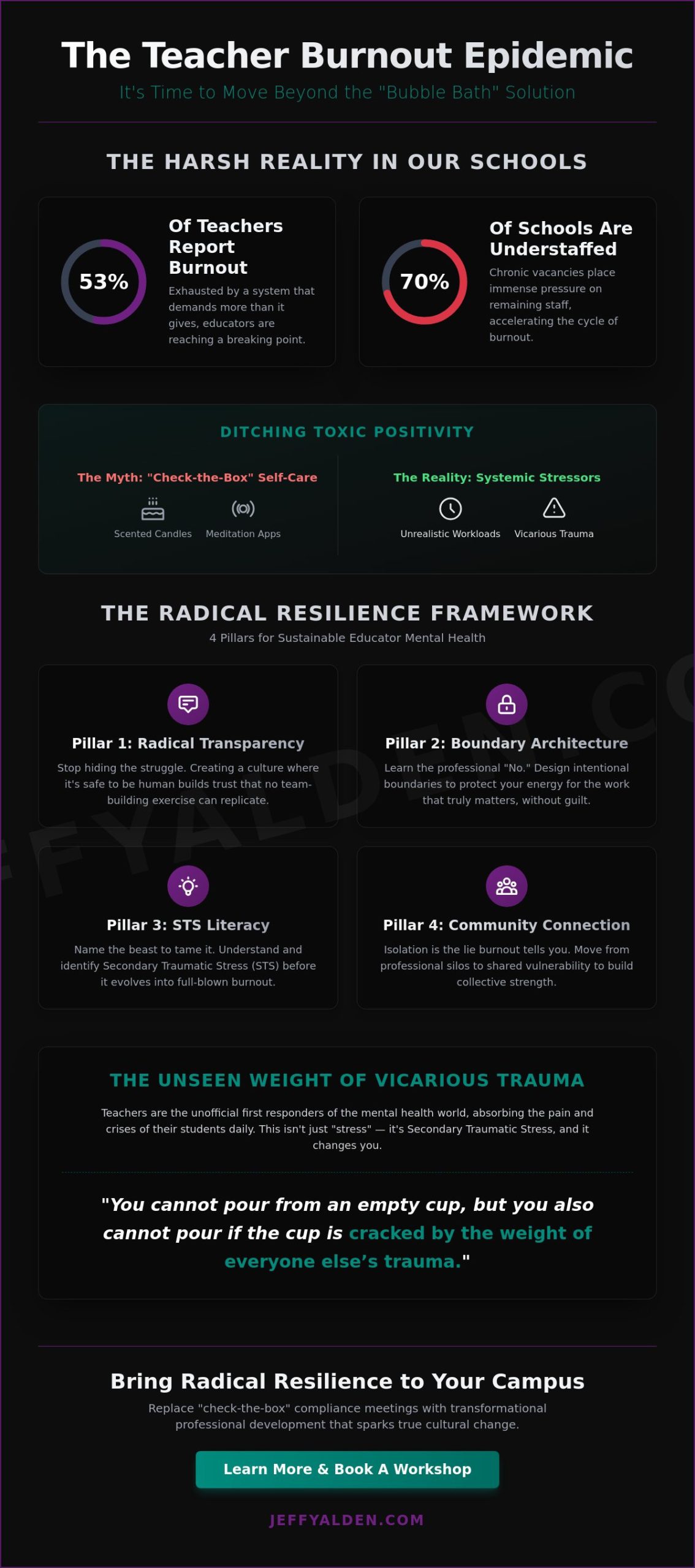
I know you’re tired of feeling like your mental health is just another box to check. You’re worried about the 53 percent of teachers who reported feeling burned out in 2025 and the 70 percent of schools that are chronically understaffed. I’ve been there. I’m telling you that there’s a way back to the passion that brought you to the classroom. In this guide, you’ll learn how to transform educator wellness into a high-impact strategy that actually saves careers and lowers turnover. We’re going to get real about the trauma we carry and provide you with the practical tools to build a campus morale that lasts.
Key Takeaways
- Move beyond the “bubble bath” myth by transforming teacher self-care professional development into a high-impact strategy that actively prevents burnout.
- Implement Radical Transparency on your campus to ditch toxic positivity and create a space where it is safe for educators to be human again.
- Design a personal “Boundary Architecture” that allows you to say a professional “no” while staying deeply committed to your students.
- Replace “check-the-box” compliance meetings with transformational PD workshops that prioritize raw connection and managing vicarious trauma.
- Discover why bringing in an outside expert can provide the “vulnerable authority” needed to spark a true cultural shift in your school.
Beyond the Bubble Bath: Why Self-Care is the Most Critical PD of 2026
Stop pretending a five-minute meditation app is going to fix a systemic collapse. In 2026, we aren’t just tired. We’re breaking. When 53 percent of K-12 teachers report feeling burned out and 70 percent of our schools are gasping for air because they’re understaffed, the old “grit your teeth” advice is an insult. We’ve spent billions on curriculum and AI integration, but we’ve ignored the human being standing at the front of the room. If you’re running on empty, the most expensive lesson plan in the world is just noise. This is why teacher self-care professional development has shifted from a “nice-to-have” to a non-negotiable survival tactic. We need Radical Transparency. We have to be brave enough to admit we’re struggling so we can finally stop the bleeding.
The High Cost of “Gritting It Out”
Your body is screaming for a break. Chronic stress isn’t just a mental state; it’s a physiological assault. It’s high cortisol. It’s a nervous system that stays stuck in “fight or flight” mode while you’re trying to grade essays. This physical toll is the primary driver of teacher burnout, and the fallout hits your students the hardest. Stress is a contagion. When you’re red-lining, your students’ anxiety spikes. Their achievement scores drop because they’re mirroring your exhaustion. You can’t inspire a future when you’re barely surviving the present.
Self-Care as a Professional Competency
We’re flipping the script. Emotional regulation isn’t a “soft skill.” It’s a high-level professional competency. Think of the oxygen mask principle with a raw, real-world twist: if you don’t put yours on first, you’re a liability to your students and your peers. An emotionally healthy teacher is a force of nature. You make sharper decisions. You handle classroom discipline with a calm, unshakable authority instead of reactive frustration. Investing in teacher self-care professional development is the most selfless act you can perform. It’s time to treat your mental health with the same urgency as your teaching credentials.
The Radical Resilience Framework: 4 Pillars of Educator Mental Health
We don’t need more vague advice or generic posters in the breakroom. We need a battle plan. The Radical Resilience Framework is designed to move your staff from survival mode to sustainable impact. This isn’t just a list of ideas; it’s the foundation of effective teacher self-care professional development. We’re building a culture where mental health is treated with the same rigor as math scores. It starts with four unshakeable pillars that change how we show up for our kids and each other.
- Pillar 1: Radical Transparency. Stop hiding the struggle. When leaders and teachers own their mess, they build a level of collective trust that no “team-building” exercise can replicate.
- Pillar 2: Boundary Architecture. Learn the professional “No.” This isn’t about doing less; it’s about being able to do the work that matters without losing your soul in the process.
- Pillar 3: STS Literacy. You have to name the beast. Identifying secondary traumatic stress (STS) early is the only way to stop it from turning into full-blown burnout.
- Pillar 4: Community Connection. Isolation is a lie that burnout tells you. Moving from isolated silos to shared vulnerability is how we stay standing when the world feels like it’s falling apart.
Facing the Raw Truth of Vicarious Trauma
Teachers are the unofficial first responders of the mental health world. Every day, you absorb the pain, the hunger, and the crises of your students. This is vicarious trauma. It’s not just “being stressed.” It’s your brain literally changing because you care so much. I’ve been in those classrooms where the air feels heavy with the weight of students’ lives. You have to realize that “You cannot pour from an empty cup, but you also cannot pour if the cup is cracked by the weight of everyone else’s trauma.” Owning this truth is the first step toward healing.
Building Your Boundary Architecture
Boundaries aren’t walls; they’re fences with gates. You need digital boundaries that keep your home life sacred. Stop answering parent emails at 9 PM. Implement a “Three-Minute Reset” between your periods to breathe and leave the last class’s drama behind. Most importantly, give yourself permission to take a mental health day. It’s not a sign of failure; it’s a sign of professional wisdom. If your team needs a roadmap to navigate this, booking an experienced mental health speaker can provide the “vulnerable authority” your staff needs to start being real about their wellness.
Mandatory Compliance vs. Meaningful Connection: Evaluating Your PD
Most professional development feels like a chore. It’s a box to check. It’s a binder that gathers dust on a shelf while you’re back in the trenches. But teacher self-care professional development has to be different. It can’t be mandatory compliance; it has to be meaningful connection. If your staff is rolling their eyes, it’s because they’ve been burned by “fluff” before. They don’t need another lecture on wellness that feels like extra work. They need a transformation that actually lightens the load. They need to feel seen, not just managed.
I hear the objection all the time: “My staff is too tired for another meeting.” You’re right. They are. They’re exhausted because they’re pouring into students without ever being refilled. But if a meeting provides actual relief, they’ll show up. If it addresses the secondary trauma they carry, they’ll lean in. This only happens when leadership is willing to be vulnerable. If the principal doesn’t admit they’re struggling too, the veteran teachers in the back row won’t buy in. Real change happens when we stop pretending everything is fine. This shift in staff culture is exactly what we focus on in our High School Assemblies, where radical transparency becomes the new standard for everyone on campus.
Why “Toxic Positivity” Kills Staff Morale
Toxic positivity is the death of trust. It’s the “good vibes only” posters in the hallway while teachers are drowning in paperwork and student crises. When you tell a struggling educator to “just remember your why,” you’re dismissing their pain. It’s an insufficient response to systemic stress. We need to replace empty platitudes with Radical Support protocols. This means acknowledging the mess. It means validating the struggle before jumping to a “fix.” Stop sugarcoating the crisis. Start supporting the human being behind the desk.
The ROI of Educator Wellness Programs
Let’s talk numbers. In 2022, district spending on professional development averaged $8,300 per teacher. If you’re spending that kind of money and still seeing a 53 percent burnout rate, the system is failing. The cost of teacher turnover is astronomical. It’s not just the hiring fees; it’s the lost institutional knowledge and the hit to student achievement. A high-impact teacher self-care professional development program is an investment in retention. You can measure the success of a resilience-first culture through lower sick day usage, higher staff retention, and internal climate surveys. When teachers feel supported, they stay. Before committing to any program, it helps to consult a comprehensive motivational speaker for high school staff buying guide so you know exactly what to look for in a presenter who leads with lived experience rather than empty enthusiasm.
How to Lead a High-Impact Self-Care PD Workshop
Don’t just schedule another meeting. If you’re going to lead teacher self-care professional development, you have to win the room before the first slide even appears. Most educators are walking in with their guard up. They’re waiting for the “cringe” factor. To break through, you have to follow a battle-tested sequence that respects their time and their intelligence. It’s about moving from theory to transformation in under sixty minutes. You aren’t just presenting; you’re facilitating a collective exhale.
- Step 1: Set the Stage with Radical Transparency. Don’t start with data. Start with your own struggle. If you aren’t real, they won’t be either.
- Step 2: Facilitate “Real Talk” Breakouts. Ditch the awkward icebreakers. Ask the hard questions: “What is the one thing keeping you up at 2 AM?”
- Step 3: Audit the “Mental Load.” Identify one systemic task that serves no purpose. Eliminate it for your staff. That’s true self-care.
- Step 4: Practice “Immediate Tools.” Don’t just talk about breathing. Do it. Give them scripts for setting boundaries with difficult parents.
- Step 5: Create a Sustainable Accountability Loop. Set up a “Wellness Buddy” system. It’s about having one person who checks in when the day gets heavy.
The “No-Fluff” Opening: Winning the Room
The first five minutes are everything. You have to address the skeptic in the back row immediately. If you don’t acknowledge their exhaustion, you’ve lost them. Try this script: “I know you’re tired. I know you have a stack of papers and a dozen emails waiting. I’m not here to give you more work. I’m here because I almost quit last year, and I want to make sure you don’t have to feel that way.” This “Vulnerable Authority” tone creates an immediate bridge. It signals that this isn’t a performance; it’s a lifeline.
Actionable Tools for the Classroom
Self-care shouldn’t stop when the bell rings. You need a “Post-Crisis Decompression” routine. When a student has a meltdown, you need a three-step process to reset your own nervous system before the next period begins. This mirrors the work we do when building resilience in teens. You can’t teach a kid to bounce back if you’re shattered yourself. Consider creating a “Wellness Corner” in the lounge. Not with posters, but with dim lighting, noise-canceling headphones, and a “no-work” policy. If you want to bring this level of impact to your campus, it’s time to book a specialized Teacher Professional Development speaker who knows how to keep it real.
Bringing Radical Resilience to Your Campus: The Jeff Yalden Approach
Jeff Yalden doesn’t do “polite.” He does “real.” When you’re searching for teacher self-care professional development, you aren’t looking for another academic lecture. You’re looking for a catalyst. Jeff brings a “Real and Raw” approach that strips away the buzzwords and gets to the heart of why we’re all so exhausted. It’s about more than just staying in the game; it’s about winning it. Often, an outside voice is the only thing that can break through the wall of skepticism built up over years of “check-the-box” training. Jeff isn’t your boss. He’s a peer who has walked through the fire and is here to show you the way out.
Why Radical Transparency Works
Jeff leads as a “vulnerable authority.” He shares his own imperfections because he knows that’s the only way to earn your trust. When he stands in front of a room of educators, he isn’t just a mental health speaker; he’s a lived-experience guide. By normalizing the conversation around secondary trauma and depression, he gives your entire district permission to be human again. Administrators across the country have seen the shift. One session can move a campus from silent suffering to vocal, collective support. It’s about creating a culture where it’s finally okay to say, “I’m not okay.”
Customizing Your Staff Wellness Day
Every school has a different scar. Some are dealing with a recent student crisis. Others are struggling with massive turnover or a total collapse of morale. Jeff doesn’t give a canned speech. He tailors every teacher self-care professional development session to the specific wounds of your campus. Whether you need a high-impact half-day intensive or a full-day culture transformation, the goal is the same: empowerment. We move from the energy of our school assemblies for students into a deep, focused session for the staff who hold those students up every day.
Your staff doesn’t need a spa day. They don’t need another coffee mug or a generic thank-you note. They need to know they aren’t alone in the dark. They need the tools to build radical resilience. It’s time to stop the burnout and start the healing. If you’re ready to transform your campus culture in 2026, let’s talk about bringing a teen mental health speaker who can also speak to the hearts of your educators. Reach out to book your Teacher Professional Development workshop today.
Your staff doesn’t need a spa day; they need to know they aren’t alone.
Stop Surviving and Start Leading Your Campus Forward
You didn’t enter education to burn out. You came here to change lives, but you can’t do that if you’re running on fumes. We’ve explored how radical transparency and boundary architecture can transform your school culture from the inside out. Investing in teacher self-care professional development isn’t just about a single workshop. It’s about a long-term commitment to the human beings who make your district run. It’s about moving past the “check-the-box” mentality and choosing meaningful connection instead.
Jeff Yalden brings over 30 years of high school mental health experience to your campus. As the author of “The 28-Day Guide to a Happier Life” and a specialist in suicide postvention and crisis intervention, he knows how to navigate the heaviest topics with grace and grit. Don’t wait for another crisis to prioritize your staff’s wellness. You have the power to stop the turnover and restore the heart of your school today. Book Jeff Yalden for your next Teacher Professional Development day and give your educators the “real and raw” support they deserve. You’ve got this, and you aren’t alone in this fight.
Frequently Asked Questions
Is self-care professional development eligible for Title II funding?
Title II funding often covers these programs because they focus on teacher retention and effective instruction. Since the goal is to improve student achievement by keeping high-quality educators in the classroom, wellness initiatives that prevent burnout fit the criteria. You should check your specific district’s plan to ensure the teacher self-care professional development aligns with your established goals for staff growth and support.
How do we address teacher burnout without sounding like we are blaming the teachers?
You address burnout by framing it as a systemic occupational hazard rather than a personal failure. It’s about the “heavy lifting” of the job, not the weakness of the person. When you stop saying “you need to be more resilient” and start saying “this job is incredibly hard,” the wall of defensiveness drops. We focus on the environment and the support systems, ensuring teachers feel seen and validated.
What is the difference between self-care and professional boundaries?
Self-care is how you recover from the work, while professional boundaries are how you protect yourself during the work. Think of boundaries as the fence and self-care as the garden inside. If you don’t have a fence, people will trample your garden no matter how much you water it. You need both to survive. Effective teacher self-care professional development teaches you how to build that fence without feeling guilty.
Can a motivational speaker really change long-term staff culture?
A speaker acts as a powerful catalyst to break the silence and spark a cultural shift. While one assembly won’t fix everything, it provides a shared language and a “vulnerable authority” that internal leadership often can’t reach. It’s the spark that starts the fire. For long-term change, you must follow that spark with the practical tools and frameworks we’ve discussed throughout this guide. To make sure you’re choosing the right fit for your team, review what separates a truly effective motivational speaker for high school staff from one who simply delivers a polished but forgettable performance.
How often should a school host self-care professional development?
You should integrate wellness into your schedule at least once a quarter to keep the momentum alive. A single “wellness day” in August is forgotten by October when the stress peaks. Consistent check-ins and mini-sessions show your staff that their mental health is a permanent priority, not a seasonal trend. Keeping the conversation active prevents the “compliance fatigue” that kills most school initiatives.
What are the most effective self-care strategies for teachers with no extra time?
Focus on “micro-strategies” that take less than sixty seconds. Use grounding techniques like the “5-4-3-2-1” method during hall duty or use pre-written “boundary scripts” for parent emails. These aren’t extra tasks on your list. They are shifts in how you handle the tasks you already have. It’s about finding the small pockets of peace in a chaotic day to reset your nervous system.
How do we measure the impact of a wellness PD session on our staff?
Measure impact through anonymous staff climate surveys, retention data, and a decrease in the use of sick days for mental health reasons. Look for qualitative shifts too. Are teachers talking more openly in the lounge? Is the “toxic positivity” disappearing? Data tells part of the story, but the “vibe” of the building tells the rest. Real success looks like a staff that feels safe being real.
What should a principal do if they are also experiencing burnout?
If you’re a principal experiencing burnout, the most powerful thing you can do is lead with radical transparency. Admit it to your staff. When you own your struggle, you give them permission to own theirs. It builds an incredible level of trust. You can’t lead a healthy building if you’re drowning. Seek your own mentor or coach and model the boundaries you want your teachers to set.
