
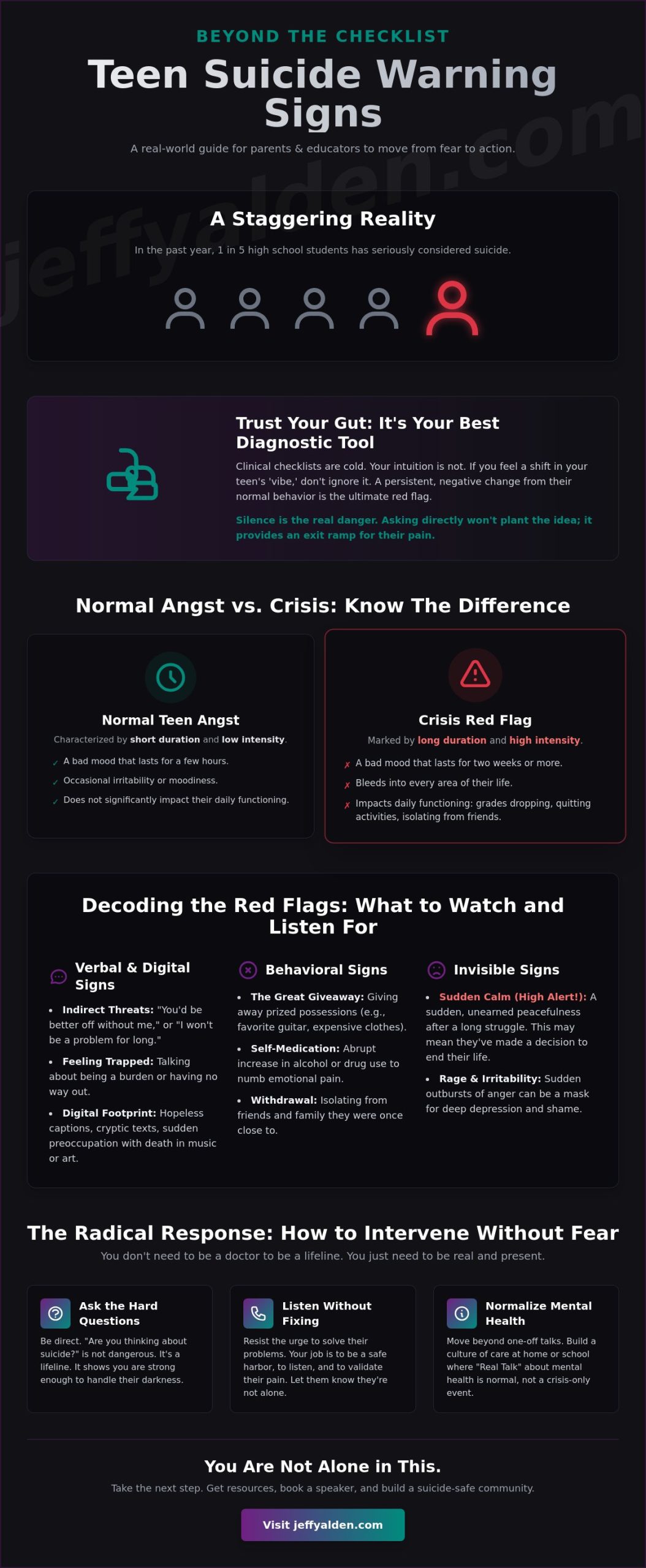
What if the “normal teen angst” you’re seeing isn’t normal at all? With 1 in 5 high school students seriously considering suicide in the past year; the stakes couldn’t be higher. You’re likely here because your gut is screaming that something is wrong, but you’re paralyzed by the fear of the “S” word. It’s okay to be scared. Most parents and educators feel completely ill-equipped to handle a mental health crisis. You’ve looked at the standard teen suicide warning signs online, but they feel cold and clinical. They don’t match the raw, messy reality of the kid sitting across from your dinner table.
I’ve been in those trenches, and I’m here to tell you that your intuition matters more than a pamphlet. I’m going to show you how to spot the critical red flags that medical lists often miss so you can intervene before a crisis occurs. We’re moving past the textbook definitions into a radical, real-world checklist. You’ll get the scripts you need to start the conversation and the validation that your “bad feeling” is worth acting on. Let’s get real about what’s happening and find the path back to hope together.
Key Takeaways
- Trust your gut. Learn why your intuition is a powerful diagnostic tool and how to spot shifts in baseline behavior that traditional checklists miss.
- Decode the silence. Uncover the coded language teens use in texts and social media to signal distress, helping you identify subtle teen suicide warning signs.
- Look past the anger. Recognize how irritability and sudden outbursts of rage are often masks for deep-seated depression and overwhelming shame.
- Be the safe harbor. Gain the confidence to ask the hardest questions directly and learn to listen without the desperate urge to fix it.
- Build a culture of care. Discover how to move beyond one-off events and normalize mental health talk in every corner of your school or home.
Beyond the Checklist: Why Radical Awareness is Your Best Tool
You’ve seen the lists. The posters in the counselor’s office. The clinical pamphlets. They tell you to watch for “loss of interest” or “changes in sleep.” But here is the raw truth: those lists are useless if you don’t understand the person behind the behavior. Real teen suicide warning signs aren’t just items on a checklist. They are deviations from the soul of the kid you know. It’s a shift in baseline. It’s the moment the light in their eyes changes or the frequency of their laughter drops. We aren’t looking for symptoms; we’re looking for the person who is slowly disappearing right in front of us.
Your gut is your best weapon. Parents and teachers often feel a “vibe” shift long before a crisis hits. You sense the tension. You feel the withdrawal. Don’t ignore that feeling. We often stay silent because we’re terrified of being wrong or, worse, “putting the idea in their head.” That is a dangerous myth. Silence is the real killer. Research shows that Teenage suicide in the United States is a complex crisis, but asking a direct question doesn’t create the thought. It provides an exit ramp for the pain. It tells the teen that you are strong enough to hold their darkness with them.
Normal Angst vs. Crisis: How to Tell the Difference
Teenagers are moody. We get it. It’s part of the biological hardware. But there is a massive difference between a bad day and a broken spirit. Focus on intensity and duration. If a bad mood lasts two hours, it’s a bad day. If it lasts two weeks and starts bleeding into every part of their life, it’s a red flag. Watch for the impact on daily functioning. Are they failing classes they used to love? Have they stopped texting the friends they were inseparable from a month ago? The ultimate indicator of risk is a persistent, negative shift away from their established baseline behavior.
The ‘Radical Transparency’ Mindset
We have to stop sugarcoating this. To save lives, we need to move from a place of fear to a place of radical curiosity. This means being unafraid to look at the dark stuff. It requires us to have “Real Talk” conversations that break the barrier of silence. When a teen mental health speaker stands on a stage, they don’t just give a speech. They open a door. They model the vulnerability that our kids are starving for. You don’t need to be a doctor to be a lifeline. You just need to be real, present, and willing to hear the truth without flinching.
The Verbal and Behavioral Red Flags: What to Watch and Listen For
Teens rarely walk up to an adult and say, “I have a plan to end my life.” Instead, they leak their pain in fragments. They use code. They test the waters to see if you can handle their truth. Research shows that 50 to 75 percent of youth who die by suicide give a warning sign to a friend or family member before the act. You just have to know how to decode these teen suicide warning signs before the window of intervention closes. It’s about listening for what isn’t being said as much as what is.
One of the most dangerous traps for parents and teachers is the “sudden calm.” You’ve been worried for weeks. Then, suddenly, the clouds seem to part. Your teen is peaceful, maybe even happy for the first time in months. Don’t exhale yet. Sometimes, that sudden improvement in mood happens because the teen has made a firm decision to end their life. The struggle is over in their mind, and the relief they feel looks like recovery. According to Johns Hopkins Medicine, recognizing youth suicide warning signs like this is the first step toward saving a life. If the “fix” feels too fast or unearned, stay on high alert.
Verbal Warning Signs (The ‘Talk’ Checklist)
Listen for indirect threats. It’s rarely “I want to die” and more often “You’d be better off without me” or “I won’t be a problem much longer.” They might talk about being a burden or feeling trapped in a situation they can’t escape. Pay attention to their digital footprint too. Hopelessness often shows up in social media captions, cryptic texts, or a sudden preoccupation with death in their music and art. If they are talking like they don’t have a future, believe them.
Behavioral Warning Signs (The ‘Action’ Checklist)
- The Great Giveaway: Watch for them giving away prized possessions, like a favorite guitar or expensive sneakers. They are clearing the deck.
- Self-Medication: An abrupt increase in alcohol or drug use isn’t just rebellion. It’s an attempt to numb unbearable emotional pain.
- Social Blackout: They aren’t just “being a teenager” when they quit the team, the band, or the gaming group they loved. They are withdrawing from the world.
- Reckless Abandon: Acting without regard for safety, like driving dangerously or picking fights, often signals they’ve stopped caring about staying alive.
Learning to identify these teen suicide warning signs isn’t about being a clinical expert. It’s about being a detective of the heart. If you see these patterns emerging in your school or home, bringing in a Youth Motivational Speaker can help open the lines of communication before a crisis peaks. We have to be the ones brave enough to break the silence.
The Invisible Signs: Mood Shifts and Environmental Triggers
Depression in teenagers is a shapeshifter. It doesn’t always look like a kid crying in a dark room. Most of the time, it looks like a kid who is suddenly impossible to be around. We are talking about explosive irritability and unexplained rage. This is the mask. They are hurting so deeply that they can’t contain the pressure; so it leaks out as anger. When we evaluate teen suicide warning signs, we must look past the surface level behavior to find the pain underneath. Shame is often the driver here. A single “public” mistake on social media or a perceived academic failure can feel like a death sentence to a teen whose brain is still wired for peer approval.
Environmental stressors act as the fuel for this fire. We know from research that students who are bullied are 2 to 9 times more likely to consider suicide. It isn’t just about the “big” events. It is the steady erosion of their self-worth through relationship breakups, identity struggles, or feeling like they don’t belong. Identifying these teen suicide risk factors requires you to be tuned into their world. You have to see the environment through their eyes, where a breakup isn’t just “puppy love,” it is the end of their world.
Mood and Personality Changes
Watch for the subtle fade. This includes a sudden loss of interest in personal appearance or hygiene. If a kid who used to care about their hair and clothes suddenly stops showering or wearing clean laundry, pay attention. These outbursts of aggression are often a cry for help from a soul that feels trapped. We have to help them pivot. Focusing on building resilience in teens is how we give them the tools to handle these triggers before they become life-threatening.
Contagion and Postvention Red Flags
There is a specific danger window that most people never talk about: postvention. When a suicide occurs in a community or school, the risk for other vulnerable teens spikes. This is the “contagion” effect. You might see students “hero-worshipping” a deceased peer or acting out in ways that mirror the loss. This is a critical time for teen suicide warning signs to be monitored across the entire student body. During these high-stakes moments, bringing in a postvention speaker for schools can provide the radical transparency needed to stabilize the culture and save lives. We can’t afford to be silent when the community is grieving.
The Radical Response: How to Intervene Without Fear
You’ve spotted the teen suicide warning signs. Your heart is racing. Your palms are sweaty. The fear of saying the wrong thing is paralyzing, but silence is a luxury you don’t have. Intervention isn’t about having a clinical degree. It’s about having the guts to stand in the fire with someone who is burning up. You don’t need to fix their life in ten minutes. You just need to be the bridge between their pain and the help they deserve. This is the moment where radical transparency saves a life.
The first step is the hardest: ask the direct question. Don’t use metaphors. Don’t ask if they are “feeling down” or “thinking of doing something reckless.” Look them in the eye and ask, “Are you thinking about killing yourself?” It feels like a punch to the gut to say it, but it’s the most loving thing you can do. If the answer is yes, move to step two: listen. You are a safe harbor, not a fixer. Your job is to let them pour out the darkness without you flinching or judging. Once they’ve spoken, you must keep them safe. Never leave a person in crisis alone. Not for a minute. Connect them to professional help immediately and commit to the follow up. The danger doesn’t vanish just because the first conversation ended.
What to Say (and What NOT to Say)
When a teen is in the depths of despair, hearing “You have so much to live for” feels like a slap in the face. It tells them that their current, crushing pain doesn’t matter. It makes them feel guilty for hurting. Instead, use phrases that anchor them to the present. Try saying, “I’m here for you, and I’m not going anywhere,” or “I can see how much you’re hurting, and we’re going to get through this together.”
Teachers, if you notice a student’s grades slipping or their personality fading, use this script: “Hey, I’ve noticed you haven’t been yourself lately and your work is falling behind. I’m not worried about the grade; I’m worried about you. Is there something heavy going on that you need to talk about?” This opens the door without the pressure of an academic lecture. If the situation escalates, you need to know how to handle a crisis at school with a clear, calm plan.
Immediate Resources for Intervention
- The 988 Suicide & Crisis Lifeline: This is a 24/7 lifeline. Don’t just tell them about it. Grab their phone and put the number in their contacts together.
- School Counselors: They are your primary allies. Involve them immediately, but explain to the teen that you’re doing it because you care too much to keep this secret.
- The ‘Warm’ Hand-off: Don’t just give a phone number and walk away. Stay on the line or in the room until a professional takes over.
Being a High School Speaker has taught me that kids are waiting for an adult to be brave enough to ask the hard questions. You have the power to be that adult. Don’t let fear keep you quiet when a life is on the line.
From Crisis to Culture: Building a Suicide-Safe School
We’ve covered the red flags. We’ve mapped out the intervention. But if we only talk about mental health when someone is in a tailspin, we’ve already lost the battle. One-off assemblies are a start, but they aren’t a solution. To truly save lives, we have to move beyond the clinical checkboxes and into the messy, beautiful reality of our students’ daily lives. We need a “culture of care” where mental health talk is as normal as talking about the football score or the upcoming prom. It has to happen in every classroom, every day. It’s about the heart, not just the policy.
The truth is that teachers and parents aren’t always the first to see the teen suicide warning signs. It’s the students. They are the ones in the DMs, the locker rooms, and the late-night group chats. They see the mask slip before anyone else does. That is why student leadership is the heartbeat of any suicide-safe school. When we empower our kids to look out for one another, we create a safety net that catches the ones who are trying to disappear. We aren’t just teaching them to be students; we’re teaching them to be lifelines.
Empowering Students to Speak Up
We have to break the “snitch” culture that keeps our kids silent. We must teach them that telling an adult isn’t a betrayal; it is the ultimate act of love. It’s about teaching “Reach Out” skills so they know exactly what to do when a friend starts leaking pain. This transformation doesn’t happen by accident. It starts with high-impact High School Assemblies that strip away the stigma and replace it with radical transparency. When the whole school hears the same raw truth at the same time, the walls of silence start to crumble.
Jeff Yalden’s Vision for 2026
My vision for 2026 is a move from “Awareness” to “Action.” Awareness is just knowing that a problem exists. Action is doing something about it before the crisis hits. We are building a “Victor” mentality in our youth. This means teaching teens that they are more than their struggle, more than their diagnosis, and more than their darkest thoughts. They aren’t victims of their circumstances; they are victors who can overcome them with the right support.
I’ve seen campuses transform from places of quiet desperation to communities of resilient hope. It happens when we stop being afraid of the “S” word and start being brave enough to be real. If you are ready to move your school from crisis mode to a culture of care, it’s time to take the lead. You can Book Jeff Yalden to bring this life-saving message to your campus and start the conversation that changes everything. Our kids are worth the “Real Talk.” Let’s give it to them.
The Choice to Be a Lifeline Starts Today
You now have the tools to look past the clinical lists and see the heart of the kid sitting in front of you. Remember that your intuition is your greatest asset. If your gut says something is wrong, it usually is. We’ve talked about how to decode the silence and why a “sudden calm” is often the most dangerous of all teen suicide warning signs. You know that asking the direct question isn’t dangerous; it is the most loving thing you can do. Now, it’s time to take this radical awareness and turn it into a culture of care in your home or school.
Jeff Yalden has spent over 30 years in youth crisis intervention. He is a Red Dot Speaker who leads with radical transparency and the author of ‘Teen Suicide: The ‘S’ Word.’ He doesn’t just point out problems; he builds victors. You can bring Jeff Yalden to your school to save lives and build resilience. Don’t wait for a crisis to act. Start building a suicide-safe culture today. You have the power to change the narrative and give our youth the future they deserve. Stay brave, stay real, and never stop listening.
Frequently Asked Questions
Will asking my teen about suicide put the idea in their head?
No. Asking directly does not plant the seed; it offers a lifeline. Research proves that talking about suicide actually lowers anxiety and provides a safe space for the teen to breathe. If you’re seeing teen suicide warning signs, silence is your enemy. You aren’t giving them the idea. You’re giving them a way out of the darkness they are already living in.
What should I do if my teen refuses to talk to me about their feelings?
If they won’t talk to you, find someone they will talk to. This could be a coach, a teacher, or a youth life coach. Your job isn’t to force the words out of them; it’s to ensure they are safe and heard. Stay in the room. Be present. Let them know you’re a safe harbor even if they aren’t ready to dock yet.
Are self-harm and suicide warning signs the same thing?
They are different behaviors with a shared root of deep emotional pain. Self-harm is often a desperate attempt to regulate overwhelming feelings or feel “something” when they are numb. Suicide is the desire to end all feeling forever. While they have different goals, both are critical signals that a teen is in a mental health crisis. Treat both with the same urgency.
How can teachers tell the difference between ‘bad behavior’ and a cry for help?
Look for the “why” behind the “what.” A student who was usually respectful but suddenly becomes aggressive or “lazy” isn’t just being difficult. They are likely drowning. When “bad behavior” is a radical departure from their normal baseline, it’s a cry for help. Teachers are often the first to see these teen suicide warning signs in the classroom environment.
What is the #1 most overlooked teen suicide warning sign?
The “sudden calm” is the most overlooked and dangerous sign of all. When a teen who has been deeply depressed for weeks suddenly seems “cured” or unusually peaceful without treatment, be on high alert. This often happens because they’ve made a firm plan to end their life. The struggle is over in their mind, and that relief looks like recovery to the untrained eye.
Should I call 911 if I see these warning signs?
Call 911 only if there is an immediate, active threat of harm or an attempt in progress. If the situation is a crisis but not an immediate life-or-death emergency, use the 988 Suicide & Crisis Lifeline. You can also take them to the nearest emergency room for a psychiatric evaluation. The goal is to keep them supervised until professional help takes over.
How do I handle a teen who says they were ‘just joking’ about suicide?
Never ignore a “joke” about death. Teens often use humor to test the waters and see if you can handle their pain. If they say they were just kidding, tell them, “I’m glad to hear that, but I love you too much to take that chance. Let’s talk about why that joke felt like an option.” Radical transparency means taking every word seriously.
What role does social media play in teen suicide warning signs today?
Social media is the modern digital diary. You have to look for “coded” hopelessness in their captions, stories, and the types of content they are reposting. Sudden black-and-white profile pictures, cryptic “goodbye” messages, or a preoccupation with dark imagery are modern red flags. It’s not just an aesthetic choice; it’s often a public broadcast of private pain.
