
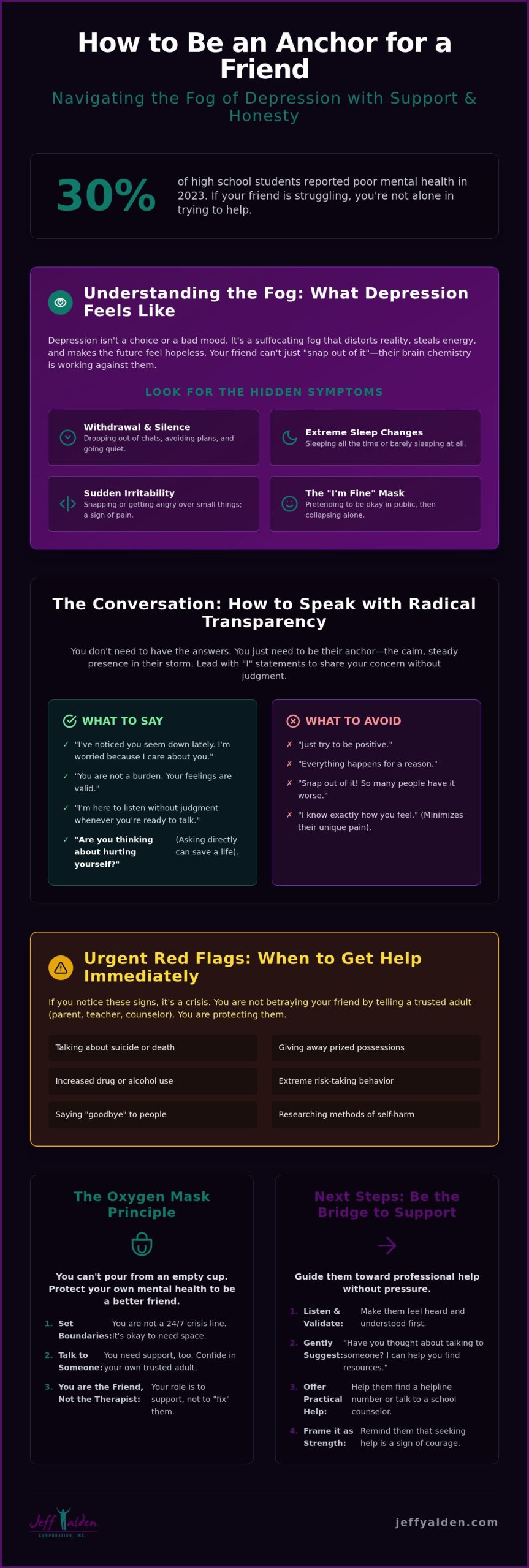
What if I told you that trying to “fix” your friend’s depression is actually the fastest way to burn yourself out and leave them feeling more isolated? Knowing what to do if your friend is depressed isn’t about memorizing a clinical script or finding a magic wand. It’s about showing up with a level of radical honesty that most people are too scared to touch. You’re likely exhausted. You’re terrified of saying the wrong thing, and you might be lying awake wondering if they’re truly safe. I’ve been there, and I know that heavy, helpless feeling in your chest. With 30% of high school students reporting poor mental health in 2023, you’re definitely not alone in this struggle.
In this guide, I’m going to show you how to be the anchor your friend needs through radical transparency, without losing your own spirit in the process. We’ll cover exactly what to say in those raw moments, when it’s time to escalate the situation to an adult, and how to protect your own mental health while you stand in the gap. It’s time to stop guessing and start leading with heart, grit, and resilience.
Key Takeaways
- Stop guessing what to do if your friend is depressed and start seeing their struggle as a heavy fog that distorts reality, not a personal choice.
- Use the power of presence and radical transparency to have real conversations that build trust without needing to have all the answers.
- Learn to recognize the urgent red flags of a mental health crisis and gain the confidence to address the topic of safety directly.
- Protect your own peace with the “Oxygen Mask” principle, ensuring you maintain your own resilience while helping someone else navigate their storm.
- Bridge the gap to professional resources and help your friend shift toward a victor mentality through the right support systems.
Understanding the Weight: What Your Friend is Actually Going Through
Depression is a thief. It doesn’t just take away your happiness; it steals your energy, your sleep, and your hope for tomorrow. It isn’t a bad mood or a choice someone makes to get attention. When you’re trying to figure out what to do if your friend is depressed, you have to understand that they are walking through a thick, suffocating fog. This fog distorts reality. It makes the people who love them seem distant and the future look like a dead end. This isn’t about having a rough Tuesday or feeling “bummed out” because of a breakup. This is a clinical weight that sits on the chest and refuses to move. To get a full picture of the clinical side, Understanding Major Depressive Disorder can help you see the symptoms as part of a real medical reality.
Depression is a persistent mental health challenge that requires professional strategy and deep empathy rather than just “cheering up” or a change in perspective.
The Symptoms You Can’t Always See
Sometimes the loudest cry for help is total silence. You might notice your friend dropping out of the group chat or skipping the activities they used to live for. Maybe they are sleeping fourteen hours a day or staying up until sunrise. Sudden irritability is another huge sign. If your once-chill friend is now snapping at everyone, it might be the pain talking. But keep a close eye on the “mask.” Many people get incredibly good at performing “okay” while they are drowning inside. They smile at school and laugh at your jokes, but the moment they get home, they collapse under the effort of pretending. If you’re wondering what to do if your friend is depressed but “looks fine,” trust your gut when you feel that something is off.
Why Your Friend Can’t Just ‘Snap Out of It’
Their brain is literally working against them. It is not a lack of willpower; it is biology. When the chemicals that regulate mood and motivation aren’t firing correctly, “thinking positive” is like trying to run a marathon with two broken legs. It just isn’t possible without support. Your friend probably feels massive guilt about this. They feel like a burden to you and everyone else. They hate that they can’t just be “normal.” Here is the raw truth: it is not their fault, and it is not your fault either. You can’t fix their brain chemistry, but you can stand beside them while they navigate the storm. They don’t need a coach to tell them to try harder; they need a friend to tell them they aren’t alone in the dark.
The Conversation: How to Speak with Radical Transparency
When you are staring into the eyes of someone you love and seeing only emptiness, the pressure to say something profound is crushing. You want to fix it. You want to save them. But figuring out what to do if your friend is depressed starts with one simple, radical truth: you don’t have to have the answers. You just have to have the guts to stay in the room. This is the “Anchor” mindset. While their world is spinning in chaos, you stay still. You stay calm. You become the one thing that doesn’t move when everything else is falling apart. Supporting a friend with depression requires this level of emotional consistency, even when it is uncomfortable.
Radical transparency means being real about what you see. Don’t dance around it. Use “I” statements to keep the connection open without sounding like a judge. Say, “I feel scared because I haven’t heard from you in three days,” rather than “You never answer your phone anymore.” This shift moves the conversation from an attack to a shared experience. It shows them that their struggle is impacting you because you value them. If your school needs a teen motivational speaker to help bridge these gaps and normalize these hard conversations, remember that honesty is always the best foundation.
What to Say (and What to Avoid)
Words have power. They can build a bridge or burn one. When you approach them, lead with specific observations. Say: “I’ve noticed you haven’t been yourself, and I’m worried because I care about you.” This is direct. It’s loving. It’s real. On the flip side, avoid the cliches that feel like a slap in the face to someone in pain. Never say “Everything happens for a reason” or “Just stay positive.” Those phrases minimize their suffering. Instead, be brave enough to ask the hard questions. “Are you thinking about hurting yourself?” It is a terrifying question to ask, but asking it with love can literally save a life.
Active Listening: The Silent Support
The best thing you can do is listen. Follow the 80/20 rule. Let them speak 80% of the time while you listen for the remaining 20%. You aren’t there to solve the puzzle immediately. You are there to validate. If they say they feel hopeless, don’t argue with them. Say, “That sounds incredibly heavy. I’m so sorry you’re carrying that.” Your body language speaks louder than your voice. Put the phone away. Lean in. Make eye contact. Create a non-judgmental space where they can be messy, raw, and completely broken without feeling like they have to apologize for it. This is what to do if your friend is depressed: you become the safe harbor in their storm.
Recognizing the Red Flags: When It’s More Than Just ‘Feeling Blue’
Knowing what to do if your friend is depressed becomes a matter of life and death when the struggle shifts into a full-blown crisis. You have to be able to tell the difference between “having a hard time” and “being in immediate danger.” This isn’t about being a doctor; it is about being a human who is paying attention and refusing to look away. When things get this heavy, finding professional support for depression is the only move left on the board. You can’t carry this alone, and neither can they. If you sense the situation is spiraling, looking into Teen Suicide Prevention Programs provides the radical approach needed to intervene before it is too late.
A “Contract for Safety” isn’t just a clinical term. It is a verbal agreement that you will not keep a secret that involves self-harm. You need to be clear with your friend from the start: “I am here for you for everything, but I will not let you hurt yourself.” This boundary is vital. It protects them, and it protects your heart from the weight of a secret that is too heavy for any one person to carry. You are an anchor, but even an anchor has limits to how much weight it can hold before it starts to sink.
Warning Signs of Suicide You Cannot Ignore
Watch for the specifics. Is your friend giving away their favorite hoodies or their gaming console? Are they saying “goodbye” in ways that feel final or weirdly sentimental? One of the most dangerous signs is a sudden, unexplained sense of calm. If they have been in the depths of despair for months and suddenly act like everything is perfect, it might mean they have made a decision to end their pain. You have to ask them directly: “Are you thinking about killing yourself?” Asking the question doesn’t plant the seed; it provides the permission they need to speak the truth.
The ‘Tattling’ vs. ‘Saving’ Debate
You might have promised to keep their secrets. Forget the promise. A secret that can kill is a secret you cannot keep. If they aren’t safe, you have to tell a trusted adult immediately. Go to a coach, a teacher, or a parent. They might get angry. They might scream that you betrayed them or that they hate you. Let them be mad. I would rather have a friend who is alive and furious at me than a friend who is gone because I stayed silent. Saving a life is never “tattling.” It is the ultimate act of love and radical transparency. It’s about being a victor for your friend when they can’t be one for themselves.
Protecting Your Own Peace: The Helper’s Guide to Resilience
You cannot pour from an empty cup. It sounds like a cliché, but when you are trying to figure out what to do if your friend is depressed, it is the only rule that matters. If you go down, you both go down. This is the “Oxygen Mask” principle in action. You have to secure your own breathing before you can even think about helping the person in the seat next to you. Being an anchor means being strong, and strength requires maintenance. You are a friend, not a clinical professional. Recognizing that line is the first step toward Building Resilience in Teens. It is okay to say, “I love you, but I can’t talk about this right now.” That isn’t abandonment. It is survival.
The weight of someone else’s darkness can start to feel like your own if you aren’t careful. You might feel like you have to be on call 24/7. You might feel like their life is in your hands. That is a heavy burden for anyone to carry, especially when you are still navigating your own life. If the pressure is becoming too much, it might be time to suggest a youth life coach who can provide the professional guidance your friend needs while you return to being just a friend. You are there to walk beside them, not to carry them on your back for miles.
Managing the ‘Helper’s Guilt’
Guilt is a liar. It will tell you that you are selfish for wanting to go to a party or watch a movie while your friend is struggling. Reject that lie. You are not responsible for their recovery. You are responsible for your own character and your own actions. Permitting yourself to still have fun is not a betrayal; it is a necessity. You need a support system of your own where you can talk through the stress of being the “strong one.” Find people who fill you back up after you’ve spent your energy supporting someone else.
Practical Self-Care for the Supporter
Resilience is built in the small, daily moments. You need habits that ground you when the world feels shaky. This means prioritizing your sleep, getting your body moving, and knowing when to unplug from the group chat. Practice radical self-honesty about your limits. If you are feeling burnt out, irritable, or hopeless yourself, you have hit your limit. Stepping back for a few hours or a day to recharge isn’t failing your friend. It is ensuring that when you do show up, you are actually present and capable of being the anchor they need. Real what to do if your friend is depressed strategy includes knowing when to save yourself first.
Next Steps: Bridging the Gap to Professional Support
You have been the anchor. You have stood in the storm and refused to move while the waves crashed around your friend. But even the strongest anchor cannot stop the rain from falling; it just keeps the ship from drifting into the rocks. Knowing what to do if your friend is depressed eventually means helping them find a lighthouse. Suggesting professional help isn’t about telling your friend they are “crazy” or “broken.” It is about telling them they deserve a life that doesn’t hurt this much. It’s about radical transparency. You are saying, “I love you too much to watch you suffer without the right tools.”
When you’re deciding what to do if your friend is depressed, remember that you are the bridge to their recovery, not the recovery itself. Your job is to facilitate the connection to someone who can help them rebuild. A teen life coach can be a game changer here. Unlike clinical settings that can feel cold, a coach focuses on building a victor mentality. They help teens take ownership of their journey and find the grit to keep moving forward. You are doing a brave, selfless thing by being there, but you don’t have to be the only one on the team.
Finding the Right Level of Care
There is a difference between therapy and coaching, and your friend might need both. Therapy often digs into the “why” of the past, while coaching focuses on the “how” of the future. Offer to walk with them to the school counselor’s office or sit in the waiting room during their first appointment. Sometimes, the hardest part is just walking through the door. For immediate crisis moments, keep the 988 Suicide and Crisis Lifeline in your phone. It is a free, confidential resource available 24/7. Having that number ready is a practical way to stay prepared without carrying the entire burden of their safety on your own shoulders.
Bringing the Message to Your School
One conversation can save a life, but a culture of transparency can save a whole community. If your school is struggling with silence, it might be time to bring in high school assemblies that actually speak the truth. Impactful teen mental health speakers can break the stigma in a single hour, giving every student the permission they need to ask for help. When school leaders invest in professional development and student programs, they create a safety net that catches everyone. You’ve done the hard work of being a friend. Now, let’s make sure no one else has to walk this path alone.
Leading with Heart and Resilience
Standing in the gap for someone else is the ultimate act of courage. You’ve learned that presence matters more than having all the answers and that radical transparency is the only way to break through the darkness. Understanding what to do if your friend is depressed isn’t about being a medical expert; it’s about being a human who refuses to look away from the pain. You now know how to set boundaries that protect your own spirit while remaining the rock your friend needs to lean on. This is how you lead with heart, grit, and a victor mentality.
This conversation shouldn’t stay between you and a screen. It needs to happen in your hallways and classrooms. I’ve spent over 30 years speaking to millions of students, bringing a level of radical transparency that actually resonates with Gen Z. My expertise in suicide postvention and crisis intervention helps schools move from fear to empowerment. Bring Jeff Yalden to your school to start the conversation on mental health and resilience.
You have the power to change a life. Keep showing up. Keep being real. You aren’t just a friend. You’re a victor.
Frequently Asked Questions
How do I know if my friend is just sad or actually depressed?
Sadness is usually a temporary reaction to a specific event, but depression is a persistent state that lasts for weeks and swallows daily life. If your friend has lost interest in everything they love for more than fourteen days, it is likely clinical. Sadness eventually passes with time. Depression is a heavy, suffocating fog that requires professional strategy to lift. Pay close attention to the duration and the intensity of their withdrawal.
What if my friend refuses to get professional help?
You cannot force someone to seek help, but you can continue to plant seeds of hope and normalize the conversation. Focus on your feelings and your concern rather than pointing out their “problems.” If they are in immediate danger, the choice is no longer theirs; you must escalate to a trusted adult immediately. Otherwise, stay the anchor and remind them that they don’t have to carry this weight alone forever.
Should I tell their parents if they told me they are depressed in secret?
If your friend’s safety is at risk, you must break that secret to save their life. A secret that can kill is a secret you simply cannot keep. If they aren’t in a crisis, encourage them to talk to their parents themselves or offer to be there when they do. Safety always overrides a promise of secrecy. I would much rather have a mad friend than a dead one.
Can I make my friend’s depression worse by saying the wrong thing?
You aren’t powerful enough to “cause” or “cure” their depression with a single sentence. While clichés like “just stay positive” are unhelpful and frustrating, your presence is far more important than your perfection. If you say something off, apologize and get back to listening. The only way to truly make it worse is to ignore them or disappear because you’re afraid of messing up a script.
How do I start a conversation with a friend I think is struggling?
Start with specific, observable facts and lead with “I” statements to keep the connection real. Say, “I’ve noticed you haven’t been coming to practice lately, and I’m worried about you.” This is the best way to handle what to do if your friend is depressed without sounding like you’re judging them. Be direct, be vulnerable, and then let them talk while you listen with everything you’ve got.
What should I do if my friend talks about wanting to end their life?
Take every threat with absolute seriousness and never leave them alone if they are in a crisis. Ask the hard question directly: “Are you thinking about killing yourself?” If the answer is yes, get them to an adult, a school counselor, or the nearest emergency room immediately. This is not a situation you can manage on your own. Safety is the only priority that matters in this moment.
Is it my job to keep my friend happy?
No, it is not your job to be their therapist or their primary source of happiness. You are a friend, which means you walk beside them, not carry them on your back. Trying to “fix” their mood will only lead to your own burnout and resentment. Focus on being a consistent, supportive presence while encouraging them to find professional tools. Your role is to be an anchor, not a savior.
Where can I find immediate help for my friend right now?
Call or text the 988 Suicide and Crisis Lifeline for immediate, confidential support that is available 24/7. This is the fastest way to figure out what to do if your friend is depressed and in immediate danger. You can also reach out to a trusted teacher, coach, or parent. If the threat is happening right now, do not hesitate to call emergency services or go to the nearest hospital.
