
You aren’t just paying for a sixty-minute speech; you’re paying for the years of survival and hard-earned expertise that prevent the next student crisis. It’s a heavy reality to face when you’re staring at a shrinking school budget. You want to save lives, but you’re terrified of hiring someone who is out of touch or, even worse, boring. Understanding the current mental health speaker cost isn’t just about balancing a spreadsheet. It’s about ensuring your students get the real, raw connection they desperately need right now.
I get it because I’ve been there. I know the urgency you feel to act before the next tragedy hits. This guide is your roadmap to radical transparency in the speaking industry for 2026. I’ll show you exactly how to navigate fees and hidden expenses without the clinical fluff. You’ll learn how to fund a high-impact assembly without draining your general fund and how to identify a speaker who offers lasting value beyond the stage. Let’s stop checking boxes and start creating the transformation your students deserve. It’s time to move from surviving to thriving.
Key Takeaways
- Get the raw truth about industry fee tiers. Stop guessing and start budgeting for a speaker who actually moves the needle for your students.
- Uncover the hidden logistics and travel expenses that often inflate the total mental health speaker cost beyond the initial quote.
- Master the strategy of using Title I, Title IV, and ESSER funds. Protect your general budget while you prioritize saving student lives.
- Learn why booking directly eliminates unnecessary middleman markups. It’s the most transparent way to secure experts who provide critical postvention support.
- Identify the specific qualities of a speaker who offers lasting value. You need more than a talk; you need a roadmap for long-term transformation.
What is the Real Cost of a Mental Health Speaker in 2026?
Let’s get real about the numbers. When you start searching for a speaker, you’ll see a wild range of fees. Professional rates in 2026 typically land between $3,500 and $25,000 or more. But here is the radical truth: the mental health speaker cost isn’t just a line item for a sixty-minute talk. It is an investment in the safety of your school. You aren’t just paying for words. You’re paying for the years of survival, the specialized training, and the emotional resilience it takes to stand in front of a thousand hurting teenagers and actually reach them.
A “cheap” speaker is often the most expensive mistake you can make. If a presenter is out of touch or relies on outdated cliches, they don’t just waste your budget. They lose the trust of your students. When students feel like an assembly is just another “box to check,” they shut down. You lose the opportunity to break through. Real impact requires a specialist who lives in the trenches, not someone who just reads from a clinical script. The base Speaking fee covers the stage time, but the value lies in the life-saving connection made during those moments.
Why Prices Vary: Experience vs. Fame
You might encounter the “Celebrity Tax.” This is when you pay a massive premium for a famous name rather than a proven ability to connect with students. Fame doesn’t equal impact. An educational specialist who understands the unique pressures of 2026 will often provide more value than a celebrity who hasn’t stepped foot in a high school in a decade. You also pay for customization. Does the speaker research your specific campus? Do they address the recent crises your community has faced? A tailored message costs more because it requires more heart and more preparation. Lived experience is the currency of 2026; it’s what makes a message stick when the lights go down.
The Cost of Silence: Why Budgeting for Mental Health is Mandatory
Contrast the fee of a professional speaker with the catastrophic emotional and financial cost of a student tragedy. The fallout of a single crisis can haunt a community for years and lead to massive legal liabilities. Investing in teen suicide prevention programs is a proactive move that protects your students and your district. In 2026, a school assembly isn’t a luxury; it’s a frontline defense against the youth mental health crisis. When you look at your budget, don’t just ask what the speaker costs. Ask what it will cost your community if you stay silent. The mental health speaker cost is a small price to pay for a culture of hope and resilience.
Mental Health Speaker Fee Tiers: What Does Your Budget Buy?
Budgeting for student wellness isn’t about finding the lowest price. It’s about finding the highest impact. The mental health speaker cost you see on a website usually reflects a specific level of experience, reach, and specialized training. When you’re looking at your numbers for 2026, you need to know exactly what you’re getting for every dollar spent. It’s not just a transaction; it’s a commitment to your campus culture.
Understanding these tiers helps you avoid the “cheap mistake” mentioned earlier. You need to know How To Book A Motivational Keynote Speaker who actually fits your needs rather than just your wallet. Here is how the industry breaks down right now.
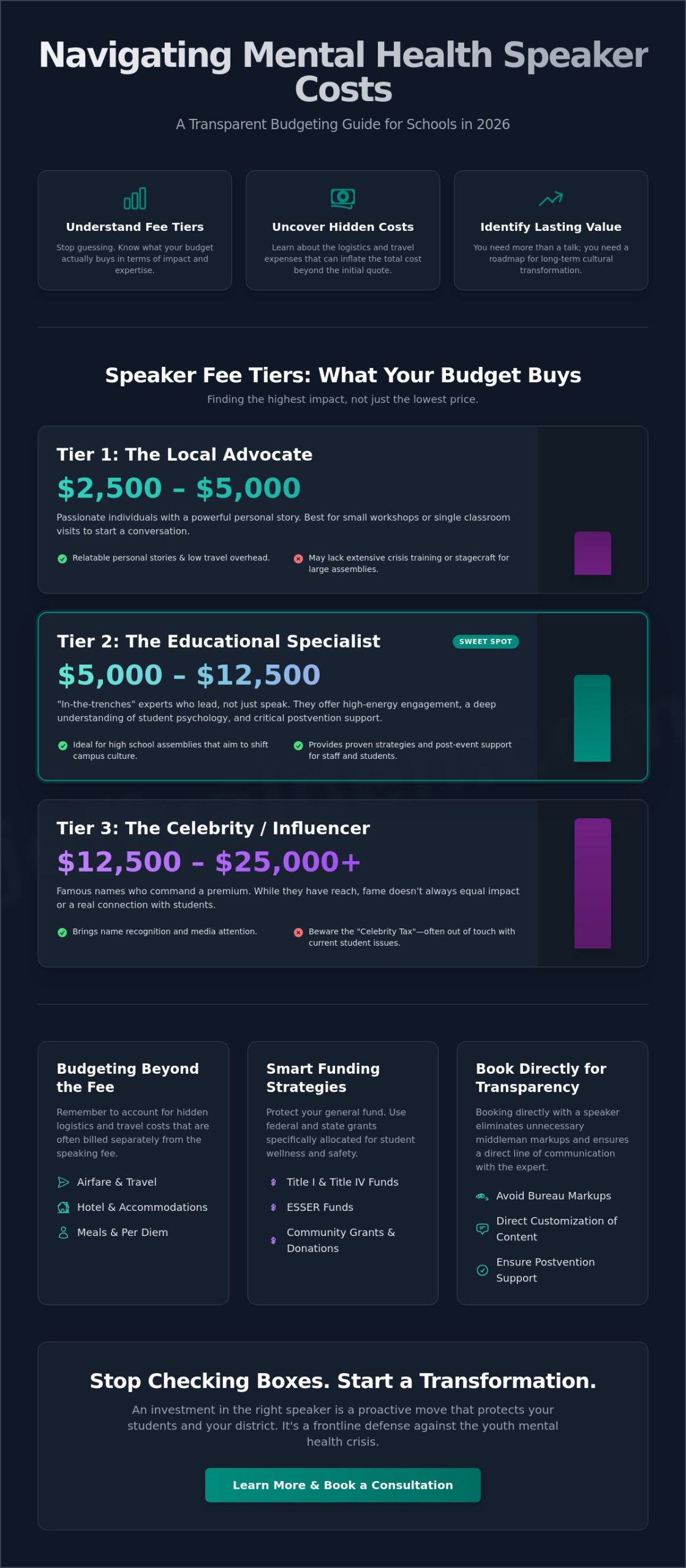
Tier 1: The Local Advocate ($2,500–$5,000)
These are often passionate individuals with a powerful personal story. They live in your community and have low travel overhead. While their stories are relatable, they often lack the extensive crisis intervention training needed for a full-scale student body. Tier 1 is best for small workshops or single-classroom visits where the goal is simply to start a conversation rather than shift an entire culture. The engagement can be hit-or-miss because they may not have the stagecraft to hold a thousand teenagers’ attention for an hour.
Tier 2: The Educational Specialist ($5,000–$12,500)
This is the “sweet spot” for high school assemblies. Speakers in this range are “in-the-trenches” experts. They don’t just speak; they lead. In this tier, you get high-energy engagement, a deep understanding of student psychology, and critical postvention support. This is where I live. It’s about providing a roadmap for students after the assembly ends. You’re paying for a professional who knows how to handle the heavy stuff that comes up when the microphone is turned off. If you want to see how this looks in action, you can explore my work as a teen mental health speaker to understand the depth of connection required.
Tier 3: The Celebrity Name ($15,000–$50,000+)
Tier 3 consists of household names, New York Times bestsellers, and media personalities. They bring a massive “wow” factor that can generate media attention for your district. However, the connection is often different. Many celebrities deliver a “canned” speech that isn’t tailored to your specific crisis. They usually have high riders and limited time for direct student interaction. These speakers are great for massive state-wide conferences, but they often miss the mark on a high school gym floor where vulnerability matters more than fame.
Hidden Costs and Logistics: Budgeting Beyond the Fee
The number on the contract is just the beginning. If you’re only looking at the base rate, you’re missing the full picture. A transparent breakdown of the mental health speaker cost includes the logistical gears that make the event actually work. You don’t want to realize two days before the assembly that you’re on the hook for a last-minute flight or a complex tech rider you didn’t budget for. It’s about being prepared so the focus stays entirely on the students and their needs.
Most professionals operate on one of two financial models. The first is ‘Fee plus Travel.’ You pay the base typical speaking fees and then reimburse for airfare, hotel, and ground transportation. The second is the ‘All-Inclusive’ model. I advocate for this. It’s cleaner. One price covers everything. It removes the stress of tracking receipts and keeps your business office from having a meltdown over fluctuating flight prices or baggage fees.
Travel and Lodging: The Flat Fee vs. Reimbursed Model
If your budget is tight, look for a speaker already in your region to cut down on airfare. But regardless of where they come from, never skimp on the hotel. It’s tempting to book the cheapest motel by the highway to save a few dollars, but you’re paying for a high-energy performance. A speaker who hasn’t slept because of paper-thin walls won’t bring the fire your students need at 8:00 AM. Rest equals performance. If you want them to change lives, they need a quiet place to recharge. This is a vital investment in the final outcome.
Technical Needs: Don’t Let Bad Sound Ruin a Good Message
Sound is the heartbeat of an assembly. If students can’t hear, they won’t care. A high-quality wireless headset is mandatory for any modern presentation. Handheld mics are momentum killers. They tether the speaker and prevent them from using their hands to express the ‘real’ and ‘raw’ emotions that foster connection. Check your gym or auditorium equipment early. Most school sound systems are designed for sports announcements, not for emotional storytelling. If your system is buzzing or cutting out, the message gets lost. Ensuring your space is ready for a professional production is a critical part of the total mental health speaker cost.
Finally, ask what happens after the microphone is turned off. Are you paying for exactly sixty minutes, or does the fee include pre-event consulting and post-event follow-up? A true specialist stays to talk to the students who line up at the edge of the stage. They provide resources for your counselors and teachers. That’s the difference between a ‘gig’ and a mission. You aren’t just buying time; you’re buying a legacy of support that lasts long after the speaker leaves the building.
Funding Strategies: How to Pay for a High-Impact Speaker
I know the feeling of a heavy heart and an empty wallet. You’ve found the right voice to reach your students, but your general fund is tapped out. Don’t let a line item on a budget stop you from saving lives. The mental health speaker cost doesn’t have to be a barrier if you know where the money is hidden. It is time to get aggressive and creative. We are talking about a mission, not just a meeting. You have to hunt for the resources your kids deserve.
Federal funding is often the most overlooked goldmine. You just have to speak the language of the bureaucracy to unlock it. Frame your request as “Mental Health Education” or “Evidence-Based Intervention” instead of just a “motivational talk.” This shift opens the door to Title I and Title IV funds specifically designed for student well-being and safety. These dollars are there for a reason. Use them.
Government Grants and School Board Allocations
Focus your proposal on building resilience in teens and character education goals. This aligns perfectly with state mandates and district-level requirements. In 2026, most districts have specific funds earmarked for suicide prevention that often go unused. ESSER funds also remain a vital tool for addressing the long-term mental health fallout and learning loss students are facing. Don’t let those dollars sit idle in a district account while your students are struggling in silence. Demand that those resources be put to work on your campus floor. To make the strongest case to your school board, it helps to understand the full landscape of mental health interventions in schools and how evidence-based programs align with federal funding requirements.
Corporate and Community Sponsorships
Your local community is waiting for an invitation to be heroes. Reach out to the Rotary Club, Kiwanis, or your local hospital system. These organizations have community outreach budgets that are often looking for high-impact youth initiatives to support. Approach a local business owner and ask them to “sponsor” a life-saving day at your school. In exchange, they get the public recognition of bringing hope to the next generation. You can also partner with your PTO for matching funds. Consider hosting a “Community Night” to expand the reach of the mental health speaker cost to parents and neighbors. It turns a school event into a town-wide movement for wellness.
Give your students skin in the game too. When kids lead the charge to raise money for a mental health event, they become the owners of the message. Whether it’s a wellness walk or a partnership with a local restaurant, student-led fundraising proves that mental health is the top priority for the people who matter most. If you are ready to stop making excuses and start making an impact, you can book me as your high school motivational speaker today and we can figure out the funding path together.
The Jeff Yalden ROI: Why Radical Transparency is Worth Every Penny
When you look at the bottom line, the mental health speaker cost is really about the return on investment for your students’ lives. I don’t hide behind bureaus. I don’t let a middleman inflate my fees by twenty-five percent just to handle a phone call. When you book me, you get me. Direct communication means radical transparency from the first email to the final handshake. It ensures every dollar you spend goes directly toward the impact on your campus, not into a booking agent’s pocket. You’re paying for a direct relationship with a guide who has been in the trenches for over three decades.
Most speakers talk about “wellness” when things are going well. I specialize in what happens when they aren’t. My postvention expertise is a safety net for your administration. If your community has faced a tragedy, you don’t need a generic “feel good” talk. You need someone who has navigated the aftermath of student loss and knows how to lead a community through the dark. That specialized support is what creates the “Yalden Effect.” It’s the moment your campus moves from a “one-off” event to a permanent culture shift. We aren’t just checking a box. We are changing the DNA of your school.
Beyond the Stage: Teacher PD and Community Support
I don’t just show up for the assembly and disappear. I stay. I stay for the kids who line up at the edge of the stage because they finally feel seen. I stay to offer Teacher Professional Development that gives your staff the tools to keep the conversation going long after I’m gone. We maximize the day by involving everyone. When you hire me as your high school speaker, you’re getting a partner who supports your counselors and empowers your teachers. My 30 plus years of experience means I’ve seen it all. I know how to hold the space for your students while providing a professional buffer for your administration.
Booking Your 2026 Assembly: Next Steps
Peak seasons like September and May fill up fast. If you want to secure a date for the 2026 school year, you should be looking to book 6 to 12 months in advance. This gives us time to customize the message and align it with your specific campus goals. Before I arrive, prepare your staff. Tell them this won’t be a clinical lecture. It will be a raw, high-energy conversation that demands vulnerability from everyone in the room. That is where the healing starts. It’s time to stop waiting for a crisis to happen and start building the resilience your students need to survive it.
Book Jeff Yalden for your next high school assembly today.
Invest in Hope: Your Next Step for Student Wellness
Choosing to bring a speaker to your campus is a declaration that your students’ lives matter more than a budget line. You now know that the true mental health speaker cost involves far more than sixty minutes on a stage. It’s about the specialized experience, the postvention support, and the strategic use of federal funds to protect your community. We’ve looked at the fee tiers, the hidden logistics, and the radical truth that a cheap choice is often the most expensive mistake you can make. It’s time to act with urgency before the next crisis hits your hallways.
I bring over 30 years of high school assembly experience to your gym floor. As a specialist in suicide prevention and postvention, I don’t just give a talk; I lead a transformation. By booking me directly, you eliminate middleman bureau fees and ensure every dollar goes toward student impact. Don’t wait for a tragedy to decide that mental health is a priority. Let’s start this journey together right now. Bring Jeff Yalden to your school for a life-changing assembly. You have the power to change the narrative on your campus. Your students are waiting for a voice they can finally trust.
Frequently Asked Questions
How much does a mental health speaker cost for a high school assembly?
Professional rates for a high school assembly depend heavily on the speaker’s level of expertise and their national reputation. While local advocates might charge lower fees, a nationally recognized specialist brings years of crisis training and engagement skills that ensure the message actually hits home. You aren’t just paying for an hour of talking. You are investing in a specialist who knows how to navigate the heavy emotional landscape of a 2026 student body.
Does the speaker fee include travel and hotel?
It depends on whether you choose an all-inclusive model or a fee-plus-expenses arrangement. Many professional speakers prefer an all-inclusive rate because it simplifies your school’s bookkeeping and removes the stress of fluctuating airfare or hotel prices. If travel is not included, you’ll usually be responsible for reimbursing airfare, a quiet hotel room, and ground transportation. Always clarify this before signing the contract so there are no surprises in your final budget.
Can we use Title IV funds to pay for a mental health speaker?
Yes, you can absolutely use Title IV, Part A funds to cover the mental health speaker cost for your school. These federal dollars are earmarked for “Safe and Healthy Students” and are intended to improve school conditions for student learning. By framing the assembly as a mental health education or suicide prevention initiative, you align the program with federal requirements. This is a smart way to protect your general fund while prioritizing vital student support.
What is the difference between a motivational speaker and a mental health speaker?
A motivational speaker usually focuses on high-energy inspiration and achieving personal goals. A mental health speaker goes much deeper into the raw reality of survival, resilience, and emotional struggle. While both bring energy, a mental health specialist is trained to handle topics like trauma, depression, and crisis intervention. They don’t just want students to feel good for an hour. They want to give them the tools to stay alive and find hope when things get dark.
Do mental health speakers provide materials for students after the event?
Most professional speakers provide digital or physical resources to keep the conversation going after the assembly ends. The assembly is the spark, but the resources are the fuel that keeps the fire of wellness burning. This might include digital guides, contact information for school counselors, or specific action plans for resilience. The goal is to ensure that when the lights come up and the gym empties, the students still have a roadmap to follow toward better mental health.
How long is a typical mental health assembly program?
A typical high school assembly program usually lasts between 45 and 60 minutes. This timeframe is designed to maximize student attention while fitting into a standard class period. However, the real work often happens after the formal talk. A dedicated speaker will stay at the edge of the stage to connect with individual students who need a moment of direct, one-on-one validation. The impact extends far beyond the time on the clock.
What happens if a student is in crisis during the assembly?
We establish a clear “Safe Room” protocol with your counseling team before the assembly begins. If a student feels overwhelmed or triggered, they have a pre-arranged way to exit and speak with a professional counselor immediately. It is vital to have your mental health staff present and visible during the program. This ensures that any student in crisis receives immediate support in a safe environment while the rest of the student body remains engaged. Understanding the common misconceptions students carry is just as important as the event itself; exploring mental health awareness for teens and the myths that keep them silent can help your staff prepare for the conversations that follow.
Is it cheaper to book a speaker directly or through a bureau?
Booking directly is the most transparent way to manage your mental health speaker cost. Bureaus often add a significant markup to the speaker’s fee to cover their own overhead and commissions. When you work directly with a speaker, you eliminate those middleman costs and establish a personal connection from the start. This direct line of communication ensures the speaker understands your school’s unique needs without anything getting lost in translation through a third-party agent.
