
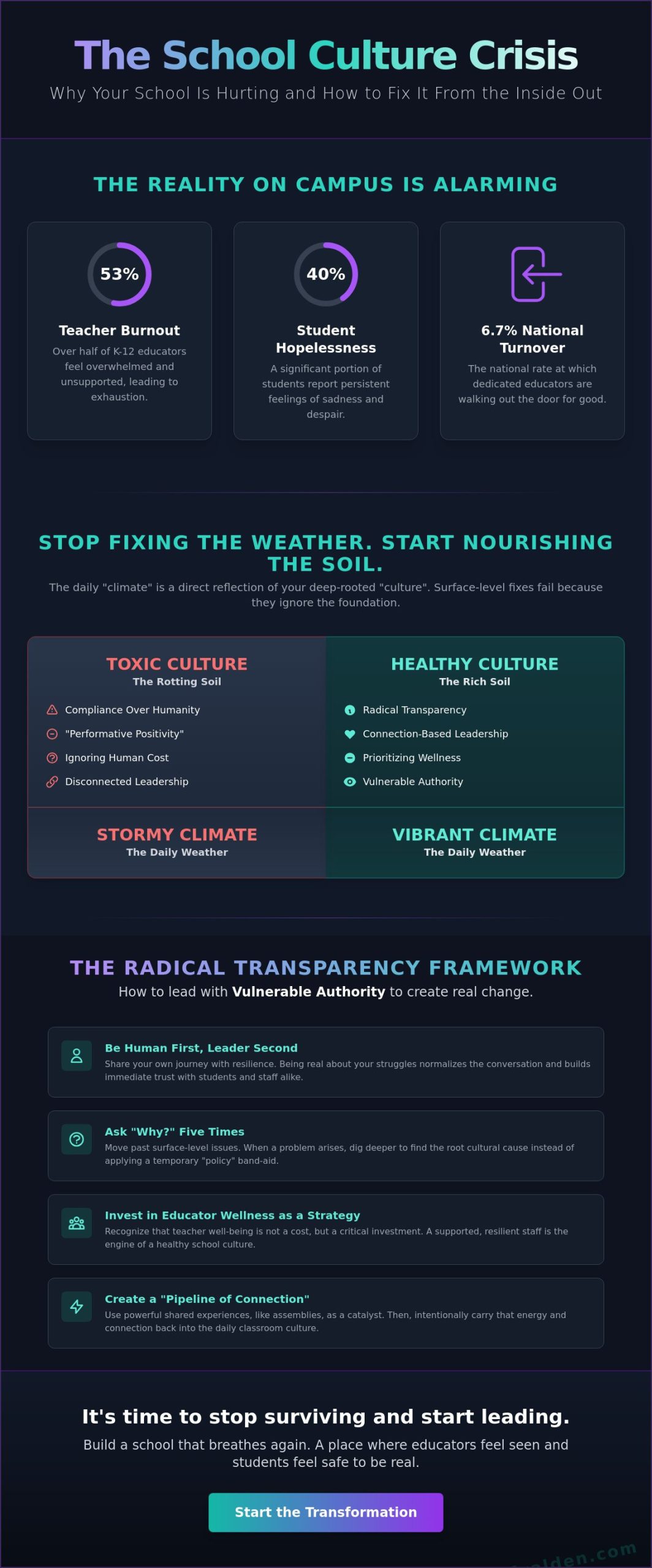
Fifty-three percent of K-12 teachers are burning out. Forty percent of your students feel a persistent sense of hopelessness. If you are tired of watching “culture” posters in your hallway get ignored while your best educators walk out the door, you are not alone. You already know that surface-level programs aren’t enough to stop the 6.7 percent national turnover rate or the rising tide of student crises. It is time to learn how to improve school culture and climate by stopping the checklists and starting a transformation that actually sticks. The old way is broken; the new way is raw, real, and radical.
In this guide, you will discover how to choose radical transparency over corporate-style compliance. I’m showing you how to move past clinical jargon to build a campus where students feel safe to be real and educators finally feel seen. We are diving into a strategy for 2026 that prioritizes resilience and uses tools like teacher professional development and high school assemblies to create a measurable drop in disciplinary issues. It’s time to stop surviving and start leading. Let’s build a school that breathes again.
Key Takeaways
- Stop chasing the daily “weather” of student moods and start nourishing the “soil” of deep-rooted values to create a foundation that lasts.
- Discover why leading with “vulnerable authority” creates a deeper connection with students and staff than detached expertise ever will.
- Follow a five-step framework on how to improve school culture and climate that uses radical transparency to turn burnout into resilience.
- Learn why prioritizing educator wellness through specialized teacher professional development is an investment; not a cost of your time.
- Create a “pipeline” of connection that carries the energy from a shared assembly experience directly back into your daily classroom culture.
Understanding the Difference Between School Culture and Climate
Let’s get real about why your building feels heavy. Most leaders spend their lives trying to fix the “weather” without ever looking at the ground beneath their feet. School climate is the weather. It is the daily mood, the atmosphere in the cafeteria, and the immediate feeling you get when you step onto campus. School culture? That is the soil. It is the deep-rooted values, the shared beliefs, and the unspoken rules that dictate how people treat each other when nobody is watching. If the soil is toxic, the weather will always be a storm.
You can’t fix the clouds if the roots are rotting. In 2026, we are facing a genuine climate crisis. With 40 percent of high school students reporting persistent feelings of sadness and teacher burnout sitting at 53 percent, the disconnect is visceral. We have been trying to paint the sky blue while the ground is on fire. Learning how to improve school culture and climate starts with acknowledging that you cannot “policy” your way out of a broken heart. It requires a gut-level shift in how we show up for our people.
Why Your Current Climate Initiatives Might Be Failing
We have all seen it. The “Be Kind” posters. The mandatory fun pizza parties. The surface-level programs that students roll their eyes at. This is performative positivity. It is a band-aid on a bullet wound. Real connection doesn’t happen on a bulletin board; it happens in the trenches. When initiatives feel like a checklist, they lose their soul. Students and staff can smell a “culture program” from a mile away, and they aren’t buying it.
Culture killers are often hidden in plain sight. They live in administrative structures that prioritize compliance over humanity. When teachers feel like cogs in a machine, they stop leading and start surviving. You can’t ask an educator to pour into a student’s cup when their own well is dry. If your culture is built on “doing more with less” while ignoring the human cost, the climate will always stay cold and distant.
The Heartbeat of a Healthy School
To change the feeling, you have to change the focus. We need to move from compliance-based management to connection-based leadership. This means leading with empathy and establishing a baseline of safety where it’s okay to not be okay. We are building an Empowering School Culture that doesn’t just tolerate diversity but thrives on it. It’s about creating an environment where every person feels they actually belong, rather than just being “included” on a spreadsheet.
This is about radical transparency. It is about showing up as a human first and an administrator second. When you lead with vulnerability, you give your staff permission to do the same. A vibrant school culture is one where every individual feels seen, heard, and valued. It’s not about being perfect. It is about being present. When the soil is rich with trust and support, the weather starts to clear on its own. This is how to improve school culture and climate from the inside out.
The Radical Transparency Framework: Leading with Vulnerability
Radical transparency is the secret weapon for school leaders in 2026. It is not about being “unprofessional.” It is about being human. For decades, we were told that leadership meant having all the answers and keeping a stoic, detached distance. That model is dead. In a world where 40 percent of students feel a persistent sense of hopelessness, they don’t need a distant expert. They need a lived-experience guide. They need vulnerable authority.
Vulnerable authority is more respected than detached expertise because it is rooted in truth. When you are real about your own mental health and your own journey with resilience, you create a ripple effect. You normalize the struggle. You break the silence that keeps staff and students isolated in their own pain. This is how to improve school culture and climate without relying on a handbook. It is about leading from the heart, not just the front office.
How to Practice Radical Transparency Without Losing Control
There is a massive difference between sharing and oversharing. Sharing is intentional. It is about providing a roadmap for others. If you are sharing just to vent, that’s for your therapist. If you are sharing to show how you navigated a dark season, that’s leadership. This approach builds immediate bridges with “at-risk” students who are used to being talked at, rather than talked with. I’ve seen this transformation happen in real time when a teen motivational speaker steps onto a stage and models this exact vulnerability.
You must create a “Safe to Fail” environment. This applies to your teachers just as much as your students. If an educator is afraid to try a new wellness strategy because it might look “imperfect,” your culture will remain stagnant. Encourage your team to be honest about what isn’t working. When you celebrate the courage to be real, you replace fear with connection. That is the foundation of a resilient campus.
Building Trust Through Real Conversations
We have to kill the “I’m fine” culture in the teacher’s lounge. It is a lie that breeds resentment and isolation. Trust is built in the gaps between the meetings. It is built when a leader handles a crisis with raw honesty instead of corporate-speak. When things go wrong, tell the truth. Corporate-speak breeds suspicion; radical honesty builds bridges. People can handle the truth, but they cannot handle being managed.
The “Jeff Yalden Method” is about using staccato, punchy honesty to capture attention. It is about saying the thing that everyone is thinking but nobody is saying. This communication style cuts through the noise of 2026. It moves people because it sounds like a conversation between friends, not a lecture from an authority figure. By practicing this level of transparency, you learn how to improve school culture and climate by simply being the most honest person in the room. Hope starts with the truth.
Administrative Policy vs. Relational Reality: Making Culture Tangible
I hear the objection every single day. “Jeff, we don’t have time for another initiative.” I get it. Your plate isn’t just full; it’s overflowing. But here is the raw truth: culture is not a “program” you add to your schedule. It is the schedule. When you ask how to improve school culture and climate, you aren’t asking for more work. You are asking for a way to stop the bleeding. Culture is an investment, not a cost. Think about the numbers. As of 2025, the cost to replace a single teacher in a large district is approximately $24,930. If you lose five teachers this year because they are burned out and unsupported, you’ve just burned over $120,000. Investing in your people is the only way to save your budget and your sanity.
Start with a Relational Audit. Look at your connection points. How do students feel when they walk through the front door? Do they see administrators who are tethered to their desks, or do they see leaders who are in the hallways, high-fiving and checking in? In 2026, we have to pivot from a mindset of punishment to one of restorative resilience. With 80 percent of schools reporting that student misbehavior has worsened, including a 56 percent increase in classroom disruptions, the old “suspend and forget” model is failing. We need to build systems that repair harm rather than just checking a disciplinary box.
Addressing the Conflict Elephant in the Room
Avoiding conflict destroys culture faster than the conflict itself. When you let tension simmer under the surface, it turns into resentment. Real leaders don’t run from the friction; they lean into it. Transforming tension into trust requires direct, honest mediation where people can be real about their frustrations. We need a postvention mindset in everyday school life. This means we don’t just wait for a crisis to talk about mental health or behavior. We make these conversations part of our daily oxygen. We address the small fires before they become an inferno.
Empowering Student Agency and Voice
Stop settling for “student government” that only plans prom. We need student ownership. This means giving students the “mic” literally and figuratively. When students have a seat at the table, they stop being spectators and start being stakeholders. They become the primary drivers of the climate you are trying to build. One of the fastest ways to ignite this spark is through High School Assemblies: Transforming Campus Culture with Radical Transparency. These events break the ice and give students permission to lead with their hearts. When they see you being real, they will be real too. That is how to improve school culture and climate in a way that actually lasts.
5 Steps to Improving School Climate Through Resilience and Connection
You can’t think your way into a new way of acting. You have to act your way into a new way of thinking. If you want to know how to improve school culture and climate, you need a roadmap that prioritizes people over paperwork. We are moving past the theory and into the dirt. These five steps aren’t suggestions. They are the lifeline your campus needs to survive the current mental health crisis and the staggering teacher burnout rates we are seeing across the country.
- Step 1: Conduct a Reality Check. Use anonymous surveys for staff and students. You need the raw, unfiltered truth about how people feel in your hallways. Don’t defend. Just listen.
- Step 2: Invest in Teacher PD. Stop focusing solely on pedagogy and test scores. Invest in teacher professional development that addresses wellness, emotional intelligence, and self-care.
- Step 3: Launch a Resilience Revolution. Integrate mental health check-ins into the daily rhythm. It shouldn’t be a special event. It should be the oxygen your school breathes.
- Step 4: Create Connection Rituals. Establish consistent moments of shared vulnerability. This could be a weekly “real talk” session or a morning huddle that goes deeper than the announcements.
- Step 5: Bring in an Outside Catalyst. Sometimes your message needs a new voice. A high-impact assembly can shatter the silence and accelerate your culture change by months.
Prioritizing Mental Health as a Cultural Foundation
Suicide prevention is not just a crisis response. It is a culture-building activity. When 60 percent of American youth suffering from major depression receive no treatment, your school becomes the front line. We must implement Teen Suicide Prevention Programs: A Radical Approach to Saving Lives in 2026 to give our students hope. Training your staff to see the warning signs hidden in plain sight is the most important professional development you will ever provide. It is about creating a safety net made of relationships, not just referrals.
Teacher Wellness as the Engine of Culture
You cannot lead a culture you aren’t living. This is the oxygen mask principle. If 53 percent of your teachers are burned out, your climate will always feel exhausted. We have to move beyond the “self-care” talk and into community support. Teacher resilience is the ability to stay present and passionate despite the systemic pressures of modern education. When educators feel supported and seen, they have the capacity to see their students. If you are ready to stop managing checklists and start leading a movement, book a youth motivational speaker to ignite this transformation on your campus today. This is how to improve school culture and climate with heart and soul.
Transforming Your Campus: The Power of a Shared Experience
You can’t survey your way into a heartbeat. While audits and policy shifts are the essential “soil” we discussed earlier, every movement needs a spark. A single high-impact event can accelerate culture change by months because it creates a shared emotional vocabulary. When every student and staff member sits in the same room and hears the same raw truth, the walls of isolation start to crumble. This is how to improve school culture and climate in real time. It is about creating a “before” and “after” moment for your campus.
The magic isn’t just in the hour spent in the gym; it is in the “Assembly-to-Classroom” pipeline. We don’t want a “high” that fades by Tuesday. We want a message that sticks. I show up as a vulnerable authority to break the ice, saying the things your students are desperate to hear but your staff might be too exhausted to say. By being real about my own struggles, I give your educators permission to be human again. This shared experience becomes the foundation for every conversation that follows in the hallways and classrooms.
Normalizing the Conversation
We have to move past the “one-and-done” assembly model. A speech is a catalyst, but a culture is a narrative. To sustain the momentum, you must integrate resilience training into the core of your daily curriculum. It is about taking the energy from that shared moment and turning it into a year-long story of growth. We are Building Resilience in Teens: The Radical Truth About Bouncing Back in 2026 by making mental health a standard part of the school day. When the conversation becomes normal, the stigma dies. That is when you see the measurable drop in crisis incidents you’ve been working for.
Next Steps: Booking Your Catalyst
When you evaluate a school speaker, look for cultural alignment. Do they offer corporate-speak, or do they offer radical transparency? Your students will roll their eyes at a polished performance, but they will lean in for a raw story. Prepare your staff for a “real and raw” experience that might feel uncomfortable at first. That discomfort is where the growth happens. If you are ready to stop managing the decline and start leading a transformation, bring Jeff Yalden to your school to jumpstart your culture shift today. This is the final, bold step in how to improve school culture and climate. It’s time to give your school its heartbeat back. Let’s get to work.
Lead the Revolution for Your Campus
You’ve seen the data. You’ve felt the weight in your hallways. Now, it is time to choose. You can keep managing the decline, or you can start nourishing the soil of your school’s soul. We have moved past the clinical jargon to uncover the raw truth about how to improve school culture and climate. It starts with radical transparency and ends with a community where every student and educator feels seen. Remember, you aren’t just building a school; you’re building a lifeline.
I’ve spent over 30 years on the front lines of youth mental health. I’m a specialist in crisis postvention and resilience building, trusted by thousands of schools worldwide to break the silence. Whether it’s through a high-impact assembly or deep-dive teacher professional development, I’m here to help you ignite that spark. Don’t wait for another crisis to find your heartbeat. Book Jeff Yalden for a High School Assembly or Teacher PD Workshop and let’s start this transformation together. You have the power to change the narrative. I’ll see you on the front lines.
Frequently Asked Questions
What is the fastest way to improve school culture?
The fastest way to shift your culture is to stop pretending everything is fine. You have to lead with radical transparency and own the struggles your building is facing. When you show up as a human instead of a title, you give everyone else permission to do the same. This vulnerability creates an immediate connection that no policy or poster can replicate. It’s about being real in the hallways and honest in the meetings.
How do you measure school climate effectively in 2026?
Effective measurement requires looking past attendance rates and test scores to find the raw truth. Conduct anonymous reality checks with staff and students to gauge the actual emotional temperature of the building. You need to know if people feel safe to be real or if they are just surviving. Use this data to understand how to improve school culture and climate by addressing the specific pain points your community identifies rather than guessing from the front office.
Can a single school assembly really change campus culture?
A single assembly is a catalyst, not a magic wand. It provides a shared experience that shatters the silence and gives everyone a common language for their struggles. While one event won’t fix everything, it can accelerate your progress by months by breaking the ice for deeper conversations. The real change happens when you use that high-impact spark to fuel your daily classroom connections and ongoing resilience work.
How do I get buy-in from burned-out teachers for culture initiatives?
Stop asking burned-out teachers for “more” and start showing them you care about their wellness. Buy-in happens when educators feel seen and supported rather than managed. Focus your teacher professional development on emotional resilience and self-care instead of just new grading rubrics. When teachers see that your culture work is designed to help them breathe again, they will become your strongest advocates for change.
What is the difference between school culture and school climate?
Climate is the daily “weather” or the immediate mood you feel when you walk through the doors. Culture is the “soil” or the deep-rooted values and beliefs that sustain the building. You can’t fix a stormy climate if the cultural soil is toxic. Understanding this distinction is vital for anyone learning how to improve school culture and climate because it helps you focus on long-term health rather than just temporary fixes.
How does mental health education impact school climate?
Mental health education creates a cultural foundation of safety and belonging. When you normalize conversations about struggle and hope, you reduce the stigma that keeps students and staff isolated. This education isn’t just about crisis response; it’s about building a resilient community where everyone knows they aren’t alone. It transforms the atmosphere from one of quiet desperation to one of active, collective support.
What are the common mistakes leaders make when trying to fix school culture?
The biggest mistake is choosing performative positivity over real connection. Leaders often fall into the trap of checklist management, thinking that a few posters or a pizza party will solve deep emotional issues. Another massive error is avoiding conflict. When you let tension simmer to keep the peace, you actually destroy trust. Real culture work requires leaning into the friction and having the hard, honest conversations that lead to growth.
Is restorative justice better than traditional discipline for school climate?
Restorative justice is about repairing harm and building resilience rather than just checking a disciplinary box. While traditional discipline often isolates students, restorative practices keep them connected to the community while holding them accountable. This approach reduces disruptions because it addresses the “why” behind the behavior. It creates a climate where students learn from their mistakes and staff feel empowered to lead with empathy instead of just authority.
