
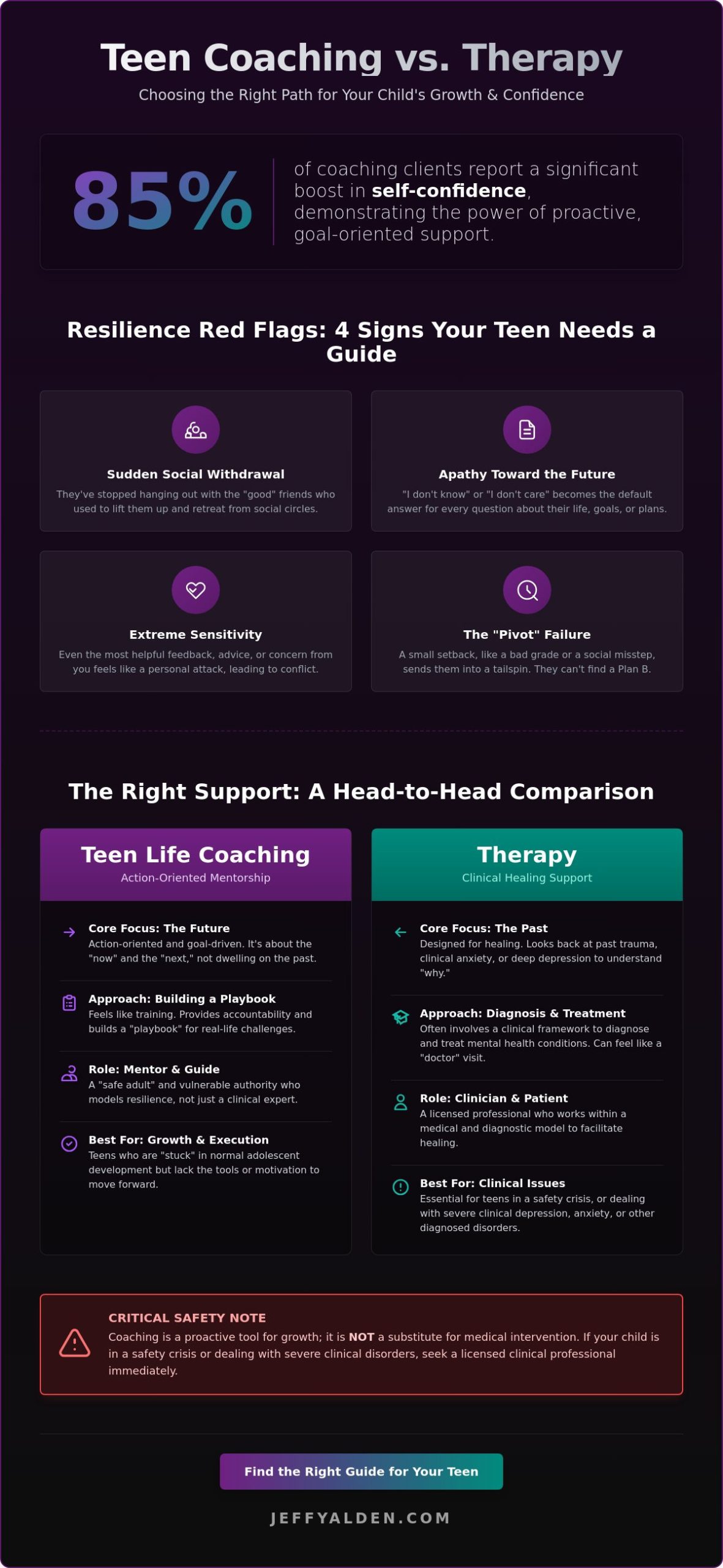
What if the silence at your dinner table isn’t about rebellion, but a desperate need for a different kind of guide? You’re tired of the slammed doors. You’re over the heavy feeling that your child is slipping into a world you can’t reach. It’s exhausting. You want your kid back. You want to see them confident again. Since 85% of coaching clients report a boost in self-confidence, the right support is the turning point your family needs. This guide shows you exactly how to find a life coach for my teenager who doesn’t just sit in a clinical chair but actually builds a bridge to your child’s heart. We’re going to cut through the noise. We’ll find a mentor who connects through radical transparency. I’ll show you the vital differences between coaching and therapy, what the unregulated 2026 coaching landscape means for your search, and how to choose a safe adult who helps restore your relationship. Peace of mind is possible. It starts with finding the right person to stand in the gap with you.
Key Takeaways
- Stop guessing if it’s just a phase. Learn to spot the real signals that your teen is losing their way and needs a mentor who speaks their language.
- Understand exactly how to find a life coach for my teenager who prioritizes forward-moving goals and action over clinical labels or past trauma.
- Discover why radical transparency and lived experience are the secret weapons that turn a “clinical expert” into a safe, trusted adult your teen will actually listen to.
- Get the exact interview script to use with potential coaches so you can filter out the noise and find a guide who won’t back down when your teen pushes back.
- Rebuild your relationship and your child’s confidence by choosing a “vulnerable authority” who models resilience instead of just talking about it.
Recognizing the Signs: When Your Teen Needs a Guide, Not Just a Parent
The silence is deafening. You see them sitting there, glowing in the blue light of their phone, but they’re miles away. You try to help. You give the best advice you’ve got. You pour your heart out. They shut down. This is the “Parent-Teen Wall.” It’s one of the most painful experiences a mother or father can endure. It’s not that your advice is bad; it’s that you’re the parent. Sometimes, the person they love the most is the last person they can actually hear. This isn’t just typical moodiness. It’s a genuine loss of direction.
When your teen starts “quiet quitting” school, sports, or long-term friendships, they are sending a signal. They don’t have the words to say, “I’m lost and I’m scared.” Instead, they just stop showing up emotionally. If you are currently searching for how to find a life coach for my teenager, you’ve already felt the shift. You know deep down that the dynamic at home has become a cycle of conflict and exhaustion. You’re looking for a “safe adult” who can say exactly what you’ve been saying, but in a way that finally lands.
The Motivation Gap in 2026
Our kids are living in a digital pressure cooker that didn’t exist twenty years ago. In 2026, social media isn’t just an app; it’s their entire social reality. It creates a brutal “paralysis of choice.” They see a thousand perfect lives and feel equipped for none of them. This digital saturation kills the drive to try because the fear of public failure is too high. Traditional “tough love” often backfires now. It adds more pressure to an already boiling pot. They don’t need a drill sergeant. They need a guide who understands the heavy weight of their world.
The Resilience Red Flags
Look at how they handle failure. If a small setback, like a bad grade or a missed text, sends them into a tailspin for days, their internal “bounce back” is broken. They haven’t learned the mechanics of recovery. Researching what life coaching is helps you see the difference between clinical support and proactive growth. While therapy might look at the “why” of the past, coaching focuses on the “how” of the future. It’s about building resilience in teens so they can face a “no” without crumbling.
Watch for these specific indicators that it’s time for outside support:
- Sudden social withdrawal: They’ve stopped hanging out with the “good” friends who used to lift them up.
- Apathy toward the future: “I don’t care” becomes their default answer for every question about their life.
- Extreme sensitivity: Even the most helpful feedback from you feels like a personal attack.
- The “Pivot” failure: They can’t adjust or find a Plan B when things don’t go their way.
You aren’t failing as a parent. You’re just hitting a biological wall that has existed for generations. Finding a youth life coach isn’t an admission of defeat. It’s a strategic move to give your child the best chance at becoming a victor in their own story.
Life Coaching vs. Therapy: Choosing the Right Support for Your Child
Stop overthinking the labels. You’re likely searching for how to find a life coach for my teenager because you want results, not just a diagnosis. Here is the raw truth. Therapy is for healing. It’s about looking back at trauma, clinical anxiety, or deep depression. Coaching is for winning. It’s about the “now” and the “next.” It’s action-oriented. It’s goal-driven. It’s about building a playbook for a kid who is stuck in the mud. If your teen is struggling with normal adolescent development but lacks the tools to execute on their goals, they don’t need a doctor. They need a mentor. If you’ve already tried the clinical route without success, understanding why a life coach for troubled teens delivers real change when therapy fails can help you make a more informed decision for your family.
The “sweet spot” is a coach who understands the mental health landscape but refuses to treat your child like a patient. This hybrid approach is powerful. It acknowledges the struggle without staying stuck in it. However, you must know when to pivot. If your child is in a safety crisis or dealing with severe clinical disorders, stop looking for a coach and call a clinical professional immediately. Coaching is a proactive tool for growth; it is not a replacement for medical intervention.
The Action-Oriented Nature of Coaching
Teens usually hate the “doctor” vibe. They don’t want to sit on a couch and be analyzed. They want to be heard. Coaching feels like training for a big game. It provides accountability. It builds a “playbook” for real-life scenarios like social pressure or academic stress. A great teen life coach acts as a bridge. They normalize mental health conversations by making them part of a high-performance lifestyle rather than a clinical problem to be fixed. It’s about moving from a victim mentality to a victor mentality.
Integrating with School Support
School counselors are heroes, but they’re drowning. They have hundreds of students and limited time. A private coach fills the gap that school systems leave behind. This work often starts with the energy found in high school assemblies, where the message of resilience is first planted. While an assembly can spark a change, individual coaching fans that spark into a flame. It’s a proactive measure. You’re giving them the skills to handle life before the slump becomes a full-blown crisis. It’s about being prepared, not just being reactive. If you’re an educator or administrator looking to bring that spark to your campus, learning how to book a school speaker who drives real cultural change is the essential first step.
You aren’t just looking for a service. You’re looking for a connection. When you understand how to find a life coach for my teenager, you’re looking for someone who can stand in the gap where you, as a parent, are currently blocked. It’s about finding that one voice they will actually listen to.
The 4 Pillars of an Effective Teen Life Coach
Teens have a built-in “fake” detector. It is sharp. It is brutal. If you want to know how to find a life coach for my teenager who actually moves the needle, you have to look past the fancy certifications. You need someone who stands on these four pillars. Most coaches promise to be “judgment-free.” That is a baseline. It is not a transformation strategy. Real change happens when a coach has the scars to prove they have been in the arena. They need a story that earns them the right to be heard.
When you are vetting a potential guide, look for these four essentials:
- Lived Experience: They aren’t just reciting a textbook. They have survived the struggle and come out the other side as a victor.
- Radical Transparency: They are willing to be raw about their own imperfections. This breaks down the wall of shame your teen is currently hiding behind.
- Crisis Competency: They understand the gravity of teen suicide prevention and know exactly when to pivot to clinical help.
- Youth-Centric Communication: They speak “teen” without being cringey. It is about emotional resonance, not using the latest slang to fit in.
Vulnerable Authority: The Secret Ingredient
Teens reject perfection. It feels like a lie to them because their own lives feel so messy. They gravitate toward “vulnerable authority.” This is the secret. A coach who shares their own failures gives your teen permission to be honest about theirs. It creates an immediate connection. You aren’t looking for a “friend” who just agrees with everything your child says. You are looking for a mentor-guide who leads by example. They show your teen that it’s okay to be a work in progress as long as you’re moving forward.
The Importance of Crisis Training
Safety is the foundation of every session. Every coach must be trained in suicide prevention and crisis intervention. They need to understand “Postvention” and recognize the subtle signs of self-harm before they escalate. This is why how to find a life coach for my teenager requires checking for a referral network. A great coach knows their limits. They should have a list of clinical professionals ready if your teen’s needs go beyond the scope of coaching. You are hiring a guide, but you’re also hiring a safety net. This proactive approach saves lives.
Your teen doesn’t need another person telling them what to do. They need someone showing them how to be. When these four pillars are in place, the “Parent-Teen Wall” starts to crumble. The focus shifts from surviving the week to building a life of resilience.
The Interview: Critical Questions to Ask a Potential Youth Coach
You aren’t hiring a resume. You’re hiring a relationship. Knowing how to find a life coach for my teenager means knowing how to interview for the heart, not just the head. Paper credentials don’t keep a kid from giving up on a Tuesday night. A real connection does. You need a coach who can walk into the fire with your teen and stay there until the smoke clears. If they can’t handle a tough question from you, they definitely can’t handle a defiant teenager.
Ask these five critical questions to see if they are the real deal:
- What is your personal story of resilience, and do you share it with the kids? If they won’t be vulnerable with you, they won’t be vulnerable with your teen. A “victor” always has a story.
- How do you handle a teen who is completely resistant to the first session? A great coach doesn’t take “no” for an answer. They find a back door to rapport.
- What is your protocol if you suspect my child is in a mental health crisis? You need a professional who knows the exact line between coaching and clinical needs. Safety is non-negotiable.
- Can you give me a specific example of a breakthrough you had with a struggling student? Look for stories of transformation, not just a list of topics they talked about.
- How do you involve parents without breaking the teen’s trust? This is the tightrope. They must be an ally to the whole family while keeping the teen’s “safe space” sacred.
Vetting for “Realness” Over Resumes
A Master’s degree is fine, but can they connect in the first five minutes? If your teen doesn’t feel “seen” immediately, the work is already over. Look for a coach who has experience with high-stakes youth engagement. Someone who has mastered how to book a school speaker for maximum student impact knows how to capture the attention of a skeptical kid. Watch out for red flags. If a coach promises “magic” or “instant fixes,” they don’t understand the process. Real change is a grind. It takes heart and it takes time.
Establishing the Coaching Contract
Boundaries are the foundation of trust. Your teen needs to know that their sessions aren’t a reporting session for the parents. However, you need to see progress. Set clear, measurable goals for the first 90 days. Maybe it’s a decrease in household conflict or an increase in self-initiated schoolwork. Determine the frequency of your sessions early. While virtual coaching is convenient for many in 2026, some teens need the physical presence of a mentor to stay grounded and focused on the work at hand.
If you’re ready to see a real shift in your child’s perspective, it’s time to bring in a teen motivational speaker and coach who leads with radical transparency.
Why Radical Transparency is the Key to Reaching Today’s Youth
Clinical talk fails because it feels sterile. It feels like a lecture. Teens in 2026 don’t want a “professional” who hides behind a desk and a degree. They want the truth. They want someone who can look them in the eye and say, “I’ve been in that dark room too, and here is how I found the door.” This is the Jeff Yalden approach. It is about being a vulnerable authority. It is about showing them that their struggle doesn’t define them. It is just a chapter. It is not the whole book. When you lead with radical transparency, the walls of shame and silence finally start to crumble.
We are moving the narrative from “struggling” to “victor.” This shift changes everything. When you are figuring out how to find a life coach for my teenager, you’re looking for someone who can spark that internal fire. A coach who has stood on stage for school assemblies has a unique edge. They’ve seen the collective pain of thousands of students. They know the patterns of modern anxiety. They know how to pierce through the armor of the most skeptical kid in the room because they’ve done it a thousand times before. That experience translates directly into one-on-one breakthroughs.
The “Real” Factor
Jeff’s no-nonsense style resonates because it’s grounded in reality. There is no magic here. There are no instant fixes. Some competitors claim their coaching works “like magic,” but that is a disservice to your family. Real change is a grind. It is about hard work and radical truth. A coach who has lived through the same darkness your teen is facing has the credibility that a textbook simply cannot provide. This isn’t just about surviving high school. It is about transitioning into long-term life leadership. It is about teaching them to lead themselves when you aren’t there to catch them.
Taking the First Step
How you present this to your child matters. Don’t frame it as an intervention. Don’t make it a punishment for bad grades or poor choices. Frame it as an investment in their future. Tell them, “I found someone who has been where you are and knows how to get to the next level.” This takes the pressure off. Prepare them for the first session by encouraging an open mind. This is about their growth, not your control. It is about giving them a safe space to be raw without the fear of hurting their parents’ feelings.
You’ve felt the distance long enough. You’ve lived in the house of conflict for too many months. It’s time to bridge the gap. Book a consultation with Jeff Yalden to see the power of radical transparency firsthand. Let’s stop the cycle of “quiet quitting” and start building the resilience your teen deserves. It starts with one honest conversation. Let’s get to work.
Take the Lead in Your Teen’s Transformation
You’ve lived in the silence long enough. You now have the blueprint to move from constant conflict to a restored relationship. Remember, coaching isn’t about fixing what’s broken; it’s about unlocking the potential that’s already there. You’ve learned to look for “vulnerable authority” and why radical transparency is the only way to reach a kid who has checked out. Figuring out how to find a life coach for my teenager is the first step toward reclaiming your family’s peace. You need someone who has been in the trenches and knows the way out.
Jeff Yalden brings over 30 years of experience as a youth motivational speaker to every interaction. As an expert in suicide prevention and crisis intervention, he provides the safety and stability your family needs during difficult transitions. Voted the #1 Youth Motivational Speaker in North America, Jeff doesn’t just talk; he connects. Book Jeff Yalden for Teen Life Coaching or a School Assembly right now. Your teen is waiting for a victor to show them the way. Let’s start the work today. Hope is closer than you think.
Frequently Asked Questions
Is a life coach different from a mentor for my teenager?
A life coach is a structured guide who focuses on measurable growth and accountability; a mentor is typically a less formal role model. While a mentor offers wisdom, a coach builds a specific playbook for your child’s success. This is about moving from “talking” to “doing.” It’s the difference between a friendly neighbor and a high-performance trainer who demands results.
How much does a teen life coach typically cost in 2026?
Fees for teen life coaching in 2026 vary widely based on the coach’s experience and whether the sessions are virtual or in-person. Some professionals offer monthly packages that include check-ins between sessions, while others charge per meeting. You should always ask for a clear breakdown of costs during your initial inquiry to ensure the investment fits your family’s budget.
What if my teenager refuses to talk to a life coach?
Resistance is normal, but it usually fades when they realize the coach isn’t another “doctor” trying to fix them. Most teens refuse because they expect a lecture. When they meet a coach who uses radical transparency, the wall drops. Focus on how to find a life coach for my teenager who prioritizes rapport over rules in that first high-stakes meeting.
Can a life coach help with a teen who is having suicidal thoughts?
No, a life coach is not a substitute for clinical mental health treatment if your child is in an active crisis. If your teen is expressing suicidal thoughts, you must contact a licensed therapist or a crisis hotline immediately. A life coach can be a powerful part of a support team later, but clinical safety always comes first.
How long does teen life coaching usually take to see results?
Many families begin to see a shift in attitude within the first 90 days, but lasting resilience often takes longer. Industry data from the ICF indicates that 89% of coaching clients report improved life satisfaction after six months of consistent work. It is a marathon, not a sprint. Real transformation requires time to break old habits and build new ones.
Does insurance cover teen life coaching services?
Insurance providers typically do not cover life coaching because it is currently an unregulated profession in the United States. Unlike clinical therapy, coaching focuses on goal-setting rather than treating a medical diagnosis. You should check with your specific provider, but most parents pay for these services out-of-pocket as an intentional investment in their child’s leadership skills.
What is the best age to start life coaching for a teenager?
The best age to start is usually between 12 and 18, during the critical transition from middle school to high school. This is when the “paralysis of choice” and social pressure are at their peak. Starting early helps build a foundation of resilience before the high-stakes challenges of late adolescence and college applications take over their lives.
How do I know if the coach and my teen are a “good fit”?
You will know it’s a good fit if your teen actually wants to go back for a second session. Trust your child’s “fake detector.” If the coach is a “vulnerable authority” who speaks with honesty, your teen will feel respected. When you are researching how to find a life coach for my teenager, look for that immediate spark of connection and mutual trust.
