
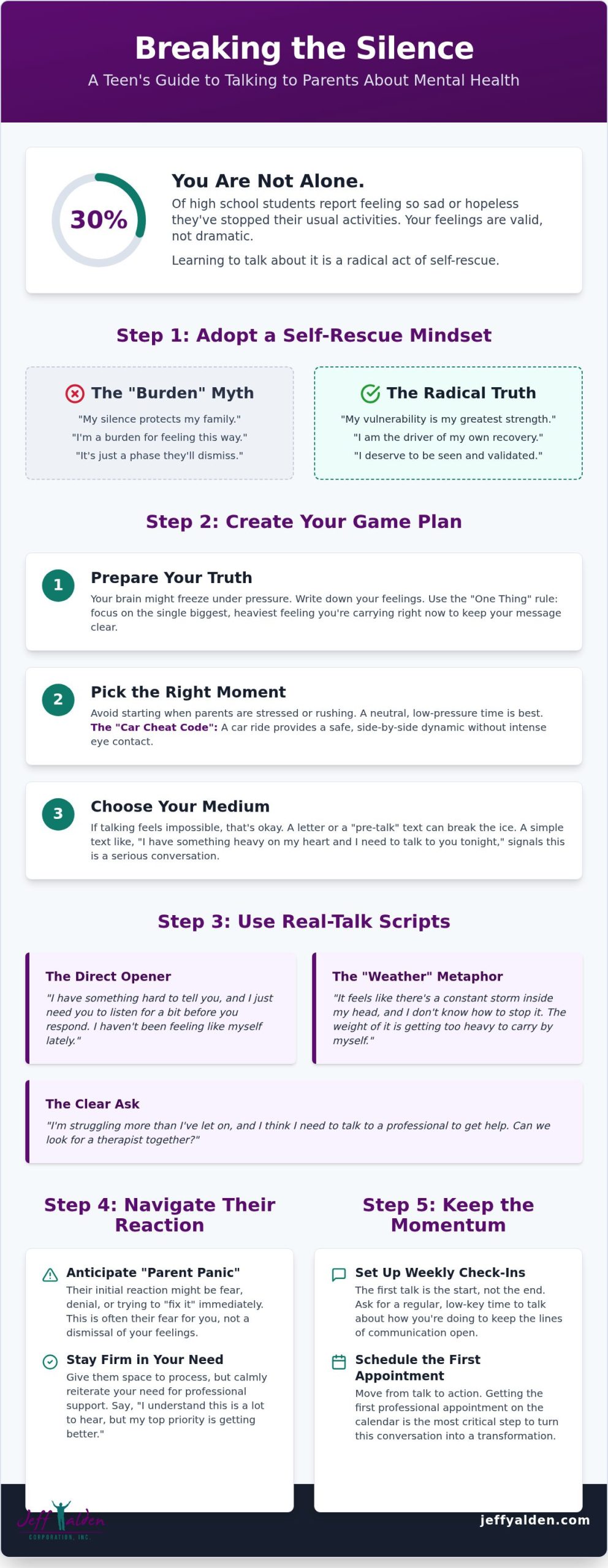
Keeping your internal pain a secret isn’t protecting your family. It is actually suffocating the person they love most: you. Right now, 30% of high school students report feeling so sad or hopeless that they have stopped their usual activities. If that is you, please know you are not being dramatic. You are not a burden. I have spent 30 years in high school gyms seeing this exact struggle. I know the fear of judgment is paralyzing. You want to speak up, but you just don’t have the words yet. Learning how to talk to parents about mental health is the most radical act of self-rescue you will ever perform.
I get it. You are scared they will freak out or dismiss your feelings as a phase. But you deserve to be seen and validated. In this guide, I am going to teach you exactly how to break the silence, prepare your truth, and have this life-changing conversation with confidence. We are going to walk through how to prepare your heart, choose the right moment, and navigate their reactions so you can finally get professional help. It is time to drop the weight of the secret and start your journey toward healing.
Key Takeaways
- Stop waiting for permission to feel better. Shift your mindset from being a victim of your circumstances to becoming a radical advocate for your own life.
- Your brain might freeze when the pressure is high. Use a written list and a neutral location to stay focused and clear when it matters most.
- Master how to talk to parents about mental health using direct openers and “internal weather” metaphors that make your pain impossible to ignore.
- Anticipate the “Parent Panic” without letting it shut you down. Learn how to give them space to process while staying firm in your need for professional support.
- Move beyond the first talk by setting up weekly check-ins and scheduling your first appointment to keep the momentum alive.
The Radical Truth: Why Talking to Your Parents is Your Greatest Move
Let’s be real. The thought of opening up to your parents feels like a gut-punch. Your stomach knots up. Your brain starts screaming a thousand reasons to stay quiet. You think you are protecting them, but you are actually drowning in a secret you were never meant to carry alone. If you are wondering how to talk to parents about mental health, start by realizing that your silence is more dangerous than their reaction. Silence isn’t a shield; it is a weight that gets heavier every single day you try to pretend you are fine.
Shifting your perspective is the only way forward. You aren’t “confessing” a crime or asking for permission to feel. You are stepping into a self-rescue mindset. When you learn how to talk to parents about mental health, you transition from being a passenger in your pain to being the driver of your recovery. Mental health is a human reality, not a mark of weakness. It is time to stop surviving and start advocating for the support you deserve.
Breaking the ‘Burden’ Myth
You think you are a burden. You aren’t. Your parents would rather walk through the fire with you now than face the devastating reality of losing you later. Most parents are actually desperate for a sign that something is wrong so they can finally help. Mental health is a physiological health issue, not a character flaw or a personality choice. Sometimes, the path to healing involves understanding family therapy and how your transparency can actually strengthen the entire household bond. Your truth isn’t going to break the family; it is going to give the family a chance to heal together.
Identifying the ‘Why’ Behind Your Fear
Why are you really afraid? Is it the fear of being called dramatic? The fear of losing your phone or being grounded? Or is it the fear of being misunderstood? You need to separate the fear from the reality. Your fear is a feeling, not a fact. It is a protective mechanism that has outlived its usefulness. As a youth life coach who has spent 30 years in high school gyms, I have seen that transparency is the ultimate weapon against these shadows. Jeff’s Take: Vulnerability isn’t a liability; it is the ultimate strength that forces the world to see you as you truly are.
The Pre-Talk Game Plan: Preparing Your Radical Truth
You have the mindset. Now you need a strategy. This isn’t a casual chat about the weather. It is a mission. Your brain is going to try to sabotage you with an adrenaline dump the second you open your mouth. It freezes. It stutters. It forgets why you even started. This is why you must write it down. A physical list or a note on your phone acts as your anchor when the room starts to spin. Use the “One Thing” rule to keep it manageable. Don’t try to explain every bad day you have had since middle school. Just focus on the biggest, heaviest feeling you are carrying right now. Mastering how to talk to parents about mental health starts with simplifying the message so they can actually hear it.
Battlegrounds matter. Do not start this conversation when your parents are rushing out the door or stressing over bills. Avoid the “rush hour” of family life. Instead, pick a neutral, low-pressure spot. The car is the ultimate cheat code. It forces a side-by-side dynamic where you don’t have to maintain intense eye contact. It feels safer because the movement of the car provides a natural rhythm to the silence. Choosing the right time and place shows you are serious about being heard.
Choosing Your Medium
Sometimes, the tongue just won’t move. That is okay. A letter is a powerful way to initiate radical transparency without the immediate fear of being interrupted. You can also send a “pre-talk” text. Just a simple: “I have something heavy on my heart and I need to talk to you tonight.” It signals that this isn’t a casual request. The Child Mind Institute offers great advice on how to talk to your parents by using these different channels to lower the barrier of entry. If you feel stuck on how to start, a youth life coach can help you find the right words to bridge the gap.
Setting the Stage for Success
Kill the distractions before you say a word. Turn off the TV. Put the phones in another room. You need their full presence, and they need yours. Open with a clear boundary: “I have something hard to tell you, and I just need you to listen before you respond.” This protects you from their immediate “fix-it” mode or accidental panic. When you are learning how to talk to parents about mental health, managing your own expectations is vital. This first talk is the start of a journey, not a one-and-done event. It is the first brick in the bridge to your new life.
Real-Talk Scripts: What to Say When You Don’t Have the Words
Stop searching for the “perfect” words. They don’t exist. The most effective script is the one that is raw, honest, and unfiltered. Your parents aren’t looking for a polished presentation. They are looking for you. When you are figuring out how to talk to parents about mental health, the goal is clarity, not perfection. You need to cut through the noise and get to the truth of your experience.
Step 1: The Direct Opener. Break the ice with a hammer. Say, “I’m not okay, and I don’t want to hide it anymore.” This kills the pretense immediately. It signals that the time for “fine” is over.
Step 2: Describe the “Internal Weather.” If “depressed” or “anxious” feels too clinical or hard to say, use a metaphor. Tell them it feels like you are carrying a heavy backpack full of rocks that you can’t take off. Tell them it is like a thick fog has settled over everything you used to love. These images help them feel what you are feeling instead of just hearing a diagnosis.
Step 3: The Call to Action. Be specific about what you need. Say, “I think I need to talk to a professional or a doctor.” This moves the conversation from a venting session to a concrete solution. It shows you are ready to do the work to get better.
Step 4: Set Boundaries. Protect your peace. Say, “I don’t need you to fix it right now; I just need you to know.” This takes the pressure off them to be “experts” and allows them to just be your parents. It creates a safe space for everyone to breathe.
If You’re Struggling with Anxiety or Depression
Depression is a thief. It steals your energy and your interest in life. If you are struggling, try this: “I feel like I’m drowning even when everything looks fine on the outside.” Or, “I’ve lost interest in the things I used to love, and it scares me.” Use “I” statements. This isn’t about what they did wrong as parents. It is about what is happening inside your mind. Expert resources like How to Talk to Your Parents About Getting Help can give you even more confidence to bridge this gap and advocate for your needs.
If You’re Thinking About Self-Harm or Suicide
This is the moment for radical, life-saving honesty. If you are in a dark place, use the Emergency Script: “I don’t feel safe with myself right now.” Do not sugarcoat this. Your life is the most valuable thing in the room. When you understand how to talk to parents about mental health during a crisis, you realize that being “dramatic” is actually being brave. If things feel too heavy to handle alone, looking into Teen Suicide Prevention Programs: A Radical Approach to Saving Lives in 2026 can provide the structure and support you need to get through the night. Radical honesty is your only path out of the darkness.
When They Don’t Get It: Building Resilience Against a Bad Reaction
You did it. You spoke your truth. But instead of the hug or the validation you expected, you hit a wall. Maybe they got angry. Maybe they dismissed you or went completely silent. This is “Parent Panic.” It is a raw, emotional reflex. They feel like they failed as parents, so they get defensive to protect themselves from that guilt. Understanding how to talk to parents about mental health means preparing for the possibility that they won’t get it right at first. Their reaction is about their own fear, not the validity of your pain.
Use the “Cool Down” period. Give them 24 hours to process what you said. Don’t push. Don’t scream. Let the information settle in their minds. Often, the second conversation is where the real breakthrough happens. If you feel more alone than before, double down on self-care immediately. Listen to your favorite music, go for a run, or talk to a friend who gets it. Your truth is still true, even if they aren’t ready to hold it yet. You have done the hardest part by breaking the silence.
Dealing with Denial (‘It’s Just a Phase’)
Denial is a survival tactic for parents who aren’t ready to face a difficult reality. When they say “It’s just a phase,” respond firmly: “It might be a phase, but I’m hurting right now and need help navigating it.” This keeps the focus on your current need for support rather than a long-term diagnosis. If they still won’t budge, bring in a neutral third party like a school counselor to act as a bridge. As a Teen Mental Health Speaker: Breaking the Silence and Building Resilience in 2026, I know that sometimes it takes an outside expert to make parents realize the urgency of the situation.
Expanding Your Village
One conversation does not define your future. If your parents aren’t stepping up, you must expand your village. Reach out to a teacher, a coach, or a mentor who sees your struggle. Finding a life coach for teens can provide you with a dedicated advocate who knows how to talk to parents about mental health in a way that gets results. For immediate support, the 988 Suicide and Crisis Lifeline is available 24/7 as a safety net. You are not a burden, and you are never truly alone. If you need someone to stand in your corner and help your parents understand your truth, connect with a Youth Life Coach who can guide you through the next steps.
The Next Steps: From Conversation to Transformation
The conversation was the catalyst. Now comes the transformation. You cannot just have one talk and expect everything to change overnight. Momentum is your best friend right now. Within 48 hours of your talk, you need to schedule that first appointment. Whether it is a doctor’s visit or a session with a counselor, get it on the calendar. This proves to yourself and your parents that you are serious about getting well. Knowing how to talk to parents about mental health is just the beginning. The real work happens in the follow-through.
Implement a “Check-In” system. Set a specific time every week, maybe Sunday night, to update your parents on your “internal weather.” It doesn’t have to be a deep dive. Just a quick temperature check. This keeps the lines of communication open and prevents the secret from creeping back in. If you want to make these moments feel more engaging and less like an interview, click here to find conversation games that help families connect. Pair this with a resilience routine. Prioritize eight hours of sleep. Move your body for thirty minutes. Practice mindset work. These are the bricks you use to build a foundation that can actually hold your weight. When you master how to talk to parents about mental health, you realize that consistency is what builds trust over time.
Don’t stop at your front door. If you are hurting, others in your hallways are too. Bringing a high school assembly to your campus can shift the entire culture from one of silence to one of radical transparency. You have the power to be the spark that helps your whole community start talking about the real stuff. Your story can give someone else the permission they need to survive.
The Long Game of Mental Wellness
How Jeff Yalden Can Help
Sometimes you need an advocate who speaks both “teen” and “parent.” I offer one-on-one youth life coaching to help you build a roadmap for your future and bridge the gap with your family. I also bring 30 years of experience to high school gyms across the country, helping students find their voice. If you want to change your life or your school’s culture, I am ready to stand in your corner. Book Jeff Yalden for your school or personal coaching today.
Your Truth is Your Superpower
You have the game plan. You have the scripts. Now, you just need to take that first step. Your silence is the only thing standing between you and the help you deserve. By preparing your list and choosing a neutral battleground, you take the power back from the fear. Mastering how to talk to parents about mental health is more than just a chat; it is the radical act of reclaiming your future from the shadows. You have already proven you are brave just by being here.
I have spent 30 plus years as an international speaker and crisis intervention specialist. I have seen thousands of teens find their voice through radical transparency that truly connects with Gen Z. You don’t have to carry this weight alone anymore. Take the first step toward resilience. Book Jeff Yalden for Youth Coaching or a School Assembly today. You are a victor, not a victim. Your story is just beginning, and it is going to be incredible.
Frequently Asked Questions
What if my parents think I’m just looking for attention?
Tell them they are right. You are looking for attention, specifically medical attention for a health issue. When you are learning how to talk to parents about mental health, you have to be clear that your request isn’t about drama. It is about survival. If they dismiss you, stay firm. Remind them that you wouldn’t “fake” a broken arm for attention, and your internal pain is just as real.
How do I start the conversation if we never talk about feelings?
Call out the elephant in the room immediately. Start by saying, “I know we don’t usually talk about this stuff, but I need to be real with you.” Acknowledging that it feels weird for everyone actually lowers the tension. You aren’t trying to change the family culture overnight. You are just trying to get the support you need right now. Keep it direct and honest.
What should I do if my parents get mad or take my phone away?
Stay calm and don’t fight back. This reaction is usually “Parent Panic” because they don’t know how to handle the fear you just handed them. Give them 24 hours to cool down and process the information. If they continue to punish you for being honest, it is time to reach out to a teacher or coach who can advocate for your safety and well-being.
Can I talk to my school counselor before I talk to my parents?
Yes, and you probably should. A school counselor is a perfect “practice run” for the real conversation. They can help you organize your thoughts and even provide a safe space for a joint meeting. They can give you specific tips on how to talk to parents about mental health in a way that your specific family will actually understand and hear.
What if I don’t know exactly what’s wrong, I just know I feel bad?
You don’t need a diagnosis to ask for help. Don’t worry about the labels like “depression” or “anxiety” if they feel too big. Just describe your symptoms. Tell them you feel heavy, you can’t sleep, or you’ve lost interest in your favorite things. Let the professionals handle the “what” while you focus on explaining the “how” of your daily struggle. Your feelings are valid evidence.
Is there a way to talk to my parents without crying?
Crying is a natural physical response to heavy stress, so don’t beat yourself up if it happens. If you want to stay focused, write a letter or a list of bullet points to read from. You can also try talking while doing an activity, like walking or driving. This “side-by-side” communication feels less like an interrogation and helps keep your emotions from boiling over too quickly.
What if my parents are the reason my mental health is bad?
This is a heavy situation that requires an outside advocate. If your home environment is the source of your pain, talking to your parents alone might not be safe or effective. Reach out to a trusted adult like a teacher, coach, or youth life coach first. They can help you navigate the situation and ensure you get professional support without putting yourself in a compromised position at home.
How do I explain that I need a therapist, not just ‘someone to talk to’?
Use a physical health analogy. Tell them that while you love talking to friends, you wouldn’t ask a friend to set a broken bone. A therapist is a trained professional with the specific tools to help you heal an internal injury. Explain that you want to get better as fast as possible, and that requires an expert who knows how the mind works and how to fix it.
