
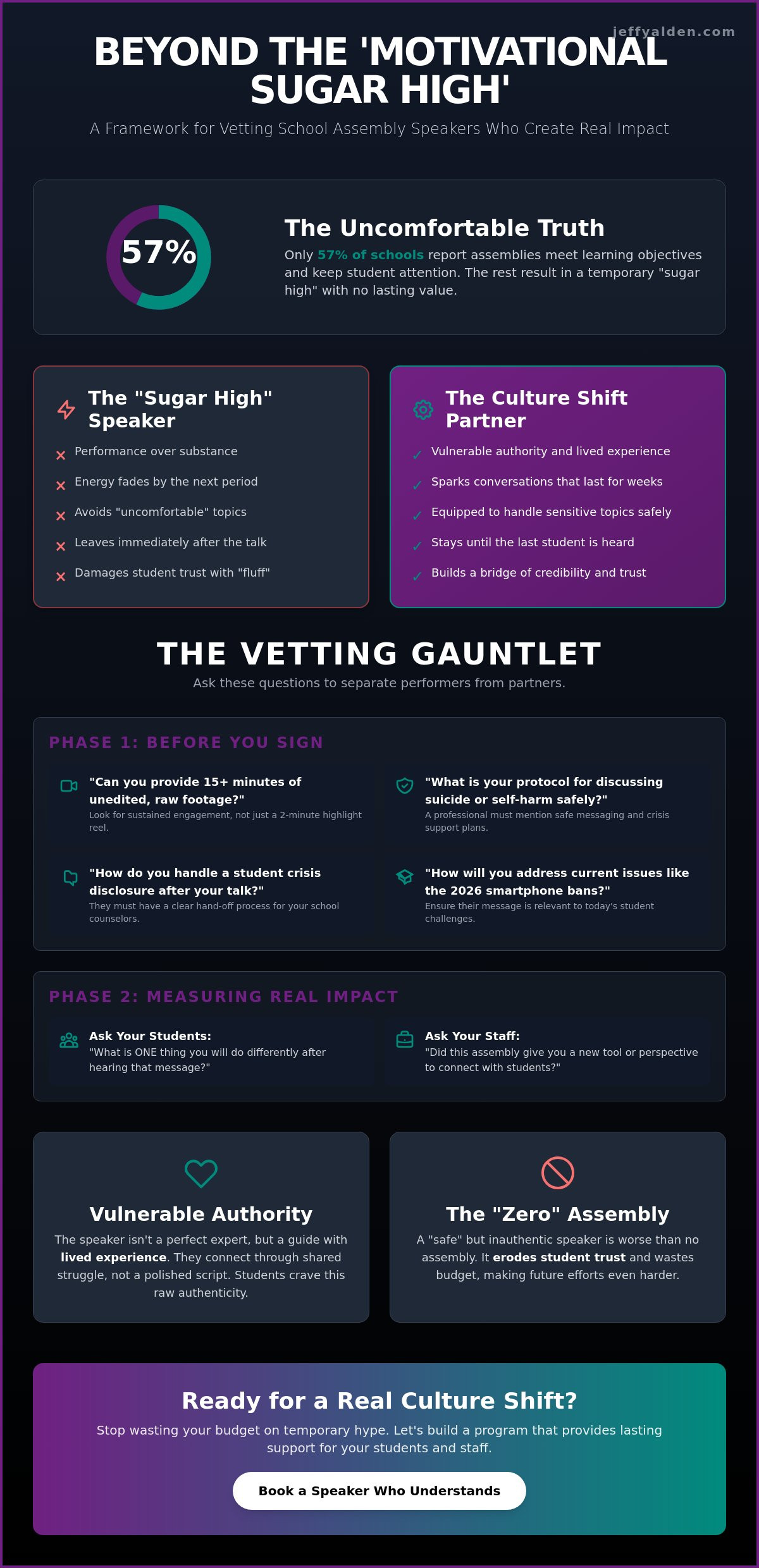
Only 57% of schools report that their assemblies actually meet learning objectives and keep students’ attention. That’s a gut-punch for any educator. You’ve felt that anxiety before. It’s the fear of wasting your budget on a speaker your students will mock before they even leave the gym. You want a campus-wide culture shift, not a “motivational sugar high” that wears off by second period. Finding that impact starts with the specific questions to ask a school assembly speaker during the vetting process.
I’ve been in the trenches. I know that a “good” talk isn’t enough when you’re dealing with sensitive topics like student mental health or the 2026 smartphone bans hitting schools this July. You need a guide who has lived it. This article gives you the exact framework to separate the performers from the world-class mentors. You’ll learn how to measure if an assembly actually worked and how to ensure your staff feels supported by the message. Let’s move past the fluff and build something that lasts.
Key Takeaways
- Identify the difference between a “motivational sugar high” and a lasting culture shift by vetting for raw, lived-experience authority.
- Master the essential questions to ask a school assembly speaker to ensure they can navigate sensitive topics like mental health and 2026 smartphone regulations.
- Equip your student leaders with “hard truth” questions that demand authenticity and create an immediate, visceral connection with the speaker.
- Implement a post-event measurement strategy that asks staff and students the right questions to prove the assembly’s long-term impact.
- Learn why a world-class speaker never leaves until the last student’s voice is heard and every crisis disclosure is handled with care.
Why the Right Questions Prevent a ‘Motivational Sugar High’
We’ve all seen it. The gym is loud. The music is pumping. The speaker is jumping around, and the kids are cheering. It feels like a win. But then the bell rings. By third period, the energy is gone. By tomorrow, the message is forgotten. I call this the “motivational sugar high.” It’s a rush of adrenaline with zero nutritional value for the soul. In a post-pandemic world where anxiety is at an all-time high, you can’t afford to waste your budget or your students’ time on fluff. You need a shift in culture, not just a show. That’s why the specific questions to ask a school assembly speaker before you sign a contract are the most important tools in your arsenal.
You aren’t just booking a date on a calendar. You’re inviting someone into the lives of your kids. That is a massive responsibility. While the art of public speaking is ancient, the needs of students in 2026 have changed. They are dealing with new smartphone bans and rising mental health challenges. You need a speaker who acts as a temporary partner in your school’s mental health strategy, not a one-man show who leaves as soon as the check clears. If you don’t use the right questions to ask a school assembly speaker, you might end up with someone who looks great on paper but falls flat in the gym.
The Cost of a ‘Zero’ Assembly
A “zero” assembly is worse than no assembly at all. When you bring in a speaker who is “safe” but fake, you damage the bridge between your office and the student body. Teens are human lie detectors. If they feel a speaker is talking down to them or reading from a script, they’ll mock the message. You lose more than money; you lose credibility. You need High School Assemblies that prioritize radical transparency. Don’t get blinded by a shiny sizzle reel. A polished performance doesn’t equal a transformed life.
Vetting for Vulnerable Authority
Vulnerable authority is the secret sauce. It’s the difference between an “expert” and a guide. In 2026, students don’t want “perfect.” They’ve seen enough filtered lives on social media. They crave the “real” and the “raw.” They want someone who has been in the darkness and found the way out. This is why you must vet for lived experience. Ask the tough questions. Make sure your speaker can handle the heavy lifting of a crisis disclosure. Your goal is a conversation that keeps going long after the gym lights go out.
The Vetting Phase: Questions to Ask Before You Sign the Contract
Stop looking at the glossy brochures. They’re designed to sell you a dream, not protect your campus. When you’re narrowing down your list, the questions to ask a school assembly speaker need to be uncomfortable. They need to be hard. You aren’t looking for a comedian; you’re looking for a lifeline. If a speaker flinches when you ask about their crisis protocol, hang up the phone. You need a professional who understands that the real work begins when the microphone turns off.
Demand raw video. Not a two-minute highlight reel with upbeat music and fast cuts. You need to see the fifteen-minute mark when the energy dips. How do they bring it back? If they can’t show you unedited footage of them commanding a room of 1,000 restless teens, they haven’t earned your stage. Ask them: “What is your specific protocol for discussing suicide or self-harm safely?” There are no second chances with these topics. If they don’t mention safe messaging guidelines or how they handle postvention, they are a liability you can’t afford.
You also need to know about the “after-care.” A world-class speaker stays until the last student is heard. Ask them how they handle a student who discloses a crisis immediately after the talk. Do they have a hand-off process for your counselors? Do they know how to stay in their lane while still providing a bridge to help? If you want to see what this looks like in action, explore our approach to school assemblies where we prioritize safety over sizzle.
Differentiating Storytellers from Crisis Experts
A great story is just entertainment. It doesn’t save lives on its own. While a narrative can open a door, building resilience in teens requires tactical empathy and clinical awareness. Ask your potential speaker about their background in mental health first aid. Have they supported schools after a recent tragedy or loss? You need a partner who can tailor their message to your school’s specific pain points, not someone who gives the same “canned” speech in every zip code.
Evaluating Relevance and ‘Gen Alpha’ Connection
The world changed in 2026. With new smartphone bans and the explosion of AI, the struggles your students face are evolving daily. Ask the speaker: “How do you stay current with Gen Alpha’s digital reality?” If they are still using 1990s motivational clichés about “aiming for the stars,” they will lose your kids in thirty seconds. Look at their social media. Are they actually interacting with students, or are they just broadcasting? Your students crave a mentor who lives in their world, not a relic from the past. Before you even get to the vetting call, it helps to understand the high school assembly topics that actually resonate with Gen Alpha in 2026 so you can evaluate whether a speaker’s content is truly aligned with what your students need.
Igniting Student Engagement: Questions to Ask During the Q&A Session
The presentation might be over, but the real work is just beginning. Most Q&A sessions are a graveyard of awkward silence or surface-level chatter. You can’t let that happen. If your students ask safe questions, they get safe answers. Safe answers don’t change lives. To spark a real culture shift, you have to empower your student leaders to dig into the raw truth. This is where the “motivational sugar high” we discussed earlier either evaporates or turns into a lasting fire. You need to arm your kids with the right questions to ask a school assembly speaker to keep the momentum moving.
Coach your student leaders before the assembly starts. Give them permission to be bold. When a student leader stands up and asks, “What was the exact moment you decided to change your life?”, the entire energy in the gym shifts. It forces the speaker to move away from their “stump speech” and back into the vulnerability of their own story. This isn’t about academic debate. It’s about heart. Other essential questions include:
- The Hard Truth: “What is the biggest mistake you see students my age making right now?”
- The Action Plan: “If I can only do one thing differently tomorrow, what should it be?”
- The Resilience Check: “How do you handle it when you feel like giving up today, right now?”
Breaking the Ice: How to Start the Q&A
Don’t leave the first question to chance. Use the “Pre-Seeded” strategy. Have two or three students ready to go with high-impact inquiries the moment the floor opens. This breaks the “bystander effect” and signals to the rest of the room that it’s safe to be real. When your speaker operates from a model of vulnerable authority, it gives the quietest kids in the back the courage to speak up. These are often the students who need the message most. They aren’t looking for a lecture; they’re looking for a sign that someone finally understands their reality.
Managing Sensitive Q&A Moments
In 2026, the stakes are high. A student might drop a bombshell or a triggering disclosure in front of the entire assembly. A professional speaker knows how to pivot with empathy without playing the role of a clinical therapist. They must be a bridge, not a destination. Ensure your school counselors are visible and positioned near the exits. The speaker should acknowledge the student’s courage, provide a supportive response, and then immediately facilitate a connection with your staff. This keeps the environment safe while ensuring every student feels heard and protected.
Measuring Impact: Questions to Ask Your Staff and Students After the Assembly
The gym is empty. The microphones are packed away. But the silence shouldn’t be empty; it should be expectant. Most schools make the mistake of checking a box once the speaker leaves the parking lot. If you don’t measure the aftermath, you’re just guessing. You need to know if that “vibe shift” in the room was a permanent change or just a temporary reaction. This is why the questions to ask a school assembly speaker must extend into your post-event evaluation. You need hard data to prove that your investment moved the needle on campus culture.
Start with your students. Don’t ask if they “liked” it. Ask them: “Did you feel the speaker understood the reality of being a teen in 2026?” If they say no, the message didn’t land. Then, go to your staff. Ask your teachers: “Have you noticed a change in how students are talking about their mental health this week?” Look for the use of the speaker’s key phrases in the hallways. Finally, talk to your counselors. A successful event isn’t measured by a lack of drama; it’s measured by an uptick in students seeking support. If your office is busy the next day, the speaker did their job. They broke the seal on the secrets students were carrying.
The 48-Hour Impact Audit
Speed is your best friend here. Conduct a digital survey within 48 hours to capture the raw emotional response before it fades. You’re looking for the students who were moved to action. Did they finally reach out to a mentor? Did they delete an app that was hurting their self-esteem? Use this feedback to justify future mental health funding to your board. When you can show that 80% of your student body felt more empowered to seek help, you move from “hosting an event” to “leading a movement.”
Integrating the Message into Campus Culture
Don’t let the fire go out. A one-hour assembly should be the launchpad for a semester-long resilience campaign. Take the speaker’s most impactful declarations and put them on the morning announcements. Give your teachers specific questions to use in small-group homeroom discussions. This turns a fleeting moment into a foundational part of your SEL curriculum. If you want a partner who helps you build this lasting legacy, it’s time to bring in a world-class High School Speaker who stays committed to the follow-through.
Your administration needs to see more than just smiles. They need to see actionable strategies. Ask yourself: “Did the speaker provide tools our students can actually use when they feel like giving up?” If the answer is yes, you’ve found a partner for the long haul. You’ve successfully separated the impact from the noise. If you’re still in the planning stages, exploring how to plan a school assembly for maximum impact in 2026 can help you build the right framework before you ever book a speaker.
Why Radical Transparency Means Never Fearing the Tough Questions
I don’t do fluff. I don’t do “sugar highs.” I do real talk for real problems. When you’re searching for the right questions to ask a school assembly speaker, you are ultimately looking for one thing: integrity. You need to know that the person on your stage can handle the weight of your students’ reality. I’ve spent over 30 years in the trenches. I’ve seen the heartbreak and I’ve seen the breakthroughs. My “No Fluff” philosophy isn’t just a catchy slogan; it’s a promise that I will meet your students exactly where they are, without the filtered nonsense they see online.
I stay until the last student is heard. Every. Single. Time. A world-class Teen Motivational Speaker doesn’t check their watch when the bell rings. If a student is waiting in line to share a burden, I am there to listen. I invite the “tough” questions from the most skeptical kids in the back of the room. I want the students who think this is just another boring assembly to challenge me. That’s where the transformation happens. My experience provides a safety net for you, the school leader, because I know how to navigate the tension between raw honesty and campus safety.
A Partner in Your School’s Mission
I’m not just a guest passing through your town. I view myself as a long-term consultant for your staff. My role as a Mental Health Speaker often involves supporting counselors and administrators through the heavy lifting of crisis postvention. If your campus has faced tragedy, I don’t shy away from it. I lean in. My “Radical Transparency” promise is simple: if I’m not the best fit to help your kids with their specific pain, I’ll tell you exactly who is. I am here to serve your mission, not my own ego.
Book Your 2026 Assembly with Confidence
Bringing a movement to your campus shouldn’t be a bureaucratic nightmare. The process is simple and direct. To get the maximum ROI on your budget, I recommend combining our High School Assemblies with Teacher Professional Development sessions. This ensures that the message of resilience doesn’t just live in the gym; it lives in the classrooms and the front office. We build a unified front that supports every student and staff member. It’s time to move past the generic “fun” events and invest in a culture shift that lasts. Stop guessing about the impact. Ask Jeff the tough questions yourself-book a discovery call today.
Your students are waiting for someone to be real with them. They are tired of the scripts. They are tired of the “perfect” experts. They need a guide who has been there and back. When you use the right questions to ask a school assembly speaker, you’ll find that the best answers aren’t found in a brochure, but in the life-changing moments that happen when someone finally tells the truth. Let’s get to work.
Take the Lead in Your School’s Transformation
Your students are waiting for a moment that feels real. You’ve now got the framework to move past the “motivational sugar high” and find a partner who actually understands the stakes of 2026. By mastering the questions to ask a school assembly speaker, you are vetting for safety, impact, and a message that sticks. Remember to focus on crisis protocol, empower your student leaders during the Q&A, and never skip the post-event audit to measure your ROI. This isn’t just about one hour in the gym. It’s about the weeks and months of healing and growth that follow.
I’ve spent over 30 years in more than 4,000 schools, specializing in suicide prevention and crisis intervention. I’ve been voted “Speaker of the Year” by multiple student organizations because I don’t hide behind a script. I bring the radical transparency your campus needs to thrive. Don’t settle for a polished performance when you can have a life-changing shift. Book Jeff Yalden for your 2026 school assembly and transform your campus culture. Let’s give your students the hope they deserve. You’ve got this.
Frequently Asked Questions
How much does a high-quality school assembly speaker cost in 2026?
Fees for professional speakers vary significantly based on their years of experience, the depth of their crisis training, and your school’s specific needs. While industry data shows a wide range of pricing for corporate events, school budgets often operate on different scales. You should consider the total value, including travel fees and any recording rights, rather than just the base fee. Always ask for a clear breakdown of costs during the initial vetting process to avoid surprises later.
What is the best length for a high school motivational assembly?
The ideal length for a high school assembly is typically 45 to 60 minutes. This timeframe respects your bell schedule and aligns with the natural attention span of most teenagers. It provides enough room for a high-energy opening, a deep dive into the core message, and a brief Q&A session. If a speaker goes longer, they risk losing the “edge-of-your-seat” engagement that makes the message stick.
How do I know if a speaker will be relatable to Gen Z and Gen Alpha?
Relatability is proven through raw, unedited video footage of the speaker in a room full of students. Don’t trust a polished studio demo. Look for a speaker who understands the digital reality of 2026, including the impact of recent smartphone bans in schools. They should speak with a “vulnerable authority” that prioritizes real-world struggle over outdated motivational clichés or forced slang that students will instantly mock. Choosing the right high school assembly topics designed for Gen Alpha is equally critical to ensuring the message lands with authenticity.
Can we use Title I or mental health grants to hire a speaker?
Yes, many schools successfully fund their programs through Title I, Part A funds or specific mental health and Social-Emotional Learning (SEL) grants. Since over 80% of educators see assemblies as crucial for reinforcing school values, these events often qualify as part of a broader school improvement plan. You should consult with your district’s federal programs coordinator to ensure the speaker’s content aligns with the specific requirements of your grant.
What should we do if a student discloses a crisis during the Q&A?
You must have a clear hand-off protocol involving your school counseling team before the assembly begins. A professional speaker will acknowledge the student’s courage with empathy and then immediately facilitate a connection with an on-site staff member. This is one of the most critical questions to ask a school assembly speaker during the hiring phase. The speaker should be a bridge to help, not a replacement for your clinical staff.
How far in advance should we book a youth motivational speaker?
It is best to book your speaker six to twelve months in advance, especially for high-demand windows like the start of the school year or Mental Health Awareness Month. Early booking gives you time to integrate the speaker’s message into your teacher professional development and campus culture. It also ensures you secure the dates that work best for your academic calendar before the most impactful speakers are fully committed.
What technical equipment does a professional speaker typically need?
Most professional speakers require a high-quality wireless headset microphone and a sound system capable of filling a gymnasium or auditorium. Avoid handheld microphones if the speaker uses movement to engage the crowd. Ask if they need a projector for visuals or if they prefer a “no-tech” approach to foster a more intimate, human-centric connection with the audience. Clear communication about tech needs prevents “dead air” during the event.
How do I vet a speaker’s experience with suicide prevention?
Ask for specific evidence of their training in safe messaging and crisis intervention. A qualified expert will be familiar with “postvention” strategies and how to support a community after a tragedy. They should demonstrate a deep commitment to radical transparency while maintaining professional boundaries. If a speaker cannot explain their protocol for handling sensitive disclosures, they aren’t the right fit for a high-stakes campus environment.
