
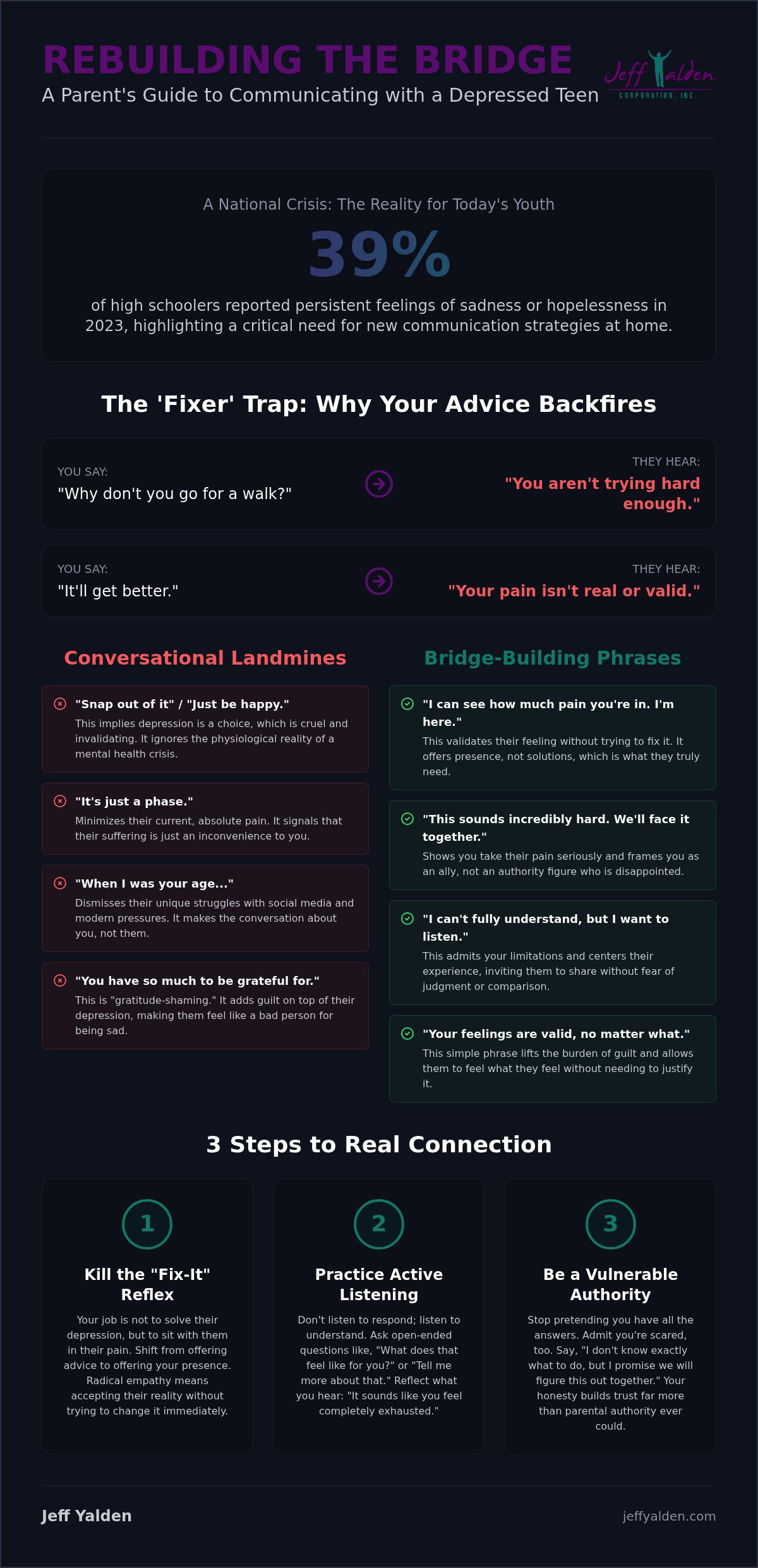
Your silence isn’t what’s killing the connection with your child. It’s your desperate, frantic need to “fix” them. You’re exhausted from walking on eggshells, terrified that one wrong word will send them back into a bedroom fortress. Knowing what not to say to a depressed teen is the first step in tearing down the wall of “I’m fine” and “Leave me alone.” It feels like you’re failing as a parent. I’ve been there. I know that heavy, suffocating weight in your chest. With 39% of high schoolers reporting persistent feelings of sadness or hopelessness in 2023, this is a crisis we can’t ignore.
I’m going to show you how to trade your parental authority for radical empathy and stop the conversational landmines that are blowing up your relationship. We will look at the specific phrases that shut down communication and a framework for radical transparency that actually restores hope. You don’t need a clinical degree to save your teen. You just need a new way to speak their language. We are going to stop the fighting and start the healing by rebuilding trust from the ground up. Let’s get to work.
Key Takeaways
- Kill the “Fix-It” reflex. Understand how a depressed brain filters your well-intentioned advice into personal attacks.
- Identify the toxic phrases you don’t realize are hurting. Learn exactly what not to say to a depressed teen to keep the connection alive.
- Shift from toxic positivity to radical empathy. Learn how to sit in the dark with your teen without rushing to turn on the light.
- Apply a three-step framework to stop walking on eggshells. Start building a bridge based on validation and active listening.
- Spot the critical red flags that demand professional support. See how a teen mental health speaker can change your home’s culture.
The Communication Gap: Why Your “Helpful” Advice Is Backfiring
You’re walking through your own hallway like it’s a minefield. One wrong look, one “How was your day?”, and the door slams. You’ve entered the “Eggshell Phase.” It’s the terrifying moment you realize your influence has evaporated. You want to help. You want to save them. But your “helpful” advice is actually the very thing driving them deeper into the dark. This isn’t because they don’t love you. It’s because the depressed brain is a master at distortion.
When you understand the clinical reality of Depression in childhood and adolescence, you realize their mind has a filter. This filter takes your “Why don’t you go for a walk?” and translates it into “You aren’t trying hard enough.” Your “It’ll get better” becomes “I don’t believe your pain is real.” This is the “Fixer” Trap. Your instinct to solve the problem is the biggest barrier to connection because it signals that their current state is unacceptable. To rebuild trust, you need radical transparency. Stop pretending you have the answers. Admit you’re scared. Admit you don’t know what to do. That’s where the real conversation begins.
The Anatomy of a Shutdown
When you push a depressed teen with high-pressure questions, their body goes into a physiological “lockdown.” Their heart rate spikes. Their prefrontal cortex, the part of the brain that handles logic, goes offline. This isn’t just “teenage angst” or a bad attitude. It’s a survival mechanism. They aren’t being stubborn; they are overwhelmed. If you keep pushing, you trigger a shame spiral. They already feel like a disappointment. Every time you try to “coach” them out of it, you’re inadvertently confirming their worst fear: that they are broken and failing you. Understanding what not to say to a depressed teen means recognizing when their nervous system is too fried to hear your logic.
Why “Normal” Parenting Doesn’t Work Here
Traditional discipline is built on the idea that behavior is a choice. In a mental health crisis, that rulebook is trash. “Tough love” is frequently interpreted as “no love” by a depressed mind. If you pull back or use “consequences” to motivate a teen who has no emotional fuel, you aren’t teaching resilience. You’re teaching them that your love is conditional. You have to pivot from being a distant expert to being a “vulnerable authority.” Show them your own cracks. Be the guide who has been in the trenches, not the judge on the bench. This is how you bridge the gap between their silence and your support.
Forbidden Phrases: What Not to Say to a Depressed Teen
Words carry weight. When your child is drowning, your words can either be a life vest or a lead weight. Knowing what not to say to a depressed teen is about more than just avoiding a fight. It’s about keeping the door to their heart from locking permanently. Most parents speak from a place of love, but that love often gets translated into pressure, judgment, or dismissal. We have to do better. We have to be more intentional.
“Snap out of it” or “Just choose to be happy.” These are the ultimate insults to a brain in crisis. Depression isn’t a bad mood; it’s a physiological state where the “happy” chemicals aren’t showing up for work. Telling a teen to use willpower to fix a chemical or situational collapse is like telling a person with a broken leg to run a marathon. It’s useless. It’s cruel. If they could “choose” to feel better, they would have done it months ago.
“It’s just a phase.” This phrase is a relationship killer. Even if their struggle is temporary, the pain they feel right now is absolute. Minimizing long-term pain makes them feel like you aren’t actually seeing them. It tells them their current agony is just an inconvenience to you. According to the Teen Depression guide from the NIMH, depression is a serious medical condition that requires real intervention, not just a “wait and see” attitude.
“When I was your age…” Stop right there. Your 1990s childhood didn’t include the 24/7 comparison engine of social media or the post-pandemic “new normal.” In 2026, the stakes are higher. The average teen spends 4.8 hours a day on social media, facing a level of scrutiny we never imagined. Your experience doesn’t translate here. “You have so much to be grateful for” is another trap. This is gratitude-shaming. It adds a layer of guilt on top of the depression. Now they aren’t just sad; they feel like a “bad” person for being sad. It breeds deeper isolation.
The Danger of Minimizing Language
When you say “it’s not that bad,” you are telling your teen that their lived reality is a lie. You are gaslighting their emotions. Comparing their struggle to someone who “has it worse” doesn’t make them feel better; it makes them feel ashamed for hurting. Minimizing language builds a soundproof wall of isolation between you and your child. They stop talking because they know you won’t believe the depth of their pain.
The “Fix-It” Phrases That Fail
“Have you tried exercising?” To a teen who can’t find the energy to brush their teeth, this feels like an attack. Immediate problem-solving before emotional validation is a recipe for disaster. This is “Toxic Positivity.” It’s the “Good Vibes Only” culture that kills honest conversation. Sometimes, a teen life coach can act as the bridge you need when your own “fix-it” instincts are getting in the way of real connection.
Toxic Positivity vs. Radical Empathy: Why “Fixing” It Doesn’t Work
Toxic positivity is a poison wrapped in a smile. It’s the “Good Vibes Only” banner that we hang up when we are too terrified to face the darkness. When you tell your child to “just stay positive,” you aren’t helping them; you’re silencing them. You’re telling them that their pain is an inconvenience to your comfort. This is exactly what not to say to a depressed teen if you want to keep the lines of communication open. Honest conversation dies when we demand optimism from someone who is emotionally bankrupt.
Radical empathy is the antidote. It’s the brave act of sitting in the dark with them without trying to turn on the light. You don’t need to have the answers. You don’t need to be a hero. You just need to be a witness. When you move from being a “judge” who evaluates their behavior to a “witness” who acknowledges their reality, the wall starts to crumble. Understanding the symptoms of teen depression helps you realize that their withdrawal isn’t a personal attack on you. It’s a symptom of a battle they are fighting internally. Your presence matters more than your advice.
What the Teen Hears vs. What You Meant
We think we’re being supportive. They hear an indictment. This disconnect is where the relationship fractures and the defensive wall goes up. Empathy acts as a solvent for that wall, but you have to use the right words.
| What You Said | What They Heard |
|---|---|
| “I’m just worried about you.” | “You are a burden and a problem I have to deal with.” |
| “Look on the bright side.” | “Your current pain is invisible and doesn’t matter to me.” |
| “You’ll feel better tomorrow.” | “I’m not interested in how you feel today.” |
The Role of Radical Transparency
Resilience isn’t built through lectures. It’s built through shared vulnerability. When you say, “I don’t know what to do, but I am here,” you’re offering the most powerful gift a parent can give: presence. Don’t be afraid to share your own struggles appropriately. Show them that you’ve been in the trenches. Show them that it’s okay to be imperfect. Radical transparency normalizes their experience. It tells them they aren’t alone in the dark. It tells them that you are a partner in this fight, not just a spectator with a clipboard. Understanding what not to say to a depressed teen is about trading your “fix-it” tools for a listening heart.
How to Rebuild the Bridge: 3 Steps to Real Connection
Rebuilding a bridge isn’t about grand gestures. It’s about small, consistent, and radical shifts in how you show up. You’ve already learned what not to say to a depressed teen to avoid driving them further away. Now, let’s focus on the active work of coming back together. This is about moving from a state of panic to a state of presence. It’s hard. It’s messy. But it’s the only way back into their world.
Step 1 is the “Shut Up and Listen” Phase. Most parents talk because they are anxious. We fill the silence with advice because we can’t stand seeing our kids in pain. Stop. Your silence is a gift. It tells them that their darkness doesn’t scare you away. Step 2 is Validation Without Agreement. You don’t have to agree that “everything is hopeless” to acknowledge that they feel hopeless. Acknowledge the pain without trying to talk them out of it. Finally, Step 3 involves Low-Pressure Invitations. Offer a walk or a drive without demanding a conversation. Give them the choice to be near you without the “tax” of having to perform or explain themselves.
Validation Scripts for Real Parents
You need a script because your brain freezes when the stakes are high. Try these on for size. “I can see you are hurting, and I hate that for you.” “I’m here for as long as you need, even if we don’t say a word.” “Thank you for being honest with me about how hard this is.” These phrases aren’t about fixing. They are about witnessing. Use the phrase “Tell me more” as your primary tool. It keeps the door open without you having to lead the way. Implement the No-Phone Rule. Put your device in another room. Your physical presence and eye contact signal that they are your only priority.
Building Resilience in the Small Moments
Resilience isn’t a destination. It’s a muscle built through building resilience in teens by validating their reality every single day. Celebrate the tiny wins. If they came out of their room for ten minutes, that’s a win. Don’t be patronizing; just be glad they are there. Encourage their autonomy by letting them make small choices. This builds a safety net that feels like a partnership, not a prison. If you feel like you’re losing the battle at home, a teen mental health speaker can help break the silence and give your family a fresh perspective on the path forward.
Beyond the Conversation: When to Seek Professional Support
Sometimes, the bridge you’re building needs a professional foundation. You’ve mastered the art of listening. You know exactly what not to say to a depressed teen to keep the peace and avoid the “Fixer” trap. But if your child is drowning, you don’t just watch them tread water; you call for backup. Recognizing the red flags is a matter of life and death. If you see extreme changes in sleep patterns, a sudden drop in grades, or social withdrawal that lasts more than two weeks, it’s time to act. In 2025, 19.2% of U.S. adolescents screened positive for depression. You aren’t alone in this fight, and neither is your teen.
Bringing in a teen mental health speaker isn’t just about a one-day event. It’s about normalizing the conversation for an entire community. When a speaker with lived experience stands on a stage and says, “I’ve been there,” the stigma dies instantly. For many teens, traditional therapy feels too clinical or intimidating. This is where a youth life coach can bridge the gap, offering a proactive partnership rather than just a medical diagnosis. Jeff Yalden’s teen suicide prevention programs focus on radical transparency, showing kids that their pain has a purpose and their future is worth fighting for.
Taking Action: The Next Steps for Parents
When you bring up professional help, don’t make it about “fixing” a broken child. Make it about adding a teammate to their roster. Tell them, “I love you too much to let you carry this alone.” This support shouldn’t stop at your front door. Teacher professional development is critical because educators are on the front lines every day. If your school’s culture feels heavy or silent, encourage your administration to book a high school assembly. A single program can be the catalyst that gives a struggling student the courage to finally ask for help.
A Message of Hope for the Journey
There is hope. Depression is a season, not a life sentence. You are moving from a state of survival into a “Victor” mentality. Your teen isn’t a victim of their brain chemistry; they are a warrior learning to navigate a storm. Connection is possible. Healing is real. I’ve seen it happen thousands of times in schools across the country. Don’t wait for the crisis to peak. Take the first step today. Book Jeff Yalden to speak at your school or provide the life-changing coaching your teen needs to find their voice again.
Start the Healing Today
You now have the tools to stop the frantic “fix-it” cycle and start the real work of connection. You understand that knowing what not to say to a depressed teen is just as critical as the radical empathy you offer in the quiet moments. By trading your parental authority for the role of a witness, you are building a bridge that can actually withstand the storm. This isn’t about being a perfect parent. It’s about being a present one who is brave enough to sit in the dark.
Sometimes, your family or your school needs a powerful catalyst to break the silence for good. With over 30 years of experience impacting millions of students worldwide, Jeff Yalden brings a radically transparent approach that teens actually trust. He is a seasoned expert in suicide postvention and crisis intervention who knows how to reach the heart of a teenager who has checked out. It is time to move from surviving to thriving. Bring Jeff Yalden to Your School to Break the Silence and transform your campus culture. You are doing better than you think. Keep showing up. Hope is real, and your teen is worth the fight.
Frequently Asked Questions
Is it okay to ask my teen if they are thinking about suicide?
Yes, you must ask. It is a myth that asking about suicide plants the seed in their mind. In reality, it shows you are brave enough to hear the truth. Be direct and say, “Are you thinking about hurting yourself?” This provides an immediate release valve for their pain. It signals that you are a safe harbor in the storm. If the answer is yes, take it seriously and seek help immediately.
What if my teen refuses to talk to me even when I use these tips?
Silence is often a survival mechanism, not a personal attack. If your teen isn’t talking, don’t push harder. Instead, maintain your presence. Keep showing up with low-pressure invitations like a car ride or a shared meal. Your consistency proves that your love isn’t conditional on their “performance” or conversation. They need to know you are still there when they are finally ready to break the silence and let you in.
How do I know the difference between normal teen moodiness and depression?
Look for the “two-week rule” and the impact on daily functioning. Normal teen moodiness comes in waves and usually has a clear trigger. Depression is a heavy, persistent fog that lasts for weeks. It changes how they eat, sleep, and interact with the world. If they have lost interest in things they used to love, it is more than just a phase. It is a clear signal for professional intervention.
Should I take away my depressed teen’s phone as a punishment?
Taking away a phone as punishment is usually a mistake during a mental health crisis. For many teens, that device is their only connection to a support system of peers. While you should set boundaries for sleep, using it as a punitive tool increases their isolation. When you are learning what not to say to a depressed teen, remember that your actions speak just as loud as your words in these moments.
How can I support my teen without neglecting my own mental health?
You have to prioritize your own well-being to be an effective guide for your child. Supporting a teen in crisis is emotionally draining and can lead to caregiver burnout. Seek your own counselor or support group. When you model healthy boundaries and self-care, you are showing your teen that mental health matters for everyone. You aren’t being selfish; you are being a resilient leader for your family during a difficult season.
What should I do if my teen says they hate me during a depressive episode?
Stay calm and don’t lash back. When a teen says they hate you during an episode, they are often lashing out at the person they trust the most. They are testing the floorboards of your love to see if they will hold. Don’t engage in the argument. Instead, say, “I can see you’re in a lot of pain right now, and I’m not going anywhere.” Your stability is their ultimate anchor.
Can a motivational speaker really help a depressed teen?
A teen mental health speaker like Jeff Yalden provides a bridge that traditional therapy sometimes misses. Teens often shut down when they feel like a “patient” in a clinical setting. A speaker with lived experience uses radical transparency to normalize the struggle. This high-energy approach breaks through the walls of shame and shows them that a “victor” mentality is possible. It is about building resilience through a shared mission and real connection.
How do I talk to my teen’s teachers about their depression?
Be direct and focus on collaboration. You don’t need to share every private detail, but teachers need to know that your teen is facing a medical challenge. Ask about available accommodations and suggest teacher professional development to help staff recognize the signs of distress. A supportive school culture is a massive part of the recovery process. You are your teen’s primary advocate in the classroom and the hallways every day.
