
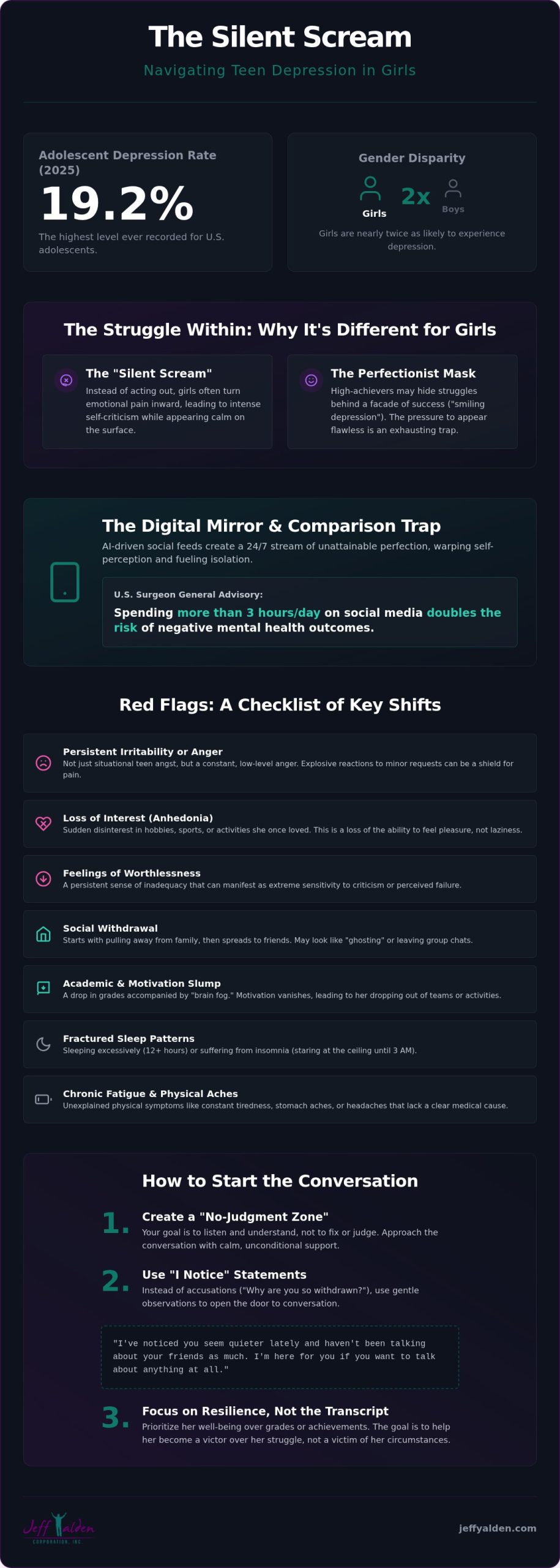
In 2025, 19.2% of U.S. adolescents screened positive for depression. That is the highest level ever recorded. Even more gut-wrenching is that girls are nearly twice as likely as boys to carry this weight. You see the change in her eyes. You feel the heavy silence behind her bedroom door. You’re terrified that saying the wrong thing will cause her to withdraw even further into the digital void. It’s exhausting to constantly guess if you’re seeing normal teen angst or the clinical signs of teen depression in girls.
I get it. I’ve spent over 30 years in the trenches with families just like yours. You’re not alone in this fight, and your daughter doesn’t have to be a statistic. You’ll learn to identify the subtle, gender-specific red flags that most people miss in 2026 and use radical transparency to lead her back to resilience. This guide provides a clear checklist of signs to watch for, a framework for starting a real conversation, and the hope she needs to become a victor over her struggle.
Key Takeaways
- Understand the “Silent Scream” and why your daughter might be masking her struggle through perfectionism or quiet withdrawal.
- Discover how to spot the specific signs of teen depression in girls, including persistent irritability and a sudden loss of interest in hobbies she once loved.
- Learn why 2026 digital algorithms create a “Comparison Trap” that leads to profound isolation even when she’s constantly connected.
- Master the art of radical transparency by creating a “No-Judgment Zone” and using “I notice” statements to break through her walls.
- Find out how to bridge the gap between home and school with a roadmap that turns your teen from a victim into a victor.
The Silent Crisis: Why Teen Depression in Girls is Different in 2026
Depression isn’t just a bad day. It’s not a temporary mood swing or a phase she’ll simply “grow out of” by next month. It’s a heavy, persistent weight that smothers her ability to find joy and function in her daily life. When we look at the clinical reality of Depression in childhood and adolescence, we see that girls experience this struggle in a unique, internal way. They don’t always act out. They act in. I call it the “Silent Scream.” While boys might manifest their pain through outward aggression or behavioral issues, girls often turn that energy inward, shredding their own self-worth in total silence. Identifying the signs of teen depression in girls early isn’t a betrayal of her privacy or a lack of trust. It’s a victor move. You’re stepping in as her advocate and guide before the silence becomes a permanent wall between her and the world.
The Pressure of the Perfectionist Mask
She’s getting straight A’s. She’s the captain of the team. She looks “fine” to every teacher and coach. But behind that mask of effortless perfection, she’s quietly drowning. This is “smiling depression,” and it’s one of the most dangerous signs of teen depression in girls because it’s so easy to ignore. 2026 culture demands that young women look flawless without ever appearing to struggle. It’s an exhausting, impossible trap. High-achieving girls become masters at hiding their pain behind a busy schedule and a curated persona. If she’s suddenly obsessed with maintaining a perfect image while losing her genuine inner spark, you must pay attention. The mask is heavy. Eventually, the weight becomes too much for any one person to carry.
Why 2026 is a Pressure Cooker for Young Women
Her phone has become a psychological weapon. AI-driven social feeds now curate a relentless, 24/7 stream of “perfect” bodies and unattainable lifestyles that don’t exist in reality. The U.S. Surgeon General issued an advisory stating that teenagers who spend more than three hours a day on social media face double the risk of negative mental health outcomes. She’s “connected” to thousands of peers but feels truly known by almost no one. This is the loneliness epidemic. She’s trapped in a digital mirror that only reflects her perceived flaws. Your daughter’s mental health is an urgent emergency that requires your radical presence and total transparency right now.
Red Flags: Recognizing the Emotional and Behavioral Shifts
Recognizing the signs of teen depression in girls requires you to look past the surface. It’s about spotting the shifts before they become permanent. We often look for overwhelming sadness, but in girls, depression frequently wears a mask of anger. It’s a defensive posture. It’s a shield. When she lashes out at you for a simple question, she isn’t necessarily being “difficult.” She might be drowning. According to the Mayo Clinic’s research on teen depression symptoms, emotional changes often include a persistent sense of worthlessness that manifests as extreme sensitivity to criticism. She’s protecting a heart that feels like it’s breaking in slow motion.
The “Withdrawal Cycle” is a major indicator. It almost always starts at home. She stops coming out for dinner. She stops sharing the small details of her day. Then, it spreads to her friends. In 2026, this looks like “ghosting” her social circle or leaving group chats she used to lead. Physical red flags follow closely behind. Look for unexplained stomach aches, chronic fatigue, or sleep patterns that have completely fractured. If she’s sleeping 12 hours a day or staring at her ceiling until 3:00 AM, her body is signaling a crisis that her voice can’t yet put into words.
Irritability as a Shield
Is it just “normal” teen attitude? Normal angst is situational. It passes after the bad grade or the fight with a friend. Depression-fueled irritability is a constant, low-frequency hum. It’s an explosive reaction to a minor request. You need to track the frequency and intensity of these outbursts. When the anger becomes her primary way of communicating with the people she loves most, it’s a cry for help. She is using rage to keep you at a distance because she doesn’t know how to let you into her pain.
The Academic and Social Slump
In the classroom, depression shows up as a thick brain fog. Her grades might slip, but more importantly, her motivation vanishes. This is the “quitter” syndrome. She suddenly drops the soccer team she lived for or stops playing the instrument she loved. This isn’t laziness. It’s a loss of the ability to feel pleasure. This is the moment where building resilience in teens becomes the priority over building a transcript. If you’re feeling overwhelmed, a youth life coach can provide the outside perspective and radical transparency needed to help her find her spark again.
The Digital Mirror: How Social Media Warps the Signs
Her phone isn’t just a device. It’s a psychological landscape. In 2026, the algorithms are more aggressive than ever. They don’t just show her what she likes; they hyper-target her deepest insecurities. This is the “Comparison Trap” on steroids. She’s spending six or more hours a day “connected,” yet she feels more alone than any generation before her. Digital isolation is real. She is surrounded by noise but starved for genuine connection. When she is excluded from a group chat or “ghosted” by a peer group, it isn’t just teen drama. It’s a major trigger for signs of teen depression in girls that can lead to a total emotional shutdown.
Cyber-Bullying and the “Perfect” Aesthetic
Bullying has evolved. It’s no longer just whispers in the hallway. Now, it’s sub-tweeting, AI-generated shaming, and calculated digital exclusion. It’s subtle. It’s cruel. It’s relentless. She feels a crushing pressure to maintain a curated, “perfect” aesthetic online while her internal world is falling apart. This performance is exhausting. She’s living a double life. Digital behavior is often the first place signs of depression appear. If you notice her social media tone shifting from engagement to total silence, or if she’s obsessively checking for validation she never finds, the mask is starting to crack. She’s trying to survive a digital world that wasn’t built for her well-being.
Escapism vs. Connection
You need to know the difference between joy and numbing. Is she using her phone to connect with friends, or is she using it to escape her own thoughts? “Scrolling paralysis” is a massive red flag. This is when she sits for hours, mindlessly flicking through feeds with a vacant look in her eyes. It’s a symptom of low energy and total hopelessness. She’s not “relaxing.” She’s numbing the pain. We need to practice Radical Transparency. Sit down with her. Talk about the “Comparison Trap.” Use resources for recognizing the signs of teen depression to help her understand that her feelings are valid, but the digital mirror is lying to her. We can’t monitor her every move without destroying trust, but we can teach her to see the algorithm for what it is: a thief of her peace. When we bring these issues into the light, we take away their power over her.
Radical Transparency: Starting the Conversation That Saves Lives
You’ve recognized the signs of teen depression in girls. Now the real work begins. You can’t just stand on a pedestal and preach. That only builds a taller wall. You have to get in the trenches. Radical transparency means being real about your own imperfections. It’s about creating a “No-Judgment Zone” where she feels safe enough to exhale. Stop using “Why are you” questions. They feel like accusations. Instead, use “I notice” statements. “I notice you haven’t been laughing lately,” or “I notice you’re spending more time alone.” This isn’t an interrogation. It’s an invitation to be seen.
Before you offer a single solution or try to “fix” her, you must validate her pain. If she says she’s miserable, don’t tell her she has a great life or a bright future. That’s a dismissal. Tell her, “I hear you, and I can see how much you’re hurting.” Sit with her in that darkness. Finally, you have to ask the hard questions. This includes the “S” word. Ask her directly: “Are you thinking about hurting yourself or ending your life?” Asking doesn’t plant the idea. It provides an escape hatch for the pressure she’s carrying. Ask with love. Ask with directness. Ask because she needs to know you can handle her heaviest truths.
The Power of Being “Real”
Teens have a world-class “fake” detector. If you act like a perfect authority who has never struggled, she’ll never trust you with her mess. Share your own struggles with resilience. Tell her about a time you felt hopeless, overwhelmed, or lost. When you show your own scars, you build a bridge to her heart. This isn’t about you becoming her peer. It’s about you becoming a vulnerable authority who has walked the path and found a way through. If you are facing a crisis situation, you need teen suicide prevention programs that prioritize this radical, life-saving approach. As a teen mental health speaker, I’ve seen that the truth is the only thing that truly breaks the cycle of silence.
Active Listening: The 80/20 Rule
You have two ears and one mouth for a reason. Listen 80% of the time. Speak only 20%. When she does find the courage to talk, don’t interrupt with a solution. Use phrases that reinforce your support: “That sounds incredibly hard,” and “I am here for all of it.” If she hits you with the dreaded “I don’t know” response, don’t get frustrated. Often, she genuinely doesn’t have the words yet. Don’t push. Just stay in the room. Your steady, non-anxious presence is the loudest thing you can offer. This is how you move from being a worried observer to being her greatest ally in the fight for her life.
Beyond Identification: Building a Roadmap to Recovery
Identifying the signs of teen depression in girls is the critical first step. It is the moment you stop guessing and start acting. But identification without a plan is just more anxiety. We need to move her from a state of survival into a “victor” phase. This starts with a daily commitment to a Resilience Toolkit. In our 2026 world, we have to fight for the basics: restorative sleep, real nutrition, daily movement, and deep, face-to-face connection. These aren’t just “wellness” tips. They are the biological foundations of mental health. We also need to adopt a “Postvention” mindset. Most communities wait for a tragedy before they take teen mental health seriously. That is a mistake we can’t afford. We must build the support systems today so that when life gets heavy, she has a foundation that is already reinforced and ready.
Life Coaching vs. Therapy: Finding the Right Fit
Transforming the School Culture
Individual help is a lifeline, but it is hard to stay healthy in a toxic environment. If the school culture is built on “effortless perfection” and digital status, she will continue to feel the weight. We have to change the atmosphere of the entire campus. This is the impact of high school assemblies that lead with truth. They break the silence for hundreds of students at once. When a teen mental health speaker stands on that stage and gets real, the “Comparison Trap” loses its power. Normalizing these conversations in a group setting gives every girl in that room permission to exhale. You have the power to advocate for these programs at your daughter’s school. Don’t wait for the school board to move first. Lead the charge to make mental health the centerpiece of the educational experience.
Turn the Tide: Lead Your Daughter Back to Resilience
You now have the tools to see through the perfectionist mask and the digital noise. Recognizing the signs of teen depression in girls is the first step in her transformation from victim to victor. By leading with radical transparency and creating a no-judgment zone, you’ve started building the bridge back to her heart. This struggle doesn’t define her future. It’s a chapter she can overcome with your steady, non-anxious presence. Recovery is a shared mission that requires a shift in our homes and our school cultures.
I’ve spent 30 years as a lived-experience guide, and I’m a specialist in suicide prevention and crisis intervention. I’ve been trusted by thousands of high schools nationwide to help families navigate these exact storms. You don’t have to do this alone. Bring Jeff Yalden to your school to start the conversation and transform your campus culture with radical honesty. Your daughter is resilient, and her spark is still there. Keep being the advocate she needs. There is profound hope and a clear path forward for both of you.
Frequently Asked Questions
How can I tell the difference between typical teen moodiness and depression?
Typical moodiness is situational and passes quickly. Clinical depression is a persistent state that disrupts her ability to function for at least two weeks. Look for the intensity and frequency of her outbursts. If she’s withdrawing from things she used to love and the dark cloud doesn’t lift after a few days, you’re seeing the signs of teen depression in girls. It’s about a total shift in her baseline personality that doesn’t reset.
What are the most common physical symptoms of depression in girls?
Depression isn’t just in her head; it’s in her body. Girls often report chronic fatigue, unexplained stomach aches, and frequent headaches. You might see her sleep patterns fracture, either sleeping 12 hours a day or struggling with insomnia until dawn. These physical red flags are her body’s way of signaling a crisis when she doesn’t have the words to describe her emotional pain. Don’t dismiss these as simple growing pains.
Should I monitor my daughter’s social media if I suspect she is depressed?
Spying usually backfires and destroys trust. Instead, practice radical transparency. The U.S. Surgeon General warns that over three hours of social media daily doubles the risk of depression. Talk to her about how algorithms target her insecurities. Monitor her behavior more than her private messages. Is she using her phone for joy or as a numbing tool for escapism? Focus on the why behind her digital habits to keep the bond strong.
What should I do if my teen refuses to talk to me about her feelings?
Don’t force the conversation or get frustrated by the “I don’t know” response. Simply being a steady, non-anxious presence in the room is powerful. Use “I notice” statements to open the door without making her feel interrogated. Tell her, “I’m here for all of it, whenever you’re ready.” Your goal is to be her greatest ally, not a detective. Sometimes, just sitting in silence together is the first step toward breaking her wall.
Is it okay to ask my daughter directly if she is thinking about suicide?
Yes, it is non-negotiable to ask directly. You won’t plant the idea by using the “S” word. In fact, asking with love and directness provides her with a life-saving escape hatch for her pain. If you’re worried, look her in the eye and ask, “Are you thinking about ending your life?” It’s the most important question you’ll ever ask. Directness shows her that you can handle her heaviest, darkest truths. It builds immediate trust.
How does depression in girls differ from depression in boys?
Girls tend to internalize their pain, leading to the “Silent Scream” of perfectionism and quiet withdrawal. Boys often manifest depression through outward aggression or behavioral issues. Because girls are nearly twice as likely to report symptoms, their struggle is often masked by high achievement or “smiling depression.” Recognizing the signs of teen depression in girls requires you to look for the internal collapse happening behind a mask of looking fine to the world.
What role do hormones play in teen girl depression?
Hormones act as a biological amplifier during puberty, but they aren’t the sole cause. They make her more sensitive to the Comparison Trap and digital pressures of 2026. While shifting chemistry plays a role, depression is a complex mix of biology and environment. Don’t dismiss her feelings as “just hormones.” Treat her struggle as a real, clinical challenge that needs your support, radical transparency, and potentially professional life coaching to navigate successfully.
How can a school assembly help with my teen’s mental health?
Individual help is vital, but a school assembly transforms the entire environment. It normalizes the conversation for hundreds of students at once, taking away the stigma of being the only one. When a speaker gets real and raw on stage, it gives girls permission to exhale and speak their truth. It’s a powerful way to move a campus from a culture of perfection to a culture of resilience and hope for every student.
