
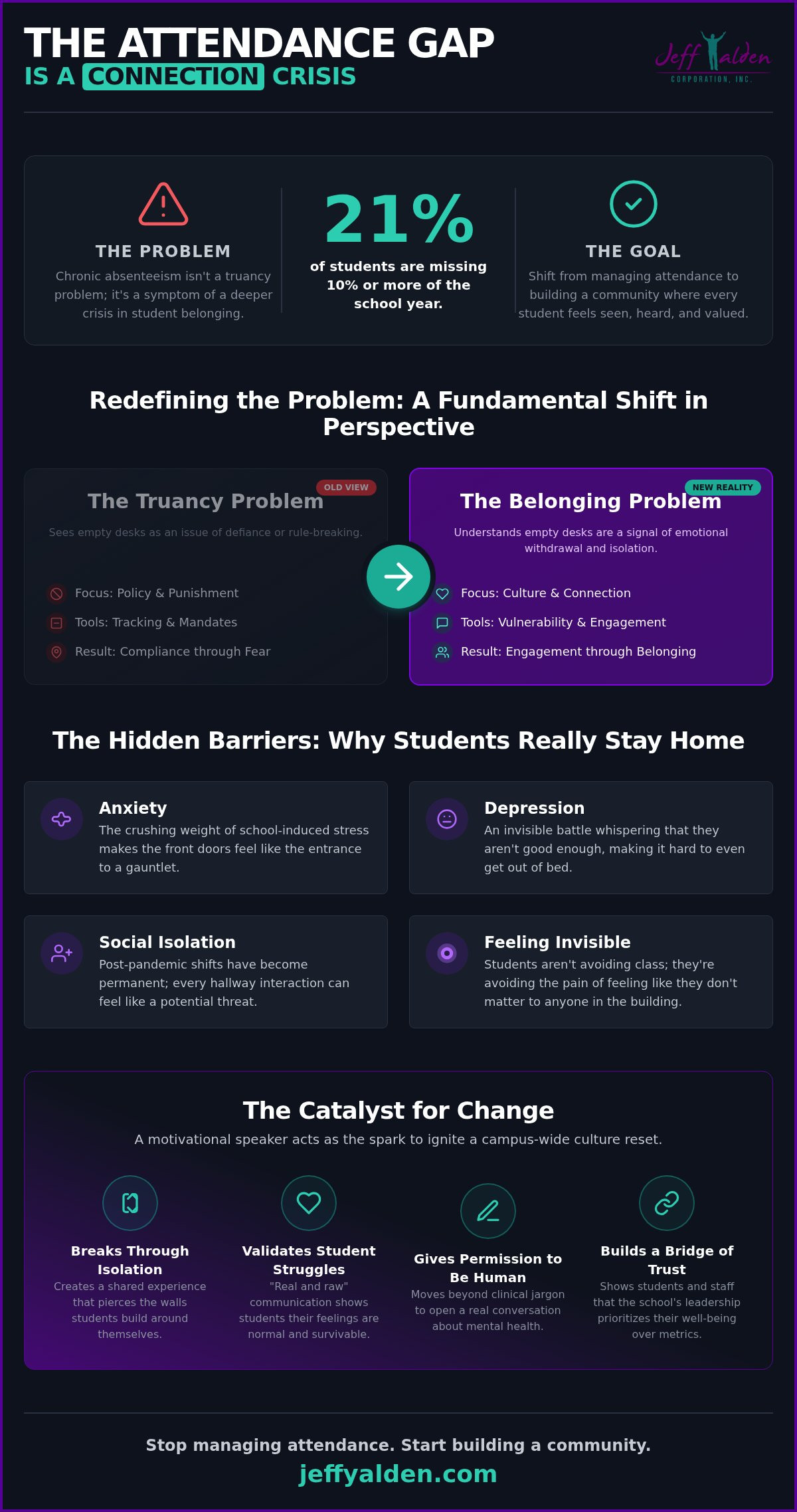
Chronic absenteeism isn’t a truancy problem; it’s a belonging problem. You didn’t become an educator to play the role of a data analyst, yet here you are, staring at reports showing that 21 percent of students are missing 10 percent or more of the school year. The pressure from state mandates is suffocating, and it’s exhausting to chase numbers while watching kids struggle with mental health challenges you can’t reach. You need more than new tracking software; you need a culture reset. Bringing in a motivational speaker to improve student attendance can be the spark that shifts your campus from a place of “have to” to a place of “want to.”
I get it because I’ve been there. I know the gut-punch of seeing empty desks and knowing those kids are slipping through the cracks. You believe every student deserves to be seen, and you’re right. This article promises a radical departure from the status quo. We’re going to stop obsessing over metrics and start winning student hearts with a culture-first strategy. You’ll learn how to bridge the mental health gap, empower your staff to lead with transparency, and implement practical strategies that move the needle. It’s time to stop managing attendance and start building a community where every kid knows they belong.
Key Takeaways
- Shift your perspective from tracking empty chairs to building a culture of belonging where every student feels seen and valued.
- Identify the hidden emotional barriers, like anxiety and withdrawal, that keep your kids from making it through the front doors.
- Discover how hiring a motivational speaker to improve student attendance can spark a campus-wide culture reset and break through student isolation.
- Move beyond cold policy mandates by implementing radical check-ins and high-impact engagement strategies for your most at-risk students.
- Learn why “real and raw” communication reaches the students in the back row more effectively than clinical or academic interventions ever will.
Redefining the Attendance Gap: It’s a Connection Crisis, Not a Truancy Problem
We’ve been looking at the wrong numbers for too long. In 2026, that 10 percent metric isn’t just a statistic; it’s a heartbeat monitor for your school’s soul. If a student misses 18 days of school, we call them “chronically absent,” but that’s just the tip of the iceberg. We’re seeing a massive shift from the old-school “skipping” to something much darker: emotional withdrawal. Kids aren’t just staying home to have fun; they’re staying home because they don’t feel like they belong anywhere. It’s raw. It’s real. And it’s happening in your hallways right now.
Pizza parties and “perfect attendance” certificates don’t work anymore. You can’t bribe a kid out of isolation with a slice of pepperoni. When you’re Defining the Attendance Gap, you have to look at the Connection Crisis. This is the root of the problem. If a student doesn’t feel a visceral connection to the people inside your building, they’ll find every reason to stay outside of it. They aren’t avoiding class; they’re avoiding the pain of being invisible.
The Reality of High School Absenteeism in 2026
The world changed, and it didn’t change back. The post-pandemic shifts in how we relate to one another have become permanent cultural fixtures. Social isolation is at an all-time high, and for many teens, the desire to attend school has been replaced by a paralyzing sense of “why bother?” Chronic absenteeism is a failure of perceived student belonging. If they don’t feel like they matter, they won’t show up. Bringing in a motivational speaker to improve student attendance can be the catalyst that breaks through that wall of silence and starts a real conversation that matters.
Why Policy Without Pulse Fails
You can’t mandate engagement. You can track every minute a kid is late, but you can’t track their heart through a spreadsheet. There is a massive difference between compliance and engagement. Compliance is a student sitting in a chair because they’re afraid of the consequences. Engagement is a student sitting in a chair because they’re afraid to miss what happens next. They need a reason to show up that isn’t on a syllabus.
It’s time to stop being a truancy officer and start being a culture architect. When you hire a motivational speaker to improve student attendance, you aren’t just checking a box for professional development. You’re making a statement that your students’ mental health and sense of connection come first. You’re building a bridge over the gap that policy alone can never fill. You’re giving them a reason to believe that school is a place where they are seen, heard, and valued.
The Mental Health Link: Why Your Students Aren’t Showing Up
Anxiety isn’t just a buzzword in a counselor’s office; it’s the primary reason your students are staring at their bedroom ceilings instead of your whiteboards. When we look at the official data on chronic absenteeism, we see a clear pattern where health challenges and student disengagement collide. It’s not just about the flu. It’s about the crushing weight of school-induced stress that makes the front doors of your building feel like the entrance to a gauntlet. If a student feels like they can’t survive the day, they won’t show up for the first bell.
We have to normalize the conversation. Students are struggling with invisible battles every single day. They’re fighting depression that whispers they aren’t good enough and social anxiety that makes every hallway interaction feel like a threat. Without the tools to navigate these emotions, every obstacle becomes a valid reason to stay home. This is where a motivational speaker to improve student attendance steps in. It’s about more than a speech. It’s about validating their struggle so they feel safe enough to return. They need to hear the real stuff. Not a filtered, clinical version of life, but the raw truth from someone who has been in the trenches and survived. That’s how you build trust.
Breaking the Silence on Campus
Real change starts when we stop pretending everything is okay. Bringing in a teen mental health speaker opens a door that has been locked for far too long. It gives students permission to be human. When your staff learns crisis intervention skills and adopts a vulnerable authority model, they stop being just instructors. They become lifeboats. Teachers who share their own imperfections create a space where students feel it’s okay to not be okay. This connection is the ultimate attendance driver. You might consider booking a youth motivational speaker to help bridge this gap between academic pressure and emotional safety.
Resilience as an Attendance Strategy
Attendance is a byproduct of grit. If we don’t focus on building resilience in teens, we are setting them up for chronic avoidance. Resilience is a learned behavior. It’s the ability to have a bad morning, take a breath, and decide to show up anyway. Schools must model this. We have to show them that a failure or a panic attack isn’t the end of the road. It’s just a pivot point. Integrating these moments into the daily school rhythm means resilience isn’t a one-time lesson; it’s the very air your students breathe. When you use a motivational speaker to improve student attendance, you’re giving them the mental armor they need to face the day.
Comparing Intervention Models: Policy vs. Radical Engagement
The 3-Tier model is the gold standard for school intervention, but let’s be honest: it often feels like a cold, clinical checklist. Tier 1 is supposed to be your universal foundation. It’s the safety net for every single student in your building. But if that net is made of generic posters and dry morning announcements, it’s going to have holes. Big ones. To actually move the needle, Tier 1 needs a Radical Transparency upgrade. You have to stop talking at students and start talking with them. It’s about the vibe, not just the rules.
The ROI of inspiration is massive. Think about it. You can send ten mailers to a home, and they’ll likely end up in the recycling bin. Or, you can bring in a motivational speaker to improve student attendance who can capture the entire student body’s attention in sixty minutes. One high-impact assembly creates a shared language. It shifts the burden of engagement from the individual teacher’s shoulders to the collective heartbeat of the school. When the energy in the room shifts, the numbers follow.
The Policy Approach vs. The Human Approach
| Data-Driven (Policy) | Relationship-Driven (Human) |
|---|---|
| Focuses on compliance and tracking. | Focuses on belonging and connection. |
| Uses punitive letters and mailers. | Uses high-energy, raw engagement. |
| Treats the symptom (absence). | Treats the cause (isolation). |
Combining research-backed metrics with high-energy engagement is how you win. You need the data to know who is missing, but you need the heart to bring them back. The Yalden Method of engagement serves as the essential bridge between Tier 1 universal support and Tier 2 targeted intervention by creating an immediate, visceral hook for every student in the room.
Empowering the Front Lines
Your teachers are tired. They feel like truancy officers instead of educators. This is why trauma-informed teaching professional development is your secret weapon for attendance. It’s not just another meeting. It’s about giving your staff the permission to be real. When teachers lead with vulnerability, they reduce their own burnout because they’re building meaningful connections rather than just managing behaviors. A motivational speaker to improve student attendance doesn’t just talk to the kids; they set the tone for the entire staff to lead with heart and resilience.
4 Radical Strategies to Reduce Absenteeism Today
You don’t need a five-year plan to start seeing empty desks fill up. You need a shift in energy right now. Waiting for policy changes or smaller class sizes is a luxury your students don’t have. These four strategies are designed to attack the connection crisis head-on by prioritizing the human being over the student ID number.
- Strategy 1: Launch a Culture Reset. Start with a high-impact event that breaks the ice. Using a motivational speaker to improve student attendance isn’t just a break from the routine; it’s a visceral declaration that your school is a place of belonging.
- Strategy 2: Implement Radical Check-ins. Move beyond the “Why were you out?” interrogation. For your Tier 2 students, try a “I’m so glad you’re here” approach. It’s about making them feel missed, not just monitored.
- Strategy 3: Transform Teacher PD. Stop talking about data and start talking about wellness. If your staff is burnt out, they can’t build the lifeboats your students need. Turn your professional development into a resilience workshop.
- Strategy 4: Use Vulnerable Storytelling. Encourage your staff to share their own struggles. When students see that the adults in the building are “real” and have overcome their own obstacles, the bridge of trust is built instantly.
Step-by-Step: The First 30 Days
The first month is about visibility. You have to identify the quietly absent; the kids who are there physically but have already checked out emotionally. Conduct a Belonging Audit. Walk the halls and ask yourself: “Who is invisible here?” This isn’t a formal survey. It’s a gut check. Use this time to schedule high school assemblies that set a new emotional tone for the entire semester. You want every kid in that room to feel like they are part of something bigger than a test score.
By the end of the first 30 days, your goal is a shift in the “vibe” of the building. When you bring in a motivational speaker to improve student attendance, you provide a shared language of resilience that students and staff can use to support one another through the hard days. If you’re ready to start this transformation, you can book a high school speaker to lead your culture reset today.
Long-Term Cultural Sustainability
Momentum is everything. To keep the fire burning after the assembly ends, you have to empower your student leaders. Let them take the lead in policing their own culture. When students start looking out for one another and noticing when a peer is missing, you’ve moved from a compliance model to a community model. This is how you move from a one-off event to a resilience-first environment. It’s about keeping the heart of the school beating long after the guest speaker has left the stage.
The Jeff Yalden Difference: Turning Attendance Around Through Heart
Clinical experts often walk into a gym with a clipboard and a script. They talk about data. They talk about brain chemistry. But they never look the kid in the back row in the eyes. That kid is the one who hasn’t been to school in three days. That kid is the one who feels like nobody would notice if they disappeared. Clinical detachment doesn’t fix a connection crisis. Heart does. If you want a motivational speaker to improve student attendance, you need someone who isn’t afraid to be human. You need someone who has been in the trenches.
Since 1992, Jeff Yalden has been the catalyst for transformation in high schools across the country. It’s not about a polished performance. It’s about radical transparency. When you show students your scars, they start to believe they can survive their own. A single day of this kind of raw communication can save an entire school year because it breaks the cycle of isolation. It changes the school from a cold institution into a place of mutual support. This is how you win the hearts of the students who have already given up on the system.
More Than a Motivational Speech
Jeff doesn’t just give a talk; he builds a lifeline. He integrates suicide prevention and mental health into every interaction. This isn’t surface-level fluff. It’s a specialized approach to resilience that addresses the core reasons kids stay home. Through his Vulnerable Authority model, Jeff leads by example. He shows that strength isn’t about being perfect; it’s about being resilient. This makes him the postvention expert schools need when a crisis hits. He knows how to help a community heal, find its footing, and get students back into the classroom with a sense of purpose.
Booking Your Culture Reset
Every school has its own unique set of ghosts. Your challenges aren’t the same as the district next door. Jeff customizes every message to hit the specific pain points of your campus. But the reset doesn’t stop with the students. To truly move the needle on attendance, you have to engage the whole community. Jeff provides sessions for parents and teachers to ensure everyone is speaking the same language of heart and resilience. This holistic approach ensures that the “vibe” shift lasts long after the assembly ends.
It’s time to stop chasing percentages and start reaching people. You have the power to change the narrative of your school. Bring Jeff Yalden to your school to reset your attendance culture today. Choosing a motivational speaker to improve student attendance is the first step toward a campus where every student knows they belong and every empty desk is a priority.
Time to Stop Tracking Absences and Start Building Belonging
The desks in your school aren’t just empty; they represent kids who feel invisible. We’ve spent years staring at data points while ignoring the emotional withdrawal happening in our hallways. You now know that fixing this isn’t about better letters or stricter policies. It’s about a culture reset. By prioritizing mental health and teaching resilience as a daily skill, you turn your building into a lifeboat. Bringing in a motivational speaker to improve student attendance is the catalyst that proves you’re serious about student hearts.
Jeff Yalden brings over 30 years of high school experience and a specialized focus on teen suicide prevention to your campus. He’s impacted millions of students worldwide by leading with the “real and raw” truth. It’s time to bridge the gap between academic pressure and emotional safety. You have the tools. You have the heart. Now, it’s time to take the first step toward a school where every student knows they matter.
Book Jeff Yalden to Transform Your School Culture and fill those empty desks with students who are ready to thrive.
Frequently Asked Questions
What is considered chronic absenteeism in high school in 2026?
Chronic absenteeism is defined as missing 10 percent or more of school days throughout the year for any reason. This includes excused absences, unexcused truancy, and even out-of-school suspensions. In a typical 180-day school year, this means a student only needs to miss 18 days to hit that critical threshold. It’s a metric used across the country to identify students who are at serious risk of falling behind both academically and socially.
How does mental health directly impact school attendance rates?
Mental health challenges like anxiety and depression act as invisible barriers that keep students paralyzed at home. When a student feels overwhelmed by social isolation or academic pressure, the school building starts to feel like a source of trauma rather than a place of learning. This emotional withdrawal leads to a cycle of avoidance. Without addressing the underlying why of their absence, traditional attendance policies often fail to reach the kids who are struggling most.
What are the most effective strategies for reducing chronic absenteeism?
The most effective strategies shift the focus from punishment to connection and belonging. Schools succeed when they implement a culture-first approach that includes radical check-ins for at-risk students and high-impact campus events. Bringing in a motivational speaker to improve student attendance can serve as the necessary spark to reset the school’s emotional climate. It’s about making students feel missed when they are gone and valued when they are present in the building.
Can a school assembly really help with attendance numbers?
A high-impact assembly does more than just fill an hour; it creates a shared language of resilience for the entire student body. It’s a powerful tool to break through the walls of isolation that many chronically absent students feel. When you hire a motivational speaker to improve student attendance, you shift the school’s vibe from a cold institution to a supportive community. This surge in engagement leads to measurable improvements in how students value their education.
How do we support teachers who are overwhelmed by absent students?
Supporting teachers means moving away from treating them like truancy officers and giving them the tools to be culture architects. Professional development that focuses on wellness and resilience helps educators manage their own burnout while building deeper connections with their students. When teachers feel empowered to lead with vulnerability, they create classrooms where students actually want to show up. It’s about shifting the burden of engagement from the individual to a collective school heartbeat.
What is the difference between truancy and chronic absenteeism?
Truancy specifically refers to unexcused absences, whereas chronic absenteeism counts every single day a student misses school. This includes excused medical absences, family emergencies, and suspensions. By looking at chronic absence, schools get a more accurate picture of how much instructional time a student is actually losing. It’s a more comprehensive way to identify which students are slipping through the cracks, regardless of whether their parents or guardians called in to the office.
How do we engage parents in the attendance conversation without being accusatory?
Engaging parents requires a shift from a punitive tone to a supportive partnership. Instead of sending cold, legalistic letters, schools should reach out with a “how can we help?” mindset. You want to frame the conversation around the student’s well-being and the resources the school can provide to bridge the gap. When parents feel like the school is a teammate rather than an adversary, they are much more likely to collaborate on getting their child back to class.
What role does student resilience play in daily attendance?
Resilience is the mental armor that allows a student to have a bad morning and still decide to show up for first period. It’s a learned behavior that helps teens navigate the anxiety and stress that often lead to school avoidance. When students are taught how to bounce back from setbacks, they stop seeing every obstacle as a reason to stay home. Building this grit through a culture of radical transparency is essential for long-term attendance sustainability.
