
What if the strongest thing a student-athlete could do after a setback wasn’t push harder, but speak up and reach for support? Sport can teach discipline and grit, but students may also feel pressure to hide pain, exhaustion, or fear to stay in the game. A resilience speaker for student athletes can offer more than a burst of motivation. The message should give young people practical ways to respond to setbacks, talk honestly about challenges, and see themselves as more than their performance.
Coaches and schools want students to keep showing up, but not at the cost of their well-being. Real resilience isn’t pretending everything’s fine or measuring your worth by wins. It grows through everyday choices, supportive teammates, trusted adults, and a school culture where asking for help is a strength.
In this article, you’ll learn what meaningful resilience looks like for student-athletes, how schools and teams can reinforce it, and what to look for in a speaker. We’ll explore ways to connect sport, school, identity, and well-being, and how Jeff Yalden’s school assemblies can open candid conversations beyond the game.
Key Takeaways
- Recognize resilience as adapting, learning, and seeking support, not hiding difficult emotions or pushing through every warning sign.
- Use simple habits to help student-athletes reflect, reset, reconnect, and ask for support when pressure builds.
- Look for a resilience speaker for student athletes who offers practical guidance and honest conversation, not empty hype.
- Help an assembly’s message carry forward by preparing students, making space for reflection, and connecting them with trusted adults and school support.
- Explore how Jeff Yalden’s high school and middle school assemblies can open candid conversations about resilience and student well-being.
What does resilience mean for student athletes beyond bouncing back after a loss?
Student-athletes can feel pressure to perform, recover quickly, and keep personal struggles out of sight. There may be practice after class, competition on the calendar, and a sense that teammates or coaches are counting on them. A loss is only one kind of setback. A mistake that lingers, a changed role, academic demands, conflict with a friend, or the transition out of a sport can also challenge an athlete’s confidence and sense of direction.
Resilience doesn’t promise that every hard moment will end in a win. It means adapting, learning, and reaching for support while facing difficulty. Psychological resilience is often understood as a process, not simply a fixed personal trait. For student-athletes, that process can include acknowledging what’s hard, choosing a next step, and drawing on people and resources around them.
Resilient recovery means recognizing that something hurts and finding a healthy way forward, not pretending nothing hurts. That distinction lets athletes be honest without treating struggle as failure.
Why student athletes face pressures beyond the scoreboard
Different demands can pile up: classes and assignments, training and travel, competition, friendships, family expectations, and pressure to earn or keep a place on the team. When selection, performance, or team status becomes closely tied to an athlete’s identity, a disappointing result can feel like a verdict on their whole life. Yet athletes don’t all experience these pressures in the same way. Their circumstances, support systems, and needs differ.
Resilience is not the same as never struggling
Persistence has value, but ignoring pain, exhaustion, or emotional distress isn’t proof of strength. Those signals deserve attention. An athlete can talk with a trusted adult, coach, family member, or appropriate school support when a challenge feels too heavy to manage alone. Asking for help is a constructive response, not a betrayal of commitment.
Learning from difficulty might mean reviewing a mistake without turning it into a judgment about your worth, or adjusting your plan when your role changes. It can also mean recognizing that the next step is rest, a conversation, or support rather than pushing harder. A resilience speaker for student athletes should make this clear: resilience is a set of responses students can practice, not a demand to suppress emotion or guarantee a particular outcome.
That’s a useful standard for schools, teams, and students. Strength can include effort and persistence, but it also includes self-awareness and connection. When young people hear that they can respond to struggle with support and intention, resilience becomes more than a slogan. It becomes a way to move through setbacks without reducing themselves to a score, a starting position, or one difficult season.
How do student athletes build resilience through habits, identity, and team support?
Resilience develops in the moments between major events: the reset after a mistake, the honest conversation after a rough practice, or the choice to rest instead of ignoring exhaustion. These actions don’t guarantee wins or erase pressure. They give student-athletes practical ways to face difficult moments without facing them alone.
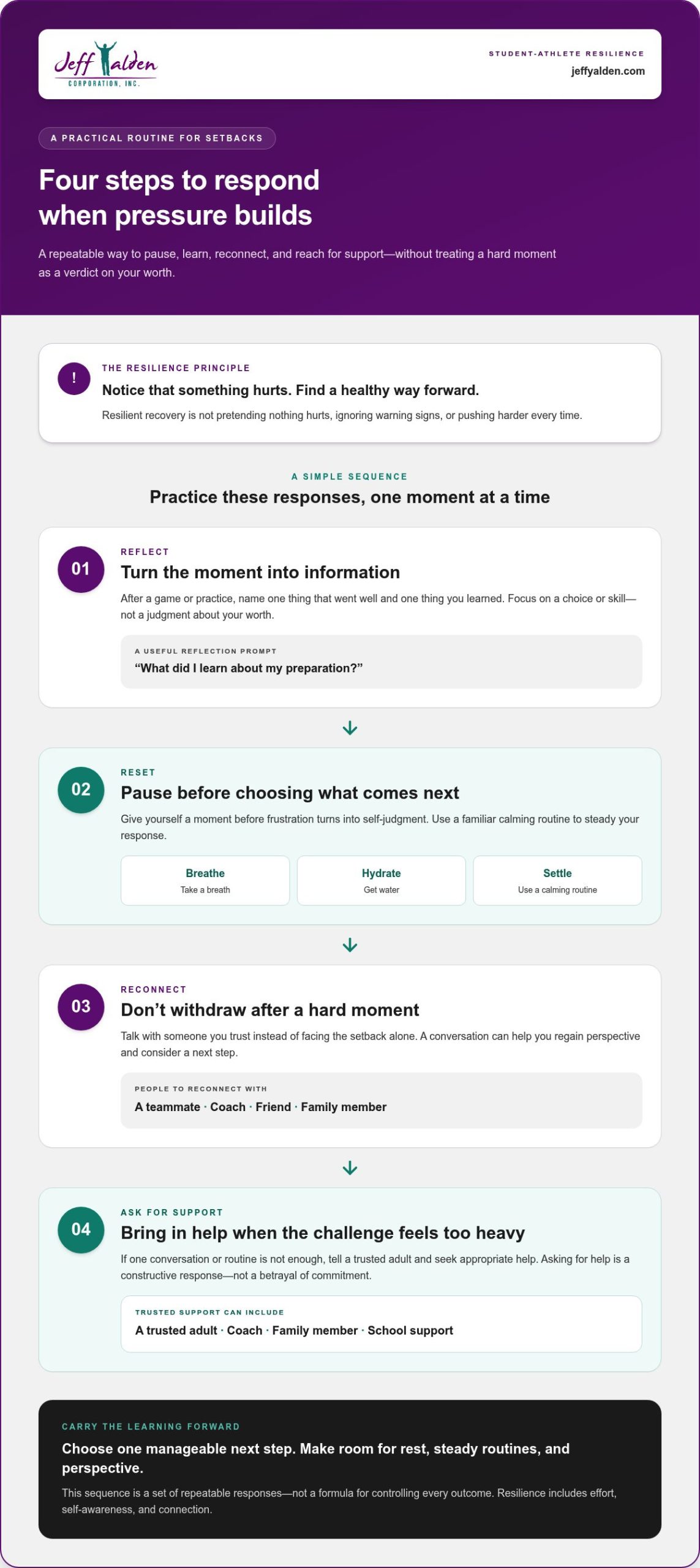
A simple routine can help an athlete pause before frustration turns into self-judgment. Try this sequence:
- Reflect. After a game or practice, name one thing that went well and one thing you learned. Focus on a choice or skill, not a verdict on your worth.
- Reset. Take a breath, get water, or use a familiar calming routine before deciding what to do next.
- Reconnect. Talk with a teammate, coach, friend, or family member instead of withdrawing after a hard moment.
- Ask for support. If the challenge feels bigger than one conversation or routine can handle, tell a trusted adult and seek appropriate help.
These are repeatable responses, not a formula for controlling every outcome. The NCAA Student-Athlete Health and Wellness Study offers context on student-athlete well-being and the pressures athletes can face. Resilience isn’t built only in competition. It’s also shaped by whether students have room to care for their health, relationships, schoolwork, and sense of self.
Small habits that help athletes respond to setbacks
A short post-game reflection can turn a difficult result into useful information. An athlete might ask, “What did I learn about my preparation?” or “What’s one thing I can work on next?” Then they can choose one manageable step, such as reviewing a play, talking with a coach, or organizing an assignment. Rest and steady routines belong in the plan, too. Sustainable effort includes recovery and perspective, not constant intensity.
For ideas that apply beyond sports, Jeff Yalden’s guide to building resilience in teens explores ways young people can respond to challenges and keep growing.
How team culture shapes a student athlete’s willingness to speak up
Habits are easier to practice when athletes feel safe being honest. A coach who listens without shaming a student for admitting they’re overwhelmed can make it easier to raise concerns early. Teammates can help, too. They can notice when someone seems unusually withdrawn, invite them into a conversation, and check in privately instead of making their struggle a joke.
A supportive team doesn’t demand that athletes handle everything alone; it makes asking for help part of looking out for one another. That culture takes consistent action, not just a slogan. Coaches can respond respectfully when students speak up, and peers can show that belonging isn’t earned only through performance. A resilience speaker for student athletes can reinforce these ideas, while everyday team choices help put them into practice. Jeff Yalden’s school assemblies open candid conversations about resilience and student well-being, giving schools a starting point for reflection and connection.
Resilience or “tough it out”: what should a student-athlete speaker actually teach?
“Play through it” can sound like commitment. But when it teaches students to ignore pain, exhaustion, or emotional distress, it confuses persistence with self-neglect. A student-athlete speaker should make room for effort and honesty at the same time. A student can care deeply about the team and still say, “I’m hurt,” “I’m overwhelmed,” or “I need help figuring out what comes next.”
The message matters because students may believe they have to earn belonging through performance. A missed shot, a place on the bench, or a difficult season doesn’t erase someone’s value. Help-seeking shouldn’t depend on whether a student is winning, starting, or meeting someone else’s expectations. A strong assembly reinforces that students are people first, athletes second.
A helpful resilience message shows student-athletes how to face pressure with honesty, practical choices, and support, not silence or shame. That’s the difference between useful guidance and a temporary rush of hype. One says, “You can name what’s hard and choose a next step.” The other says, “Stop feeling it and push harder.”
Signs a resilience message offers more than a temporary motivational rush
Look for takeaways students can use after the assembly: questions for reflection, a way to pause before reacting, or language for starting a conversation with a trusted adult. The speaker should acknowledge setbacks without suggesting that students must endure distress to become stronger. The message should also recognize the whole person, including school, relationships, interests, and life beyond sport.
When choosing a resilience speaker for student athletes, listen for what students are invited to do, not just how loudly they’re encouraged to feel. Does the message offer a realistic next step after a mistake or tough day? Does it leave room for different experiences, including students who feel connected to their sport and those questioning their place in it? Specific, age-appropriate guidance gives students something to carry into everyday life.
How to discuss pressure without reinforcing harmful expectations
Slogans like “silence is strength” or “winning proves your worth” can make students less likely to share what they’re carrying. Better guidance shows that commitment can include naming a struggle, talking with a coach or trusted adult, and following school support pathways when more help is needed. Students should understand that a speaker can encourage reflection and conversation, while ongoing support belongs within the school’s established resources.
- Useful: “I’m frustrated about my role. Can we talk about what I can work on?”
- Less useful: “If I admit I’m struggling, I’ll let everyone down.”
The first statement doesn’t guarantee a changed role or an easy answer. It gives the student a constructive way to communicate. That’s what a grounded resilience message offers: not a promise that hardship disappears, but permission and practical language to respond without tying personal worth to the scoreboard.
How can schools and teams reinforce resilience after a student-athlete assembly?
An assembly can open a door. What happens next helps students see whether the message belongs in everyday school life. Coaches, educators, and school leaders can build that bridge by preparing students, connecting the talk to their community, inviting reflection, and keeping support visible.
A resilience speaker for student athletes can share a message, prompt conversation, and give students language for thinking about challenges. The speaker doesn’t replace ongoing support from school staff or established student services. A powerful assembly is a starting point, not a complete support plan.
Before the event: connect the assembly to school and team needs
Start with a conversation among school leaders, coaches, and educators about what students are facing as a group. Identify relevant themes, such as transitions, team belonging, pressure, or balancing school and sport, without sharing private details about individual students. Agree on language that supports honest conversation and doesn’t frame struggle as weakness. Set expectations for respectful participation, and make sure staff know how students can access existing support afterward.
After the event: keep the conversation open
Give students a low-pressure way to reflect soon after the assembly. A brief team meeting, advisory discussion, or classroom check-in can turn a broad idea into a next step. Students can write privately, share with a partner, or pass. Participation should feel inviting, not like a demand to disclose personal experiences in front of the group.
Coaches and educators can use simple, nonjudgmental questions to keep the door open:
- “What idea from the assembly stayed with you?”
- “What could make it easier to ask for support on this team?”
- “Would you like to talk now, or connect with someone else at school?”
Listen without rushing to fix the situation or turning a student’s answer into a public lesson. Remind students which trusted adults and school support pathways are available, and follow the school’s established policies when a concern needs additional attention. Staff should also know their roles and appropriate next steps. A speaker’s message doesn’t take the place of that system.
Keep checking in. A single conversation can be meaningful, but it shouldn’t be treated as proof that every student is fine or as the end of the school’s responsibility. Coaches might revisit the assembly’s themes during regular team conversations, while educators can connect them to classroom culture and student well-being. Adapt follow-up to the school’s policies, resources, and age groups.
Jeff Yalden’s high school and middle school assemblies address resilience and student well-being, helping schools open candid conversations that connect with wider support across the community. Explore Jeff Yalden’s school assemblies as one way to bring that conversation to your school.
What can a resilience speaker for student athletes bring to a school community?
A strong assembly can help students connect the pressures they experience in sport with the wider realities of school, relationships, identity, and mental health. It gives the community a chance to talk plainly about setbacks and well-being, rather than leaving students to guess which struggles are safe to share. For student-athletes, that message can matter on the field, in the classroom, and beyond the season.
Jeff Yalden speaks at high school and middle school assemblies about resilience and student well-being. His candid approach helps schools open conversations that include athletes without treating them as only athletes. The aim isn’t to promise a particular outcome or replace ongoing support. It’s to create a meaningful starting point for students and the adults who support them.
What students and school leaders should take away
Students should hear that one loss, mistake, changed role, or difficult season doesn’t define their worth or determine their future. They can care about competition and still be more than their performance. That perspective makes room for each student’s experience, whether they’re thriving in their sport, feeling uncertain about their place, or working through a challenge others can’t see.
School leaders can treat the assembly as an opening, then make time for continued conversation through existing school and team structures. Coaches and educators can carry the message into everyday interactions with supportive check-in questions such as, “How are you doing beyond practice?” or “Would talking with someone here help?” Consistent, respectful conversations make student well-being part of the culture, not a topic raised only during a special event.
Jeff’s high school assembly approach connects candid communication with campus culture, while his teen mental health speaking addresses breaking silence and supporting resilience. Together, these themes can help schools frame the conversation around students as whole people, not just competitors.
Bring an honest resilience conversation to your school
A resilience speaker for student athletes can bring energy and perspective to a school gathering, but the deeper value lies in how the message fits the community. When resilience, mental health, and student well-being are discussed openly, students may find it easier to name what they’re facing and recognize the adults and school resources available to support them. Those conversations should continue through the school’s established support systems.
Jeff Yalden’s high school and middle school assemblies create space for candid conversations about resilience and student well-being. School leaders can connect the assembly’s themes to their students’ needs and the culture they want to build. No single event does the work of an entire community, but it can help get an important conversation moving.
Bring Jeff Yalden to your school and start a conversation about an assembly focused on resilience and student well-being.
Make resilience part of the culture you build next
The next step isn’t asking student-athletes to carry more pressure. It’s creating a school culture where they can be driven, honest, and supported at the same time. A well-matched resilience speaker for student athletes can help open that conversation, while the way adults listen and respond gives it room to continue.
Jeff Yalden delivers high school and middle school assemblies focused on resilience and student well-being. His work also includes teacher professional development and community programs, extending the conversation beyond the assembly and into the wider school community. These efforts complement support already provided by school staff and established student services.
You don’t have to wait for a difficult season to make well-being part of the conversation. Start with one clear intention: help students know they matter beyond their performance, and make it easier for them to speak with someone they trust. Bring Jeff Yalden to your school and take a meaningful step toward a community where young people can grow through challenges together.
Frequently Asked Questions
Can a student athlete be resilient and still ask for help?
Yes. Asking for help can be a thoughtful way to keep moving toward a goal while taking a concern seriously. A student might tell a trusted adult, “I want to stay involved, but I’m having a hard time managing everything.” They can also ask that person to help identify a useful next step, such as talking with a coach or finding the right school support. Speaking up isn’t giving up.
How can parents support a student athlete after a disappointing performance?
Start by listening, not replaying every moment of the game. Your child may need time to cool down before talking, so ask whether they’d prefer company, quiet, or a conversation later. Remind them that one result doesn’t define who they are. When they’re ready, ask what kind of support would help. If distress continues or affects daily life, help them connect with a trusted adult or appropriate school support.
What can a student athlete do when sports no longer feel enjoyable?
They can begin by noticing what feels different, without forcing an immediate decision about quitting or staying. Is the change connected to pressure, fatigue, conflict, injury, or demands outside sport? Naming what’s going on can make a conversation with a trusted adult or coach more specific. If distress persists, a school support professional or appropriate mental health professional can help the student consider what support may be useful.
How can an athlete rebuild confidence after making a mistake?
They can separate the mistake from their identity and look at the moment with curiosity rather than blame. For example, was the issue preparation, communication, or a decision made under pressure? A coach may help put the play in context, while a teammate can offer perspective. The athlete can then choose one skill to focus on next time. One error is information to learn from, not a verdict on talent or potential.
What should a student athlete do if team pressure is affecting schoolwork?
They can describe the specific conflict to a trusted adult, such as having practice when a major assignment is due or feeling unable to keep up with several commitments. A coach, family member, or school counselor may help them consider priorities and available school supports. The student doesn’t have to solve the whole schedule alone. If stress continues or affects well-being, reaching out for appropriate professional support is a responsible choice.
How can schools include student athletes in a resilience assembly?
Make the message relevant to sport without assuming every athlete has the same experience. A resilience speaker for student athletes can connect competition with belonging, identity, and life beyond a team, while examples from classrooms and other activities help the wider student body feel included. Offer students options to reflect privately or participate without sharing personal details. Coaches and educators can then use the same themes in everyday conversations.
