
What if the “bad attitude” and explosive anger you are seeing isn’t rebellion, but a desperate cry for help? We often mistake a boy’s rage for simple teenage angst, but the radical truth is that the signs of teen depression in boys are frequently masked by a “wall of silence” or a hair-trigger temper. You are not alone in feeling confused. You are definitely not failing because you can’t “get through” to him right now. It’s a heavy weight to carry when the boy you love starts feeling like a total stranger.
I know that fear. I know the gut-punch of watching your son or student retreat into a shell where you aren’t invited. It’s terrifying to feel like you are losing him to a darkness you can’t even name. In this guide, I’m going to give you the tools to break that silence and identify the hidden symptoms that clinical textbooks often miss. You will gain a clear understanding of boy-specific depression and the confidence to start a real conversation without him shutting down. We’re going to look at why his pain looks like aggression, how to bridge the gap, and exactly when it’s time to seek professional intervention. Let’s get real about what is happening beneath the surface.
Key Takeaways
- Stop mistaking rage for rebellion and start identifying the real signs of teen depression in boys that hide behind explosive fuses and irritability.
- Uncover the “Boy Code” that keeps young men silent and learn why social withdrawal is a massive red flag you cannot afford to ignore.
- Get crystal clear on the “Three Ds” to determine if his behavior is normal teen moodiness or a clinical situation that requires immediate action.
- Learn the “Shoulder-to-Shoulder” method to spark a real conversation and break through the wall of silence without him shutting down.
- Build a powerhouse support team using school resources and mentors to transition from managing a crisis to fostering true resilience.
Beyond Sadness: Why Depression in Boys Often Looks Like Anger
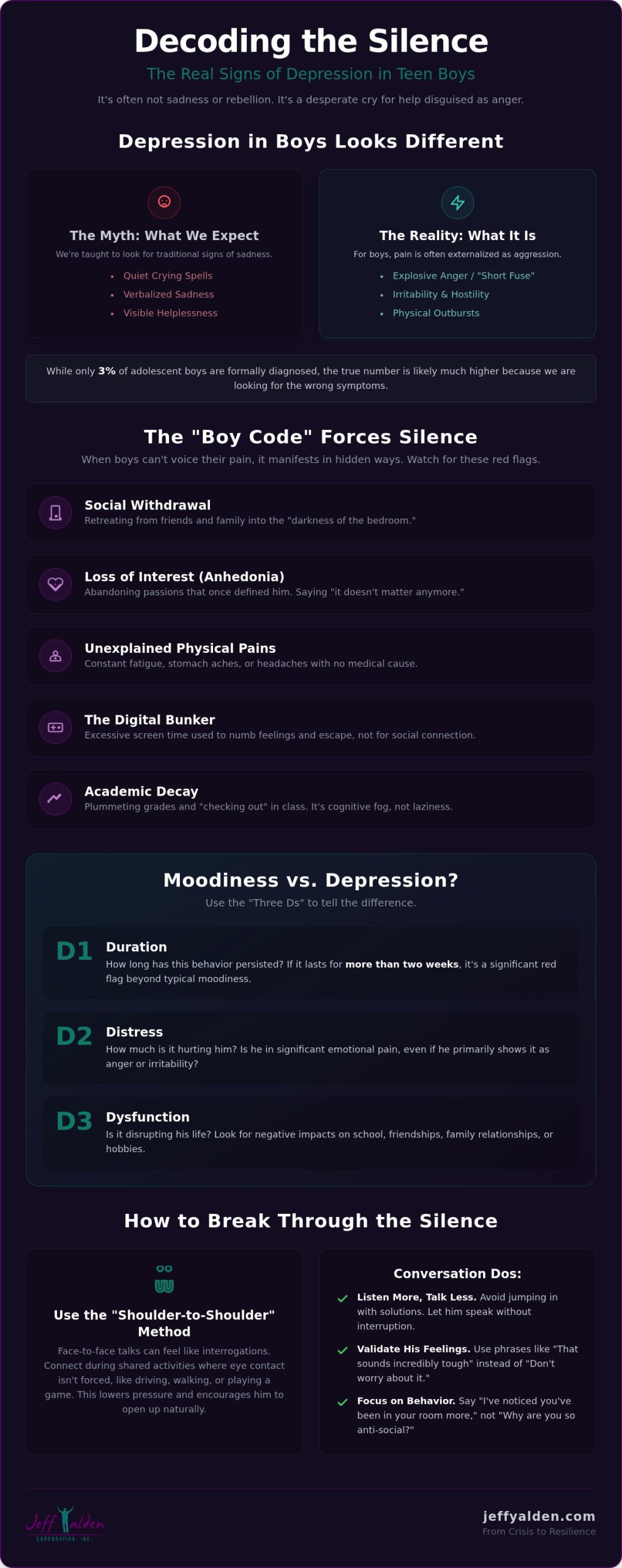
Forget the image of a kid crying quietly in a corner. That is not what I see in the trenches. For many young men, depression doesn’t look like tears; it looks like a fist through a wall. It looks like a “get out of my room” shouted at the top of his lungs. We have to redefine how we view Depression in childhood and adolescence because the old clinical guides are failing our sons. They tell us to look for sadness. In reality, the signs of teen depression in boys are often explosive fuses rather than crying spells. Even though the CDC reported in 2025 that 3% of adolescent males are diagnosed with depression, the real number of boys suffering is likely much higher because we are looking for the wrong symptoms.
Boys are conditioned to believe that vulnerability is a death sentence. They don’t “act in” by reflecting or weeping; they “act out.” They turn that internal agony into external fire. It’s a protective shell. If he’s angry, he feels in control. If he’s sad, he feels like a victim. He will choose anger every single time because it feels safer than being broken. We have to stop seeing the “short fuse” as a discipline issue and start seeing it as a desperate cry for help.
The Aggression Mask
When a boy feels like his life is spiraling, he grabs for the only weapon he has left: hostility. You see a hair-trigger temper. You see uncharacteristic defiance or slamming doors. You might think it’s just “boys being boys” or a phase of rebellion. It isn’t. It’s a survival strategy. These physical outbursts are the raw manifestations of a heart that’s drowning. He isn’t trying to be a “bad kid.” He’s trying to feel anything other than the crushing weight of hopelessness. Anger is the mask that protects him from the world seeing his pain.
The Loss of Interest (Anhedonia) in “Boy Language”
Watch for the shift in his eyes. It’s more than just being a moody teenager; it’s the slow death of his passions. When a kid who lived for the football field or stayed up late gaming with his brothers suddenly says “it doesn’t matter,” you need to listen. This isn’t a phase. It’s anhedonia. In “boy language,” total withdrawal is a retreat into a fortress where the world can’t reach him. If he’s abandoning the hobbies that once defined his identity, he’s signaling that he’s losing his grip. Recognizing these signs of teen depression in boys means looking past the silence to see the white flag he’s waving.
The “Boy Code” and the Hidden Symptoms of Withdrawal
“Man up.” “Don’t be a sissy.” These aren’t just words; they are the bars of a cage. The “Boy Code” forces young men to bury their pain under a mountain of stoic silence. When they can’t speak their truth, they disappear. One of the most dangerous signs of teen depression in boys is this sudden, heavy withdrawal. It’s a move from being the “life of the party” to living in the “darkness of the bedroom.” They aren’t just being “moody.” They are retreating because the world feels like too much to handle and they don’t have the permission to say so.
He won’t tell you his heart is breaking. Instead, he’ll tell you his stomach hurts. He’ll complain about being tired all the time, even after ten hours of sleep. These physical complaints are often the only way his body knows how to voice the struggle. According to the National Institute of Mental Health, Teen Depression: More Than Just Moodiness often manifests in these somatic ways. If your son is suddenly plagued by aches and pains with no clear medical cause, pay attention. His body is sounding the alarm that his mind can’t. He is following the code: stay strong, stay silent, and don’t let them see you crack.
The Digital Bunker
Gaming used to be social. Now, it’s a numbing agent. He’s not playing to win; he’s playing to forget. You see him in a “zombie state,” staring at a screen for hours, disconnected from reality. This excessive screen time is a digital bunker. It’s where he hides when social anxiety and feelings of unworthiness take over. He’s swapping real-world connection for a low-stakes digital existence because he doesn’t have the energy to face his actual life. It’s a numbing mechanism, not a hobby.
Academic Decay and “Checking Out”
Teachers see it first. The kid who used to be engaged is now a ghost in the back of the room. Grades don’t just slip; they plummet. This isn’t laziness. It’s cognitive fog. Depression robs the brain of executive function. Missing assignments and “checking out” are secondary signs of teen depression in boys that scream for intervention. He isn’t failing his classes; he’s failing to stay afloat. Breaking this cycle requires more than just a lecture. It takes a bridge. Sometimes a Youth Life Coach can reach a boy in a way a parent or teacher can’t, helping him rewrite that internal code and find his voice again.
Normal Teen Moodiness vs. Clinical Depression: Where is the Line?
Is he just being a moody teenager or is something deeper happening? This is the question that keeps parents up at 2 AM. To find the answer, we have to look past the surface. We use the Three Ds: Duration, Degree, and Deviation. These aren’t just clinical checkboxes. They are life-saving markers. First, look at Duration. We all have bad days. But if the darkness has lasted for two weeks or more, it’s no longer a “phase.” That two-week mark is the baseline for clinical concern. It means the brain is stuck in a loop it can’t break on its own.
Next, look at Degree. How much is this behavior interfering with his life? If he’s stopped showering, if his grades have tanked, or if he’s stopped eating, the degree of impact is severe. Finally, look at Deviation. Compare him to his baseline personality from a year ago. Is the kid you see today a complete stranger? If he’s deviated significantly from who he was, you aren’t seeing “growth.” You are seeing the signs of teen depression in boys taking hold of his identity. For more detailed clinical context, you can review Teen depression – Symptoms and causes.
The Sleep and Appetite Shift
Sleep is the first thing to go. You’ll see hypersomnia, where he sleeps all day to escape reality, or insomnia, where he’s up all night ruminating on his failures. His appetite will follow suit. He might stop eating entirely or start bingeing on junk to numb the pain. The lethargy cycle in depressed teen boys creates a self-sustaining loop where physical exhaustion feeds emotional hopelessness, making even the simplest tasks feel like climbing a mountain. This isn’t laziness. It’s a body under siege.
The Danger Zone: Risk-Taking and Self-Medication
When a boy feels numb, he’ll do anything to feel a spark. This leads to the Danger Zone. You might see impulsive behaviors, reckless driving, or early signs of substance use like vaping and alcohol. He isn’t trying to be a rebel. He’s trying to self-medicate a pain he can’t name. These behaviors are massive red flags that the situation is escalating toward a crisis. If you see him spiraling, you need to look into Teen Suicide Prevention Programs: A Radical Approach to Saving Lives in 2026. Don’t wait for him to “grow out of it.” These signs of teen depression in boys are an urgent call for you to step in and lead him back to the light.
Breaking the Silence: Talking to a Hurting Teen Boy
Talking to a boy in crisis feels like trying to diffuse a bomb while wearing a blindfold. If you’ve spotted the signs of teen depression in boys, your gut instinct is probably to sit him down, look him in the eye, and demand to know what is wrong. Stop. Don’t do that. To a boy, intense eye contact feels like an interrogation. It triggers his “fight or flight” response and causes that wall of silence to shoot up even higher. Instead, use the “Shoulder-to-Shoulder” Method. Connect while you are doing something else. Wash the car. Shoot hoops. Walk the dog. When the pressure of a direct stare is removed, the truth finally has room to breathe.
You have to model radical transparency if you want him to open up. Use “I” statements. Instead of asking “Why are you so angry?” try saying, “I’ve noticed you haven’t been yourself lately, and I’m worried because I love you.” Then, do the hardest thing imaginable: shut up. Let the silence do the work. We often rush to fill the quiet because it makes us uncomfortable, but that silence is where he processes his thoughts. When he does speak, validate his pain without trying to “fix” it immediately. If he says he feels like a failure, don’t argue with him. Say, “That sounds incredibly heavy to carry.” He needs to know you can handle his darkness before he’ll let you lead him to the light.
The Drive-Time Talk
The car is your greatest weapon for high-stakes emotional conversations. It is the ultimate “third object” environment. You are both looking at the road. The music provides a buffer. It creates a safe space where the tension is naturally lower. Use that specific opening line: “I’ve noticed you haven’t been yourself lately, and I’m here for it. No judgment, just here.” If he stays silent, let it be. You’ve planted the seed that you are a safe harbor. You’ve shown him that you see the signs of teen depression in boys without making him feel like a project to be solved.
Normalizing the Struggle
Lower his guard by sharing your own imperfections. Mental health isn’t about being “broken.” It’s about “mental fitness.” We train our bodies in the gym; we have to train our minds to handle the weight of the world. By positioning the struggle as a challenge to be conquered rather than a defect, you empower him. This is the foundation for Building Resilience in Teens: The Radical Truth About Bouncing Back in 2026. Sometimes, a boy needs to hear the truth from someone who has been in the trenches. If you are ready to bring a high-energy, life-changing message to your community, hiring a Teen Mental Health Speaker can be the catalyst that finally breaks the silence for good.
Taking Action: From Crisis Intervention to Building Resilience
Identifying the signs of teen depression in boys is the first step. Now, we move. We act. You cannot carry this weight alone, and neither should he. It takes a village, but not just any village. You need a powerhouse team of school counselors, coaches, and mentors who speak his language. This is the “Team Approach.” When a boy sees that the men he respects are all on the same page, his wall of silence starts to crumble. He begins to realize that seeking help isn’t a sign of weakness. It’s a sign of strength.
We also have to talk about “Postvention.” It is a word most people avoid, but it is vital. Supporting a community after a mental health crisis isn’t just about cleaning up the mess. It is about healing the collective soul. We ensure that one crisis doesn’t lead to a domino effect of despair. We build a “Resilience Roadmap” through one-on-one youth life coaching. This isn’t just talk; it is a strategic plan to help him find his feet and keep moving forward. We turn his pain into a platform for growth.
When to Call in a Professional
Sometimes, the situation escalates beyond a heart-to-heart talk. If you see red flags like self-harm or talk of suicide, you don’t wait. You call in a professional immediately. You need to know the difference between a life coach and a clinical therapist. A therapist dives into the “why” of the past; a Youth Life Coach focuses on the “how” of the future. Both are essential. If he is in immediate danger, a clinical setting is non-negotiable. If he is ready to build a life he is proud of, coaching is the spark. Check out how a Teen Mental Health Speaker: Breaking the Silence and Building Resilience in 2026 can help bridge that gap.
Bringing the Conversation to Your School
One of the fastest ways to change the narrative is to bring the truth to the masses. Jeff Yalden’s High School Assemblies are designed to blow the doors off the “Boy Code.” When a thousand kids hear someone speak the raw truth about struggle, the shame evaporates. It isn’t just for the students, though. Teacher professional development is the backbone of a safe campus. We equip staff to spot the signs of teen depression in boys before they become a headline. It is about being proactive, not reactive. Ready to change the culture? Book Jeff Yalden for your next school assembly or community event. Let’s get to work.
Breaking the Silence and Leading Him Home
You now have the eyes to see what most people miss. You know that his explosive anger and his retreat into the digital bunker aren’t just phases; they are the signs of teen depression in boys screaming for your attention. We have to stop waiting for them to “man up” and start showing them how to “speak up.” By using the shoulder-to-shoulder method and validating his pain without jumping to a quick fix, you are building the bridge he needs to cross back to safety. It’s about moving from a state of constant crisis to a future of sustained resilience.
I bring over 30 years of high school assembly experience to this fight. As a nationally recognized suicide prevention expert voted the #1 Youth Motivational Speaker in North America, I’ve seen the transformation that happens when we finally normalize the struggle. You are the advocate he needs right now. Let’s work together to turn his pain into a platform for growth.
Bring Jeff Yalden to your school to start the conversation that saves lives.
There is hope on the other side of this darkness. Your son or student is still in there. Let’s go get him.
Frequently Asked Questions
How is depression in boys different from depression in girls?
Boys tend to externalize their pain through anger and aggression, while girls often internalize it through sadness and withdrawal. While girls might talk about their feelings, boys are conditioned to hide them. This makes identifying the signs of teen depression in boys much harder because their symptoms look like behavior problems. You see a “bad kid” instead of a hurting one. Girls might cry; boys might pick a fight or smash a phone.
What are the most common physical signs of depression in teen boys?
Chronic fatigue, unexplained stomach aches, and major changes in sleep patterns are the most frequent physical indicators. He might sleep for twelve hours and still feel exhausted, or he might pace the halls at 3 AM. You’ll also see changes in appetite, either eating everything in sight or skipping meals entirely. These somatic symptoms are real physical pain caused by mental agony. He isn’t faking it to skip school; his body is under intense stress.
Can gaming or social media cause depression in teenage boys?
Digital platforms don’t always cause depression, but they act as a massive numbing agent and a source of toxic comparison. The U.S. Surgeon General warned in 2023 that teens spending over 3 hours a day on social media face double the risk of poor mental health outcomes. Gaming becomes a bunker where he hides from real world failures. It’s a symptom of his withdrawal, creating a loop of isolation that makes recovery feel impossible without a radical intervention.
What should I do if my son refuses to go to therapy?
Start by changing the environment and the terminology you use. If he views therapy as “being broken,” he will fight it. Try a Youth Life Coach or a mentor who focuses on “mental fitness” and future goals rather than past trauma. Sometimes a “shoulder to shoulder” talk in the car is more effective than a clinical office. Don’t force the issue immediately; instead, bring in a relatable authority figure who has lived through similar struggles to build trust first.
Is irritability a normal part of puberty or a sign of depression?
The difference lies in the “Three Ds”: Duration, Degree, and Deviation. Normal puberty involves mood swings that come and go quickly. Depression is a persistent dark cloud that lasts for two weeks or more. If his irritability is so severe that it’s destroying his relationships or stopping him from doing things he loves, it’s not just hormones. It is one of the primary signs of teen depression in boys that requires a professional check in.
How can teachers identify a depressed male student who isn’t disruptive?
Look for the “quiet disappearance” rather than the loud outburst. This student is the one who has stopped turning in assignments, avoids eye contact, and sits in the back of the room like a ghost. He might have been a high achiever who suddenly stopped caring about his future. Academic decay and a lack of hygiene are major red flags. He’s not being lazy; he’s experiencing cognitive fog that makes basic tasks feel like moving mountains.
What is the “Boy Code” and how does it affect mental health?
The “Boy Code” is an unwritten set of societal rules that demands boys be stoic, silent, and physically strong at all costs. It teaches them that vulnerability is a weakness and that “real men” don’t ask for help. This code creates a pressure cooker of suppressed emotions. When a boy can’t speak his truth, he explodes or implodes. Breaking this code is the only way to reach him and start the healing process.
What are the warning signs that a teen boy is thinking about suicide?
Pay attention to “giving away” prized possessions, sudden calmness after a long period of depression, or direct talk about being a burden. He might say things like “You’d be better off without me” or “I just want the pain to stop.” Any talk of self harm or hopelessness is a crisis. Don’t be afraid to ask him directly if he has a plan. Asking the question won’t “put the idea in his head”; it might save his life.
