
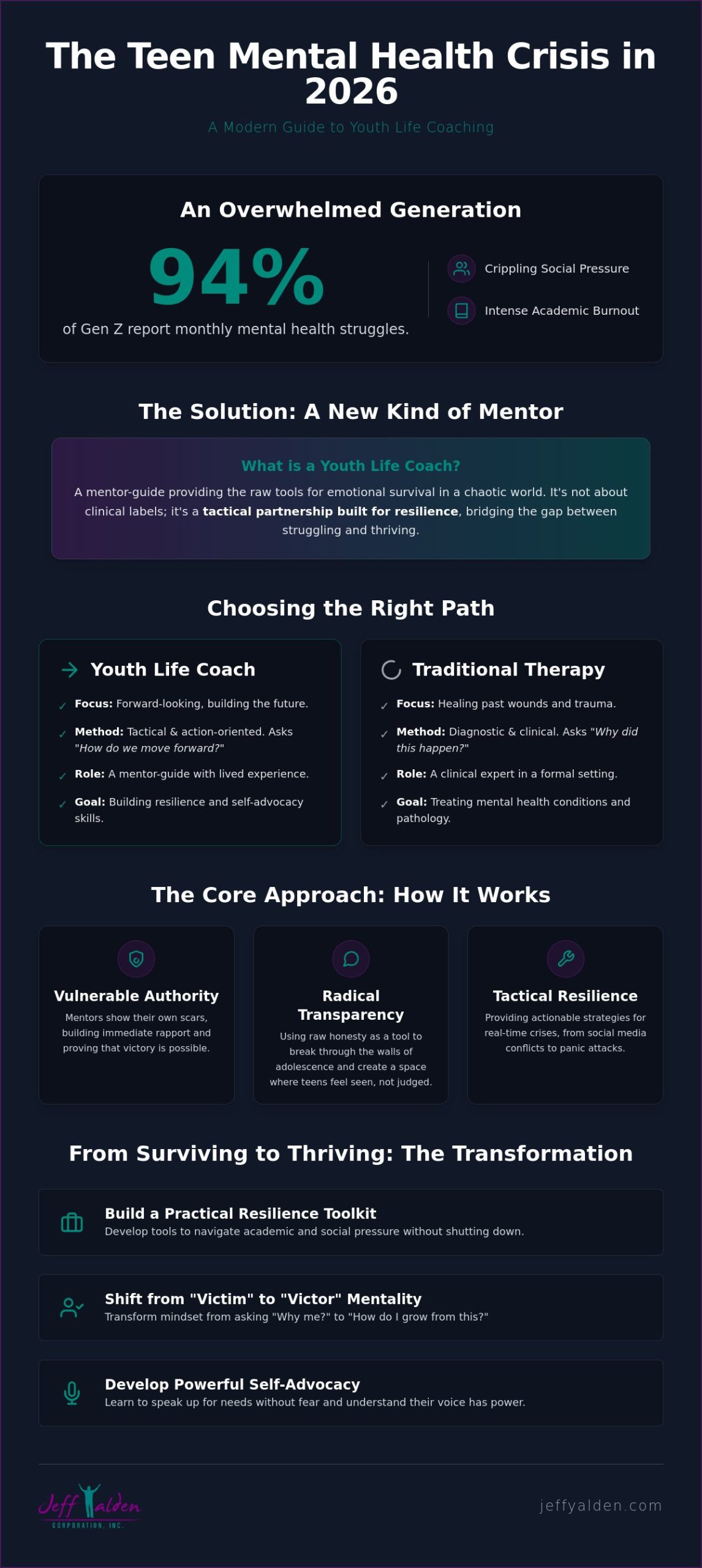
In 2026, a staggering 94% of Gen Z members report facing mental health struggles every single month. That isn’t just a number on a page. It’s a scream for help from a generation drowning in social pressure and academic burnout. You see it when your teen shuts down or refuses to engage, making the search for a Youth Life Coach feel like a race against time. You feel the terrifying distance growing between you. You’re scared. It’s a heavy weight to carry alone.
You already know that traditional, clinical approaches often feel too cold for a kid who’s already feeling isolated. By trading clinical detachment for radical transparency, we can reach the heart of the crisis and build the life-saving resilience your child needs right now. I’ve been in those trenches. I know the way out. This article will show you how to normalize these hard conversations and create a clear, self-motivated path for your teen to move from crisis to thriving.
Key Takeaways
- Define the role of a Youth Life Coach as a mentor-guide who prioritizes tactical resilience over clinical labels.
- Discover how to build a practical resilience toolkit that helps teens navigate academic and social pressure without shutting down.
- Learn when to choose forward-looking coaching versus traditional therapy to ensure your child gets the specific support they need.
- Identify why a mentor’s lived experience and radical transparency are more effective than academic credentials alone when reaching a teen in crisis.
- Explore how high-stakes mentorship can transform a teen’s mindset from simply surviving to proactively thriving in 2026.
What is a Youth Life Coach in 2026?
In 2026, the definition of support has fundamentally shifted. A Youth Life Coach isn’t just someone who helps a teen pick a college or organize a study schedule. They are a mentor-guide providing the raw tools for emotional survival in a world that feels increasingly chaotic and disconnected. This isn’t about clinical labels or deep-seated pathology; it is a tactical partnership built for resilience. We’ve moved past simple “goal setting” because the stakes are higher now. We are in the business of identity building. Youth life coaching is the bridge between struggling and thriving through radical transparency.
The Role of a Vulnerable Authority
Teens have a built-in radar for anything that feels “fake.” They’ve spent their lives surrounded by curated social media feeds and AI-generated content. They reject the distant expert who speaks from a pedestal of academic perfection. Instead, they follow mentors who aren’t afraid to show their own scars. This is the core of what mentorship is in its most powerful, human form. When I share my own struggles with mental health and recovery, I’m not just telling a story. I’m building immediate rapport. I’m showing them that victory is possible because I’ve lived through the same darkness they’re feeling right now. It’s about being a trusted life-guide rather than just another non-parent adult giving advice.
Why Traditional Support Often Falls Short
The standard 50-minute clinical hour doesn’t always work in a world where crises happen in real-time. Traditional therapy is vital for healing past wounds, but it often focuses on the “why” rather than the “how” of moving forward. Meanwhile, school counselors are heroic but frequently overwhelmed. They’re managing hundreds of students and can’t always provide the deep, one-on-one focus required to navigate the unique noise of the 2026 social landscape. A coach fills that gap. We provide a proactive extension of the impact seen in high school assemblies. We address the specific pressures that traditional systems often miss:
- Digital Overload: Managing the constant stream of social comparison and notification fatigue.
- Academic Burnout: Moving beyond grades to find genuine purpose and self-worth.
- Emotional Isolation: Breaking the cycle of “shutting down” when life feels like too much to handle.
We deal with the pressure of right now. We give them the tools to regulate their emotions and find their voice before they reach a breaking point. It’s fast-paced, direct, and deeply supportive.
Key Benefits: Why Your Teen Needs a Coach Now
Your teen isn’t just “being difficult.” They are overwhelmed. In 2026, the digital noise is deafening, and the pressure to perform is constant. A Youth Life Coach provides the strategy to cut through that noise. We build a resilience toolkit that doesn’t just sit on a shelf. It works when a panic attack hits at 2 AM or when a social media conflict spirals out of control. We normalize the conversation around mental health to remove the shame that keeps them silent. Shame is a cage. We provide the key to help them break out.
We focus on moving from a “victim” mentality to a “victor” mentality. It’s a fundamental identity shift. It is the difference between asking “Why is this happening to me?” and “How do I grow from this?” This shift builds self-advocacy skills they’ll use in school, in their future careers, and in every relationship they ever have. They learn to speak up for their needs without fear. They learn that their voice has power, even when the world feels like it’s trying to drown them out.
From Crisis Intervention to Daily Resilience
Coaching acts as a vital safety net. While we aren’t clinical therapists, we are the front-line defense. Research highlights the effectiveness of coaching to support youth mental health by providing immediate, actionable strategies that teens can use in their daily lives. This is especially true for those who have engaged with teen suicide prevention programs. We teach them to bounce back rather than break down. It’s about grit. It’s about knowing they are stronger than their circumstances. We turn those dark moments into fuel for a brighter, more stable future.
Radical Transparency as a Growth Tool
The “shut down” phase is real. You’ve seen it. The door slams. The phone becomes a shield. We break that shield with radical transparency. By being real and raw, we create a space where they feel seen, not judged. It’s an edge-of-your-seat engagement. They aren’t being lectured. They are being led by someone who understands their struggle. If you want to see this transformation in action, consider how a Youth Life Coach can bridge the gap in your own home and restore the connection you’ve been missing.
When we use honesty as a tool, we break through the walls of adolescence. We don’t hide behind professional jargon. We speak their language. This creates an environment where genuine change isn’t just possible; it’s inevitable. We keep them invested in their own growth because they finally see a version of themselves that is capable, confident, and ready to lead.
Youth Life Coach vs. Teen Therapy: Choosing the Right Path
Don’t confuse the two. Therapy and coaching are different tools in the same toolbox. Therapy looks in the rearview mirror to heal past wounds. It’s about processing trauma and diagnosing clinical conditions. Coaching looks through the windshield to navigate the road ahead. One heals; the other builds. If your teen is stuck in a cycle of lifestyle blocks or a mindset that keeps them small, a Youth Life Coach is the tactical partner they need to move forward.
I hear the concern from parents all the time. Is this just unlicensed therapy? Let’s be clear. No. This is performance mentorship. We don’t diagnose pathology. We strategize for victory. We treat your teen’s life like a high-stakes mission where every choice carries weight. For many families, the most effective path involves using both simultaneously. Therapy provides the healing foundation, while coaching provides the daily battle plan. They work together to create a 360-degree support system that leaves no room for your child to fall through the cracks.
The Focus on Actionable Strategies
Coaching isn’t a venting session where we sit and talk about feelings for an hour. It’s a working session. We get into the grit of daily life. We build specific, non-negotiable habits around sleep hygiene, hard digital boundaries, and rewriting toxic self-talk. This is the core of building resilience in teens. We focus on what they can control today to change how they feel tomorrow. It’s about taking immediate action that produces visible results in their mood and motivation.
Identifying the Right Intervention Level
You have to know when the situation requires more than a mentor. If your teen is experiencing active self-harm, severe substance abuse, or deep clinical depression, they need the specialized care of a licensed therapist or an inpatient facility. For families navigating gender identity challenges, the Gender Identity Center provides the specialized clinical support that often works in tandem with the tactical guidance of a life coach. A coach acts as a first responder in the mental health ecosystem. We are often the first to spot the red flags because we’ve built that raw, honest rapport. Our approach is trauma-informed. We respect the history, but we stay focused on the future. We provide the bridge between the clinical office and the real world, ensuring your teen has the support they need at every level of their journey.
How to Find the Best Life Coach for Your Teenager
Finding the right Youth Life Coach isn’t about scanning a list of degrees or counting certifications. It’s about finding “scars, not just stars.” Your teen doesn’t care about a framed certificate on a wall. They care about whether the person across from them actually understands the weight of their world. Look for a mentor who has navigated their own darkness and come out the other side. This lived experience creates an immediate, unbreakable bond that no textbook can teach. It’s the difference between an expert and a guide.
Check for experience in high-pressure, high-stakes environments. You want someone who has stood in front of thousands in high school assemblies and held their attention through raw, radical honesty. If they can’t command a room of skeptical teenagers, they won’t command the respect of your child. The “click” is everything. If your teen doesn’t respect the coach, the coaching fails before it starts. Demand radical transparency in the coach’s own branding. If their message feels like a corporate brochure, they won’t reach a kid who is already shutting down.
Questions to Ask a Potential Youth Coach
Don’t be afraid to dig deep during the initial conversation. You are looking for a tactical partner, not a babysitter. Ask these questions to see if they have the grit to handle the reality of 2026:
- How do you handle a teen who doesn’t want to be there? You need to know they can break through resistance without getting defensive.
- What is your experience with crisis intervention and suicide prevention? This is the baseline for safety in today’s mental health landscape.
- Can you share a time you were vulnerable with a student to build trust? If they can’t be real with you, they won’t be real with your child.
Evaluating the ‘Vulnerable Authority’ Factor
A coach’s “realness” is more important than their certificate. Your teen needs to see a mentor who models the resilience they teach. They need to see that it’s okay to be imperfect as long as you are proactive. This is why a specialized academic life coach for high school students often succeeds where traditional tutors fail. They address the human being before they address the GPA. They lead by example, showing your teen how to turn a setback into a comeback. If you are ready to find a mentor who leads with transparency and heart, connect with a Youth Life Coach who has been in the trenches and knows the way out.
The Jeff Yalden Approach: Radical Mentorship for Real Results
Jeff doesn’t hide behind a desk or a clinical file. He’s been in the trenches with teenagers since 1992. He knows that in 2026, teens are tired of being handled with kid gloves. They want the truth. They want a Youth Life Coach who can look them in the eye and say, “I’ve been where you are, and there is a way out.” This approach isn’t about coddling. It’s about radical transparency. It’s about moving from the “victim” mentality that keeps so many kids stuck in a cycle of “why me?” to a “victor” mentality where they own their story and their future. We don’t just talk about problems. We build high-energy, direct paths to well-being.
The “Victor” mentality is the heartbeat of this work. It means teaching a teen that their past doesn’t have to be their prison. We dive into the hard topics that others avoid. We talk about the suicidal ideation, the deep-seated anxiety, and the social isolation that 2026 has made “normal.” We don’t ignore the pain. We use it. We turn that struggle into a foundation for grit. This is a high-energy path. It’s supportive but direct. We don’t have time for fluff when lives are on the line.
Jeff’s style breaks through the noise because it’s authentic. Teens can smell a script from a mile away. When Jeff speaks, he’s sharing his own life. He’s showing them that a “vulnerable authority” is the most powerful kind of leader. This creates a safe space where the “Real and Raw” conversations can finally happen. It’s about building a student’s well-being by treating them like the capable, resilient human being they are meant to be. This is why a Youth Life Coach is a game-changer for a family in crisis.
From Assembly Speaker to Personal Mentor
Most people know Jeff as a powerhouse on the stage. He is the teen mental health speaker schools call when the campus culture is breaking. But an assembly is a moment. Coaching is a movement. Jeff takes that same electrical energy from the stage and focuses it into a one-on-one partnership. He uses the rapport built during live performances to fuel personal growth that actually sticks. It’s a transition from a public message to a private mission. Parents trust this approach because it’s grounded in over 30 years of crisis intervention and suicide prevention experience.
Take the Next Step for Your Teen
The clock is ticking. In 2026, the pressures on our youth aren’t slowing down. They’re accelerating. Don’t wait for the “shut down” to become a permanent wall. Don’t wait for the crisis to deepen before you seek the radical mentorship your child deserves. The journey toward resilience starts with a single, decisive action. It’s time to move from surviving to thriving. Book Jeff Yalden as your Youth Life Coach today and give your teen the tools to build a future they are excited to live.
Build a Future of Resilience Today
The mental health crisis of 2026 demands more than just traditional talk. It requires a mentor who has walked through the fire and knows how to lead others out. We’ve explored how shifting from a “victim” to a “victor” mentality changes everything for a struggling teen. We’ve also looked at the vital difference between healing the past in therapy and building a tactical future with a coach. Choosing the right Youth Life Coach is about finding that raw, honest connection that finally breaks through the silence and the shutdown.
Jeff Yalden brings over 30 years of high-impact youth work to every interaction. As a specialist in teen suicide prevention and postvention, he has been a featured speaker for thousands of high schools nationwide. He doesn’t just teach resilience; he lives it. Your teen is standing at a crossroads. They don’t need another clinical expert. They need a guide who sees their potential even when they can’t see it themselves.
Start Your Teen’s Journey to Resilience – Book Jeff Yalden Today
The path from crisis to thriving is possible. Your child has the strength to overcome these modern pressures. Let’s work together to unlock the self-motivated, resilient leader waiting inside them. Victory is within reach.
Frequently Asked Questions
What exactly does a youth life coach do during a session?
A session is a high-energy working meeting where we build your teen’s resilience toolkit. We identify the immediate stressors, like social media pressure or academic burnout, and develop a battle plan to handle them. We don’t just talk about feelings; we practice self-regulation, set hard digital boundaries, and rewrite toxic self-talk. It is about creating a victor mentality through direct action and radical honesty. We focus on the how of moving forward rather than the why of the past.
How many coaching sessions does a teenager typically need?
Most teens find their stride with a commitment of three to six months of weekly or bi-weekly sessions. This timeline allows us to move past the initial shut down phase and build permanent habits. Resilience isn’t built in a single hour. It takes consistent effort to transform a crisis into a thriving lifestyle. We monitor progress constantly to ensure the coaching remains high-impact. The goal is to give them the tools to eventually coach themselves through life’s challenges.
Is youth life coaching covered by insurance?
Youth life coaching is typically not covered by insurance because it is a performance-based mentorship rather than a clinical medical treatment. Insurance companies generally require a mental health diagnosis to provide coverage. Since we focus on lifestyle, mindset, and future-oriented strategy, most families pay for these services out of pocket. It is an investment in your child’s long-term emotional and social success. Think of it as specialized training for their mental and emotional well-being.
What happens if my teen refuses to participate in coaching?
If your teen is resistant, we start by building rapport through radical transparency and shared scars. I don’t force a clinical environment. I meet them where they are, often using the energy of my school assemblies to break the ice. Most teens refuse help because they fear judgment or boredom. Once they realize I’m a vulnerable authority who has been in the trenches, the walls usually come down. We turn their resistance into the first lesson in self-advocacy.
Can a youth life coach help with college applications or career planning?
Yes, we integrate future planning into our identity-building work. A Youth Life Coach helps teens navigate the immense pressure of college applications by focusing on their purpose rather than just their GPA. For families who need help with the strategic side of admissions, Top Colleges provides expert guidance on navigating the process. We work on self-advocacy, time management, and clarity of vision to ensure they aren’t just getting into a school, but are actually prepared to thrive once they get there. We build the confidence they need to own their future and make bold career choices.
How do I know if my teen needs a coach or a therapist?
You choose a therapist for clinical issues like deep trauma, active self-harm, or substance abuse. You choose a coach when your teen is struggling with mindset, motivation, or navigating the noise of 2026. If the goal is healing the past, see a therapist. If the goal is building a resilient future, a coach is the right partner. Many families use both to provide a total support system. We act as the first responders who bridge the gap between clinical care and real-world action.
What is the age range for youth life coaching services?
My coaching services primarily focus on middle school students, high schoolers, and young adults in college. These are the high-stakes years where identity is formed and the pressure to perform is at its peak. Each age group requires a different tactical approach, but the goal remains the same. We aim to build the grit and self-motivation needed to handle the transition into adulthood. We prepare them for the real world by teaching them how to lead themselves first.
Does Jeff Yalden offer virtual coaching sessions for teens?
Yes, I offer virtual sessions to reach teens across the country. In 2026, many students feel more comfortable in a digital environment, and virtual coaching allows us to maintain a consistent connection regardless of location. These sessions are just as high-energy and direct as in-person meetings. They provide the same radical mentorship and life-saving resilience tools that have defined my work as a Youth Life Coach for over 30 years. We use technology to build a bridge, not a barrier.
