
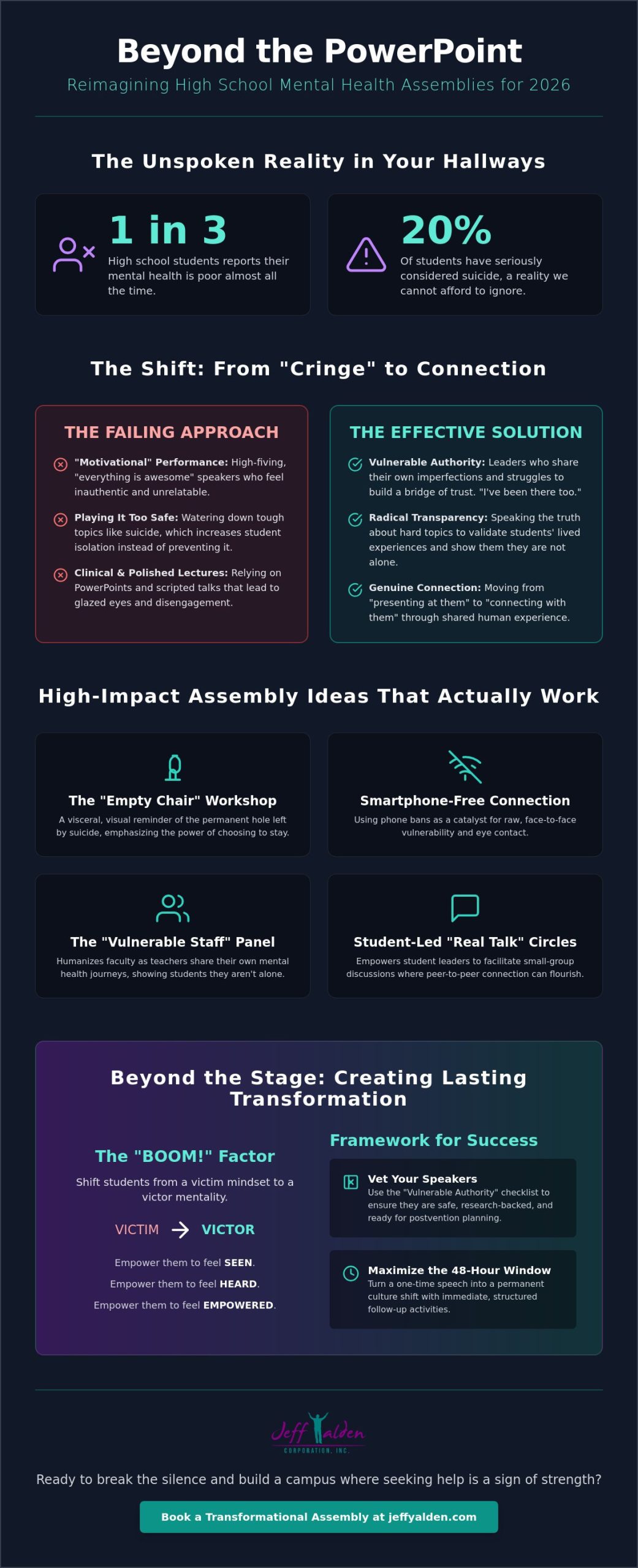
Did you know that as of March 2026, nearly one in three high school students reports their mental health is poor almost all the time? You see the reality every day in your hallways. You’re fighting an uphill battle against student apathy and the collective eye-roll that happens the second a wellness PowerPoint hits the screen. It’s frustrating to watch your limited budget disappear on mental health assembly ideas for high school that don’t deliver results, especially when recent data shows 20% of students have seriously considered suicide. You want more than just a presentation; you want a shift in culture.
I’ve been in those trenches, and I know that radical transparency is the only thing that breaks the silence. This article promises to give you high-impact, research-backed strategies that trade “cringe” for genuine connection. We’re going to dive into 15 radical ways to build student resilience and create a campus where seeking help is a badge of strength, not a source of shame. It’s time to move past the surface and start saving lives through sessions that actually stick.
Key Takeaways
- Stop wasting your budget on “cringe-worthy” presentations and learn how to use radical transparency to break through the wall of student apathy.
- Discover 15 innovative mental health assembly ideas for high school that utilize visual storytelling and smartphone-free zones to foster deep, face-to-face vulnerability.
- Use our “Vulnerable Authority” checklist to vet speakers, ensuring your program is safe, research-backed, and prepared for postvention if your campus is navigating tragedy.
- Maximize the critical 48-hour window following an event to turn a one-time speech into a permanent shift in your school’s mental health culture.
- Learn the “BOOM!” factor approach to move your students from a victim mindset into a “victor” mentality where they feel seen, heard, and empowered.
Why Traditional High School Mental Health Assemblies Fail (and How to Fix It in 2026)
Students are tired. They’re exhausted by the performative nature of traditional school events. When you look out from the stage, you see glazed eyes and slumped shoulders. Why? Because most mental health assembly ideas for high school are still stuck in 2010. They’re too polished. They’re too clinical. In 2026, students are navigating a world of strict smartphone bans and massive social media fatigue. They don’t want a scripted lecture; they want a pulse. Radical transparency is the only way to cut through the noise. It means showing up as a human first and an expert second. It’s about moving from a “checking the box” mentality to a “changing the culture” mission. We have to stop presenting at them and start connecting with them.
The Death of the “Motivational” Performance
The era of the high-fiving, “everything is awesome” speaker is dead. Students in 2026 can spot a fake authority figure in under 30 seconds. They live in a world of curated filters, and they’re starving for something raw. If you stand on that stage and pretend you have it all figured out, you lose them instantly. The conversation has to shift from generic “you can do it” platitudes to “I have been in that dark room too” reality. The Vulnerable Authority model is a leader who shares their own imperfections and struggles to build a bridge of trust with their audience. It’s about being a victor, not just a survivor. This approach turns a passive audience into an active community.
The Cost of Playing It Too Safe
We often worry about “triggering” students, so we water down the message. This is a dangerous mistake. Avoiding hard topics like suicide or self-harm actually increases student isolation. When we don’t talk about the heavy stuff, we send the message that those feelings are too scary to handle. There is a massive difference between triggering someone and validating their lived experience. Understanding mental health in education requires us to be brave enough to name the pain. You need a teen mental health speaker who isn’t afraid to go into the trenches with your kids. If you want to break the silence, you have to be willing to speak the truth. Safety doesn’t come from silence; it comes from shared understanding and real support systems.
15 Radical Mental Health Assembly Ideas for High School
Finding the right mental health assembly ideas for high school requires looking past the “entertainment” and focusing on the connection. In 2026, students aren’t looking for a show. They’re looking for a lifeline. We need to stop filling their time and start filling their hearts with actionable tools. These 15 concepts move away from the clinical and toward the communal. They leverage the reality of 2026, including the widespread smartphone bans and the deep social media fatigue students feel every single day. Here is how we break the silence together.
- The “Empty Chair” Resilience Workshop: Place a single, spotlighted chair on stage to represent those lost to suicide. It’s a gut-wrenching, visual reminder of the permanent hole left behind and the radical power of choosing to stay.
- Smartphone-Free Connection Hour: Use the 2026 phone bans as a catalyst. Facilitate a session where students look each other in the eye without a screen, practicing raw, face-to-face vulnerability.
- The “Vulnerable Staff” Panel: Nothing humanizes a faculty faster than teachers sharing their own mental health journeys. It shows students that their mentors have also walked through the fire.
- Student-Led “Real Talk” Circles: Empower your campus leaders to lead small-group discussions immediately following the main event. Peer-to-peer connection often reaches places an adult cannot.
- The Letter to My Future Self: Students write a letter to themselves for when things get dark, including three reasons to keep fighting.
- The Gratitude Wall: An interactive, physical space where students pin one thing they are fighting for.
- Breathing Under Pressure: A live, guided demonstration of tactical breathing to manage panic attacks in real-time.
- The “Walk in My Shoes” Gallery: Anonymous stories from students displayed around the gym to build empathy.
High-Impact Resilience Concepts
We have to give them tools they can use at 2:00 AM when the world feels heavy. One of the most effective is “The 24-Hour Rule.” It’s a simple, life-saving commitment to wait 24 hours before making any impulsive, permanent decisions during an emotional crisis. We also tackle “The Mask We Wear,” which is an interactive exercise examining the gap between our social media personas and our actual reality. This is critical for building a culture of resilience in teens that doesn’t just fade when the assembly ends. It’s about creating a foundation of truth in a world full of AI-driven perfection.
Interactive and Peer-Driven Formats
Engagement happens when students feel heard. We use an “Anonymous Question Box” paired with live-polling tech to answer the “unaskable” questions in real-time. This level of transparency builds immediate trust. We also focus on “Mental Health First Aid” for students, teaching them how to recognize a friend in crisis and how to bridge them to professional help. These aren’t just one-off events. By integrating high school assemblies into a year-long wellness curriculum, you ensure the message sticks. Research shows that student peer-leader mental health programs are vital for long-term campus safety. If you want a high school speaker who can facilitate this kind of deep work, you have to be willing to go beyond the surface.
Beyond the Stage: Turning an Idea into a Campus Transformation
The gym lights go up. The students file out. Most schools think the job is done once the speaker gets in their car. They’re wrong. The real work begins the second the applause stops. If you’ve implemented radical mental health assembly ideas for high school, you’ve just cracked the seal on years of suppressed emotion. You now have a “48-Hour Impact” Window. This is the critical time when students are most likely to seek help, disclose a struggle, or reach out to a peer. You must be ready to catch them. This means setting up “Safe Spaces” with counselors immediately after the session. It isn’t enough to just talk about the pain; you have to provide the bridge to the cure. Your student leaders are the ones who will keep this momentum alive in the hallways long after I leave the stage. They are the heartbeat of the mission. This event should be the high-octane fuel for your existing teen suicide prevention programs. We’re moving from a single day of awareness to a lifetime of resilience.
The Staff Debrief and Professional Development
Your teachers are on the front lines, and they’re often just as overwhelmed as the students. They need their own session to process the heavy topics we’ve just uncovered. When a student finally feels seen, they’re going to go to the adult they trust most. Usually, that’s a teacher. We have to equip your staff to handle those raw disclosures without burning out. This is where trauma-informed teaching professional development becomes the backbone of your strategy. It’s about creating a campus where everyone knows how to respond with empathy and authority. We don’t just train the kids; we fortify the entire system.
Measuring Success Beyond the Applause
How do you know if it worked? It isn’t about how many kids clapped or how many “thank you” emails you received. You have to track “help-seeking” behaviors. That is your primary KPI. Are more students visiting the counseling office? Is the anonymous tip line more active? These are the numbers that matter. We use post-assembly surveys to identify hidden “hot spots” of distress that might have gone unnoticed. This data allows you to build a long-term character education framework that actually sticks. We’re trading temporary motivation for permanent transformation. Success is measured by the lives we save, not the boxes we check.
The Safety First Framework: Vetting Speakers and Planning Postvention
Safety isn’t a checkbox. It’s the heartbeat of your event. When you’re searching for mental health assembly ideas for high school, you’re looking for a catalyst for change. But a catalyst can be dangerous if it isn’t handled with precision. You need more than a “good talker.” You need a professional who understands the weight of the words they speak. The “Do No Harm” rule is our north star. We must avoid romanticizing the struggle or making pain look like a performance. Raw honesty is essential, but it has to be anchored in clinical safety. If your school is currently navigating a recent tragedy, your focus shifts to postvention. This is about stabilization and preventing contagion. It requires a speaker who has a deep background in crisis intervention and knows how to lead a room through the fog of grief toward a place of hope.
Vetting Your Mental Health Speaker
Don’t get blinded by celebrity or entertainment value. A speaker with a million followers might not have the clinical grounding to handle a student in crisis. Lived experience is powerful, but it must be paired with professional safety training. During your pre-booking call, ask the hard questions. Ask how they handle disclosures. Ask about their experience with teen suicide prevention. It is non-negotiable that a speaker has a clear, written crisis referral protocol to immediately bridge students to professional help during and after the event. You are looking for a “Vulnerable Authority,” which is someone who leads by example but remains a grounded professional.
Logistics that Support Mental Health
When implementing mental health assembly ideas for high school, the environment dictates the outcome. Sometimes, “split assemblies” by grade level or gender can create a safer space for vulnerability. It’s easier for a freshman to be real when they aren’t being watched by seniors. You also have to prepare your counseling team for the “surge.” A high-impact assembly will drive students to your office in record numbers. That’s a win, but only if you’re ready for it. Develop a “Safe Room” protocol. This is a designated space where students can step out if the topics become too intense. It should be staffed by a counselor, not a disciplinarian. If you want to ensure your next event is both radical and safe, you need an experienced mental health speaker who prioritizes student wellness above all else.
From Motivation to Transformation: The Jeff Yalden Approach
I’ve stood on stages in over 4,000 schools across all 50 states. These administrators didn’t bring me in for a feel-good performance. They brought me in to deliver the uncomfortable truth that saves lives. My approach to mental health assembly ideas for high school isn’t about checking a box. It’s about the BOOM! Factor. It’s that visceral, life-altering moment when a student decides to move from a victim mindset to a victor mentality. We don’t just talk about the struggle. We talk about the power to transform it. Every campus has its own unique culture and its own specific crises. I don’t do canned speeches. I adapt my message to the specific needs of your students right now, whether you’re navigating a recent loss or fighting a rising tide of anxiety.
Transformation doesn’t happen in 60 minutes. That’s why I offer a 360-degree impact through a full-day experience. We start with the high-energy assembly that breaks the silence. Then we move into teacher professional development to equip your staff with the tools to handle the disclosures that follow. Finally, we host a parent seminar in the evening. This ensures the entire community is speaking the same language of resilience. We’re building a fortress of support around your students. We’re moving from temporary motivation to a permanent shift in campus culture.
A Partner in Your School’s Mission
My commitment to your school doesn’t end when the bell rings. Since 1992, I’ve been a partner in postvention and immediate crisis support for leaders in the trenches. I’m the “vulnerable authority” that teens actually trust because I’ve been where they are and I’ve found the way out. This legacy spans over three decades of real, raw connection. I’m already securing dates for the 2026 school year to help districts move from crisis management to proactive wellness. Let’s start the conversation today before the silence becomes deafening on your campus.
Taking the Next Step
The process for booking is simple, but the impact is permanent. The biggest mistake I see school leaders make is waiting for a tragedy to happen before they act. Waiting for a crisis to be your catalyst is a gamble with student lives. Be the leader who provides the tools for resilience before they’re needed. We can prepare your campus for a transformation that outlasts any single event. Bring Jeff Yalden to your school and start the radical conversation today.
Transform Your Campus Culture Today
Your students are waiting for someone to be real with them. We’ve explored how radical transparency and the 48-hour impact window can turn a simple event into a life-saving movement. By implementing these mental health assembly ideas for high school, you move beyond “checking a box” and start building a foundation of resilience. It’s about safety, vetting the right experts, and ensuring your school has the postvention support it needs before a crisis hits.
I’ve been in this fight since 1992; serving over 4,000 schools as an expert in suicide prevention and postvention. I don’t just speak at kids. I lead from a place of lived experience, redefining the “vulnerable authority” model for the specific challenges of 2026. You have the power to change the narrative on your campus. Don’t wait for another tragedy to be your wake-up call. Book Jeff Yalden for your next high school assembly today. You aren’t just booking a speaker. You’re choosing a partner dedicated to seeing your students thrive. Let’s do this.
Frequently Asked Questions
How do you talk about mental health in a high school assembly without triggering students?
You prevent triggers by prioritizing validation over romanticization and ensuring a clear safety protocol is in place before the first word is spoken. It’s about being raw and real without being graphic or sensational. We focus on the “Do No Harm” rule; which means we name the pain but always point toward the solution. Providing a “Safe Room” for students to step into ensures that those feeling overwhelmed have immediate; professional support available.
What are the best mental health topics to cover for 9th-12th graders?
The most effective mental health assembly ideas for high school focus on resilience; the impact of social media; and practical crisis tools like the “24-Hour Rule.” Students in 2026 are dealing with intense academic pressure and digital fatigue. They need to hear about the “Mask We Wear” and how to bridge the gap between their online persona and their actual reality. These topics move the conversation from clinical theory to lived experience.
How long should a high school mental health assembly be for maximum engagement?
A high-impact assembly should typically last between 60 and 75 minutes to maintain a strong emotional arc without losing the audience. This timeframe allows for a deep; vulnerable keynote that captures their hearts followed by a few minutes of practical; actionable takeaways. Anything shorter feels rushed; while anything longer risks losing the “edge-of-your-seat” momentum required to keep high schoolers truly engaged and present.
What is the “vulnerable authority” model in school speaking?
The vulnerable authority model is a leadership approach where the speaker leads by example through the radical sharing of their own imperfections. Instead of acting like a distant expert; the speaker positions themselves as a lived-experience guide who has walked through the fire. This transparency builds an immediate bridge of trust. It shows students that you can be both successful and a work in progress; which is a message they desperately need.
How do we handle student disclosures after a mental health speaker leaves?
You handle disclosures by having your counseling team prepared for an immediate “surge” in visits the moment the assembly ends. Teachers should be equipped through professional development to listen without judgment and bridge students to professional help. The 48-hour window following an event is the most critical time for help-seeking. You must have clear; pre-established protocols to ensure no student who finds the courage to speak up falls through the cracks.
Can a mental health assembly actually help prevent teen suicide?
Yes; a radical mental health assembly can save lives by breaking the silence and normalizing the act of seeking help. When a speaker uses the vulnerable authority model; it reduces the stigma that often keeps students suffering in isolation. By providing practical tools for resilience and connecting students to school resources; you create a campus culture where choosing to stay is seen as a badge of incredible strength.
How much does a professional high school mental health speaker cost?
Professional speaking fees in the youth market typically range from $4,000 to over $15,000 for high-impact; in-person events in 2026. These costs generally cover the speaker’s honorarium and expertise; though travel and production expenses are often additional. While budgets are always a factor; it’s vital to prioritize a speaker’s clinical safety record and experience in crisis intervention over the lowest possible price point.
What should we do if our school has recently experienced a student suicide?
If your campus is grieving; your immediate focus must be on postvention and stabilization to prevent further tragedy. You need a speaker who is an expert in crisis intervention to lead a session specifically designed for healing. This is not the time for a standard motivational speech. You need a guided conversation that acknowledges the collective pain while providing a structured; safe path toward recovery and hope for the entire community.
