
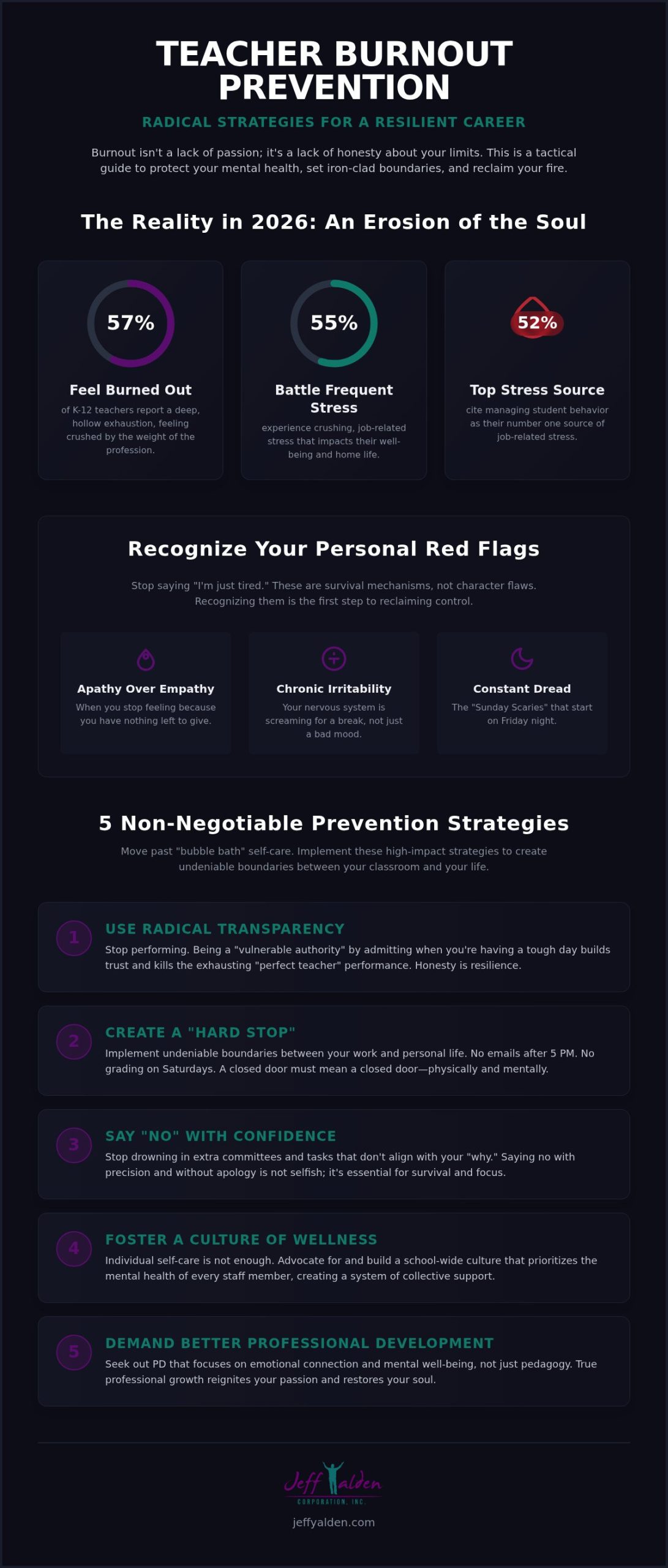
Burnout isn’t a lack of passion; it’s a lack of radical honesty about your own limits. In 2026, 57% of K-12 teachers report feeling completely burned out, while 55% of us are battling frequent, crushing job-related stress. You’re not a “failure” because you’re tired. You’re a human being operating in a system that often forgets you have a heartbeat. The compassion fatigue from student crises and the unmanageable workloads are real, and they are heavy. I’ve been in those trenches. I know that “self-care” isn’t just a bubble bath; it’s a battle cry for your own survival.
I agree that the weight you’re carrying feels impossible right now. But here’s the truth: you can reclaim your fire without losing your mind. This guide explores radical teacher burnout prevention strategies designed to protect your mental health through tactical transparency and iron-clad boundaries. We’re moving past the clinical jargon to find real, raw ways to handle stress in real-time. You’ll discover how to set practical limits, find a renewed sense of purpose, and finally stop apologizing for being human. It’s time to shift from surviving the school year to actually thriving in your calling.
Key Takeaways
- Stop treating burnout like a “bad week” and start using radical transparency to build an authentic, resilient connection with your students and peers.
- Implement high-impact teacher burnout prevention strategies that create an undeniable “Hard Stop” between your classroom and your life.
- Learn to say “no” with confidence and precision so you can stop drowning in extra committees and start focusing on your “why.”
- Move beyond the “bubble bath” self-care trap by fostering a school-wide culture of wellness that prioritizes the mental health of every staff member.
- Discover how professional development focused on emotional connection can reignite your passion and restore your soul in the middle of a crisis.
The Reality of Teacher Burnout in 2026: Why Passion Isn’t Enough
It’s 2026, and the old definitions of “tired” don’t cut it anymore. We aren’t just dealing with a long week or a stack of ungraded papers; we’re facing an erosion of the soul. When you look at the current data, 57% of K-12 teachers are feeling this deep, hollow exhaustion. It’s raw. It’s heavy. If you’re feeling like a failure because you can’t “just push through,” I want you to hear this: your struggle is valid. You aren’t failing. You’re being crushed by a weight that wasn’t meant for one person to carry alone.
Teacher burnout is a systemic mismatch between energy output and emotional intake.
We call it the “Passion Paradox.” The teachers who care the most, the ones who pour their entire hearts into their classrooms, are the ones at the highest risk. Your heart is your greatest tool, but without radical teacher burnout prevention strategies, it becomes your greatest vulnerability. Caring isn’t the problem, but caring without boundaries is a recipe for disaster. When your “why” is used as a weapon to demand more of your “how,” you’re on a collision course with a breakdown.
The 2026 Classroom Climate
The post-pandemic mental health crisis didn’t just fade away; it evolved into a complex landscape where teachers are expected to be therapists, social workers, and bodyguards. Managing student behavior is now the top source of job-related stress for 52% of educators. The digital noise of social media creates a 24/7 feedback loop where teachers feel they must be “on” at all times, eroding the sanctuary of home life. Traditional professional development often misses the mark because it focuses on pedagogy while ignoring the visceral, human need for emotional safety and wellness.
Recognizing Your Personal Red Flags
Stop telling yourself you’re “just tired.” That’s a lie we use to stay in the race until we collapse. You need to identify the shift from empathy to apathy. When you stop feeling for your students because you literally have nothing left to give, that’s not a character flaw; it’s a survival mechanism. Watch for the physical toll: chronic sleep issues, constant irritability, and the paralyzing “Sunday Scaries” that start on Friday night. Recognizing these signs early is the only way to apply teacher burnout prevention strategies that actually protect your future in this profession. Irritability isn’t just a mood; it’s your nervous system screaming for a break.
Radical Transparency: The Secret to Long-Term Resilience
Stop pretending you have it all together. The “perfect teacher” mask is a weight that will eventually break your neck. We’ve all been there, standing in front of a class or a faculty meeting, acting like we’ve got every answer while our internal world is crumbling. This performance is exhausting. It’s one of the primary reasons why Teacher turnover in the United States continues to climb. Real resilience doesn’t come from being bulletproof. It comes from radical transparency.
I call this being a “vulnerable authority.” You are still the leader. You are still the expert in the room. But you are also a human being. When you hide your struggles, you create a wall between yourself and the very people who could support you. Saying “I don’t have the answer right now” or “I’m having a tough day, too” isn’t a sign of weakness. It’s a bridge. It builds trust. It tells your students and colleagues that it’s okay to be imperfect. This honesty is one of the most effective teacher burnout prevention strategies because it kills the “performance” aspect of teaching that drains your battery.
Vulnerability as a Strength, Not a Weakness
We need to kill the myth of the “super-teacher.” When we suffer in secret, we reinforce a toxic culture that says struggle is shameful. Instead, try sharing your own resilience stories during staff meetings or school gatherings. When I provide Teacher Professional Development, I see the immediate relief on faces when someone finally admits they’re struggling. It creates a supportive culture where people can breathe. In the classroom, modeling healthy emotional regulation means showing your students how you handle frustration. If a lesson fails, own it. If you’re stressed, name it. You’re teaching them how to live, not just how to pass a test.
The Victim vs. Victor Mentality
The shift from surviving to thriving starts with your narrative. Are you a victim of the system, or are you a victor in the trenches? Shifting from “this is happening to me” to “this is how I am growing” changes your brain chemistry. It’s about agency. When a student acts out, it’s not a personal attack; it’s an opportunity to practice your craft. By reframing these daily challenges, you protect your peace. This mindset is exactly what we teach when Building Resilience in Teens, and it starts with us. You can’t lead where you won’t go. Stop being a victim of your schedule and start being the victor of your boundaries.
5 Non-Negotiable Burnout Prevention Strategies for Educators
Forget the fluffy advice about bubble baths and scented candles. You’re in a fight for your professional life, and you need tactical, battle-tested teacher burnout prevention strategies that actually work in the chaos of a 2026 classroom. Research shows that 32% of teachers cite working too many hours outside of their contract as a top stressor. We’re going to fix that. These five steps aren’t suggestions; they’re survival requirements for any educator who wants to stay in the game without losing their soul.
- Step 1: The Hard Stop. Pick a time. 4:30 PM. 5:00 PM. Whatever it is, that’s when the school day ends. You leave the building, you close the laptop, and you stop being “Teacher.” The work will always be there tomorrow.
- Step 2: Tactical No-Saying. “No” is a complete sentence. When you’re asked to join another committee or run another club, check your capacity. If it’s not a “hell yes,” it’s a “no.” You can’t pour from an empty cup.
- Step 3: The 10-Minute Reset. Between classes, don’t check your phone. Don’t grade. Stand by a window. Breathe. Use these ten minutes to ground your nervous system before the next wave of students hits.
- Step 4: Radical Peer Support. Stop the “venting sessions” in the breakroom. They just leak energy. Instead, form “truth circles” with trusted colleagues to find real solutions and share teacher burnout prevention strategies that focus on resilience.
- Step 5: Digital Detox. Delete your school email from your personal phone. Right now. If it’s an emergency, they’ll call you. If it’s not, it can wait until you’re back on the clock.
Setting Boundaries That Stick
You have to teach people how to treat you. Communicate your availability clearly to parents and administration. Implement an “Email Sunset” rule: no replies after 6:00 PM. Period. When you set these boundaries, you aren’t being “difficult”; you’re being professional. Protecting your peace is your most important job description because a regulated teacher is the only one who can effectively regulate a classroom. My Teacher Professional Development programs focus heavily on this mindset shift because your health is the foundation of your impact.
Reclaiming Your Personal Identity
You were a person before you were an educator. It’s time to find that person again. Find a hobby that has absolutely nothing to do with school. Paint, hike, lift weights, or learn to cook. Whatever it is, do it for you. It’s vital to be “Jeff” or “Sarah” before you’re “Teacher.” When you find personal fulfillment outside of those four walls, you prevent the resentment that leads to burnout. You’re a human being with a calling, not a machine with a job. Reclaim your identity, and you’ll reclaim your fire.
Creating a Culture of Wellness: Beyond Individual Self-Care
If your school culture is toxic, a yoga mat is just a place to trip. We’ve been told for years that the answer to burnout is “more self-care,” but that’s a trap. It places the entire burden of resilience on your shoulders while the system continues to grind you down. True teacher burnout prevention strategies must move beyond the individual and into the community. We need a systemic shift where wellness isn’t a suggestion; it’s the foundation of the building. When leadership prioritizes the mental health of the staff, the entire school breathes easier. This is why trauma-informed teaching professional development is so critical. It’s not just about understanding the students; it’s about protecting the educators who serve them.
Individual resilience is a start, but community-wide support systems are the finish line. We have to move past the idea that being “strong” means suffering in silence. A culture of wellness means that administrators and staff are in a constant dialogue about workload, emotional weight, and real-time support. It’s about creating a space where you can be a “vulnerable authority” without fear of judgment. When the system changes, the people within it can finally stop just surviving and start truly teaching again.
The Power of Staff Connection
The teachers’ lounge shouldn’t be a “complaint lounge.” We’ve all seen how negativity leaks and drains the room. We need to replace that cycle with collaborative problem-solving. When we celebrate small wins, we actively fight the “negativity bias” that makes us forget why we started teaching in the first place. This also means building a “Postvention” mindset. When a campus crisis hits, we have to support each other with the same intensity we give our students. We are a team in the trenches. If one of us is struggling, we all have a stake in their recovery. It’s about being each other’s first line of defense.
Staff Wellness as Student Safety
Let’s get real about the stakes. An exhausted, burned-out teacher cannot effectively spot teen suicide warning signs. Your brain simply doesn’t have the bandwidth to catch the subtle red flags when you’re drowning in your own stress. Staff mental health is directly tied to student outcomes and, quite literally, student safety. A resilient staff creates a resilient student body. You can’t lead a child out of a dark place if you’re lost in the woods yourself. Healthy teachers save lives. If you’re ready to transform your school’s culture from the heart out, it’s time to bring in Teacher Professional Development that actually addresses the human side of education. We don’t just need better curriculum; we need better-supported humans.
Professional Development That Actually Works: The Jeff Yalden Approach
Traditional “sit and get” professional development is dead. We’ve all sat through those soul-crushing sessions where a speaker reads off a slide deck while you check your watch every five minutes. In 2026, you don’t need more theories or pedagogical jargon. You need a visceral, high-energy connection that reminds you why you stepped into this calling in the first place. My approach to teacher burnout prevention strategies starts with “The Heart of the Educator.” If the human being at the front of the classroom is broken, the curriculum doesn’t matter. We have to heal the teacher before we can reach the student.
My method is built on real talk and radical transparency. I don’t stand on a stage as a distant expert; I speak as a lived-experience guide who has been in the trenches with you. We dive deep into the raw, uncomfortable truths of the profession to find actionable hope. This isn’t about a temporary “rah-rah” moment. It’s about a fundamental shift in how you view your worth and your work. Bringing a teen mental health speaker to your campus sends a powerful message to both staff and students: mental health is our top priority, and no one has to struggle in silence.
Transforming Your Campus Culture
One-off assemblies are a start, but lasting change requires a cultural shift. We move beyond the “event” and focus on empowering your staff to lead their own mental health initiatives. This is the long-term ROI of investing in quality teacher burnout prevention strategies. When you invest in the well-being of your educators, you see lower turnover, higher engagement, and better student outcomes. A healthy staff is the most valuable asset any school district possesses. It’s time to stop treating teacher wellness as an afterthought and start treating it as the foundation of student success.
Next Steps: Booking a High-Impact Session
Every school faces unique challenges, from community crises to staff morale issues. I customize every PD day to meet your specific needs, ensuring the message hits home with your team. There’s a massive difference between a “motivational speaker” who gives a speech and a “transformational guide” who changes a culture. I’m here to help you navigate the path back to passion and purpose. If you’re ready to move past the “perfect teacher” myth and build a resilient, transparent, and thriving campus, let’s get to work. Book Jeff Yalden for your next Teacher Professional Development day and let’s reignite the fire in your building.
Reclaim Your Fire and Lead with Heart
You’ve carried the weight of the world for long enough. It’s time to put it down. Radical transparency and iron-clad boundaries are the only real teacher burnout prevention strategies that work in the modern classroom. You’ve learned that being a “vulnerable authority” doesn’t make you weak; it makes you reachable. It makes you resilient. When you protect your peace and reclaim your identity, you aren’t just saving your career. You’re becoming the healthy, regulated leader your students desperately need. Healthy teachers save lives. Your well-being is the foundation of student safety.
School culture won’t change on its own. It requires a bold shift toward community-wide support. With over 30 years of experience and deep expertise in crisis and suicide prevention, I’ve seen radical transparency transform campuses from the heart out. I’m not just a speaker; I’m a partner in your mission. Bring Jeff Yalden to your school for a life-changing Professional Development session and let’s build a culture where teachers don’t just survive, but thrive. You have a purpose. Let’s protect it together. You’re a victor. Take that first step today.
Frequently Asked Questions
What are the first signs of teacher burnout I should look for?
The first signs of burnout often manifest as a shift from empathy to apathy. You’ll notice a nagging sense of dread on Sunday nights, chronic fatigue that sleep doesn’t fix, and a shorter fuse with students. Irritability isn’t just a mood; it’s a signal. When you stop caring about your “why” and start counting minutes until the bell, your nervous system is sounding the alarm. Don’t ignore physical tolls like headaches or insomnia.
How can I set boundaries with parents who expect immediate responses?
You must teach parents how to treat you by setting clear expectations from day one. Use an “Email Sunset” rule where you don’t respond after a specific time, such as 6:00 PM. Communicate these hours in your syllabus and through automated replies. By being transparent about your availability, you protect your peace while remaining professional. It’s not about being unavailable; it’s about being sustainable for the long haul.
Is teacher burnout a sign that I am not cut out for this profession?
Burnout is never a sign of personal failure or a lack of calling. In 2026, 57% of teachers report feeling burned out, which proves the issue is systemic, not individual. The teachers who care the most are often at the highest risk because they pour everything into their students. Feeling exhausted means you’re human, not that you’re in the wrong job. You don’t need a new career; you need radical teacher burnout prevention strategies.
How does teacher burnout impact student mental health and performance?
An exhausted teacher cannot effectively regulate a classroom or spot critical red flags in students. When you’re operating on empty, your ability to provide the emotional safety students need to learn effectively vanishes. This directly impacts academic performance and, more importantly, student safety. Healthy teachers are the first line of defense in suicide prevention. If you’re drowning, you can’t be the life raft for a teen in crisis.
What is the difference between normal stress and clinical burnout?
Normal stress is about “too much” to do, but you can still imagine feeling better once the task is finished. Clinical burnout is about “not enough” left to give. It’s an erosion of the soul where you feel hollow, cynical, and completely disconnected from your purpose. Stress is a sprint you can recover from; burnout is a total system collapse that requires a radical shift in your approach to work.
Can a motivational speaker really help with long-term teacher burnout?
A “rah-rah” speech won’t fix a toxic culture, but a transformational guide can. High-impact teacher burnout prevention strategies require more than just a lecture; they need a visceral connection that addresses the heart. As a lived-experience guide, I provide radical transparency that empowers staff to reclaim their fire. Real change happens when you stop focusing on curriculum for a moment and start focusing on the human being standing at the front.
How do I talk to my principal about feeling overwhelmed without sounding like a complainer?
Approach your principal with a “victor” mentality by focusing on solutions rather than just problems. Use radical transparency to explain how current workloads are impacting your ability to serve students effectively. Frame the conversation around your commitment to the school’s mission. Instead of saying “I can’t do this,” try “I want to be at my best for my students, and I need to adjust these specific responsibilities to maintain excellence.”
What role does trauma-informed teaching play in preventing staff burnout?
Trauma-informed teaching isn’t just about the kids; it’s a shield for the staff. When you understand the “why” behind student behavior, you stop taking student crises personally. This shift reduces the emotional weight of compassion fatigue. By using trauma-informed frameworks, you create a classroom environment that is predictable and safe for everyone. It allows you to maintain your boundaries while still providing deep, impactful support to students who are struggling.
