
A long directory won’t help if you’re unsure what to do first. In a student crisis, the next step matters more than the number of resources you can name. School counselor resources for student crisis should provide a clear path from recognizing immediate danger to connecting a student with appropriate support.
In a few urgent minutes, you may be assessing risk, coordinating with school staff and caregivers, and trying to make sure a referral leads to support. That is a lot to manage. A compassionate response does not mean handling a crisis alone.
This guide explains how to follow your school’s emergency procedures, choose among school-based, community, and crisis supports, and plan a clear handoff with follow-up. It also covers resources such as the 988 Suicide & Crisis Lifeline, so you can respond with greater clarity and help a student take the next safe step.
Key Takeaways
- Distinguish immediate danger from urgent distress or concerns suited to routine school support, then follow established school procedures.
- Use school counselor resources for student crisis to connect each student with appropriate school, family, community, or crisis support.
- Compare resources by who they serve, how quickly they can help, how students access them, and whether follow-up is available.
- Make the response a sequence: notice, assess within your role, activate support, hand off clearly, and follow up.
- Build readiness with shared language and staff learning, while keeping school programs separate from crisis assessment and clinical care.
School counselor resources for student crisis: start with urgency and safety
A student in crisis does not need you to deliver a perfect script. They need a calm adult who can identify the next safe step and bring in appropriate support. A student crisis is a situation in which a student’s safety or ability to cope may require prompt support. It describes urgency, not a diagnosis. The role of a school counselor can include crisis intervention, but counselors should work within their training and school procedures rather than trying to manage a crisis alone.
Think in three broad categories: immediate danger, urgent distress, and concerns that can be addressed through routine school support. Signs can help you recognize a concern, but they do not tell you everything. Listen to what the student says, note what you observe, ask clear questions, and consult your school’s emergency procedures and applicable local guidance. The response depends on the situation and on who is qualified to assess it.
When should a counselor treat a student concern as urgent?
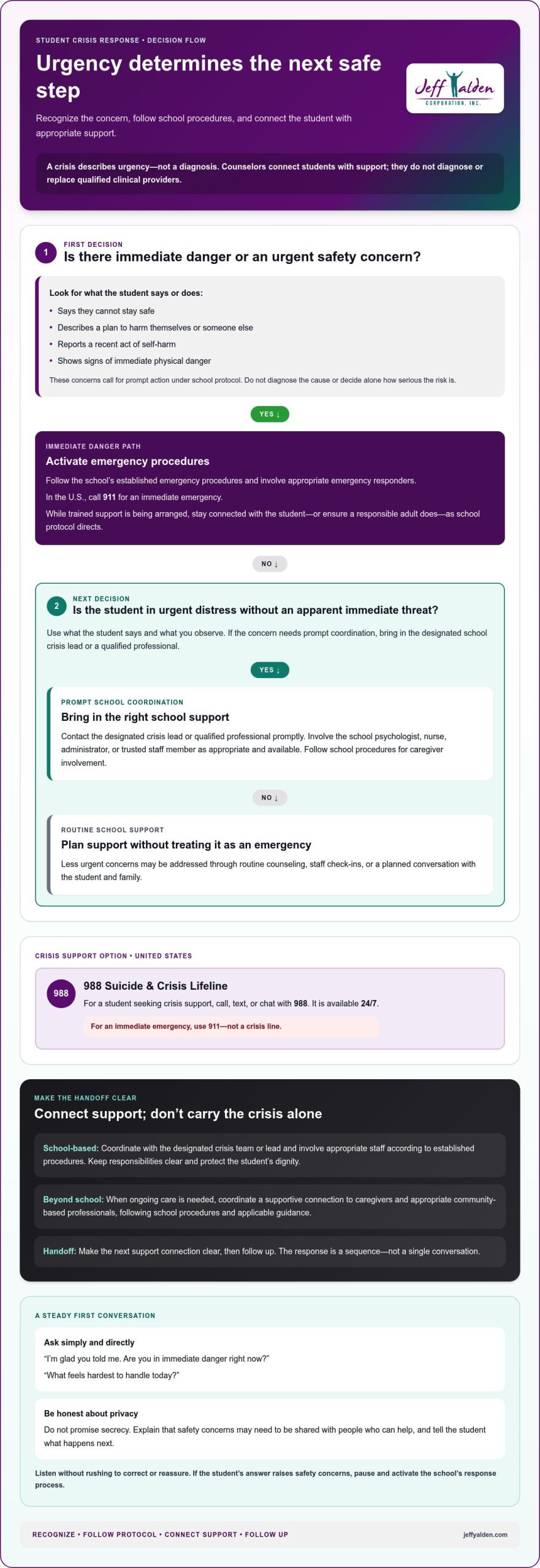
Focus on what the student says or does, rather than labeling them or assuming their intent. A student may say they cannot stay safe, describe a plan to harm themselves or someone else, report a recent act of self-harm, or show signs of immediate physical danger. These concerns call for prompt action under school protocol. Do not try to diagnose the cause or decide alone how serious the risk is.
If there is immediate danger, activate the school’s emergency procedures and appropriate emergency response. While trained support is being arranged, stay connected with the student, or ensure a responsible adult does, as your school’s protocol directs. For urgent distress without an apparent immediate threat, contact the designated school crisis lead or qualified professional promptly, and follow the school’s process for involving caregivers. Less urgent concerns may be addressed through routine counseling, staff check-ins, or a planned conversation with the student and family.
What should the first conversation sound like?
Keep your voice steady. Use simple, direct, nonjudgmental language, then give the student time to answer. You might say, “I’m glad you told me. Are you in immediate danger right now?” or “What feels hardest to handle today?” Listen without rushing to correct, reassure, or fill every silence. If the student’s answer raises safety concerns, pause the conversation and activate the school’s response process.
Be honest about privacy. Do not promise secrecy. Explain that you may need to share information with people who can help keep the student safe. You could say, “I’ll respect your privacy, and if I’m concerned about your safety, I’ll bring in the right support. I’ll explain what happens next.” Then consult the designated crisis lead or qualified professional. This is where school counselor resources for student crisis become a pathway: recognize the concern, follow protocol, and connect the student with support.
Match school counselor resources to the student’s crisis and support needs
Once you have identified the level of urgency, match the next step to the student’s needs. Urgency determines the pathway: immediate danger calls for school emergency procedures and emergency response, while urgent distress or ongoing concerns call for coordinated school, family, community, or crisis support. Counselors connect students with support; they do not diagnose or replace qualified clinical providers.
| Support need | Possible resource | How it can help |
|---|---|---|
| Immediate danger or urgent safety concern | School crisis team and emergency response | Activate the school’s established procedures and involve appropriate emergency responders. In the U.S., call 911 for an immediate emergency. |
| Distress needing prompt school coordination | Designated crisis lead, school psychologist, nurse, or administrator | Bring in appropriate staff to coordinate support according to school procedures and professional roles. |
| Ongoing concern that needs care beyond school | Caregivers and appropriate community-based professionals | Coordinate a supportive connection to care outside school, following school procedures and applicable guidance. |
| Student seeking crisis support in the U.S. | 988 Suicide & Crisis Lifeline | Call, text, or chat with 988 for crisis support. It’s available 24/7. Use 911 for immediate emergencies rather than relying on a crisis line. |
Which school-based resources can support a student?
Start with the school’s designated crisis team or lead. Then involve the school psychologist, nurse, administrator, or trusted staff member as appropriate and available. Each person may contribute different information or support. Coordinate according to established procedures, protect the student’s dignity, and keep responsibilities clear. SchoolSafety.gov offers school mental health resources that can inform prevention and early support planning.
Shared preparation helps staff understand how to raise a concern and where to turn. Professional development for school counselors and educators can build a common language around student well-being. Mental health and well-being professional development can complement a school’s established protocols.
When do community and crisis resources become part of the plan?
Involve caregivers when appropriate under school policy and applicable guidance. Coordinate with community-based professionals when a student needs support beyond school. A crisis line can offer immediate conversation and connection, but it is not a substitute for emergency response when someone faces immediate danger. Make the handoff practical: clarify who will make the connection and how the school will follow up.
Use school counselor resources for student crisis as a coordinated support map, not a list of referrals that leaves the student to figure out the next step alone.
Compare crisis resources by access, urgency, and follow-through
A resource only helps when it fits the student’s situation and they can use it. Compare who it serves, how to reach it, what level of urgency it addresses, and what support needs to happen afterward. These options are not interchangeable, and none removes the need to follow school procedures or plan a thoughtful handoff.
| Resource | Who it serves and access | Best fit and follow-through |
|---|---|---|
| 988 Suicide & Crisis Lifeline | People in the U.S. can call, text, or chat with 988. Support is available in English and Spanish, with interpretation in more than 240 languages. | A student or caregiver can use it for mental health, substance use, or suicidal crisis support. It offers crisis contact, not a substitute for emergency response or ongoing school follow-up. |
| Crisis Text Line | Text HOME to 741741 to connect with a crisis counselor. | Text-based crisis support may suit someone who finds writing easier than speaking. Coordinate the next step with school and caregiver support as appropriate. |
| The Trevor Project | LGBTQ young people under 25 can call 1-866-488-7386, text START to 678-678, or use online chat at TheTrevorProject.org. | Provides crisis intervention and suicide prevention support. It does not replace emergency response for immediate danger or a continuing support plan. |
| School counselor association resources | ASCA resources are for school counselors and other education professionals; they include reference and professional learning materials. | Useful for preparation and practice, not a student-facing crisis line. Explore ASCA Crisis & Trauma Resources to support staff readiness. |
How can counselors judge whether a resource fits?
Use the resource’s authoritative information to review eligibility, current access methods, and geographic scope. Then consider practical barriers: can the student safely call, use text or chat, understand the language offered, and access the service privately? Explain that privacy has limits when safety is at stake, and follow school procedures for caregiver involvement and information sharing. A resource being available does not automatically make it appropriate for the student’s immediate need.
How can a counselor make a referral feel supportive?
Offer context, not just a link. Explain what the resource does and why it may help, then involve the student in an appropriate next step. When suitable under school protocol, make a warm handoff by helping the student connect while a trusted adult remains involved. A resource contact is a bridge, not the whole plan, so clarify who will check in afterward. Broader teen suicide prevention programs can help schools build shared understanding before a crisis, alongside established response procedures.
Use a crisis response workflow that includes a handoff and follow-up
A referral is not the finish line. The student needs to know who is helping, what happens next, and how they can reconnect with a trusted adult. Use your school’s established procedures and applicable local guidance, and let qualified professionals guide assessment and decisions. The process may differ by school, but the goal is consistent: move from concern to coordinated support, then stay connected.
Follow school protocol: notice the concern, assess within your role, activate support, hand off to the right person, and follow up.
What steps belong in a school crisis response?
- Notice and listen. Attend to what the student says and what you observe. Ask clear questions within your role, and identify whether immediate safety concerns require an urgent response.
- Activate support. Follow the school’s designated response process. Contact the crisis lead or appropriate school team, and involve emergency responders when school procedures call for it.
- Coordinate the handoff. Share relevant information with the staff members responsible for next steps. Coordinate with caregivers according to school procedures and applicable requirements.
- Clarify responsibility. Before the conversation ends or the student moves to another support person, confirm who will make the next contact and how the student can seek help in the meantime.
Keep records and share information according to district policy and applicable privacy and documentation requirements. Record relevant observations and actions, not speculation or diagnosis. Clear communication helps the next person pick up the thread without making the student repeat more than necessary.
What should happen after the initial referral?
Make the follow-up plan specific enough to use. Agree with the student and responsible staff member on who will check in and how the student can reconnect if their needs change. Follow school procedures to confirm whether the connection to support happened, while respecting privacy and documenting only as policy requires. If a death affects the school community, use the district’s established postvention guidance to coordinate communication and support.
Follow-through matters because a student may not be ready to explain everything in the first conversation, and a referral can encounter practical barriers. A planned check-in gives staff a chance to learn whether the student reached support and whether the next step needs to change.
Schools can strengthen their shared response through educator learning focused on teen mental health, suicide prevention, crisis intervention, and resilience. Explore educator professional development as an addition to established crisis procedures, not a substitute for assessment, emergency response, or clinical care.
Strengthen school crisis readiness with training, trust, and clear next steps
A crisis response is easier to coordinate when staff do not have to invent the pathway under pressure. Before a student needs help, make sure the people around them know how to raise a concern, who receives it, and where to find current school and community resources. Shared language can reduce confusion, and trust can make it easier for a student to speak up.
How can schools prepare before a student crisis?
Map how a concern moves through your school. Identify who receives reports, who coordinates the response, and how staff locate current procedures and resources. Make the plan easy to understand, while reminding staff to follow school protocols and consult qualified professionals for assessment and decisions.
Use staff learning and school planning to practice communication and handoffs. A simple scenario can help staff rehearse how to pass along a concern, protect the student’s dignity, and clarify who takes the next step. Training on trauma-informed teaching professional development can support a more thoughtful, consistent approach to conversations about student well-being.
How can staff learning support a healthier school culture?
Students may be more willing to seek help when adults respond with care, listen without judgment, and know where to turn. Educator professional development focused on student mental health and well-being can help staff feel more prepared to start these conversations and use shared language around support. It can also help school teams make referral pathways easier to understand.
Jeff Yalden’s school programs and educator training address teen mental health, suicide prevention, crisis intervention, and resilience. Assemblies and community programs can help normalize conversations about mental health and encourage awareness across a school community. They complement prevention and staff learning, but do not replace established crisis protocols, qualified crisis assessment, emergency response, or clinical care.
Build readiness in everyday moments, not only when a crisis hits. Clear pathways, prepared staff, and supportive conversations can make it easier for a student to take the next step and for adults to help them get there. If your school is strengthening its approach to teen mental health, Jeff Yalden’s educator training and school programs can be part of that broader effort.
Build a clearer path to student support
When a student is in crisis, you do not need a perfect script. You need a safe next step, a resource that fits the student’s needs, and a clear plan for what happens after the handoff. The most useful school counselor resources for student crisis work together as a pathway guided by school procedures and qualified professionals.
Keep that pathway visible to staff. Shared language and clear referral routes can help students reach support without being left to navigate the next step alone. Follow-up matters, too. A referral is a beginning, not a guarantee that support has connected.
School programs addressing teen mental health, suicide prevention, and resilience, alongside educator professional development focused on student well-being, can strengthen prevention and schoolwide conversations. These programs complement established crisis protocols and clinical care; they do not replace them. Explore Jeff Yalden’s school programs and educator support to help your school build a more prepared, connected community.
Your calm presence and thoughtful follow-through can help a student feel less alone. Keep the next step clear. It matters.
Frequently Asked Questions
What resources should a school counselor use when a student is in crisis?
Start with your school’s crisis procedures, then coordinate with the designated crisis lead or team and appropriate staff, such as a school psychologist, nurse, or administrator. The right support depends on the student’s needs and the level of urgency. In the U.S., 988 offers crisis support by call, text, or chat; immediate emergencies require emergency response. The best school counselor resources for student crisis connect students to support and include a clear follow-up plan.
When should a school counselor call 911 instead of 988?
Call 911 when there is an immediate emergency or a person faces immediate danger. Follow your school’s emergency procedures and involve appropriate responders. In the U.S., 988 is a crisis contact option for mental health, substance use, or suicidal crises, but it is not a replacement for emergency response. If you are unsure what applies, promptly activate your school’s designated crisis process and consult qualified professionals.
Can a school counselor promise a student confidentiality during a crisis?
No. Do not promise secrecy when a student’s safety may be at risk. Be caring and clear: “I’ll respect your privacy, but if I’m worried about your safety, I may need to share this with people who can help.” Explain what you will do next and involve only the appropriate people, following school policy and applicable privacy requirements. Transparency can help preserve trust, even when information must be shared to support safety.
How can a counselor help a student access crisis support?
Explain the resource in plain language and, when appropriate, help the student connect rather than handing over an unexplained phone number or link. Ask about practical barriers, such as whether they can safely call, text, or chat, and follow school procedures for caregiver involvement. Clarify who will stay with the student, who is responsible for the handoff, and when someone from school will check in.
What should a school counselor do if a student refuses help?
Listen without judgment and ask what makes the support feel difficult. Offer appropriate options and explain what each involves, while following school procedures and consulting the designated crisis lead or qualified professional. A student’s refusal does not remove the need to respond to immediate safety concerns. If danger is present, activate the school’s emergency process. Otherwise, keep the conversation open and agree on a next contact when appropriate.
What resources can help school counselors support students after a crisis?
Coordinate ongoing support through appropriate school staff, caregivers, and community-based professionals, following school policy and privacy requirements. Plan check-ins, clarify who will make the next contact, and confirm whether the student connected with support. For staff reference and learning, the American School Counselor Association offers crisis and trauma resources. If a death affects the school community, follow established district guidance for communication, support, and postvention.
How can schools prepare counselors and staff for student crises?
Make the response pathway easy to find: identify who receives concerns, who coordinates support, and where staff can access current procedures and resources. Practice communication and handoffs through appropriate staff learning. Educator professional development can build shared language around student mental health and well-being, while school programs can support awareness and resilience. These efforts complement established crisis protocols, qualified assessment, emergency response, and clinical care; they do not replace them.
