
You’re sitting across from a teenager whose eyes are hollow, and the air in your office feels like lead. They’ve finally opened up, but now the clock is ticking. You know the protocol says you have to pick up that phone, but your heart is screaming that you’re about to break the only bridge they have left. The weight of notifying parents of student suicidal ideation isn’t just a legal checkbox. It’s a high-stakes moment that can redefine a child’s future. With suicide remaining the second-leading cause of death for youth in 2026, the pressure to get this right is absolute.
I know that gut-wrenching fear. You’re worried about liability, but you’re more worried about the kid. You’re caught between the clinical coldness of school policy and the raw, human need for connection. It’s heavy, and it’s okay to feel that burden. I’m here to show you how to move through that fear with radical transparency. We’re going to turn a terrifying mandate into a life-saving partnership. This guide provides a clear, immediate action plan to help you stay calm, protect the student’s trust, and transition them safely to professional care.
Key Takeaways
- Be the steady anchor a student needs when their world is crashing down in those first 60 seconds.
- Master the delicate balance of notifying parents of student suicidal ideation while keeping the student’s trust intact.
- Use the “warm hand-off” to physically walk a student to help; don’t ever let them face the next step alone.
- Protect your own mental health from the heavy weight of trauma by learning how to decompress with your peers.
- Shift your campus from a reactive “crisis mode” to a culture of prevention that saves lives before the phone rings.
The First 60 Seconds: Immediate Steps When a Student Confides
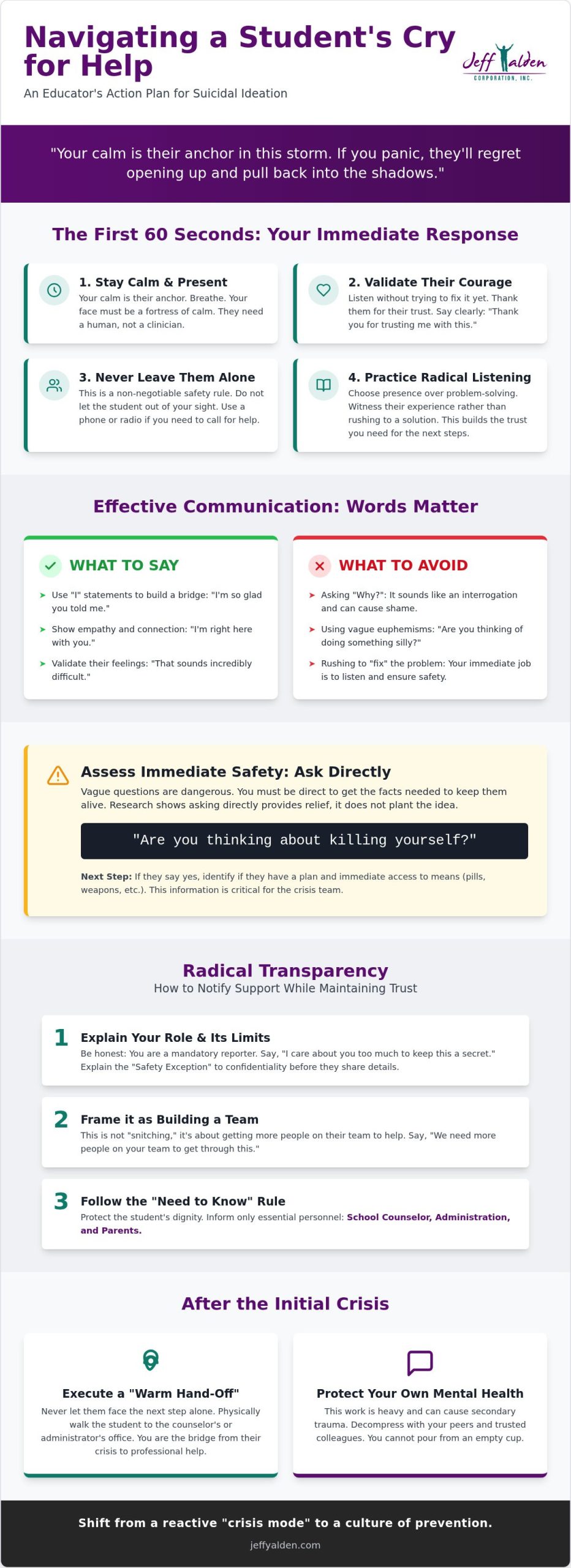
The air in the room just changed. A student looked you in the eye and said the words you never wanted to hear. Right now, your heartbeat is racing, but your face must remain a fortress of calm. They aren’t looking for a clinician; they’re looking for a human being who won’t flinch at their darkness. Your calm is their anchor in this storm. If you panic, they’ll regret opening up and pull back into the shadows. Stay present. Breathe. This is the moment where your relationship with that student becomes a lifeline.
Listen to the raw truth without trying to fix it yet. It takes radical trust for a teenager to drop the mask and show you their pain. Thank them for their courage. Say it clearly: “Thank you for trusting me with this.” It validates their struggle and reinforces that they made the right choice by coming to you. Remember, the process of notifying parents of student suicidal ideation is coming, but for these first sixty seconds, it’s just you and them. Never leave the student alone. This is a non-negotiable safety rule. If you must call for help, use your phone or a radio, but do not let that student out of your sight for a single second.
What to Say (and What to Avoid)
Use “I” statements to build a bridge. “I’m so glad you told me” or “I’m right here with you” works better than clinical scripts. Avoid asking “Why?” because it sounds like an interrogation and forces them to justify their pain. Radical listening is the act of choosing presence over problem-solving; it is about witnessing their experience rather than rushing to a solution. When you stop trying to solve the problem, you actually start helping the person.
Assessing Immediate Safety
You have to be direct. Vague euphemisms like “Are you feeling okay?” or “Are you thinking of doing something silly?” are dangerous. They create room for avoidance. Ask the hard question: “Are you thinking about killing yourself?” Research into Suicidal Ideation shows that asking directly does not put the idea in their head; it actually provides a massive sense of relief. Once the truth is out, identify if they have immediate access to means, such as pills, weapons, or medication. This information is critical for the school counselor and for the eventual process of notifying parents of student suicidal ideation. You need facts to keep them alive, and you need them right now.
Radical Transparency: Notifying Parents of Student Suicidal Ideation
Transparency isn’t just a policy; it’s a lifeline. When a student opens up, you have to be brutally honest about your role. You are a teacher, a coach, or a mentor. You are not a clinical therapist. Tell them that. Tell them, “I care about you too much to keep this a secret.” This is where you explain the “Safety Exception” to confidentiality. Before they share the deepest parts of their pain, they need to know that if their life is at risk, you are required to bring in reinforcements. Don’t let them feel blindsided later. Honesty right now is the only way to keep the bridge from burning.
Framing is everything. If you treat the report like a legal requirement you’re forced to do, it feels like a betrayal. If you frame it as building a team to keep them alive, it feels like love. The act of notifying parents of student suicidal ideation should never feel like “snitching.” It’s about saying, “I’m not going anywhere, but we need more people on your team to get through this.” This honesty builds a foundation for School-Based Suicide Prevention that actually works because it’s rooted in trust, not just paperwork. You’re showing them that their life is worth the difficult conversation.
The ‘Need to Know’ Rule
Not everyone in the building needs to know the details of a student’s trauma. Privacy is still a priority. You inform the school counselor, the administration, and the parents. That’s it. Your job is to ensure a smooth transition to the crisis team while protecting the student’s dignity. By keeping the circle small and professional, you show the student that you’re protecting their story while prioritizing their safety. This transition shouldn’t be a cold hand-off. It should be a warm, guided movement where the student feels supported at every turn. You are the bridge between their crisis and the professional help they need.
Maintaining the Bond Post-Report
The biggest fear students have is that once the “secret” is out, you’ll disappear or treat them differently. Address that fear head-on. Tell them, “I’m still your teacher. I’m still in your corner.” Radical honesty builds long-term resilience. It teaches them that reaching out doesn’t lead to abandonment; it leads to support. Jeff Yalden often says that connection is the ultimate prevention tool. When we lead with heart, we move beyond clinical protocols into real, life-saving territory. If you want to dive deeper into building these skills for your staff, consider exploring Teacher Professional Development to empower your entire campus culture.
Navigating the Hand-off: Working with School Counselors
The moment you stand up to lead that student out of your room is the most critical physical action you’ll take. Don’t just give them a pass or point down the hall. Walk with them. Physically escorting the student to the counselor’s office sends a powerful message: “I am not discarding you.” It keeps them safe in that vulnerable transition period. You’re the bridge between their crisis and the clinical support they need. Your presence during this walk is a silent promise that they aren’t facing the system alone.
Once you arrive, your role shifts to being a factual witness. Provide a clear, factual briefing to the crisis team. Tell them exactly what you heard, what you saw, and what the student confirmed. This isn’t the time for fluff or vague impressions. It’s about providing the data they need to keep this child alive. This is where the process of notifying parents of student suicidal ideation moves from your hands into a collaborative effort. But remember, the hand-off isn’t an exit. It’s a partnership. You are still that student’s person, and your ongoing involvement is vital for their long-term stability.
To do this right, you need to understand the underlying mechanics of trauma. Integrating lessons from trauma-informed teaching professional development into this hand-off ensures you’re not just following a checklist. You’re actually supporting a nervous system in collapse. You’re acting as a co-regulator. Your presence stays steady even when the situation feels chaotic. This training helps you see the student’s behavior as a cry for help rather than a disruption, which is essential for a successful hand-off.
The Crisis Team’s Role
The counselors will start a clinical assessment to determine if the risk is low, medium, or high. They aren’t just checking boxes; they’re trying to see the full picture. As an educator, you can support the “Safety Plan” they develop. Maybe that means letting the student step out of class if they feel overwhelmed or having a specific signal for when things get dark again. Documentation is also vital. Write down the facts of the event as soon as you can. It protects the school, but more importantly, it ensures the student’s history of care is accurate. When notifying parents of student suicidal ideation, having clear notes helps the school communicate effectively with the family.
Post-Crisis Classroom Re-entry
When a student returns after a psychiatric hold or a crisis, they are often terrified of how you’ll look at them. Support them by normalizing the return. Don’t make it a spectacle. Don’t pull them aside in front of everyone to ask if they’re “okay.” Just welcome them back with a simple, genuine, “It’s good to see you today.” Building a supportive environment for recovery means being the same steady presence you were before the crisis. Your classroom needs to be the one place that feels consistent and safe while they navigate the aftermath of their struggle.
Post-Crisis Care: Protecting the Educator’s Mental Health
The door finally closes. The student is safe with the counselor. Now, the silence in your room is deafening. You just absorbed the crushing weight of a young life hanging by a thread. This is secondary trauma. It is heavy. It is real. Hearing a report of this magnitude is a high-intensity event that stays in your bones long after the final bell rings. You cannot just “shake it off.” You need to decompress. Do not carry this weight alone. Find a trusted peer or a supervisor. Speak the raw truth of what you’re feeling right now.
The emotional labor of notifying parents of student suicidal ideation is physically exhausting. It drains your reserves. You have to watch for the warning signs of burnout or compassion fatigue in your own life. Are you losing sleep? Are you feeling detached? To understand the long-term journey of recovery, dive into building resilience in teens. Knowing the radical truth about bouncing back helps you see that this crisis is a single chapter, not the entire story. You are a witness to their struggle, but you don’t have to be a victim of it.
Processing the Experience
Guilt is a persistent liar. It loves to whisper “what if” and “I should have noticed sooner.” Stop that cycle. You were the anchor when that student needed one. You did your job. Now, you need to process that experience so it doesn’t become a permanent burden. Seeking specific professional development helps you feel more equipped and confident for future crises. Remember, teacher self-care is a leadership trait. It is not selfish. If your tank is empty, you cannot lead your students to safety. You have to be okay so they can be okay.
Normalizing the Conversation Among Staff
We have to stop pretending we are bulletproof. It is time to normalize these conversations among the staff. Staff meetings should include intentional mental health check-ins for the educators. We need to create a culture of radical transparency in the teacher’s lounge. Let’s reduce the stigma of mental health struggles for ourselves first. When we are honest about our own struggles, we give our students permission to do the same. We are a team. We move together. No one should have to navigate the aftermath of a crisis in isolation.
Ready to equip your staff with the resilience they need to face these challenges head-on? Book a session for Teacher Professional Development today and start building a stronger, more transparent school community.
Building a Culture of Prevention with Jeff Yalden
We’ve spent this entire guide talking about how to respond when the siren is already wailing. But what if we could stop the fire before it starts? Moving from “Crisis Mode” to a “Prevention Culture” is the ultimate goal for every administrator and educator. While notifying parents of student suicidal ideation is a non-negotiable safety net, we want to reach our students long before they hit that breaking point. It’s about building a campus where the silence is broken and the masks come off. When we normalize the struggle, we give our kids the air they need to breathe.
Jeff Yalden doesn’t do “clinical.” He doesn’t do boring. In 2026, teens are hyper-aware. They can spot a script a mile away. Jeff’s high-energy, raw approach resonates because it’s real. He’s been in those trenches. High school assemblies are the spark that can transform your school’s atmosphere in a single afternoon. By empowering students to be the first line of defense for their peers, we create a network of support that moves faster than any protocol. They talk to each other first. We need to make sure they know how to listen and when to get help.
Bringing Radical Transparency to Your School
A mental health speaker doesn’t just deliver a speech; they shift the entire frequency of your campus. By bringing a voice that is both a vulnerable authority and a resilient guide, you make it okay for students to seek help before they are in a tailspin. This isn’t just about a one-day event. It’s about launching teen suicide prevention programs that actually work because they are rooted in radical transparency. When the conversation is out in the open, the stigma loses its power. You aren’t just managing a school; you’re leading a movement of hope.
Training Your Staff for the Front Lines
Professional development shouldn’t be another box to check on a Friday afternoon. It should be an experience that equips your team for the reality of 2026. We need educators who aren’t afraid of the hard, messy conversations. We need a team that understands that notifying parents of student suicidal ideation is an act of love, not just a legal requirement. When your staff is trained to lead with heart, the entire safety of your campus rises. Don’t wait for the next crisis to hit. Take a proactive step for your community right now. Book Jeff Yalden for your next high school assembly or teacher PD and let’s start saving lives together.
Lead With Heart to Save a Life
You are more than just a mandatory reporter. You are a bridge between a student’s darkest moment and a future filled with hope. By staying calm in those first 60 seconds and prioritizing radical transparency, you protect the student’s life while preserving their trust. Remember that notifying parents of student suicidal ideation is an act of deep care that brings more people onto the student’s team. You’ve learned how to navigate the clinical hand-off and why your own mental health matters just as much as theirs. This work is heavy, but it is the most important work you will ever do.
You don’t have to build this culture of resilience in isolation. With over 30 years of experience, Jeff Yalden is a specialist in crisis intervention and postvention who knows how to reach the hearts of both students and staff. He is a passionate advocate for your well-being and the safety of your campus. Book Jeff Yalden to bring a culture of resilience to your school and turn your campus into a fortress of support. You have the tools. You have the heart. Now, take the next step to ensure no student feels invisible. You are making a difference every single day.
Frequently Asked Questions
What if the student asks me not to tell anyone?
You tell them the truth immediately. You cannot keep that secret because you care about their life more than their temporary comfort. Explain that your role as an educator means you have to bring in more people to keep them safe. It is not a betrayal; it is a lifeline. By being transparent about the process of notifying parents of student suicidal ideation, you maintain your integrity while ensuring they get the professional help they need.
How do I know if the student is in immediate danger?
You ask the hard, direct question: “Are you thinking about killing yourself right now?” Don’t dance around it with vague language. If they have a specific plan, access to means like pills or weapons, or a set timeline, they are in immediate danger. Your job isn’t to diagnose them but to keep them in your sight until the school’s crisis team takes over. Directness is your best tool for clarity and safety.
Should I call the parents myself or wait for the counselor?
Follow your school’s specific protocol, which usually identifies the counselor or administrator as the primary contact for families. They are trained to handle the clinical nuances of notifying parents of student suicidal ideation. Your role is to provide the factual briefing and stay with the student. If you are in a situation where you must call, lead with empathy and facts. However, the crisis team is typically best equipped to manage this high-intensity communication.
What are the common warning signs I might have missed?
Look for radical changes in behavior. This includes withdrawal from friends, giving away prized possessions, or a sudden, eerie calmness after a period of deep depression. They might use language that suggests they are a burden to others or that the world would be better without them. These signs are often subtle cries for help. If your gut says something is off, trust that instinct and start the conversation immediately.
How do I talk to the rest of the class if they suspect something is wrong?
You protect the student’s privacy above all else. If the class is buzzing, acknowledge that “someone is going through a hard time” without naming names or details. Remind them that your classroom is a community where people look out for each other. Focus on the resources available to everyone, like the counselor’s office. You want to normalize seeking help without turning a single student’s crisis into a public spectacle or a gossip point.
Can a teacher be held liable if a student reports suicidal thoughts?
Liability generally arises when an educator fails to follow established school protocols or ignores a direct report of self-harm. As long as you follow your training, stay with the student, and alert the proper authorities immediately, you are doing your job. Your primary duty is the “duty to care.” Documentation of your actions is vital. By acting quickly and transparently, you protect the student and fulfill your professional and legal obligations.
What is the difference between suicidal ideation and a suicide plan?
Suicidal ideation involves thoughts or images of wanting to die, which can range from fleeting to persistent. A suicide plan is much more dangerous because it includes the specific “how,” “where,” and “when.” Both require an immediate response. You don’t need to be a doctor to know that any mention of self-harm is a signal for intervention. Treat every thought as a serious request for help and move to the next safety step.
How can I support a student who is returning after a mental health crisis?
Be the same steady presence you’ve always been. Welcome them back with a simple, “It’s good to see you,” rather than an intense interrogation about their health. Don’t overwhelm them with missed assignments or pressure to catch up immediately. Your classroom should be their safe harbor. By normalizing their return and offering a low-stress environment, you help them rebuild their resilience and feel like a valued member of the school community again.
