
It’s Friday night and the house is dead silent. No car doors slamming. No group chat pings. Just the glow from under their bedroom door and that heavy, hollow ache in your chest. You’re stuck in a loop of panic, thinking my teenager has no friends, and you’re terrified they’re being left behind or broken by a world that feels increasingly cold. I’ve stood in those shoes. I’ve heard the silence that screams.
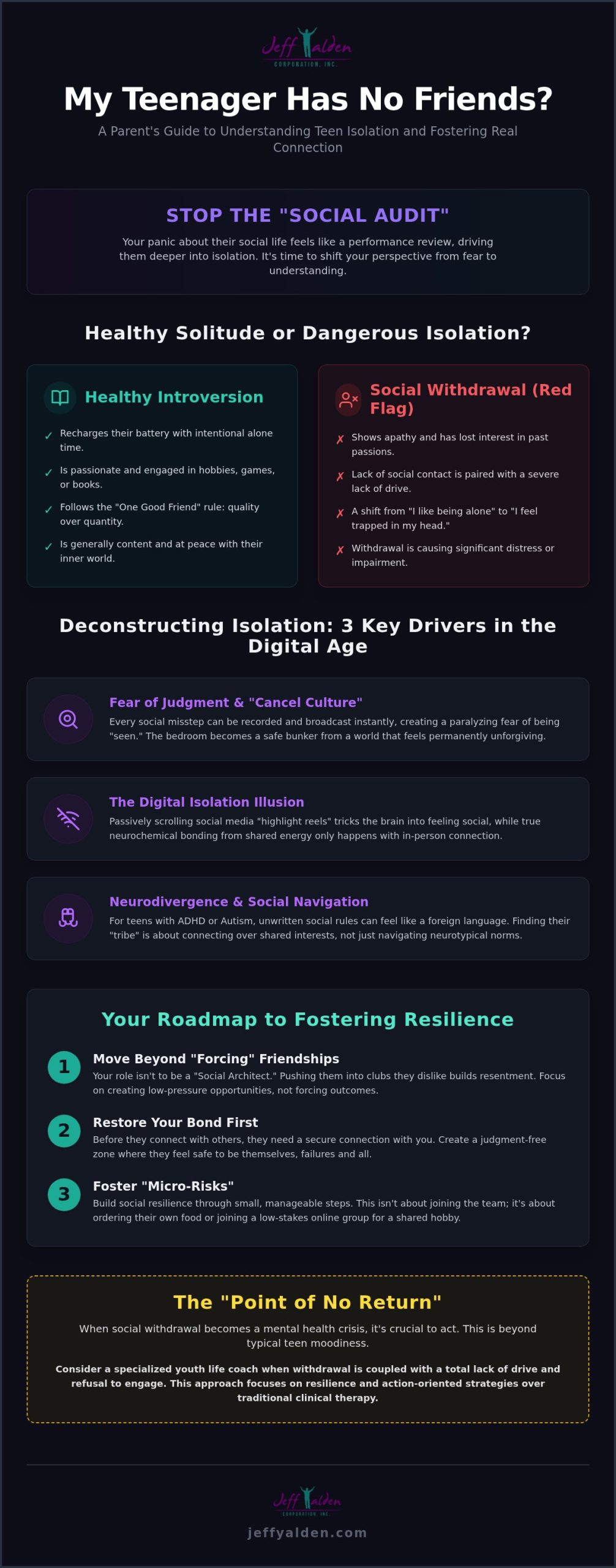
You feel like you’re failing because you can’t “fix” their social life. You want to push, prodding them to go out or sign up for something, anything. I’m here to tell you to stop the social audit right now. This guide is your roadmap to move past the panic and start building the raw resilience your teen needs to find authentic connection in a digital age. We’ll break down the difference between healthy introversion and dangerous isolation, how to restore your bond with them first, and how to guide them toward their tribe without being the overbearing parent they push away.
Key Takeaways
- Stop the “social audit” and learn why your panic acts like a performance review that drives your teen deeper into isolation.
- Understand the 2026 social landscape to determine if my teenager has no friends because of a preference for solitude or a paralyzing fear of digital rejection.
- Move beyond “forcing” clubs and learn how to foster “Micro-Risks” that build genuine social resilience without the pressure of performance.
- Identify the “Point of No Return” where social withdrawal becomes a mental health crisis requiring a specialized youth life coach approach over traditional clinical therapy.
Silence in the Hallway: What ‘No Friends’ Means in 2026
You’re standing in the hallway. The house is quiet. Too quiet. You look at that closed bedroom door and the panic starts to rise. You’re convinced that my teenager has no friends, and you’re already mourning the prom photos and graduation parties that might never happen. I’ve been there. I’ve talked to the kids who feel the weight of your expectations like a lead vest. Your heartbreak is valid, but your panic is a “performance review” your teen can feel through the drywall.
In 2026, the definition of friendship has been twisted into something unrecognizable. We have to be surgical about what we’re seeing. Defining Social Isolation is the first step in understanding if your child is actually in danger or just navigating a world that values “likes” over loyalty. Sometimes, the kid with the most followers is the loneliest person in the building. Popularity is frequently just a high-gloss mask for deep-seated insecurity.
Healthy Introversion vs. Social Withdrawal
Not every quiet teen is a broken teen. Some kids are natural introverts who need the silence to recharge their battery. If they’re passionate about a hobby, crushing it in a game, or lost in a book, they might just be fine. The “one good friend” rule is my gold standard; quality beats quantity every single time. One authentic person they can trust is enough to build a foundation of resilience. If you’re constantly spiraling because my teenager has no friends, you might miss the fact that they’re actually content with their inner world.
The red flags appear when the silence turns into apathy. If they’ve lost interest in their passions and the lack of social contact is paired with a total lack of drive, we’re looking at social withdrawal. This is the shift from “I like being alone” to “I’m trapped in my own head.”
The Impact of Digital Isolation
Digital connectivity is the great illusion of our time. Your teen is staring at a highlight reel of everyone else’s “perfect” life, which triggers a visceral sense of being left out. The passive scroll is a motivation killer. It tricks the brain into thinking it’s socializing while the body remains isolated. Digital isolation serves as a direct barrier to the neurochemical bonding that only occurs through physical presence and shared energy. We have to break the cycle of digital consumption to find real-world connection again.
Deconstructing the Isolation: Why Teens Pull Back Today
Isolation isn’t just a phase; it’s often a calculated survival strategy. When you tell me that my teenager has no friends, we have to look at the world through their eyes. They aren’t just “being difficult” or “lazy.” They’re navigating a high-stakes social environment where the cost of a mistake feels permanent. Recent research on Generation Z Isolation shows that this withdrawal is a growing epidemic, fueled by a fear of being “seen” and judged in real time.
The Fear of Judgment and “Cancel Culture”
High school used to be a place where you could mess up, apologize, and move on. Not anymore. Today, every social slip-up can be recorded, screenshotted, and blasted to the entire grade in seconds. This creates a paralyzing fear of saying the wrong thing. For many teens, the bedroom feels like a bunker. It’s the only place where they don’t have to perform or worry about being “canceled” for a joke that didn’t land. I tell parents all the time: your teen’s withdrawal is often an attempt to protect themselves from a world that feels unforgiving. We have to model radical transparency about our own social failures to show them that perfection isn’t the price of admission for friendship.
Neurodivergence and Social Navigation
The “standard” social path is built for neurotypical brains, but that’s not how every kid works. If your teen has ADHD or Autism, the unwritten rules of high school social life can feel like a foreign language they never learned. They might miss the subtle cues or get overwhelmed by the sensory chaos of a crowded cafeteria. If my teenager has no friends in their specific grade level, it might be because they haven’t found their “tribe” yet. Tribes today are built on shared interests, not just shared hallways. Being “quirky” is actually a superpower; it just requires finding the right community that speaks their language.
Building meaningful connections starts with building resilience in teens so they can handle the inevitable sting of peer rejection. It’s about teaching them that their worth isn’t tied to a group text. Sometimes, a teen life coach is the only person who can help them see that their brain isn’t broken, it’s just wired for a different kind of connection. We have to stop trying to force them into boxes they weren’t meant to fit in.
The “Social Architect” Mistake: Why You Can’t Force Friendships
Stop trying to be the CEO of your kid’s social life. When you spiral because my teenager has no friends, your first instinct is to build a schedule. You sign them up for the debate team. You push them into soccer. You try to engineer “organic” hangouts with your friend’s kids. Stop. You’re falling into the Parent Trap. You’re either trying to recreate your glory days or you’re terrified they’re repeating your social nightmares. Either way, you’ve stopped seeing your kid and started seeing a project. They can feel the difference, and it’s driving them further into their room.
Forcing friendships doesn’t work. It creates a performance-based relationship where your teen feels they have to “produce” social wins to keep you happy. Real growth happens in “The Pause.” This is the uncomfortable space where you let them feel the weight of their own social life without you rushing in to carry it. It’s the radical shift from being a “Fixer” to being a “Supporter.” You aren’t the architect of their life; you’re the foundation they stand on while they build it themselves.
Why Your Urgency is Their Pressure
Your teen is a heat-seeking missile for your anxiety. When you hover, asking who they ate lunch with or why they aren’t going to the game, they don’t hear “I love you.” They hear “something is wrong with me.” This pressure is suffocating. If you want them to connect with others, you have to show them what a healthy life looks like. Maintain your own friendships. Model what it means to be a good friend. Parental over-functioning leads to teen under-functioning because they never have to develop the muscles of initiative. Understanding the basics of Fostering Social Connection starts with letting them take the lead in their own time.
Establishing Boundaries Without Isolation
We need to talk about gaming. If you’re using “no gaming until homework is done” as a blunt instrument, you might be cutting off their only social lifeline. In 2026, the headset is often the only place they feel heard and accepted. You have to balance boundaries with the reality of their digital world. Your home should be a safe harbor, a place where their social status doesn’t matter. Try low-pressure “parallel play.” Sit in the same room while you both do your own thing. No questions. No prodding. Just being together. It builds the bond without the interrogation, proving you’re on their team even when the world feels empty.
Actionable Steps to Foster Real Connection and Resilience
Stop the lectures. Start the work. If your current reality is waking up every day thinking my teenager has no friends, you don’t need another theory. You need a strategy. This isn’t about making them “popular” or forcing them to be someone they aren’t. It’s about helping them find one person who gets them. First, validate their pain. Stop trying to “silver-lining” the situation. When they say they’re lonely, don’t tell them it’ll be better in college. Tell them you hear them. Tell them it sucks. Meet them in the hole before you try to pull them out of it.
The Power of Micro-Risks
We don’t go from total isolation to the homecoming court overnight. We focus on micro-risks. A micro-risk is a small, manageable social step that doesn’t feel like a life-or-death situation. We celebrate the effort of the risk, regardless of the outcome. If they said hi and the other kid didn’t respond, that’s still a win. Why? Because they exercised their “rejection muscle.” Resilience isn’t the absence of failure; it’s the ability to fail and keep moving. We’re training them for the long game. Examples of micro-risks include:
- Saying “hey” to one person in the hallway without expecting a conversation.
- Joining a Discord server or online forum dedicated to a specific niche hobby.
- Asking a single question in class to practice being “seen” by peers.
- Sitting in a public space like a library or cafe for 30 minutes without a phone.
Finding the Tribe Through Interests
Stop looking for friends in the school cafeteria. For many kids, the school walls are a prison of judgment. We need to look at identity-first social planning. They find the “tribe” through the “thing.” Whether it’s community theater, a local coding camp, or martial arts, these environments provide a shared goal. For instance, you can learn more about Bushi Ban Child Care to see how structured programs foster these types of peer connections. Shared goals lower the social barrier and make interaction feel natural rather than forced. Sometimes, an intergenerational friendship with a mentor or a coach can bridge the gap for a lonely teen better than a peer ever could. A teen mental health speaker can often be the spark that helps them realize they aren’t alone in their struggle.
Finally, practice radical transparency. Tell them about the time you sat alone at lunch. Share your social failures. It humanizes you and takes the pressure off them to be perfect. If they won’t listen to you, find them a mentor outside the family unit. Sometimes they need a voice that isn’t yours to tell them the truth about their potential. If you’re ready to stop the cycle of isolation and start building real grit, consider working with a youth life coach who can speak their language and push them toward growth.
We have to talk about the dark side. It’s one thing to be a quiet kid; it’s another to be a kid who is disappearing. When you say my teenager has no friends, you might be witnessing a slow-motion collapse. There is a point of no return where isolation stops being a social preference and starts being a survival crisis. I’ve spent 30 years in the trenches with kids who feel invisible. I know the look in their eyes when they’ve stopped trying. They aren’t just “lonely.” They are losing their grip on their own value.
Traditional clinical approaches often miss the heart of the matter. They focus on the “what” instead of the “why.” Your teen doesn’t need to be analyzed under a microscope. They need to be understood by someone who has walked through the fire. This is about more than just social skills; it’s about the fundamental belief that they deserve to take up space in this world. We have to move with urgency when the silence becomes a wall that you can no longer reach over.
The Warning Signs of a Mental Health Crisis
Look for the radical shifts. Is the sleep schedule destroyed? Did their appetite vanish or double? These aren’t just “teen things.” They are red flags. Sometimes, the phrase “I have no friends” is actually a shorthand for “I am drowning in trauma and I don’t know the way out.” We have to connect these dots to teen suicide prevention programs because isolation is the primary fuel for ideation. When a teen feels they have no witness to their life, they start to believe their life doesn’t matter. We cannot afford to wait for them to “grow out of it” when their mental health is on the line.
Mentorship vs. Therapy: A Different Path
Traditional therapy fails some teens because it feels like a performance. They sit on a couch and tell a stranger what they think the stranger wants to hear. A life coach for teens offers a different energy. It’s a partnership, not a diagnosis. We focus on building a “victor” mentality rather than a “victim” narrative. We don’t just talk about the pain; we build the resilience to move through it. Sometimes, all it takes is hearing a high school assembly speaker who speaks with radical transparency to break the seal of silence. It gives them permission to be real.
Your teen is not a problem to be solved; they are a soul to be seen. They need to know that you are their fiercest advocate, even when they’re at their most difficult. If you’re ready to bring in a professional who can reach them when they’ve shut everyone else out, Book a consultation with Jeff Yalden. Let’s stop the social audit and start the restoration. It’s time to bring your teenager back to the light.
Breaking the Silence and Building the Future
You’ve been carrying the weight of that hallway silence for far too long. When you look at that closed door and think my teenager has no friends, it’s easy to let fear dictate your next move. But remember: your teen is not a project to be managed; they are a person to be understood. You’ve learned that forcing connections only builds resentment, while fostering micro-risks and finding a tribe through shared passions builds real grit. We’ve moved from the panic of isolation to the power of resilience.
I’ve spent 30+ years as a youth motivational speaker and life coach, specializing in crisis intervention and resilience. As the author of “The 28-Day Guide to a New You”, I know that transformation doesn’t happen by accident. It happens through partnership. If you’re ready to bridge the gap and help your teen find their voice, it’s time to take the next step. Book Jeff Yalden to Speak at Your School or Coach Your Teen today. You don’t have to navigate this journey alone. Your teen has greatness in them; they just need the right guide to help them see it. Keep showing up. Keep being real. The connection is coming.
Frequently Asked Questions
Is it normal for a 16-year-old to have no friends?
It is increasingly common in 2026, but “normal” doesn’t mean it’s healthy for their development. Many teens are navigating a digital-heavy world where traditional social skills have withered under the weight of screens. If you’re constantly thinking my teenager has no friends, realize they aren’t alone in this struggle. However, a total lack of connection at sixteen often signals a need for intentional intervention to build the resilience required for adulthood.
How do I know if my teen is lonely or just an introvert?
Introverts find energy in solitude; lonely teens are drained by it. An introvert usually has deep creative interests and seems content with their own company. A lonely teen often shows signs of apathy, sadness, or a desperate desire for connection they don’t know how to initiate. Watch the energy levels closely. If they seem peaceful while alone, it’s introversion. If they seem heavy and stuck, it’s painful isolation.
What should I do if my teen is being bullied and withdrawing?
Stop the bleeding by creating a safe harbor at home immediately. Validate their experience without jumping to “solutions” that might make them feel more vulnerable. You need to be their advocate with the school, but more importantly, you need to be their emotional anchor. When a teen withdraws due to bullying, they are in survival mode. They need to know that their value isn’t determined by the cruelty of others.
Can a life coach help a teenager with social anxiety?
Yes, a youth life coach provides a partnership that traditional clinical therapy often lacks. Instead of just talking about the past, a coach focuses on the future and actionable “micro-risks.” We help teens build a “victor” mentality. We work on the “rejection muscle” and social resilience in real-time scenarios. It’s about moving from the “victim” narrative of social anxiety into a proactive, growth-oriented mindset that builds confidence.
Should I force my teenager to join a club or sport?
Forcing participation almost always backfires and leads to deeper resentment. Instead of mandating a specific activity, offer choices that align with their authentic interests. If you push them into a sport they hate just for “socialization,” they’ll likely feel more out of place. Focus on finding their “tribe” through the “thing” they already love. You can discover Agility Sports to explore interests in sports like badminton or pickleball as potential avenues. Let them choose the vehicle for their social growth so they own the outcome.
What are the warning signs that teen isolation is becoming dangerous?
Watch for radical personality shifts, changes in sleep or appetite, and a total loss of interest in things they once loved. If their withdrawal is accompanied by expressions of hopelessness or self-harm, it’s a crisis. These are the “Point of No Return” signs. Isolation is the primary fuel for suicidal ideation. If you’re worried that my teenager has no friends and you see these signs, seek immediate support from a specialist.
How can I talk to my teen about their social life without them shutting down?
Lead with vulnerability and ditch the interrogation. Instead of asking “Who did you eat lunch with?”, try sharing a story about a time you felt lonely or socially awkward. Practice radical transparency. When you stop acting like the perfect authority and start acting like a lived-experience guide, they’ll stop feeling like a project. Create a space where they can be real without fearing a performance review from you.
Does social media make teen loneliness worse?
It often creates a “highlight reel” effect that makes real-world isolation feel more intense. While it offers a sense of connectivity, it frequently lacks the neurochemical bonding of physical presence. Teens spend hours in a “passive scroll,” watching others “live” while they sit in silence. This digital isolation acts as a barrier to authentic connection. It tricks the brain into thinking it’s socializing while the body remains lonely.
