
Mindfulness doesn’t have to mean sitting perfectly still, closing your eyes, or trying to feel calm. Mindfulness exercises for high school students work best when they’re practical, easy to adapt, and offered without pressure. Students should be able to choose another activity or simply observe if a prompt feels uncomfortable.
That matters in a crowded classroom, between classes, or whenever focusing inward feels like too much. Mindfulness isn’t about clearing your mind or pretending stress has disappeared. It’s a chance to notice what’s happening and choose where to place your attention, in a way that feels manageable.
Below are 10 low-pressure exercises students can try in class or between classes, from sensory check-ins to simple movement. You’ll also find ways to choose an activity for the setting, invite participation without pressure, and recognize when a student may need support beyond a mindfulness exercise. Start with the option that feels doable.
Key Takeaways
- Mindfulness doesn’t require students to empty their minds or feel calm on command.
- Breath, sound, and sensory exercises can offer quick options for a school-day pause.
- Movement, visual focus, and body-awareness activities give students alternatives for different settings and comfort levels.
- A simple four-step approach helps teachers explain an activity, offer choices, guide it briefly, and close without judgment.
- Mindfulness is one optional part of student support, not a replacement for connection or help when a student needs it.
What mindfulness exercises for high school students are, and what they are not
Mindfulness means noticing what’s happening in the present moment, including thoughts, feelings, and physical sensations, without needing to change them. Mindfulness exercises for high school students are simple ways to practise that kind of attention during an ordinary school day.
The goal isn’t to empty your mind, concentrate perfectly, or reach a particular state of calm. Thoughts will come up: maybe a quiz, a conversation from lunch, or the next item on your schedule. Mindfulness means noticing when your attention has wandered and choosing whether to return it to something happening now. That return is part of the practice, not a sign you’ve done it wrong.
The term has roots and applications beyond classroom activities. A broader overview of Mindfulness explains how it’s used in different contexts. In school, an exercise can be straightforward: listen for a sound, notice your feet on the floor, or pay attention to one breath. No special belief is required.
Think of these activities as optional skills practice, not treatment or a guaranteed way to feel calm. A short pause may help someone notice what’s happening, but it won’t erase a stressful situation or work the same way for every student. Students deserve honest expectations, not pressure to perform calmness for the room.
Why mindfulness can feel different for teenagers
Trying an activity in front of classmates can feel awkward. A student may be short on time, distracted, or more comfortable focusing on the room than on internal sensations. Those responses aren’t a failure. If attention drifts, noticing it is part of the practice; returning to the exercise is optional. One activity won’t solve a difficult situation, and students shouldn’t be told it will.
Choice makes a classroom exercise more approachable
Before beginning, explain what the activity involves and what students can choose to do. Keep eyes open as an option, and make it clear that students can participate, observe, or choose a quiet alternative. They can stop or switch focus at any point. Clear choices make the exercise an available tool rather than a public test.
- Participate: Follow the prompt in a way that feels comfortable.
- Observe: Listen without doing the activity yourself.
- Choose another focus: Look around the room or notice a neutral detail nearby.
These options make the invitation clear: there’s no single correct way to take part, and students don’t need to explain if they opt out.
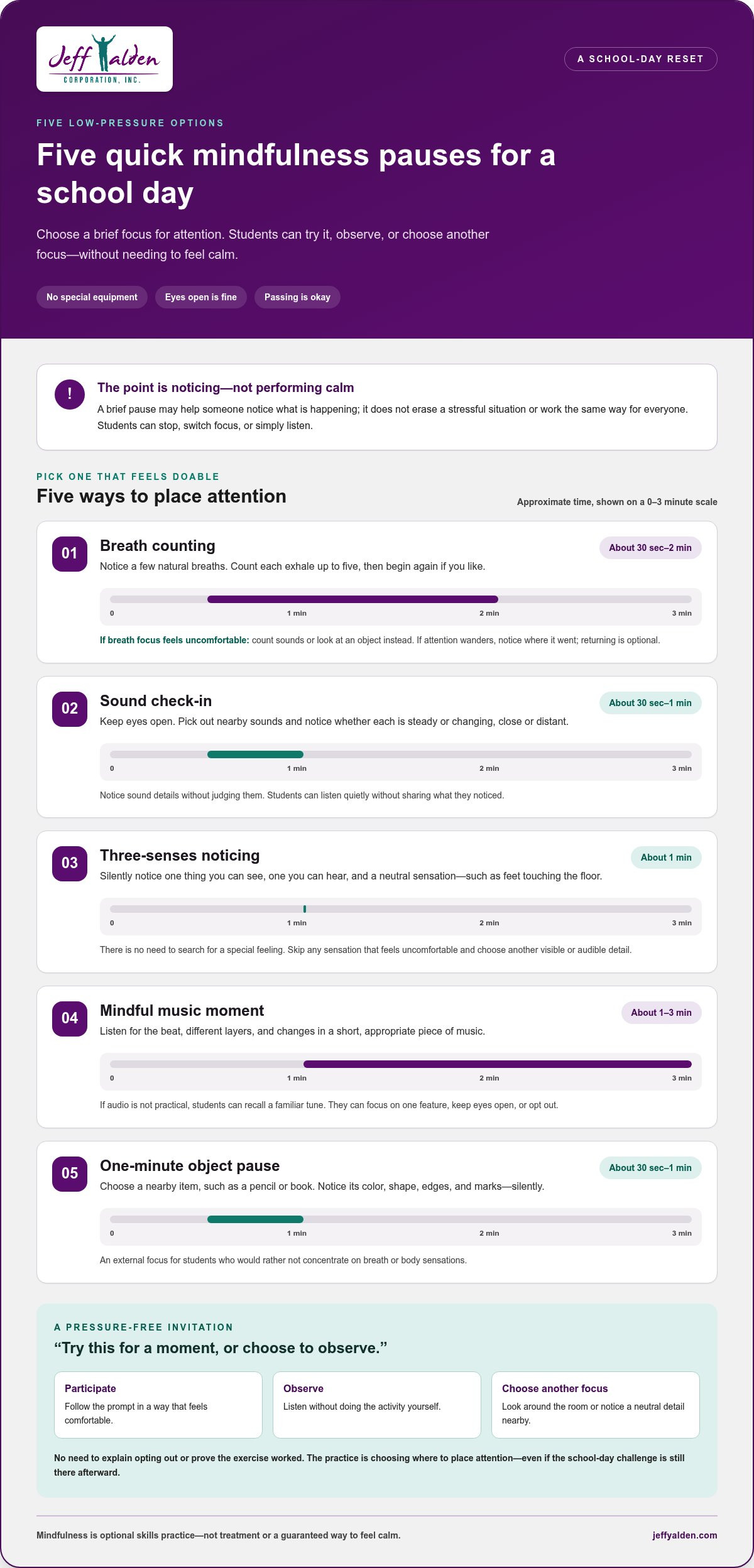
Five quick mindfulness exercises for a school-day reset
A brief pause creates a moment to notice what’s happening, but it doesn’t have to change how anyone feels. Invite students to try one of these mindfulness exercises for high school students, adapt it, or pass. Each can fit into a school day without special equipment.
- Breath counting, about 30 seconds to 2 minutes. Notice a few natural breaths without trying to make them deeper or slower. Count each exhale up to five, then begin again if you like. “If your attention wanders, notice where it went, then choose whether to return to the next breath.” If focusing on breathing feels uncomfortable, count sounds or look at an object instead.
- Sound check-in, about 30 seconds to 1 minute. Keep your eyes open and notice nearby sounds. Pick out one, then another. Is each steady or changing, close or distant? Notice the details without judging the sound. Students can listen without sharing what they noticed.
- Three-senses noticing, about 1 minute. Silently notice something you can see, something you can hear, and a neutral sensation, such as your feet touching the floor. There’s no need to search for a special feeling. Skip any sensation that feels uncomfortable and choose another visible or audible detail.
- Mindful music moment, about 1 to 3 minutes. Play a short, appropriate piece of music, or invite students to recall a familiar tune if audio isn’t practical. Listen for the beat, different layers, and changes in the sound. Students can focus on one feature, keep their eyes open, or opt out.
- One-minute object pause, about 30 seconds to 1 minute. Choose a nearby item, such as a pencil or book. Notice its color, shape, edges, and marks without describing it aloud. An object gives attention an external focus for students who don’t want to concentrate on breath or body sensations.
Keep the invitation simple: “Try this for a moment, or choose to observe.” Don’t ask students to prove the exercise worked or report feeling calmer. The practical skill is choosing where to place attention, even if the school-day challenge is still there afterward. For schools that want to support staff in broader student well-being conversations, teacher professional development can complement classroom efforts.
Mindfulness for high school students who would rather move or look around
Mindfulness doesn’t require students to sit perfectly still. Attention can rest on a small movement, a visible detail, or a comfortable point of contact with the floor. For some students, focusing on the room feels more manageable than closing their eyes or concentrating on internal sensations. Keep eyes open, stay seated, or choose another focus. The exercise should fit the student.
These options need little or no preparation. Teachers can offer them as quiet individual activities without asking anyone to demonstrate, explain, or report what they felt.
Mindful movement without putting students on display
A slow movement check-in can work beside a desk or in a chair. Invite students to roll their shoulders gently or open and close their hands, noticing the movement at a comfortable pace. They can instead notice their feet on the floor. There’s no target stretch, correct posture, or flexibility test. Students can skip the movement and simply notice their feet.
This can fit a brief pause after students have been sitting for a while, and it requires no equipment. Keep the prompt low-key: “If you’d like, try one small shoulder roll or hand stretch. Notice the movement, or feel your feet on the floor.” Students don’t need to share what they notice. They can stop, stay seated, or watch quietly.
A visual anchor or body-awareness alternative
For a visual focus, invite students to choose an ordinary object within reach and quietly notice its shape, color, edges, or small marks. They don’t have to name anything aloud. If looking closely doesn’t feel comfortable, they can focus on a neutral sound or another part of the room. This option needs no setup and keeps attention outside the body.
A brief body check-in offers another choice. With eyes open, students might notice their hands resting on a desk or their feet touching the floor. Keep it optional and specific, rather than asking students to scan every part of the body. If a sensation feels uncomfortable, shift attention outward or stop.
- Slow movement: Try a gentle hand or shoulder movement while seated or standing. It needs no equipment and doesn’t put anyone on display.
- Visual anchor: Look at a familiar object and notice a few details. This may suit students who prefer an external focus.
- Body-awareness alternative: Notice one neutral point of contact, such as feet on the floor. Students can shift focus outward at any time.
When choosing among these mindfulness exercises for high school students, consider the setting and the student’s comfort, not which option looks most focused. A quiet visual activity may fit a busy classroom; a subtle hand movement may feel more natural after a long seated lesson. Offer the choices plainly, then let students decide what works for them, including choosing none.
How teachers can choose and lead mindfulness exercises without pressure
A classroom exercise is an invitation, not a test of focus or cooperation. Use a simple sequence: explain why you’re offering the pause, give students options, guide the activity briefly, and finish without judging the result. This keeps the focus on the moment instead of asking students to perform calmness or share private feelings.
- Name the purpose. Explain the pause in plain language, such as “Let’s take a short moment to notice what’s around us before we begin.” Avoid promising that students will feel better or focus perfectly afterward.
- Offer options. Students can try the prompt, observe, or quietly choose another focus. Make eyes-open participation an option, and don’t assume everyone wants to direct attention inward.
- Guide briefly. Give a few clear instructions, with room for students to stop, shift focus, or skip a step. Match the length and intensity to the class and the moment.
- Close without judgment. Give students a clear signal that the pause is over. Don’t ask who felt calmer or require anyone to explain what came up.
Match the exercise to the time and classroom
For a quick transition, choose a brief, eyes-open prompt that doesn’t require moving desks or creating silence. A longer activity may suit a quieter moment, but consider the room first: Is it noisy? Is there privacy? Can students move comfortably, or is staying seated a better fit? Explain what will happen and how students can participate differently before you begin.
The same prompt can feel manageable to one student and uncomfortable to another. Keep instructions neutral and specific. Instead of directing everyone to focus on breathing or close their eyes, offer an external point of attention too. The aim is to make the activity accessible, not to see who follows every instruction.
Respond when an exercise feels uncomfortable
If a student seems distressed, pause the activity and offer a neutral next step, such as returning attention to the room or taking a quiet moment. Don’t single the student out or ask them to explain personal feelings in front of classmates. If concerns persist, encourage connection with a trusted adult or appropriate school support. A mindfulness activity isn’t a substitute for support a student may need.
Thoughtful facilitation also means looking beyond one exercise. A trauma-informed approach can help teachers consider safety, choice, and classroom context. Jeff Yalden’s trauma-informed teaching professional development guide offers broader context. Schools can also use teacher professional development to support staff learning alongside everyday classroom practices.
Make mindfulness a small part of a wider culture of student support
A classroom pause can give students a chance to practise noticing and directing attention. It can’t replace caring relationships, school support, or professional help when those are needed. The role of mindfulness exercises for high school students is modest: an optional everyday practice within a wider culture where students are heard, respected, and supported.
That wider culture takes consistency and honesty. One activity won’t solve the pressures a student faces, and participation isn’t proof that someone is doing well. Treat mindfulness as one possible tool, not a one-time fix or a measure of student resilience. Make room for choice, listen to what students find comfortable, and respond when they need more than a brief classroom pause.
Build a routine that respects student feedback
Start with one short activity and offer it consistently enough for students to know what to expect. Afterward, invite low-pressure feedback, perhaps through an anonymous note or a private check-in. Ask what felt useful or uncomfortable, not whether the exercise “worked.” Keep alternatives available and adjust based on what students say. Silence, visible calm, and participation from every student aren’t measures of success.
Flexibility matters more than following a script. If students prefer looking around the room to focusing on breath, make that a valid option. If an activity isn’t landing, try a different approach or leave it out. These choices help keep the routine responsive rather than compulsory.
Know when mindfulness is not the next step
A mindfulness exercise is not a diagnosis, treatment plan, or crisis response. If a student appears to need more support, follow school procedures and connect them with appropriate adults or school supports. Don’t ask them to disclose personal experiences to the class. If a concern persists or seems urgent, take it seriously and follow the school’s established process for getting support.
Mindfulness alone cannot prevent suicide or resolve a mental-health crisis. Everyday activities may complement wider support, but they never stand in for it. Student well-being depends on more than a single technique. It calls for attention, connection, and follow-through.
That wider conversation can include building resilience in teens, with space to talk about challenges and the people and resources that can help. Classroom practices work best as one small part of that broader effort. Schools can bring student well-being into a shared conversation through Jeff Yalden’s school assembly programs, alongside everyday support.
Make room for small steps and honest conversations
The next step doesn’t need to be a perfect routine. Invite students to help shape what feels comfortable, then stay open to changing course. Their feedback can make mindfulness exercises for high school students a choice students can make for themselves, rather than a task adults assign.
Keep the bigger picture in view. A classroom pause can create a moment to notice and talk, but a supportive school culture grows through ongoing connection, honest conversations, and adults who take concerns seriously. Small moments matter most when they sit alongside that wider care.
To bring student well-being into a school-wide conversation, explore Jeff Yalden’s school programs.
Keep listening and making room for choice. A more supportive school culture grows one thoughtful step at a time.
Frequently Asked Questions
How long should a mindfulness exercise for high school students last?
A practice can take a minute or two, while a classroom activity may run longer if there’s time and students want to participate. Choose a length that fits the moment, not because longer is automatically better. Before starting, explain what students will do and how they can opt out. If anyone seems uncomfortable, pause, offer another option, or end the activity.
Can high school students practice mindfulness with their eyes open?
Yes. A student might look at a neutral object, listen to a nearby sound, or notice their feet on the floor while staying aware of the classroom. During a quiet work period, for example, students could focus on one item on their desk without changing posture. No one needs to close their eyes or draw attention from classmates.
What if a student cannot stop their thoughts during mindfulness?
They don’t need to stop their thoughts. If a student notices they’re thinking about an upcoming test or a conversation, they can recognize that and return attention to a chosen anchor, such as a sound. Thoughts coming and going is ordinary, not a sign of failure. If inward attention feels uncomfortable, they can switch to something in the room or leave the exercise.
Is mindfulness a religious practice?
Mindfulness activities can be presented as attention practices without asking students to follow a religion or adopt a belief. Teachers can use neutral language, such as inviting the class to notice sounds or movement, and explain the activity before beginning. Participation should be voluntary and consistent with school policies. Offer a quiet alternative for students who don’t want to take part.
Can mindfulness exercises replace therapy or counseling for teens?
No. A classroom exercise isn’t therapy, counseling, a diagnosis, or crisis care. It may be an optional everyday activity, but a student who needs additional help should be connected with trusted adults and appropriate school resources. If there’s immediate danger, follow the school’s emergency and safety procedures. Don’t rely on mindfulness as a crisis response or substitute for needed support.
What is an easy mindfulness exercise to try between classes?
Try a brief sound check-in as you move between rooms: notice a few sounds nearby and consider whether each is steady, changing, close, or distant. You can do it with your eyes open and without stopping in a busy hallway. Keep it optional. If listening closely feels uncomfortable or makes the transition harder, shift attention to an object or simply continue on your way.
