
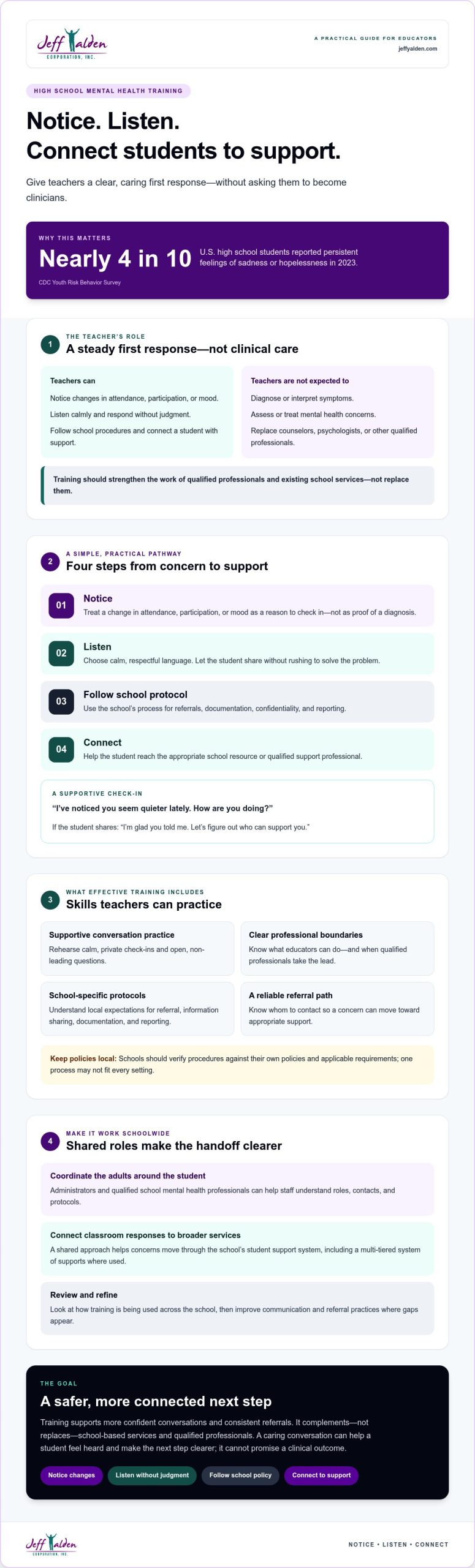
Nearly 4 in 10 U.S. high school students reported persistent feelings of sadness or hopelessness in 2023, according to the CDC’s Youth Risk Behavior Survey. When a student shares something painful, you may be the first adult they trust. What should you say, and where does your responsibility end? Effective mental health training for high school teachers helps answer those questions without asking educators to become clinicians.
You care and want to respond well, but it can feel daunting to balance a student’s need for support with limited time, uneven staff preparation, and the need to protect sensitive information. Teachers aren’t expected to diagnose or treat mental health concerns. They need practical guidance to notice changes, listen calmly, and connect students with the right school resource.
This guide explains what useful training can cover, how to stay within professional boundaries, and how school policy should shape referrals and information sharing. You’ll also learn how teacher professional development can support more consistent, confident conversations across a school community while complementing the work of qualified professionals and existing mental health systems. The goal is clear: notice, connect, and refer, so students aren’t left to navigate distress alone.
Key Takeaways
- Effective mental health training for high school teachers builds practical skills for noticing concerns and responding with care, without turning educators into clinicians.
- Look for training that lets staff rehearse supportive conversations, clarifies professional boundaries, and aligns with school policies and referral pathways.
- Make training useful beyond a single session by coordinating administrators and qualified school mental health professionals around clear roles and protocols.
- Review how the training is being used across the school, then refine communication and referral practices where gaps appear.
- Teacher professional development and community programs can support more confident conversations while complementing, not replacing, school-based services and qualified professionals.
Why Mental Health Training for High School Teachers Matters
A student stays after class. The room is almost empty, the next bell is close, and they say they’re not coping. You want to help, but you also have other students to teach, limited time, and a role that isn’t clinical. Mental health training for high school teachers gives educators a practical way to respond with care while understanding what belongs with qualified support staff.
Training can prepare teachers to notice possible concerns, respond supportively, and connect a student with appropriate help. It builds awareness without asking educators to interpret symptoms or make clinical judgments. For background on how student well-being and school systems intersect, see this overview of mental health in education.
Teachers can offer a steady first response, but diagnosis and treatment belong to qualified mental health professionals. Training should strengthen, not replace, the work of school counselors, psychologists, administrators, families, and community providers. Each has a distinct role, and school policies should guide how concerns are shared and referrals are handled.
What mental health training can help teachers do
Useful preparation focuses on skills teachers can practice: listening without judgment, choosing calm and respectful language, and asking open questions rather than jumping to conclusions. For example, instead of labeling a student “unmotivated,” a teacher might notice a change in participation and ask privately, “I’ve noticed you seem quieter lately. How are you doing?” Then they can listen and follow the school’s process for connecting the student with support.
A consistent, respectful response can help a young person feel heard and make the next step clearer. It can’t guarantee that every crisis will be prevented or produce a clinical outcome. The goal is a safer, more connected handoff, not a promise that one conversation will fix everything.
Why the high school setting needs a clear shared approach
Students move through classrooms, activities, and relationships with different adults. One teacher may hear a concern while another notices a change in behavior. Without an agreed process, important information can stall or be passed along inconsistently. A shared approach helps staff understand whom to contact, what school policy requires, and how qualified professionals take the lead.
That coordination can be part of a schoolwide system, such as a multi-tiered system of supports, so classroom responses connect with broader student services. Educators exploring how experiences and context affect student behavior may also find trauma-informed teaching professional development relevant to their practice. Clear roles matter, as does a reliable path from concern to support.
What Effective Mental Health Training for Teachers Should Cover
Strong training doesn’t ask teachers to become mental health specialists. It gives them skills to recognize a possible concern, respond with care, and take the next appropriate step. The best mental health training for high school teachers focuses on actions educators can practice, while leaving assessment and treatment to qualified professionals.
A useful core sequence is simple: Notice a concern, listen, follow school protocol, and connect the student with support. Training should help staff treat changes in attendance, participation, or mood as reasons to check in, not as proof of a diagnosis. It should also explain local expectations for documentation, confidentiality, and reporting. Schools need to verify those details against their own policies and applicable requirements rather than assume one process fits every setting.
Listening, language, and supportive classroom conversations
Practice makes a difference. Educators can rehearse a calm, private check-in using open, non-leading questions such as, “How have things been feeling for you lately?” If a student chooses to share, listen without rushing to solve the problem. A steady response like “I’m glad you told me. Let’s figure out who can support you” acknowledges the student and keeps the next step clear.
Dismissive or shaming language can close the door. “You’re overreacting” may leave a student feeling judged, while “Everything will be fine” may minimize what they’re experiencing. Teachers don’t need perfect words. They need a respectful first response and a clear plan for what follows. Practice scenarios should stay hypothetical and protect student privacy by avoiding identifying details.
Boundaries, privacy, and referral skills
Care also means being honest about limits. Teachers shouldn’t diagnose, provide therapy, or promise absolute secrecy. If a student shares something sensitive, explain in plain language that you’ll respect their privacy while following school procedures to involve the right support. Training should clarify whom to contact, how to document a concern, and what to do if the designated person isn’t available. Verify each step against current school policy.
A referral shouldn’t be a handoff into a void. Staff should know how to connect with the designated qualified professional and communicate relevant observations through approved channels. Broader resources, including teen suicide prevention programs, belong within a coordinated school support system, not in place of established school procedures or qualified care.
For schools considering educator learning around student well-being, Jeff Yalden’s teacher professional development may be a related option to explore. Whatever training you choose, confirm its format and content, then check that it aligns with your school’s roles, privacy practices, and referral pathways.
Evaluating Teacher Training Without Clinical Expectations
One concern deserves a direct answer: will training make teachers responsible for managing students’ mental health? Effective training should do the opposite. It supports educators in their school roles while clinical assessment and treatment remain with qualified professionals. A program that blurs that boundary isn’t a better fit just because it sounds more intensive.
Use this comparison to assess whether a program prepares staff for the work they’re expected to do:
| What to evaluate | What a strong fit should include | What to ask |
|---|---|---|
| Practical rehearsal | Opportunities to practice supportive responses through relevant scenarios | What will staff be able to do differently, and how will they practice it? |
| Clear scope | A defined educator role, separate from clinical diagnosis and treatment | How does the training distinguish teacher responsibilities from clinical work? |
| School-policy fit | Content that can be aligned with current school procedures and staff roles | Can administrators and school support staff review the material for local fit? |
| Referral coordination | Guidance that points staff toward established school pathways | How are sensitive scenarios discussed without replacing local crisis procedures? |
Educator awareness training and training for qualified mental health professionals serve different purposes. Awareness training can help school staff notice concerns, communicate respectfully, and follow referral procedures. It shouldn’t be presented as clinical preparation or a substitute for professional care. When evaluating mental health training for high school teachers, check the provider’s stated qualifications, the curriculum, and any evidence behind claims of effectiveness. Don’t assume a credential or outcome that hasn’t been clearly explained.
Questions to ask before choosing a training program
Ask for concrete learning objectives, not just broad promises about “raising awareness.” What skills will teachers practice? How does the material fit your existing protocols and the roles of counselors, psychologists, and administrators? How does the provider address difficult scenarios while making clear that school procedures remain in charge? Specific answers help you assess both usefulness and boundaries.
Signs a training program fits a school’s needs
Look for age-aware examples that reflect high school settings, along with clear information about any follow-up resources or opportunities for staff discussion. Confirm how the provider supports alignment with school policy instead of assuming one curriculum works everywhere. Be cautious of promises that teachers will diagnose or treat students, or that training can guarantee crisis prevention. A suitable program builds staff confidence without overstating what educators can do.
How Schools Can Put Mental Health Training Into Practice
Training is more useful when staff know what to do before a student needs help. Build the plan with administrators and qualified school mental health professionals, then connect learning to the school’s actual support pathways. This sequence can help turn good intentions into consistent practice:
- 1. Identify needs. Decide which staff groups the training should reach, what concerns they may encounter, and which support routes already exist. Ask staff where they feel unsure, such as how to respond to a disclosure or whom to contact.
- 2. Coordinate school roles. Involve administrators and qualified school mental health professionals in planning. Clarify who receives referrals, who supports staff, and how responsibilities fit together.
- 3. Train staff. Choose learning that reflects educators’ roles and gives staff a chance to practice appropriate responses. Make sure it complements, rather than replaces, professional care and school services.
- 4. Share protocols. Make relevant procedures easy for staff to find. Confirm local policies for safety concerns, reporting, privacy, and family communication. Explain how teachers can reach the designated support person during the school day.
- 5. Review implementation. Check whether staff understand the process and can access the support they need. Use their feedback to address gaps and update guidance when school procedures change.
Before training: align people, policies, and support pathways
Before a session, map the route a concern should take. A teacher should be able to identify the appropriate contact and understand how to reach them during the school day. Administrators and qualified school mental health professionals can help verify that training examples match local policies, including procedures for safety concerns, documentation, privacy, and communication with families. Don’t assume one school’s process applies to another.
After training: reinforce learning and review the approach
A single training session can’t answer every question that arises in practice. Use brief refreshers, staff discussions, and approved school resources to keep procedures familiar. Ask educators whether they feel clearer about their role, whether referral steps are easy to follow, and what makes the process difficult. These are useful implementation checks, not proof that training caused a particular student outcome.
Mental health training works best when it’s connected to school procedures and reinforced through follow-up. For a related option, teacher professional development focused on student mental health can be considered alongside the school’s support system and qualified professionals.
How Jeff Yalden Supports Teacher and School Community Learning
Choosing training is only part of the work. Learning also needs to fit the people and support systems already in place at your school. Jeff Yalden offers teacher professional development and community programs focused on student mental health and well-being. School leaders can explore these options as they consider how to support educators and strengthen conversations across the school community.
For schools seeking mental health training for high school teachers, the key is to confirm what a particular program covers and how it aligns with your goals. Training can complement school procedures and the work of qualified professionals. It should not replace counseling, assessment, or emergency response.
Connecting educator learning with a wider school conversation
Professional development can sit alongside the work of school counselors, psychologists, administrators, and other existing supports. This connection matters: educators can build more confident, connected conversations with students while following the school’s referral pathways and leaving clinical responsibilities with qualified professionals.
Jeff Yalden also provides school assemblies and community programs as related options for schools. These can contribute to a broader conversation about student mental health and well-being, but they aren’t substitutes for school-based services or clinical care. School leaders should confirm each program’s scope and fit with existing supports before making plans.
Taking the next step with Jeff Yalden
Start with your school’s needs. When reaching out, share who the learning is for, what you hope educators or the wider school community will gain, and what support structures and procedures are already in place. This context can help clarify whether the professional development is a suitable option to explore.
Ask directly about the program’s content, format, duration, intended audience, and learning outcomes. Confirm these details rather than assuming them. A clear conversation up front helps your team assess alignment with school policy, staff roles, and the support students can access.
Schools can learn more about teacher professional development at Jeff Yalden’s website.
Build a More Connected Path to Student Support
Teachers don’t need every answer to make a meaningful difference. The right mental health training for high school teachers helps staff approach difficult conversations with steadiness, understand their role, and connect a student with appropriate support.
Keep the focus on practical skills, clear boundaries, and school procedures that staff can follow together. Involve qualified school professionals in shaping referral pathways and reinforcing what happens after training. That shared foundation can help educators respond with greater confidence while keeping clinical care where it belongs.
Jeff Yalden offers teacher professional development intended to support educators and school communities. As your school considers its next step, share your goals and existing support structure, then confirm the program’s scope and fit.
Every calm response and clear connection matters. You can help make support easier to reach, one thoughtful step at a time.
Frequently Asked Questions
What does mental health training for high school teachers include?
Mental health training for high school teachers typically prepares educators to notice possible concerns, respond supportively, and connect students with appropriate help. Useful topics may include attentive listening, respectful communication, professional boundaries, school procedures, privacy, documentation, and referral pathways. Training should fit local policies and clarify which staff member receives concerns. It builds awareness and response skills, not clinical expertise or a promise that every crisis can be prevented.
Can teachers diagnose or treat student mental health conditions after training?
No. Training can help teachers recognize that a student may need support, but it doesn’t qualify educators to diagnose conditions or provide treatment. A teacher can listen, share observations through approved school channels, and refer the student to the designated qualified professional. Keep the boundary clear: educators offer a supportive connection, while assessment and care belong with appropriately qualified providers. Follow school policy when deciding what information to share and with whom.
How can a teacher respond when a student shares a mental health concern?
Stay calm, listen without judgment, and thank the student for trusting you. You might say, “I’m glad you told me. Can you tell me what support would help right now?” Avoid dismissing their concern or promising absolute secrecy. Explain that you may need to involve someone who can help, then follow school procedures to contact the designated staff member and document the interaction as policy requires. If there’s immediate danger, use the school’s emergency protocol.
What is the difference between mental health awareness training and clinical training?
Mental health awareness training helps school staff notice potential concerns, communicate respectfully, understand their limits, and connect students with support. Clinical training prepares qualified professionals for specialized assessment or treatment within their professional roles. These have different purposes and aren’t interchangeable credentials. Before choosing a program, check who it’s designed for, what skills it teaches, and whether its stated scope matches staff responsibilities and the school’s established procedures.
How often should high school teachers receive mental health training?
There isn’t one schedule that applies to every school. Follow relevant state or district requirements and your school’s policies, then consider refreshers when procedures change, new staff join, or staff identify gaps in understanding. Short reviews of referral steps and privacy expectations can help keep processes familiar. Ask educators whether they know whom to contact and what to do next. Use their answers to decide whether additional learning or clarification is needed.
Who should lead mental health training for teachers?
School administrators and qualified school mental health professionals should help shape training so it matches staff roles, local procedures, and available support. A training provider can contribute educator-focused learning, but schools should verify the instructor’s qualifications, curriculum, and any claims about evidence or outcomes. The right arrangement makes responsibilities clear and coordinates training with counselors, psychologists, and other designated staff. No outside program should replace the school’s referral pathways or clinical professionals.
What should a school do if a student may be in immediate danger?
Act promptly. Follow the school’s emergency and safety procedures, alert the designated administrator or crisis lead, and involve qualified mental health professionals according to local protocol. If it’s safe to do so, stay with the student until an appropriate adult takes over. Don’t promise secrecy or try to manage the situation alone. If emergency services are needed, use the school’s established process and applicable local guidance, then document and communicate as policy directs.
