
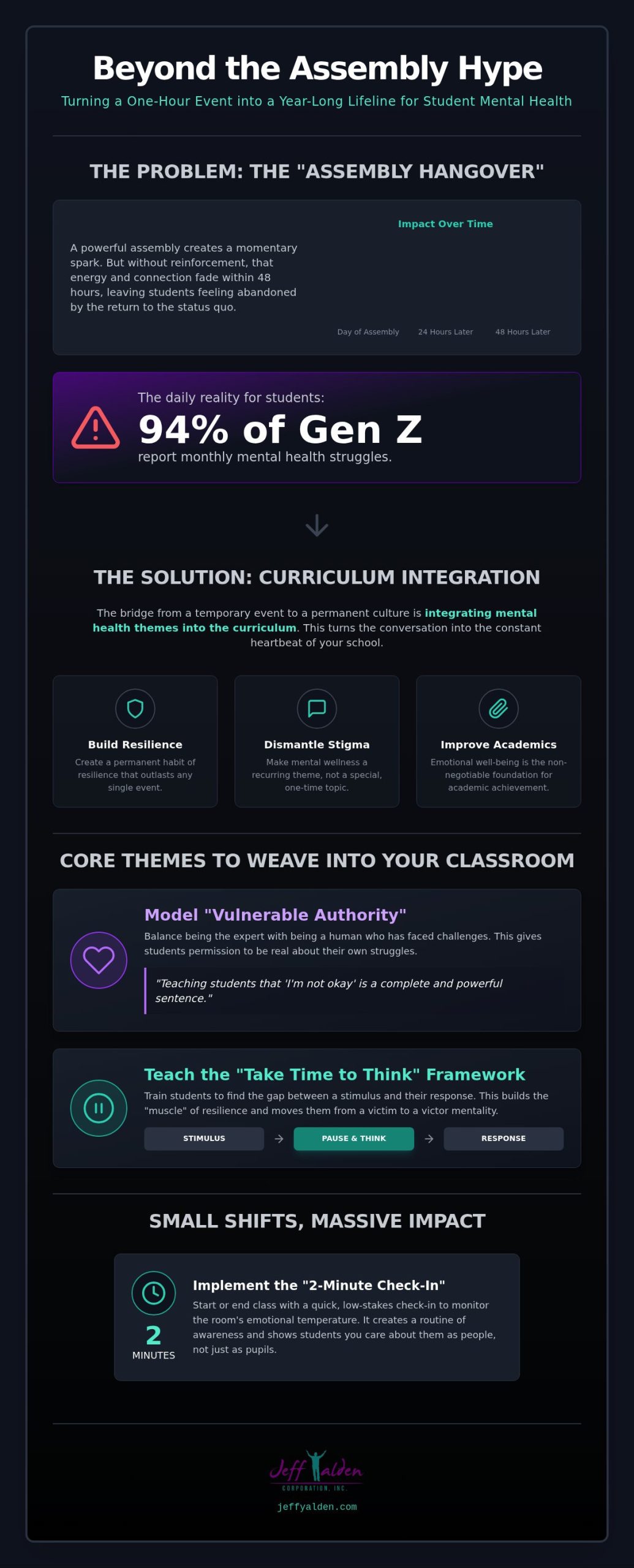
The high-energy hype of a school assembly is a lie if it dies the moment the gym lights turn off. You’ve seen it happen. A speaker brings the fire, students feel seen for an hour, and by Tuesday, it’s back to the status quo. With 94% of Gen Z reporting monthly mental health struggles in 2026, we can’t afford that 48-hour fade anymore. The real, life-saving transformation happens by integrating mental health assembly themes into curriculum so the conversation becomes the heartbeat of your school.
I know you’re exhausted. I know the burnout is real and your schedule is already stretched thin. You might even fear saying the wrong thing when a student mentions a crisis. I’ve been in those trenches. This article is your guide to stopping the “one-and-done” cycle and weaving wellness into your daily classroom culture. We’ll dive into practical, subject-specific integration tips that turn a 60-minute event into a sustainable year-long lifeline. You’ll learn how to make your classroom a place where students feel safe asking for help every single day.
Key Takeaways
- Crush the “assembly hangover” by transforming a single hour of high-energy hype into a sustainable, year-long culture of wellness.
- Discover the exact subject-specific strategies for integrating mental health assembly themes into curriculum without adding to your already heavy workload.
- Lead your classroom with “vulnerable authority” to build deep, authentic connections that make every student feel safe enough to speak up when they are struggling.
- Implement high-impact, low-time micro-integrations like the “2-minute check-in” to monitor your classroom’s emotional temperature every single day.
- Transform your next school assembly from a temporary event into a permanent anchor for your campus-wide mental health strategy and shared vocabulary.
Beyond the One-Hour Hype: Why Integration is Non-Negotiable
The gym is electric. The energy is raw. For sixty minutes, your students are locked in, feeling every word, and finally breathing because someone spoke their truth. But then the lights go up. The students file out. By the time the final bell rings on Friday, that life-changing momentum has already started to bleed out. This is the “Assembly Hangover.” It’s the heartbreaking reality where a powerful moment fails to become a permanent movement because there’s no follow-up. We’re essentially telling our kids that their mental health only matters when there’s a microphone and a spotlight involved. That’s a dangerous message to send in 2026.
Moving from awareness to action requires more than just a great speech. It requires integrating mental health assembly themes into curriculum to create a relentless, daily pulse of support. When we treat mental wellness as a recurring theme rather than a special event, we dismantle the stigma that keeps kids silent. This consistency is exactly what makes teen suicide prevention programs actually work. It’s not about the one big talk; it’s about the thousand small conversations that happen in the hallways and classrooms afterward. In today’s world, mental health literacy is just as vital as financial literacy or reading comprehension. We can’t expect students to navigate a world where 94% of Gen Z report monthly mental health struggles without giving them the tools to survive every single day.
The Cost of Silence Between Events
Progress is fragile. When the “realness” of an assembly vanishes the moment the speaker leaves, students feel abandoned. They go back to the same desks and the same pressures, but now they have a new awareness with nowhere to put it. We have to create a “brave space” that outlasts a gym presentation. If we don’t, we risk losing the trust of the very kids we’re trying to save. Curriculum integration is the bridge between a fleeting moment of inspiration and a permanent habit of resilience. As explored in the broader context of Mental Health in Education, the classroom must become the primary site for wellness reinforcement if we want to see lasting change.
Mental Health as a Core Academic Competency
Let’s be real: a student who is drowning in anxiety isn’t worried about their algebra grade. Mental wellness is the non-negotiable foundation for all academic achievement. There’s a direct, undeniable link between emotional regulation and test scores. When we shift our perspective from seeing this as “extra work” to “essential work,” we unlock a student’s ability to actually learn. It’s not a distraction from the curriculum; it’s the engine that makes the curriculum possible. If they aren’t okay inside, the outside results will always suffer.
Core Mental Health Themes to Weave into Your Classroom
You can’t teach what you won’t model. If we want our students to be real, we have to start by being real ourselves. Radical transparency isn’t about dumping your personal baggage on a sixteen-year-old. It’s about teaching them that “I’m not okay” is a complete and powerful sentence. When you are integrating mental health assembly themes into curriculum, you’re giving them a roadmap for their own emotions. You’re showing them that struggle isn’t a sign of weakness; it’s a part of the human experience that we navigate together.
This starts with what I call “Vulnerable Authority.” It’s the balance of being the expert in the room while remaining a human being who has faced challenges. When a teacher admits they had a tough morning or struggled with a setback, it gives students permission to do the same. This creates a bridge of trust that no textbook can build. If you’re looking to bring this energy to your campus, inviting a teen motivational speaker to lead a professional development session can help your staff find their own “vulnerable authority” before the students arrive.
We also need to teach the “Take Time to Think” framework. In a crisis, the brain wants to react instantly with fear or anger. We have to train our students to find the gap between the stimulus and the response. This is how we move them from a “victim” mentality to a “victor” mentality. Resilience isn’t a trait you’re born with; it’s a muscle that gets stronger every time you choose to pause, breathe, and think before you act. By integrating mental health assembly themes into curriculum, you’re giving them daily reps for that muscle in every single class period.
Normalizing the Conversation Around Struggle
We have to standardize the language of help-seeking across every department. Whether it’s math, art, or gym, the vocabulary should stay the same: vulnerability, resilience, self-care, and “the ask.” Teachers are often the first line of defense. You might see teen suicide warning signs hidden in a creative writing piece or a change in a student’s participation level. When the conversation is normalized, “the ask” for help becomes a natural next step rather than a terrifying confession.
Building Resilience Through Daily Reflection
Check-ins need to go deeper than a generic “how are you?” Use bell-ringer activities to gauge the room temperature. Ask them to rate their energy or share one win from the last 24 hours. This is the core of building resilience in teens during academic setbacks. When a student fails a test, don’t just hand back the paper. Use it as a moment to journal about the “victor” response. Simple prompts like “What did this setback teach me?” turn a moment of defeat into a building block for future success.
Subject-Specific Strategies: Bringing Mental Health to Life
Stop looking at your lesson plan as a barrier. It’s actually your greatest tool. You don’t need to pause your teaching to talk about wellness; you need to start teaching wellness through your subject matter. Integrating mental health assembly themes into curriculum means finding the human heartbeat that’s already there. Whether you are teaching the quadratic formula or the causes of the Civil War, there is an opportunity to connect with the lived experience of your students. This isn’t about adding “fluff” to your day. This is about making your content resonate in a way that actually sticks because it matters to their survival.
Your students are walking into your room carrying heavy weights. Data from 2023 shows that 30% of high school students reported feeling so sad or hopeless they stopped their usual activities. By 2026, we know that 94% of Gen Z deal with mental health struggles every single month. If you ignore that reality, you’re teaching to a room full of ghosts. When you bring these themes into your specific subject, you’re telling them that their internal world is just as important as the external facts they’re learning. You’re building a culture where the “assembly spark” becomes a daily fire.
ELA and Social Studies: The Narrative of Mental Health
In English and Social Studies, you have the ultimate platform for empathy. Don’t just analyze a character’s actions; analyze their resilience. Use the “Hero’s Journey” to discuss how personal mental health struggles are often the “abyss” characters must face before they can transform. Analyzing a character’s struggle builds student empathy by forcing them to stand in the shoes of someone else’s darkness. In Social Studies, debunk the myths of the “perfect leader.” Show them that historical figures faced crushing depression and anxiety, yet they still led. It humanizes greatness and makes their own struggles feel like a rite of passage rather than a dead end.
STEM: The Biology and Logic of Wellness
Science and Math teachers, you have the power of logic on your side. In Biology, teach the “Science of the Stress Response” as a physical, measurable event in the body. When students understand the amygdala and cortisol, they stop feeling “crazy” and start feeling “biological.” Use statistics to normalize the prevalence of mental health challenges. Showing them the numbers proves they aren’t alone. Apply logical problem-solving to emotional regulation. If a student can solve for X, they can learn to solve for the “why” behind their own panic. This is how integrating mental health assembly themes into curriculum turns abstract concepts into life-saving skills.
Overcoming the ‘No Time’ Barrier: Small Shifts, Massive Impact
I get it. You’re drowning in data, grading, and a pacing guide that feels like a ticking clock. You don’t have forty minutes for a wellness workshop. But here is the radical truth: integrating mental health assembly themes into curriculum isn’t about adding more to your plate. It’s about changing the way you serve the food. When you prioritize the emotional state of your students, you actually reclaim lost instruction time. A regulated brain learns faster. A safe student is a focused student. You aren’t losing time; you’re making an investment that pays off in academic engagement.
Start with the 2-minute check-in. Before you dive into the day’s objective, take the room’s temperature. Use a simple scale of one to five or a “red, yellow, green” system. This isn’t just a “feel-good” exercise. It’s data. It tells you who is ready to learn and who is just surviving. You can also use micro-integrations by adding a single reflection prompt to existing homework. Ask them how a specific math problem challenged their patience or what character trait they would use to describe their own resilience today. These small shifts create a massive ripple effect across your campus culture.
Your own wellness is the most powerful lesson plan you’ll ever write. If you’re running on empty, your students will feel that vibration. Modeling self-care and setting boundaries isn’t selfish; it’s professional excellence. This is where trauma-informed teaching professional development becomes your secret weapon. It gives you the tools to manage a classroom without sacrificing your soul. It streamlines your management so you spend less time policing behavior and more time building humans who are ready to succeed.
Protecting Teacher Capacity While Supporting Students
You are a teacher, not a clinical counselor. It’s vital to know where your role ends and professional support begins. Avoid the “savior complex” because you can’t carry the weight of every student’s trauma home with you. Set clear boundaries. Have an efficient system for documenting concerns and referring them to the right experts immediately. This protects your capacity so you can stay in the game for the long haul without burning out.
The Power of the ‘Mindful Minute’
Transitions are the danger zones for classroom energy. Use a “Mindful Minute” between subjects or right before a high-stakes test. It’s sixty seconds of intentional breathing. It’s not “cringey” if you lead with “vulnerable authority.” Lowering those cortisol levels isn’t just about wellness; it’s about optimizing the brain for performance. When the brain is calm, the learning sticks. If you’re ready to lead this shift on your campus, book a teacher professional development session and let’s build a sustainable culture together.
The Jeff Yalden Roadmap: From Assembly Spark to Sustainable Culture
The spark is the beginning. The curriculum is the lifeblood. You can’t have one without the other. If you want to stop the “one-and-done” cycle, you have to treat the assembly as the starting gun, not the finish line. Jeff Yalden doesn’t just show up to deliver a speech; he shows up to ignite a movement. By integrating mental health assembly themes into curriculum, you ensure that the message of resilience doesn’t evaporate into the gym rafters the moment the students walk out. His high school assemblies provide the shared vocabulary your staff and students need to talk about the hard stuff without the awkwardness or the fear of saying the wrong thing.
The real magic happens in the classroom during the “Assembly Debrief.” This isn’t just a casual chat. It’s a structured, high-energy discussion that uses Jeff’s specific frameworks to kickstart deeper connection. When teachers are trained as “vulnerable authorities” through Jeff’s professional development workshops, they stop being distant experts and start being trusted guides. In the 2026 reality, where 94% of Gen Z individuals report monthly mental health struggles, we have to stop treating wellness like an elective. It has to be the heartbeat of your campus. It has to be the foundation of every lesson plan, every interaction, and every grade.
Booking the Anchor Event
You need a jolt to wake up the system. A professional speaker brings a level of raw, lived-experience authority that a textbook simply cannot match. This “anchor event” serves as the emotional reference point for the entire school year. When you align these assembly themes with your school’s specific annual goals, you create a cohesive narrative. It’s about building a multi-year plan for mental health excellence, moving beyond temporary awareness into permanent, cultural transformation. You’re setting a standard that says, “In this school, we take care of each other.”
Next Steps for School Leaders
Your first move is to evaluate your current curriculum for “mental health gaps.” Where are the missed opportunities for connection? Where can you weave in the themes of transparency and resilience? Don’t try to do it all at once. Identify your “Mental Health Champions” among the staff, the ones who are already leading with heart, and empower them to pilot these shifts. The time for “someday” is over. Our kids are waiting for us to lead them out of the dark. It’s time to act. Bring Jeff Yalden to your school for a radical transformation and start building the culture your students deserve.
Turn the Spark into a Permanent Movement
The 2026 school year demands more than just a momentary hype. It demands a radical commitment to the humans sitting in your classrooms. Small shifts in every subject, from English to Biology, turn a single hour of inspiration into a year-long lifeline. By integrating mental health assembly themes into curriculum, you stop just talking about wellness and start living it. This isn’t just about grades. It’s about survival. You’re building a culture where “I’m not okay” is met with immediate support rather than silence.
You don’t have to navigate this shift alone. With over 30 years of high-impact school assemblies and specialized expertise in crisis and postvention, I’m here to help you bridge the gap. My approach uses radical transparency to cut through the noise and connect with Gen Z on a level that actually sticks. Let’s move from the assembly gym to the daily classroom culture together. We can transform your campus into a place where every student feels seen and every teacher feels empowered.
Book Jeff Yalden for a High School Assembly or Teacher PD Workshop and let’s start the transformation. Your students are ready for the real talk. It’s time to lead with heart.
Frequently Asked Questions
How can I integrate mental health into a math or science curriculum?
You can use data analysis and biology to make wellness feel logical and grounded. In math, have students analyze 2026 mental health statistics to see the prevalence of these struggles, which helps normalize the conversation. In science, teaching the physical biology of the stress response turns “feelings” into measurable brain chemistry. This approach shows students that their internal world is a biological reality that can be managed with the right tools.
What if a student has a crisis during a classroom discussion about mental health?
Stop the lesson immediately and follow your school’s emergency referral protocol to ensure the student’s safety. You don’t have to be the hero or the therapist in that moment. Your job is to be the calm bridge to professional help. Ensure the student is supervised and contact your counseling team or administration right away. Having a clear plan in place before you start these discussions is the key to managing a crisis with confidence.
Can teachers really make a difference without being trained therapists?
You are a “vulnerable authority,” and your daily connection with students is often the most powerful tool in the building. Research from 2026 shows that 94% of Gen Z struggle monthly, and they need to feel seen in their daily environment. By integrating mental health assembly themes into curriculum, you create a safe culture that empowers students to seek professional help. You aren’t diagnosing them; you’re building the trust that makes healing possible.
How do we keep the momentum of a mental health assembly going all year?
Treat the assembly as the “anchor event” and use Jeff’s shared vocabulary in your weekly bell-ringers and check-ins. Consistency is the only way to kill the “assembly hangover” and keep the fire burning. When you use the same language from the presentation in your daily lessons, the message becomes a habit rather than a memory. Small, recurring micro-integrations like a “mindful minute” before tests keep the wellness conversation alive all year long.
What are the best mental health themes for middle school vs. high school?
Middle school themes should focus on social belonging, self-esteem, and navigating digital life, while high schoolers need a focus on resilience and future pressure. Younger students are still learning to identify their emotions, so they need help with immediate regulation. High school students need the “victor” mentality to face the high-stakes stress of 2026. While the application changes, the core message of “it’s okay to not be okay” remains the same for every grade level.
Is it safe to talk about suicide in the classroom?
Talking about suicide is safe and necessary when you follow evidence-based guidelines and emphasize help-seeking resources. Silence is where the stigma grows and where students feel most alone. By integrating mental health assembly themes into curriculum, you provide a controlled, supportive environment for these vital conversations. Focus on warning signs and the power of “the ask.” When students know how to ask for help, the risk decreases because the isolation is broken.
How do I handle parents who are skeptical of mental health in the curriculum?
Lead with the data that connects emotional regulation to higher test scores and better academic performance. Remind parents that mental health literacy is a fundamental life skill, just like financial literacy or reading. When students can manage their stress, they perform better in every single subject. Transparency is your best friend here. Share your goals for a safe classroom culture and show them how these small shifts actually protect instruction time for everyone.
What happens if a teacher feels overwhelmed by student disclosures?
Recognize your limits and immediately refer the student to a counselor to protect your own mental capacity. You can’t pour from an empty cup, and you must avoid the “savior complex” to stay in the game. It’s natural to feel the weight of their struggles, but you aren’t meant to carry it alone. Use your school’s reporting system and lean on your staff “Mental Health Champions” for support. Your wellness is the foundation of your classroom.
