
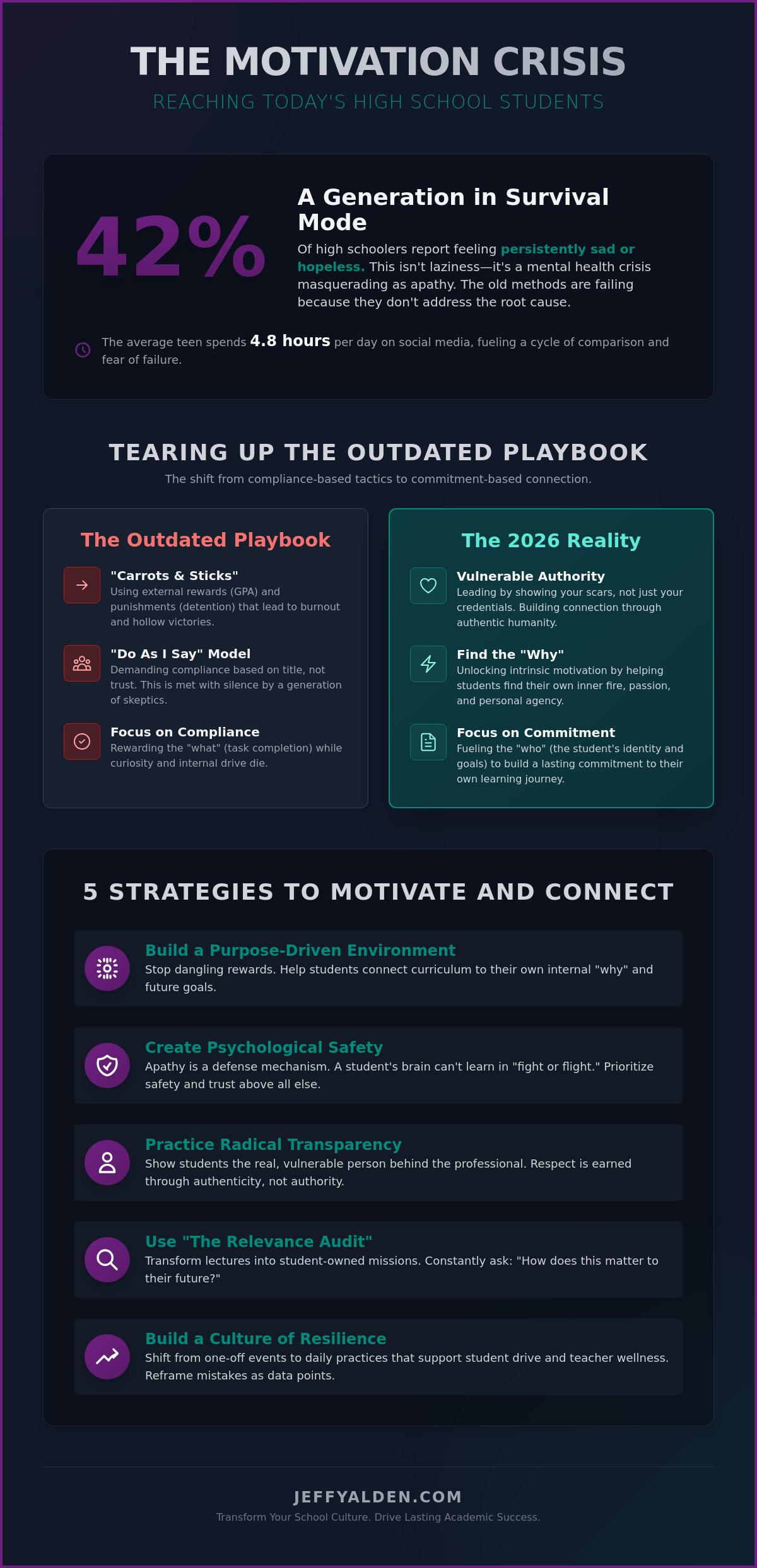
What if the reason your students aren’t listening isn’t because they’re lazy, but because they’re stuck in survival mode? You see it every day. The glazed eyes. The glowing phone screens. The crushing weight of a generation where 42% of high schoolers report feeling persistently sad or hopeless. You feel like a broken record, shouting into a void of apathy. It’s exhausting to care this much when it feels like they don’t care at all. You’re searching for how to motivate high school students who seem checked out before the bell even rings. I’ve been there. I’ve felt that same desperate need to bridge the gap.
You’re right to feel like the old methods are failing. They are. Today, we’re tearing up the outdated playbook. I’m going to show you the raw, real strategies to break through the noise and build a culture of intrinsic drive and resilience. We’ll dive into radical transparency, psychological safety, and the exact steps to turn your school into a place where students finally take ownership. It’s time to move from being a “broken record” to becoming a mentor who drives real, lasting academic success through meaningful connection.
Key Takeaways
- Stop using “carrots and sticks” and start building a purpose-driven environment where students find their own internal “why.”
- Understand that apathy is often a defense mechanism against anxiety; breaking through requires psychological safety, not just better rules.
- Discover how to motivate high school students through radical transparency by showing them the real, vulnerable person behind the professional.
- Use “The Relevance Audit” to transform your curriculum from teacher-led lectures into student-owned missions that actually matter to their future.
- Shift your focus from one-off events to a daily culture of resilience that supports both student drive and teacher wellness.
What is Student Motivation in 2026? Moving Beyond Rewards
Stop looking for the magic prize. It doesn’t exist. In 2026, motivation is the raw, internal “why” that drives a human being to move. It’s the pulse. It’s the fire. We’ve spent far too long leaning on the “carrot and the stick.” We dangled a GPA. We threatened a Saturday school. We treated kids like machines that just needed the right input to produce the right output. But the machines are tired. Traditional rewards have lost their currency. A trophy doesn’t mean anything to a student who feels the weight of the world on their shoulders. To reach them, we need a new approach. We need “Vulnerable Authority.” This means leading from the front by showing your scars, not just your credentials. When you’re trying to figure out how to motivate high school students, you have to start with the heart, not the gradebook.
The Death of the “Do as I Say” Model
Students in 2026 demand the “why” before they ever give you the “how.” They don’t want compliance. They want commitment. If you demand obedience just because you have a degree on the wall, you’ll be met with a wall of silence. Digital saturation has turned every teen into a professional skeptic. They see through fake authority in seconds. They’ve grown up in a world of influencers and instant access. They don’t respect a title; they respect a person. The shift from compliance-based learning to commitment-based learning is the only way forward. If they don’t see the relevance, they won’t give you their focus.
Intrinsic vs. Extrinsic: The 2026 Reality
Extrinsic rewards lead to “playing the game.” It’s a hollow victory. Students learn to jump through hoops while their curiosity dies. This leads to massive burnout. We see it in the data. We see it in their eyes. We have to stop rewarding the “what” and start fueling the “who.” Student engagement thrives when we prioritize autonomy and mastery over simple obedience. We need to help them find their own inner fire. Intrinsic motivation is the intersection of passion and personal agency. When a student feels like they own their learning, the need for how to motivate high school students through external pressure disappears. They drive themselves because the journey finally matters to them.
The Psychology of Apathy: Why High Schoolers Check Out
Apathy isn’t what you think it is. It’s a mask. It’s a suit of armor. When we look at the causes of teenage apathy, we see students who are terrified of being “less than.” In 2026, the average teen spends 4.8 hours a day on social media. Every second of that time, they are comparing their behind-the-scenes to everyone else’s highlight reel. This constant exposure creates a massive gap in self-efficacy. They don’t think they can win, so they stop playing the game. This isn’t laziness. It’s a mental health crisis masquerading as a lack of effort. Understanding this shift is the first step in learning how to motivate high school students who have completely checked out.
Fear of Failure vs. Desire for Success
Many students are trapped in a fixed mindset. They believe their intelligence is a static score. If they try and fail, they believe it defines their worth. So, they choose “not trying” as a way to protect their ego. We have to reframe these mistakes. Mistakes are just data points. They’re the bricks we use to build a foundation. This is why building resilience in teens is the most radical thing you can do in your classroom. When a student knows they can bounce back, they finally find the courage to engage.
The Safety-Motivation Connection
The brain is a survival machine. If a student is in “fight or flight” mode because of anxiety or home-life stress, they cannot learn. Their prefrontal cortex literally shuts down. You cannot lecture someone into being motivated if they don’t feel safe. You have to be their secure base. They need to know that you see them, not just their test scores. Creating this psychological safety is the only way to unlock their potential. If you need someone to help jumpstart this culture shift for your whole school, bringing in a Teen Motivational Speaker can set that new tone.
Neuroplasticity is our greatest ally. The teen brain is still under construction. It’s incredibly plastic. We can literally rewire their response to stress and failure. By consistently modeling resilience and providing a safe space to fail, we help them rebuild their drive. It’s not a quick fix. It’s a daily commitment to seeing the human being behind the student ID. How to motivate high school students starts with realizing that their apathy is a cry for help, not a lack of character. We meet them where they are to lead them where they can go.
Radical Transparency: The Secret to Breaking Through
Motivation isn’t some secret tactic you find in a dusty textbook. It’s a relationship. It’s a connection forged in the trenches of the classroom. If you’re searching for how to motivate high school students, you have to stop hiding behind your credentials. You have to get real. Radical transparency is the secret. It’s about being raw about the struggle while remaining the leader they need. Students in 2026 have a high-speed “fake” detector. They don’t trust the “teacher” persona. They trust the human being. They want to know if you’ve ever felt the same crushing anxiety they deal with every single morning.
When you share your own “victor” story, you build a bridge. You aren’t just a distant expert. You’re a guide who has survived the same storms. Use the “Real Talk” method. Address the elephant in the room. If the students are checked out because of world events or school stress, talk about it. Don’t ignore the apathy. Call it out with love. By acknowledging their reality, you give them permission to be human. This is how you finally break through the wall of silence.
Leading with Vulnerability
Vulnerability is not a sign of weakness. It’s a massive power move. You can share your imperfections without losing your professional authority. In fact, it actually strengthens your leadership. When you have the courage to say, “I don’t have all the answers,” or “I’m having a hard time today too,” you model the resilience you want to see in them. You show them that being a victor isn’t about being perfect. It’s about showing up even when things are difficult.
Building the Bridge of Trust
Trust isn’t built during a lecture. It happens in the small gaps. Try the 2-minute connection rule. Engage with them about their interests outside of the curriculum every single day. This is exactly why youth empowerment programs work so well. They leverage deep, authentic trust to drive academic success. Practice active listening as a high-intensity tool. When a student feels truly heard, their drive to engage skyrockets. You stop being another voice talking at them. You become a partner in their mission.
5 Actionable Strategies to Motivate High Schoolers Today
Stop waiting for the district to hand you a solution. The solution is in your hands, right now. We’ve talked about the psychology and the heart. Now, we’re talking about the boots-on-the-ground tactics. If you want to know how to motivate high school students, you have to change the game. You have to move from being the “sage on the stage” to being the “guide on the side.” It’s about creating a culture where they feel the weight of their own potential. Let’s look at the five strategies that are moving the needle in 2026.
Strategy 1: The Relevance Audit
Every lesson plan needs a gut check. Before you walk into that room, ask yourself: “If a student asks why this matters to their life, can I answer without mentioning a test score?” If you can’t, you aren’t ready to teach it. You must connect every curriculum point to real-world survival and success skills. Whether it’s critical thinking, communication, or the ability to learn quickly, they need to see the “why” immediately. Relevance is the bridge between a textbook and a dream. When they see the connection, the apathy starts to melt away.
Strategy 2: Empowering Student Leadership
Give them the wheel. Stop making every decision for them. Give your students a seat at the table in classroom decision-making. When they have a say in how they learn, they take ownership of the results. This is exactly why motivational speakers for student leaders are so vital to campus health. They spark the initiative that turns a passive observer into an active leader. Autonomy breeds responsibility. When you trust them with the “how,” they will surprise you with the “what.”
Strategy 3: The Power of the Guest Voice
You’re doing the work. You’re saying the right things. But sometimes, they just need to hear the same message from a fresh face. It’s a psychological reset. High School Assemblies act as a massive catalyst for campus culture. A guest voice validates everything you’ve been preaching and gives it a new sense of urgency. It’s a high-energy culture shock that can drive classroom motivation for the rest of the semester. If you’re ready to ignite that spark, booking a High School Motivational Speaker is the fastest way to bridge the gap.
Finally, implement the “Micro-Win” framework. Success is addictive. Break large projects into tiny, achievable victories to build momentum. Combine this with Radical Accountability. Use peer mentorship to let students hold each other to a higher standard. They often value the respect of their peers more than the approval of an adult. By letting them lead each other, you’re teaching how to motivate high school students through community, not just authority.
Transforming Your Campus Culture for Long-Term Drive
Motivation isn’t a one-time event. It’s not a speech you hear in August and forget by October. It’s a daily pulse. It’s the atmosphere of the hallways. If you really want to master how to motivate high school students, you have to look at the culture you’ve built. Is it a culture of compliance or a culture of character? Jeff Yalden’s approach has always been about the “Heart of Character.” We focus on the person before the pupil. When we prioritize the human being over the test score, the scores actually follow. It’s about building kids who are resilient enough to care when things get hard. This isn’t a theory. It’s a lived reality that changes lives.
This transformation starts at the top. Administration must be the anchor. You can’t expect teachers to be radically transparent if they don’t feel supported by their leaders. Teacher wellness is the foundation of student engagement. If your staff is burnt out, your students will be checked out. When leaders model transparency and vulnerability, it trickles down into every classroom. It creates a space where postvention and crisis management don’t derail your momentum. Instead, those difficult moments become opportunities to show students that we don’t just celebrate the wins. We stay together through the losses. We prove that resilience is a team sport.
Sustaining the Spark
You need “Moments of Momentum” baked into your school year. Don’t let the fire die out after the first month of school. Professional development needs to stop being about data points and start being about the human element. We need to talk about the soul of education again. This is why integrating social emotional learning speakers for high school is critical for your yearly calendar. It keeps the conversation about mental health and resilience alive. It reminds everyone that the “why” matters more than the “what.” It provides a consistent language for struggle and success that students can actually trust.
Taking the Next Step
You’ve read the strategies. You’ve seen the psychology. Now, it’s time to move. Bringing this radical approach to your campus isn’t just about a speech. It’s about a total shift in soul. Whether it’s through a High School Speaker keynote or a deep dive into Teacher Professional Development, Jeff Yalden’s programs are designed to shake things up and show you exactly how to motivate high school students in a way that sticks. The impact of a high-energy, transparent message on student morale is immediate. It’s the spark that turns “checked out” into “all in.” You have the power to change the narrative for every student in your building. Don’t wait for another crisis to happen. Book a discovery call today and let’s transform your school culture into a place where every student knows they matter.
Take the Lead and Ignite Lasting Change
The days of compliance are over. You now have the blueprint to move beyond the old carrot and stick methods. By choosing radical transparency and prioritizing the human heart, you’ve unlocked the real secret of how to motivate high school students in a world that feels increasingly disconnected. Remember, it’s about building that bridge of trust and giving your students the autonomy they crave. You don’t have to carry this weight alone. It’s time to stop feeling like a broken record and start seeing the transformation you’ve been fighting for.
Jeff Yalden has spent over 30 years redefining school assemblies through raw, real connection. As a specialist in crisis intervention and teen mental health, he understands exactly how to break through the apathy that holds your campus back. If you’re ready to shift your culture from “checked out” to “all in,” let’s make it happen. Bring Jeff Yalden to Your School and Ignite Student Drive Today. You have the tools. You have the heart. Now, let’s take the next step together and build a future where every student believes they can win.
Frequently Asked Questions
How do you motivate a student who has completely given up?
Focus on connection before you ever touch the curriculum. A student who has checked out is usually protecting themselves from the pain of failure. You have to build a bridge of trust first. Find one thing they care about outside of school and ask them about it. Once they feel seen as a person, they’ll be more open to taking the risks required for learning.
Can one school assembly really change student motivation long-term?
An assembly acts as a massive cultural catalyst, not a magic pill. It breaks the ice and changes the language on your campus overnight. To make it last, you have to follow up with the daily strategies of transparency and safety. A high-energy keynote is the spark that starts the fire, but your classroom culture is the fuel that keeps it burning.
What is the difference between motivation and inspiration in a high school setting?
Inspiration is the “feel good” spark that happens in the moment, while motivation is the internal drive that keeps a student moving when that feeling fades. Inspiration gets them through the door. Motivation keeps them doing the work. True success happens when we move students from being inspired by our stories to being motivated by their own personal agency and future goals.
How do I deal with students who are only motivated by grades?
Shift the focus from the final outcome to the actual process of growth. These students are often terrified of failure and only see value in a letter grade. Show them how the skills they are learning apply to real-world survival, not just a transcript. When you connect the work to their own dreams, they start to value the mastery more than the “A.”
Is it possible to motivate students without lowering academic standards?
High standards actually provide the structure students need to feel safe and successful. You don’t lower the bar; you increase the support. When you understand how to motivate high school students through resilience and radical transparency, they often exceed those high standards. They want to be challenged, but they need to know you are right there in the trenches with them.
What should I do if my students are more interested in their phones than my lesson?
Address the phone addiction with radical honesty instead of just banning the devices. Talk about why those apps are designed to steal their focus. Use the “Relevance Audit” to make your lesson more compelling than a social media scroll. If your content connects to their real-world success, they’ll put the phone down because they don’t want to miss what actually matters.
How does mental health affect student motivation in 2026?
Mental health is the absolute foundation of all engagement. When a student’s brain is stuck in survival mode, academic focus becomes biologically impossible. You can’t lecture a student into being motivated if they are drowning in anxiety. Addressing their well-being isn’t a distraction from your lesson plan. It’s the prerequisite. By prioritizing psychological safety, you unlock the space they need to care.
What are the first steps to becoming a ‘vulnerable authority’ in the classroom?
Start by admitting a small mistake or a moment of struggle to your class. You don’t have to share your whole life story on day one. Just show them you’re human. When you model resilience after a setback, you give them permission to do the same. This how to motivate high school students strategy starts with being real, not being perfect, and it builds a bridge of trust.
