
What if the heavy silence across your dinner table isn’t just “teenage attitude,” but a desperate plea for help that you haven’t learned to decode yet? You’re not alone in feeling like you’re losing the battle against an algorithm. With one in seven adolescents worldwide experiencing a mental health condition in 2026, the fear of suicide or self-harm is a weight that keeps you up at night. You’re tired of clinical brochures and cold resources that offer “tips” while your child feels miles away. It’s time to stop waiting for a crisis and start building a bridge. Hosting a radical parent seminar on teen mental health is how we reclaim our families and our communities from the shadows.
I know the terror of feeling out of the loop with your own kid. I’ve been there. I’ve felt that distance. Transparency is your greatest weapon. In this guide, you’ll learn how to host a high-impact, raw, and life-saving event that actually reaches parents’ hearts. We’ll show you how to move past the fear, identify the red flags that matter, and restore the communication you thought was gone forever. It’s time to move from being afraid to being empowered. We’re going to break down the exact steps to turn your community into a safety net and bridge the gap between generations.
Key Takeaways
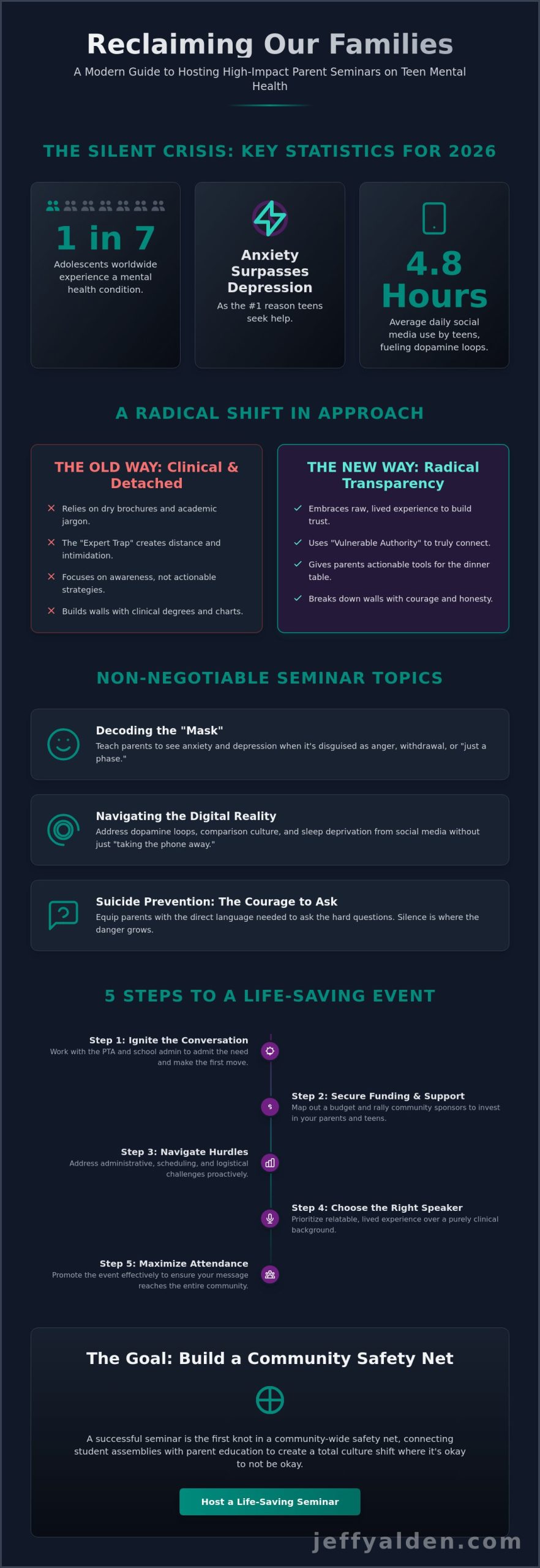
- Move beyond clinical pamphlets and learn to host a high-impact event that breaks the silence and normalizes the mental health struggles teens face in 2026.
- Identify the critical topics your parent seminar on teen mental health must cover, including the hidden “masking” of symptoms and the reality of social media dopamine loops.
- Ditch the “expert trap” and learn why parents respond to raw, lived experience more than clinical degrees when the stakes are this high.
- Follow a clear, 5-step organizational roadmap to secure funding, navigate administrative hurdles, and ensure your event sees maximum attendance.
- Move past the “one-and-done” mindset to create a culture of radical resilience that connects your student assemblies with parent education for a total community shift.
What is a Parent Seminar on Teen Mental Health in 2026?
A parent seminar on teen mental health in 2026 is not a polite lecture in a cold gymnasium. It’s a high-impact, radical intervention. It’s a community gathering designed to smash the stigma and normalize conversations that were once whispered. We are past the point of “awareness.” Awareness is just knowing a problem exists. We need action. We need radical resilience. In 2026, the “new normal” means our kids are dealing with a digital landscape that moves faster than our ability to parent it. Clinical pamphlets and detached medical advice don’t cut it anymore. These seminars are the front line of defense. Hosting a parent seminar on teen mental health is the most direct way to bridge the gap. It’s the primary tool for teen suicide prevention because it equips the people who see these kids every day: the parents.
The Shift from Clinical to Radical Transparency
Parents are tired. They’re done with “experts” who speak in jargon and have never felt the gut-wrenching fear of a child who won’t come out of their room. They want someone who has been in the trenches. This is where “vulnerable authority” changes the game. When you lead with honesty, you give others permission to do the same. True mental health awareness for teens doesn’t start with a doctor’s note. It starts with adult honesty. It starts with a speaker who is willing to say, “I’ve struggled too.” That raw connection breaks down the walls that clinical degrees usually build. It’s about being a guide, not a god. It’s about showing our kids that it’s okay to not be okay.
Identifying the Need in Your Community
There is a silent crisis in every school district. It doesn’t matter your zip code or your tax bracket. The statistics don’t lie. In 2023, 30% of high school students reported poor mental health, and by 2026, anxiety has officially surpassed depression as the primary reason teens seek help. understanding the youth mental health crisis means realizing that “it won’t happen here” is a dangerous myth. The PTA and school administration must be the ones to light the match. You have to initiate the conversation before a tragedy makes the decision for you. This isn’t about looking for problems. It’s about admitting they’re already there and deciding to do something about it together.
We are building a safety net. This seminar is the first knot in that net. It’s about moving from a state of fear to a state of empowerment. It’s about giving parents the tools to see the “masking” and the dopamine loops before they spiral. We aren’t just talking. We’re intervening. We’re saving lives by being real, raw, and present.
Core Topics Every Teen Mental Health Seminar Must Address
Content is king, but context is the kingdom. If your parent seminar on teen mental health only focuses on clinical definitions, you’ve already lost the room. Parents don’t need a medical degree; they need a roadmap for the dinner table. You must address the “masking” of symptoms. In 2026, anxiety has officially overtaken depression as the leading issue for teens, and many have become experts at hiding it behind a wall of “I’m fine.” You can find detailed breakdowns of these shifts in NIMH resources on teen mental health, but your seminar needs to bring that data to life. Show them what anxiety looks like when it’s disguised as anger or withdrawal.
The digital reality is another non-negotiable. The average American teen now spends 4.8 hours per day on social media. This isn’t just “screen time.” It’s a relentless dopamine loop that fuels comparison culture and sleep deprivation. Your seminar must teach parents how to navigate this without just “taking the phone away,” which often shuts down communication entirely. We also have to hit the hardest topic: suicide prevention. We have to teach parents how to ask the direct questions. It’s about having the courage to be blunt because silence is where the danger grows. If you want to see how we tackle this in schools, look at our teen suicide prevention programs that prioritize radical honesty over clinical distance.
The Language of Connection
Stop asking “How was your day?” It’s a dead-end question that gets a dead-end answer. We need to teach parents to use open-ended prompts that invite a narrative. You don’t need a textbook to understand the teen brain; you just need to know that the emotional center is red-lining while the logic center is still under construction. Postvention is the support provided after a crisis to prevent further tragedy. We must prepare parents for the “after” just as much as the “before.”
Crisis Intervention and Postvention Strategies
When a teen is in immediate danger, parents often freeze. Your seminar must provide a clear, three-step action plan for that moment. This includes knowing the school’s specific role and how to mobilize a support network instantly. It’s about supporting the whole family, not just the child in crisis. If you’re looking for a Teen Mental Health Speaker who can bridge this gap with lived experience, focus on someone who can speak to both the heart and the strategy. We are building resilience by teaching our kids that it’s okay to fail and showing them how to bounce back. That shift from “fixing” to “supporting” is where the healing begins.
Clinical vs. Relatable: Choosing the Right Speaker for Your Parents
Don’t fall for the “Expert Trap.” A wall of certificates in a doctor’s office doesn’t always translate to trust in a high school cafeteria. When you’re planning a parent seminar on teen mental health, you aren’t just looking for a data dump. You’re looking for transformation. Parents are already overwhelmed. They’re scared. If you put a clinical expert on stage who speaks in the third person about “the adolescent brain,” your audience will check out within ten minutes. They need someone who has been in the trenches. They trust lived experience because it proves survival is possible. It proves there’s a way out of the darkness. Lived experience turns a lecture into a lifeline.
Energy is everything. A mental health seminar shouldn’t feel like a funeral. If the room feels heavy and hopeless, parents will leave feeling more defeated than when they arrived. You need a speaker who brings a high-intensity, “edge-of-your-seat” vibe. This isn’t about being “entertaining” for the sake of it. It’s about engagement. It’s about holding their attention so the life-saving message actually sinks in. When you consider the mental health speaker cost, don’t just look at the invoice. Look at the long-term impact on your community. A cheap speaker who puts people to sleep is the most expensive mistake you can make.
The Jeff Yalden Difference: Radical Transparency
Jeff Yalden doesn’t show up as a distant doctor. He shows up as a “mentor-guide.” This is the core of radical transparency. He’s real. He’s raw. He’s unafraid to share his own imperfections because that’s where the connection happens. This “vulnerable authority” is what makes parents lean in and listen. High-energy presentations lead to higher turnout and, more importantly, higher retention of the tools provided during a parent seminar on teen mental health. When parents see a speaker who is both a victor and a human being, they start to believe they can be victors too.
Checking References and Cultural Fit
You have to see the speaker in action. Don’t just rely on a bio or a headshot. Check the footage. You need to know they can handle the “Audience Questions” that come from a place of deep pain or skepticism. When evaluating a potential speaker, consider these factors:
- Authenticity: Do they speak from the heart or a script?
- Adaptability: Can they pivot if the room’s energy changes?
- Authority: Do they command the room without being intimidating?
- Action: Do they leave parents with concrete steps or just “thoughts”?
The tone must match your school’s current emotional climate. If your community is reeling from a recent tragedy, you need someone who can balance that weight with a path toward hope. If you’re in a proactive phase, you need a high-energy spark to ignite the conversation. It’s about the right fit at the right time. Choosing the right voice is the difference between a “nice event” and a community-wide shift in culture.
5 Steps to Organize a Successful Community Parent Seminar
Organizing a parent seminar on teen mental health isn’t just about booking a room and hope. It’s a rescue mission. If you want parents to show up, you have to treat this like the life-saving intervention it is. Logistics matter because they remove the barriers to connection. You’re building a bridge. Every step needs to be solid. We aren’t just checking boxes. We’re creating a turning point for families who are currently living in fear. Let’s get to work.
Step 1: Secure funding and administrative buy-in. You need the green light from the top. Don’t just ask for a budget. Present a vision. Show the administration that a proactive seminar is a strategic investment in student safety. Step 2: Choose a date that doesn’t compete with major school events. Avoid homecoming week. Skip the big rivalry game. You need their full attention. Step 3: Market the event with urgency. Use “Real Talk” headlines that stop the scroll. Step 4: Prepare the venue for intimacy and safety. A cavernous gym feels cold and clinical. A library or a local community center feels like a safe harbor. Step 5: Follow up. The seminar is the spark, but mental health interventions in schools are the fuel that keeps the fire of resilience burning. The conversation cannot end when the lights go out.
Marketing Your Seminar to Busy Parents
Stop using clinical flyers that look like a tax audit. Parents are exhausted. They’re overwhelmed. Use emotive, urgent language that speaks directly to their gut. Headlines like “What Your Teen is Hiding” or “The Silence is Dangerous” get attention. Leverage local influencers. Get the popular coach or the respected youth leader to post a video about why they’re attending. And here is a pro-tip: provide food. The “Dinner and Dialogue” model works. It takes “what’s for dinner?” off the to-do list so they can put their focus where it belongs: on their child.
Creating a Safe Space for Vulnerability
Vulnerability requires absolute safety. You have to set ground rules the second they walk through the door. No judgment. Total confidentiality. What is said in this room stays in this room. Provide resources they will actually use. No 50-page manuals. Give them punchy, one-page cheat sheets they can stick on the fridge. Most importantly, ensure counselors are on-site. If a parent realizes their child is in immediate danger during the session, they shouldn’t have to wait until Monday morning for help. If you’re ready to bring this level of impact to your district, it’s time to hire a Youth Motivational Speaker who can lead the way with radical honesty.
Transforming Your School Culture Through Radical Resilience
A single event is a spark. But a spark without fuel dies out. Transforming your school culture requires more than a one-night stand with mental health. It’s a movement. It’s a commitment to radical resilience that doesn’t end when the auditorium lights go down. If you want real change, you have to keep the conversation alive. You have to be relentless. This isn’t about a line item in a budget. It’s about the heartbeat of your community.
One night isn’t enough. Integration is the secret. When you pair a parent seminar on teen mental health with high school assemblies, you create a shared vocabulary for the entire community. The parents hear the raw truth. The students hear the raw truth. Suddenly, the wall between generations starts to crumble. They can finally talk to each other without a translator because they’ve both been given the tools to be honest.
This is the ripple effect. Empowered parents create resilient students. When you stop being afraid of the dark, your kids learn how to find the light. It’s about moving from a state of panic to a state of preparation. You’re not just hosting an event; you’re building a safety net that catches them before they fall. That safety net is woven from the trust you build during these sessions.
Beyond the Seminar: Long-Term Support
Don’t let the momentum fade into the background. Build a parent support network that actually works. These shouldn’t be clinical gripe sessions. They are strategy meetings. Keep the fire burning with monthly “Coffee with the Counselor” sessions to address new challenges as they arise. Consistency is the only way forward. We know that building resilience in teens requires the same message being shouted from the rooftops at home and in the halls of the school. It’s a unified front against the silence.
Ready to Break the Silence?
The clock is ticking. Our youth are navigating a world in 2026 that is louder and more confusing than ever. Waiting for a “better time” is a gamble you will lose. You need a voice that doesn’t just speak, but resonates. Jeff Yalden brings the heart, the soul, and the “real” that your community is starving for. He has been in the trenches. He knows the way out. He leads with a vulnerable authority that turns skeptics into advocates.
Stop the silence. Start the healing. It’s time to lead your community toward a future where no teen feels they have to struggle alone. Book Jeff Yalden for your next parent seminar today.
It’s Time to Reclaim Your Community
The silence is the enemy. We’ve broken down why clinical pamphlets fail and how to nail the logistics of your event. Now it’s about the courage to act. Hosting a parent seminar on teen mental health is the first step in a culture shift that saves lives. You’re building a bridge between the dinner table and the classroom. It’s about being a “vulnerable authority” that parents can actually trust. You’ve seen the roadmap. You know the red flags. Now you need the voice that brings it all home with raw honesty.
Jeff Yalden brings over 30 years of experience in youth motivation and is a specialist in suicide postvention and crisis intervention. He doesn’t just speak; he creates a Red Dot level impact on campus culture that lasts long after the session ends. Don’t wait for a tragedy to define your school’s story. You have the power to change the narrative right now. Let’s build a community that’s empowered rather than afraid. Let’s give our kids the resilient future they deserve.
Bring Jeff Yalden’s Radical Transparency to Your School
You’re not in this alone. We’ve got your back. Let’s start the conversation that changes everything today.
Frequently Asked Questions
How much does a parent seminar on teen mental health usually cost?
The cost of a seminar depends on the speaker’s expertise and the logistical needs of your community. While you might find varying rates across the industry, the focus should always be on the long-term impact rather than just the initial fee. A high-impact event is an investment in your students’ lives. Contact potential speakers directly to get a transparent breakdown of what’s included in their program.
Can we host a mental health seminar virtually, or is in-person better?
In-person seminars are far superior for creating the visceral, “edge-of-your-seat” connection that drives real change. Virtual events are convenient, but they can’t replicate the energy of a live room where parents feel supported by their peers. Being physically present allows for immediate crisis intervention and deeper vulnerability. You want a speaker who can look parents in the eye and tell them survival is possible.
How do we get parents to actually show up to these events?
You get parents to show up by using “Real Talk” marketing that promises to solve their biggest pain: the communication gap. Stop using clinical language on your flyers. Use punchy, urgent headlines that address their fears about their teen’s digital life or mental health. Offering a “Dinner and Dialogue” model also removes a major hurdle for busy families. Make the event feel like a rescue mission, not a lecture.
What are the most common red flags we should cover in the seminar?
The most common red flags are “masking,” sudden digital isolation, and a total shift in sleep patterns. During a parent seminar on teen mental health, we teach you to look past the “I’m fine” defense. Anxiety in 2026 often disguises itself as perfectionism or sudden outbursts of anger. We focus on these subtle changes because they are the early warning signs that your child is struggling to stay afloat.
Is it safe to talk about suicide in a large group setting?
It’s not just safe to talk about suicide; it’s a life-saving necessity. The myth that talking about it “plants the seed” is dangerous and wrong. You must address it directly and with radical transparency. When you bring the topic into the light, you take away its power to isolate. Ensure you have counselors on-site to provide a safety net for anyone who feels overwhelmed during the discussion.
How can we fund a mental health speaker if our budget is limited?
Secure funding by tapping into local community grants, Title I funds, or corporate sponsorships from local businesses. A parent seminar on teen mental health is a high-priority event that many community leaders are eager to support. Don’t be afraid to ask the PTA or local mental health organizations to partner with you. When you show them the data on the youth crisis, the “buy-in” usually follows quickly.
What resources should we provide to parents after the seminar ends?
Provide parents with a “Quick-Action” guide they can stick on their fridge, not a thick clinical manual. Include a list of local specialists who are actually taking new clients and have been vetted by the school. Give them specific conversation starters they can use that very night. The goal is to move from the seminar into immediate, meaningful dialogue at home without feeling overwhelmed by too much data.
How do we handle sensitive audience questions during the live event?
Handle sensitive questions by using anonymous submission cards so parents don’t feel exposed in front of their neighbors. This allows for total honesty and “real” answers. A speaker with lived experience can pivot from a professional explanation to a personal reflection that resonates with the room. This approach maintains a safe environment while ensuring that the most difficult, heart-wrenching questions are met with grace and authority.
