
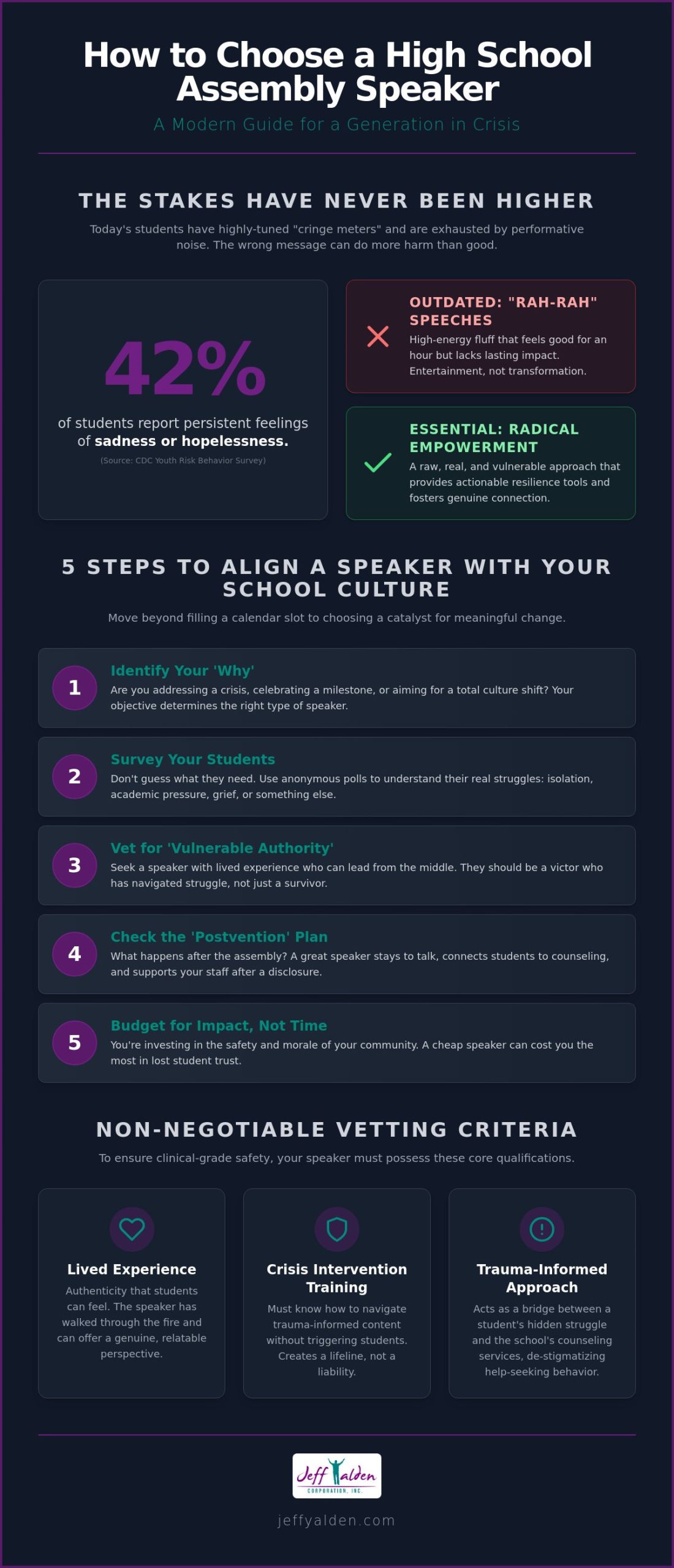
Your students have the most sensitive “cringe meters” in history. They are exhausted by the performative noise of social media and can spot a fake from the back row of the bleachers. In a world where 42% of students report persistent feelings of sadness or hopelessness, the old “rah-rah” motivational speech isn’t just outdated. It is dangerous. You are likely feeling the weight of budget constraints and the very real fear of hiring a speaker who “bombs” or, worse, mishandles a delicate mental health conversation. You need to know how to choose a high school assembly speaker who moves beyond entertainment to provide a clinical-grade safety net and a radical cultural reset.
I have been in those trenches since 1992. I know that choosing a speaker is no longer about filling a time slot; it is a critical safety decision for your entire school community. This guide will teach you exactly how to vet and hire a speaker who delivers measurable impact and actionable resilience tools. We will explore how to identify “vulnerable authority,” navigate 2026’s shifting student expectations, and ensure every word spoken on your stage aligns with the highest professional standards. It is time to move from student apathy to a campus culture that breathes hope.
Key Takeaways
- Stop settling for “rah-rah” speeches and start identifying your school’s unique “Why” to drive a genuine, lasting cultural reset.
- Discover the essential vetting criteria for how to choose a high school assembly speaker who balances radical transparency with clinical-grade safety.
- Learn why lived experience and crisis intervention training are non-negotiable for speakers addressing the 2026 mental health and suicide crisis.
- Transform a single event into a long-term movement by connecting student assemblies with trauma-informed teacher professional development.
- Gain the tools to bridge the gap between student apathy and resilience using a “vulnerable authority” model that students actually trust and respect.
The High Stakes of High School Assemblies in 2026
The stakes have never been higher. Your students aren’t just “kids”; they are a generation grappling with a level of isolation that would break most adults. By 2026, the oldest members of Gen Alpha are 16. They are burned out by the performative nature of their digital lives. If you are researching how to choose a high school assembly speaker, you need to understand that a “good” speech is no longer the metric for success. One wrong move, one tone-deaf joke, or one moment of inauthenticity can destroy the fragile trust you’ve spent all year building.
Students today have an internal “cringe meter” that is finely tuned to detect anything fake. They don’t want a polished performance. They want a human being who has been through the fire and come out the other side. When you bring someone into your gym or auditorium, you are inviting them into the heart of your school culture. If that person doesn’t respect the weight of that invitation, they will fail your students. Campus culture is a living, breathing thing. It is fragile. Choosing the wrong voice can set your progress back by years, leaving students feeling more misunderstood than before the assembly started.
Moving Beyond ‘Rah-Rah’ Motivation
High-energy fluff doesn’t stick. It’s entertainment, not transformation. While effective public speaking is a baseline requirement, it’s just the wrapper. The content inside has to be raw and real. We are shifting from “rah-rah” motivation to radical empowerment. A performer wants the standing ovation; a mentor wants the student to change their life. You need the latter. Fluff feels good for forty-five minutes, but the impact disappears the second the bell rings for next period. To reach students who are “exhausted” by social media noise, you need a voice that cuts through the static with radical transparency.
The Crisis Intervention Reality
Let’s talk about the reality of the 42% statistic. These aren’t just numbers from a report; these are the faces in your third-period class. Your assembly speaker must be a “vulnerable authority” who understands the clinical-grade safety required for suicide prevention. They must know how to navigate trauma-informed content without triggering the very students they are trying to help. This is about creating a lifeline. Since 1992, I’ve seen what happens when schools try to ignore the underlying trauma. It doesn’t go away; it just gets louder. The right speaker doesn’t just talk at students. They open a door to your counseling services that many students have been too afraid to walk through. They act as the bridge between a student’s hidden struggle and the help they desperately need.
5 Steps to Aligning a Speaker with Your School Culture
Stop looking at open dates on your calendar. Start looking at the hearts of your students. Knowing how to choose a high school assembly speaker means looking past the highlight reel and digging into the soul of your campus. You aren’t just hiring a person with a microphone. You are choosing a catalyst for change. If you want more than just a forty-five-minute distraction, you need a tactical plan that aligns with your specific culture.
- Step 1: Identify your ‘Why.’ Is your campus in the middle of a crisis? Are you celebrating a milestone? Or do you need a total culture shift? A speaker who excels at a pep rally might fail miserably during a postvention crisis.
- Step 2: Survey your students. Don’t guess what they are feeling. Ask them. Use anonymous polls to find out if they are struggling with isolation, academic pressure, or grief.
- Step 3: Vet for ‘Vulnerable Authority.’ This is the secret sauce. You need someone with lived experience who can lead from the middle. They should be a victor, not just a survivor.
- Step 4: Check the ‘Postvention’ plan. The most important moments happen after the assembly. Does the speaker stay to talk to the students who disclose? Do they have a plan for when the lights go down?
- Step 5: Budget for impact. You aren’t paying for an hour of time. You are investing in the safety and morale of your community. Cheap speakers often cost the most in lost trust.
Defining Your Primary Objective
Your assembly shouldn’t be an island. It needs to be a bridge. When you are deciding high school assemblies goals, make sure the message supports your existing Social-Emotional Learning (SEL) curriculum. If you are teaching resilience in the classroom, find a speaker who can bring those theories to life with raw, personal stories. This alignment ensures the message sticks long after the speaker drives away. If you are serious about connecting with a speaker who leads by example, focus on the outcomes you want to see in your hallways next month, not just next period.
Matching the Speaker to the Student Vibe
Middle school students need a different energy than high schoolers. They need more movement, more interaction, and a different level of transparency. High schoolers, on the other hand, can spot a “canned” speech from a mile away. They want the truth. When you vet speaker videos, look for authenticity rather than high production value. Does the speaker look the students in the eye? Do the students look engaged or are they checking their phones? In 2026, relatability is the only currency that matters. If the speaker can’t connect with the “exhausted” reality of today’s teens, they won’t be able to lead them toward hope.
Critical Vetting: Beyond the ‘Motivational’ Label
The word “motivational” has become a hollow shell. In the world of 2026, where students are drowning in performative content, a generic pep talk is white noise. When you are researching how to choose a high school assembly speaker, you have to look past the high-energy music and the flashy promo reels. You are vetting for clinical-grade safety and radical transparency. You need to know if the person on your stage has the backbone to handle the reality of a student body where nearly half are struggling with their mental health. Theoretical knowledge is useless in a crowded gym. You need someone who has walked through the fire and can show your students the way out.
The vetting process must be rigorous. It’s about more than just an “engaging” personality. Ask the hard questions before you sign the contract. Does the speaker have specific crisis intervention training? What is their protocol when a student approaches them after the assembly to disclose a plan for self-harm? A professional doesn’t just “hand off” a kid to a counselor. They act as a bridge. They use their lived experience to validate the student’s pain while guiding them toward the help they deserve. If a speaker can’t explain their safety protocol, they aren’t ready for your stage.
To ensure you are considering only the most qualified candidates, utilizing a reputable bureau like Speakers.com can help you find speakers who have already demonstrated a commitment to these high ethics and safety protocols.
- Lived Experience vs. Theory: Has the speaker actually lived the struggle they are talking about? Students can smell a script from a mile away.
- Crisis Intervention: Are they equipped to handle the heavy lifting of a post-assembly disclosure?
- Safe Messaging: Do they follow international guidelines for suicide prevention, avoiding graphic details and the glorification of struggle?
- The Victor Mentality: Do they lead as a victor who has overcome, or do they stay stuck in the “survivor” narrative?
The ‘Vulnerable Authority’ Standard
Safety and Ethics in Youth Speaking
Ethics are non-negotiable. Beware of speakers who use “scare tactics” or lean into the “shock factor” to get a reaction. That isn’t impact; it’s manipulation. You need a professional who understands the nuances of teen suicide prevention programs and the responsibility that comes with speaking to a vulnerable audience. Vetting for safety means ensuring the message focuses on resilience and actionable tools. The goal is to leave students feeling empowered and seen, not triggered or overwhelmed. Every word spoken must be a brick in the foundation of a safer campus culture.
Maximizing Impact: Logistics and Post-Assembly Sustainability
The most expensive mistake you can make is letting the inspiration die the moment the students walk out the double doors. An assembly is a spark. It is not the whole furnace. If you are focused on how to choose a high school assembly speaker who actually changes lives, you have to look at what happens on Friday morning. The “one-and-done” trap is real. It is that fleeting high that fades by the weekend, leaving your students right back where they started. To avoid this, you need a strategy that weaves the speaker’s message into the very fabric of your school’s daily life.
Sustainability is the difference between entertainment and an investment. This is why I advocate for integrating the student experience with trauma-informed teaching professional development. When your teachers understand the “why” behind the speaker’s stories, they can carry the torch in the classroom. They become equipped to handle the disclosures and the heavy conversations that follow. You aren’t just changing the students; you are evolving the entire system. This holistic approach ensures that the “vulnerable authority” modeled on stage becomes a shared value throughout your building.
Measuring success shouldn’t be a guessing game. Look at the data. Track the number of students who seek out counselor visits in the forty-eight hours following the event. Use school climate surveys to gauge the shift in morale and student engagement. If you want a lasting impact, you need to create “speaker-to-student” touchpoints long after the microphones are packed away. This might mean follow-up video messages, resilience rooms, or student-led discussion groups that keep the dialogue alive. You are looking for a shift in behavior, not just a temporary change in mood.
Preparing Your Staff and Parents
Your staff members are on the front lines of the student mental health crisis every single day. They need their own session to process the weight of what the students just heard. Hosting parent seminars is equally vital. It bridges the gap between the school hallways and the dinner table. When parents and teachers speak the same “language of resilience” as the speaker, the message becomes unavoidable. It becomes the new standard for how your community handles struggle and victory.
Building a Culture of Resilience
The assembly should be your launchpad for building resilience in teens. It is the beginning of a larger movement. Get your student leaders involved. Let them take ownership of the message. Whether it is through “deep dive” workshops for at-risk groups or student-led mental health awareness weeks, the momentum must continue. If you are ready to stop the cycle of apathy and start a movement of hope, you can book a comprehensive school culture program today and start the transformation.
Why Schools Trust Jeff Yalden for Radical Transformation
Longevity in this industry isn’t an accident. It’s a testament to relevance. Since 1992, I have stood on stages in all fifty states and across the globe. I’ve seen the trends come and go. I’ve seen the “rah-rah” era fade and the mental health crisis take its place. When you are deciding how to choose a high school assembly speaker, you aren’t just looking for someone who can talk. You are looking for a veteran who has stayed in the trenches and evolved alongside your students. My approach isn’t built on a script. It’s built on truth. It’s “real” and “raw” because that is the only language today’s teens respect.
I don’t just show up for the forty-five minutes of the assembly. I am the one schools call when the unthinkable happens. My expertise in suicide prevention and crisis intervention means I understand the heavy weight of postvention support. I know how to speak to a room full of grieving students and how to guide a staff through the fog of a campus tragedy. This is a holistic mission. By integrating high school assembly programs with teacher professional development and youth life coaching, we create a unified front. We don’t just spark a conversation; we build a foundation for a permanent culture shift.
The Power of the ‘Victor’ Mentality
We have a generation that is being taught to identify with their trauma. I want them to identify with their strength. My goal is to move every student from “victim” to “victor” in a single session. I lead as a vulnerable authority, sharing my own imperfections to earn the right to be heard. My delivery is fast-paced and high-energy. It’s staccato. It’s direct. It’s designed to keep them on the edge of their seats. Administrators often tell me they’ve never seen their “toughest” students so locked in. That is the power of a “been there” perspective. It isn’t theory. It’s a lived-experience guide showing them that resilience is a choice they can make today.
Booking for 2026: What to Expect
The urgency of now cannot be overstated. Your students are facing pressures that didn’t exist five years ago. They can’t wait another semester for a cultural reset. When you book a program for 2026, you are getting a seamless partnership. From the first discovery call to the final follow-up, my team and I are dedicated to your school’s specific needs. We offer customizable programs for high schools, middle schools, and staff sessions that provide actionable tools for immediate use. Don’t leave your campus culture to chance. If you want to know how to choose a high school assembly speaker who delivers radical impact, look for the one who has spent three decades proving it works. Let’s start the transformation together.
Your Students Can’t Wait Another Semester for Hope
The landscape of 2026 demands more than just a speech. It demands a lifeline. You now have the tactical roadmap for how to choose a high school assembly speaker who provides radical impact and clinical-grade safety. Remember to focus on your specific “Why,” vet for lived experience, and ensure your staff is part of the long-term transformation. This is about moving from a temporary “assembly high” to a permanent culture of resilience where every student feels seen and supported.
I have spent over 30 years in these trenches. As a specialist in suicide prevention and postvention, I’ve seen millions of students find their way back from the edge by embracing a “victor” mentality. I lead as a vulnerable authority because I’ve been where they are. Don’t leave your campus morale to chance. Bring Jeff Yalden to Your Campus—Book Your 2026 Assembly Now. The shift in your school culture starts with one brave decision. You’ve got this.
Frequently Asked Questions
How much does a high school assembly speaker cost in 2026?
Professional fees for national youth speakers typically range from $3,500 to $15,000 depending on their level of expertise and the depth of the program. While emerging speakers might start around $3,000, established experts with specialized crisis intervention training often fall in the $5,000 to $10,000 range. You aren’t just paying for an hour on stage; you’re investing in safety, vetting, and a lasting impact on your campus culture.
What should I look for in a speaker’s video to ensure they’re good?
Look at the audience’s eyes rather than just the speaker’s highlight reel. If the students are locked in, leaning forward, and off their phones, you’ve found a winner. Avoid videos that look overly produced, scripted, or “canned.” You want to see “real” moments of connection where the speaker is being vulnerable and raw, not just performing a polished routine that feels disconnected from the 2026 reality.
Can one assembly really change a school’s culture?
One assembly acts as a powerful catalyst for change, but it isn’t a magic wand. It provides the “radical reset” needed to break through student apathy and open doors for deeper, life-saving conversations. For a lasting shift, you must pair the event with follow-up touchpoints and teacher development. It’s the spark that starts the fire, but your school’s daily commitment is what keeps that fire burning.
How do we handle students who might be triggered by mental health topics?
Handling triggers requires a trauma-informed approach and strict adherence to safe messaging guidelines. Your speaker should avoid graphic details and instead focus on the “victor” mentality. Ensure you have “Resilience Rooms” or counselors available immediately after the session for students who need to process. A professional speaker acts as a bridge to these services, making it safe for students to disclose their struggles and seek help.
What is the best length for a high school assembly?
The ideal length for a high school assembly is between 45 and 60 minutes. This timeframe respects the average attention span of a digital-native student while allowing enough room for a deep, emotional narrative arc. If you go shorter, you risk staying on the surface. If you go longer, you risk losing the energy of the room. Quality and intensity always matter more than the total number of minutes.
How do I get my school board to approve a speaker on ‘sensitive’ topics?
Present the speaker as a safety asset and a risk-management tool rather than just an entertainer. Highlight their crisis intervention training and how their message aligns with state SEL standards and school board safety requirements. Show the board that ignoring mental health crises is far more expensive than investing in someone who understands how to choose a high school assembly speaker who delivers clinical-grade impact.
Should we have separate assemblies for different grade levels?
Separate assemblies are highly recommended because the emotional needs of a 14-year-old differ wildly from a high school senior. Middle schoolers need higher energy and more movement, while older students respond better to raw transparency and adult-level conversations. If your budget allows, splitting the groups ensures the message is perfectly tailored to the maturity level and “vibe” of every student in the room.
What is the difference between a motivational speaker and a mental health speaker?
A motivational speaker focuses on “rah-rah” energy and chasing dreams, while a mental health speaker provides “vulnerable authority” and crisis expertise. In 2026, students are exhausted by generic motivation. They need a voice that addresses anxiety, depression, and suicide prevention with radical transparency. You need someone who can handle the heavy lifting of a mental health crisis while still inspiring students to become victors over their circumstances.
