
When a student interaction gets tense, the first step may not be finding the perfect thing to say. It may be slowing yourself down. Effective de-escalation techniques for high school students begin with adult self-regulation and connection, not control. Still, when a student is upset and everyone is watching, it’s easy to worry that one wrong word could make things worse.
That pressure is real. You need to protect safety without shaming a student or turning distress into a public showdown. This guide offers practical ways to respond with calm, clear, respectful communication, while recognizing when a situation exceeds your role or training and it’s time to involve support. You’ll learn how to use body language, listen without endorsing harmful behavior, and offer simple choices without overwhelming a student. You’ll also find guidance for following up once the immediate tension eases. Consistent, supportive conversations can help make seeking help feel safer across the school. You don’t have to handle every moment alone. Start by staying steady, protecting dignity, and knowing when to bring in others.
Key Takeaways
- Distress can look like silence, withdrawal, refusal, agitation, or raised voices. Focus on what you can observe instead of assuming you know the cause.
- Choose de-escalation techniques for high school students that fit the moment: lower pressure, listen, and offer a manageable next step instead of demanding instant compliance.
- Match your response to the situation, and follow school procedures when safety may be at risk or the moment exceeds your role or training.
- A flexible sequence can help you respond with intention: notice, regulate yourself, reduce pressure, listen, offer choices, and follow up.
- Shared language, clear staff roles, and consistent procedures can make difficult moments less confusing and help create a school culture where students can seek help without shame.
De-escalation for Distressed High School Students
A student’s distress doesn’t always look like shouting. It may show up as silence, agitation, refusal, raised voices, or withdrawal. Those behaviors tell you that something is happening, but not why. A student who stops responding might feel overwhelmed; one who argues might feel embarrassed or misunderstood. Start with what you can observe, not a guess about the student’s motives.
De-escalation means reducing tension and supporting safety while giving a student room to regain control, not forcing instant compliance. The goal isn’t simply to stop visible behavior. It’s to lower pressure and protect the student’s dignity. That differs from punishment, which focuses on consequences; permissiveness, which removes all boundaries; and diagnosis or clinical treatment, which are outside an educator’s role. Broad de-escalation methods emphasize calm communication to help manage and resolve a tense situation.
A supportive response can be firm and respectful at the same time. You might say, “I can see this is frustrating. We can talk here quietly, or move to a less crowded spot if that feels better.” You aren’t excusing unsafe behavior or promising the student can avoid every expectation. You’re offering a lower-pressure way to move toward safety and communication.
Why a student may escalate in a school setting
Conflict with a peer, embarrassment in front of classmates, academic overwhelm, or feeling misunderstood can all contribute to distress. Public attention may intensify the moment. Repeated demands, several adults speaking at once, or feeling cornered can add pressure, too. These factors don’t explain every situation or excuse harm. They are reminders to stay curious: “What might this student be experiencing right now?”
When it’s safe, reduce the audience and avoid turning the interaction into a public contest. A quieter, respectful approach gives the student more room to respond.
De-escalation is not the same as crisis treatment
Educators can offer immediate support while staying within their training and role. If there’s imminent danger or an urgent mental health concern, follow school protocols and involve designated professionals. Don’t try to manage a crisis alone or substitute a conversation for qualified care. For related school safety planning, see this teen suicide prevention programs guide.
Effective de-escalation techniques for high school students begin with noticing distress, responding without shame, and knowing when to bring in support. Respect and safety belong in the same response.
How adult self-regulation and respectful communication lower tension
A tense moment can pull you into its pace. You may feel pressure to speak louder, ask more questions, or get an immediate answer. Pause first. Use a steady voice, relax your shoulders, keep your hands visible, and speak at an unhurried pace. Stand at a respectful angle and leave the student enough room to move. If several adults are present, decide who will speak. One calm voice is easier to follow than several people giving instructions.
Your calm won’t control a student’s feelings, but it can shape the tone of the exchange. That’s why effective de-escalation techniques for high school students start with noticing your own reactions. Take a breath, lower your volume, and keep your words simple. Then wait. Silence can give a student time to process instead of adding another demand.
What to say when a student is upset
Use short, open questions and reflect what you hear without claiming to know exactly how the student feels. Try, “I can see this is a lot right now,” or, “What would help you take the next step?” Ask once, then give the student time to answer. Don’t demand eye contact or an immediate explanation. You can acknowledge feelings while setting a clear limit: “You can be angry. I can’t let anyone get hurt.”
Reflective listening doesn’t mean agreeing with every claim or behavior. It shows you’re trying to understand before responding. If the student says, “Nobody listens,” you might say, “You feel like your side hasn’t been heard.” Then pause and let them correct or add to it.
What to avoid saying or doing
Skip sarcasm, threats, ultimatums, labels, and public power struggles. “You’re being ridiculous” attacks the student; “Let’s lower our voices so we can talk” identifies a workable next step. Avoid rapid-fire questions or debating fairness while the student is highly distressed. Extra demands can add pressure, and an audience can make it harder for a student to step back.
Keep physical boundaries clear. Don’t crowd, touch, or block the student. Physical intervention should only occur when school policy and the staff member’s specific training allow it. If there are immediate safety concerns, follow school procedures and involve designated support rather than trying to manage the situation alone.
These communication habits take practice, especially when emotions are running high. Schools looking to strengthen supportive conversations among staff can explore Jeff Yalden’s teacher professional development as one part of broader student well-being efforts.
Which de-escalation response fits the situation?
There isn’t one script for every tense moment. Start with what you can observe, then choose a response that fits the immediate level of concern. The examples below are adaptable prompts, not a diagnostic checklist or a promise that a student will calm down. If safety is uncertain, follow your school’s policy, assigned roles, and training.
| What you observe | Low-pressure first response | Next support step |
|---|---|---|
| Frustration, refusal, or raised voice, with no immediate safety concern | Reduce the audience if possible. Pause nonessential demands and offer a brief choice: “Would you rather take a quiet moment here or talk with me in a quieter place?” | Tell the student when and where you can follow up. Check in later, even if they aren’t ready to talk now. |
| A peer disagreement is getting heated | Create space between students without crowding or blaming. Use a calm prompt such as, “Let’s pause here. I’ll hear from each of you one at a time.” | Follow school procedures for peer conflict and involve the appropriate staff member if the disagreement continues or safety becomes uncertain. |
| Observable signs suggest immediate danger or an urgent mental health concern | Prioritize safety. Keep your words clear and brief, and avoid making promises you can’t keep. | Activate established school response procedures and involve designated administrators, counselors, or crisis personnel according to policy and training. |
When the student is frustrated but immediate safety is not at risk
Lower the pressure before asking for an explanation. If classmates are watching, reduce the audience when it’s safe and practical. Pause requests that can wait, and offer a small, genuine choice instead of several demands. You might say, “We can check in after class, or you can tell me when you’re ready.” Withdrawal or refusal doesn’t mean the student is ready to talk. Give them space, then follow up as agreed.
When there may be a threat to safety
Don’t treat a serious safety concern as an ordinary behavior challenge. Follow the school’s established procedures and call on designated support. Don’t promise secrecy; calmly explain that you may need to involve others to help keep people safe. Avoid trying to conduct a clinical assessment beyond your role. The goal of de-escalation techniques for high school students is to respond thoughtfully, not to manage every situation alone or replace school crisis procedures.
When in doubt, get support early. Clear roles and consistent procedures help staff respond without leaving one person to make a high-stakes decision in isolation.
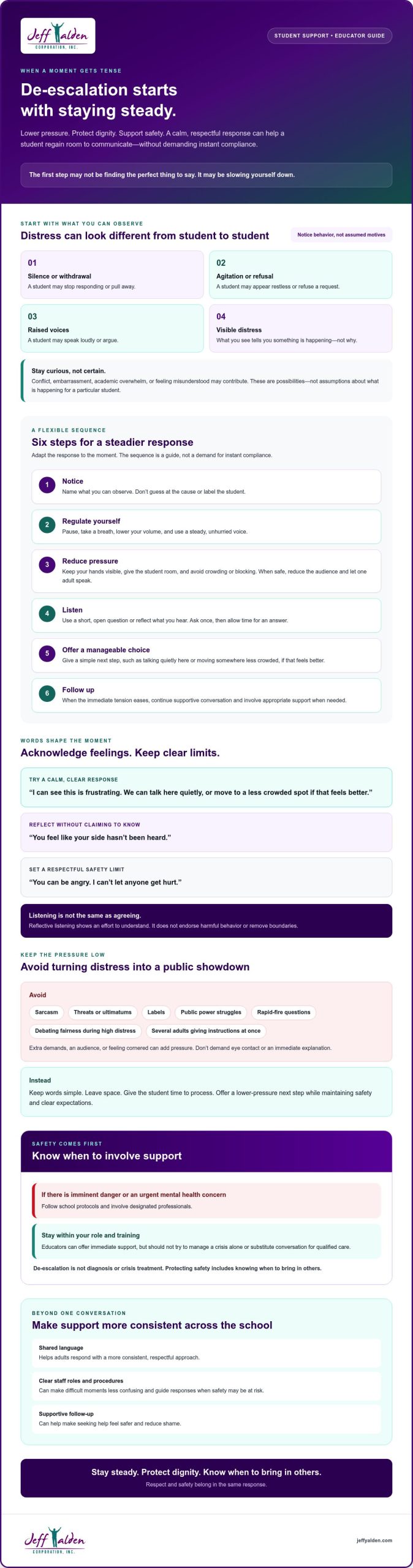
A practical de-escalation sequence educators can adapt
A simple sequence can keep your response focused without turning it into a rigid script. These steps are options, not a guarantee that tension will disappear. Adapt them to the student, setting, immediate safety needs, your role, and school procedures. If safety is uncertain, involve designated support staff.
- Notice: Describe what you observe to yourself, such as a student going quiet or pushing work away. Don’t assume you know the reason.
- Regulate yourself: Pause, breathe, and choose a steady pace before speaking.
- Reduce pressure: If it’s safe, limit the audience and pause requests that can wait.
- Listen: Offer one calm invitation, then leave room for an answer.
- Offer a next step: Give two realistic options only when both are safe and genuinely available.
- Follow up: Reconnect when the student is settled, and consider what may help next time.
During the interaction: pause, listen, and offer a next step
Keep it simple. One direction or invitation at a time gives the student space to process. For example: “You can sit here quietly, or we can talk in the hallway with another staff member.” Don’t offer choices you can’t honor. If the student becomes more distressed, stop debating or adding demands and seek support according to school procedures.
Imagine a student pushes a worksheet away after a difficult exchange with a classmate. The teacher notices the student’s tense posture, takes a breath, and says, “We can pause the work for a moment. Would you rather sit quietly or talk with me when you’re ready?” The student doesn’t answer. The teacher gives them space, stays attentive, and follows up later instead of treating silence as agreement or defiance.
After the moment: reconnect and learn
Once everyone is settled, invite the student to talk about what happened without shame or interrogation. Try, “What felt hardest about that moment?” Listen, then discuss a manageable next step. Follow your school’s documentation and communication requirements, and share sensitive information only with appropriate staff. Consider what could change before a similar situation occurs: Was the space crowded? Did instructions come too quickly? Could a trusted staff member help with a future check-in?
These de-escalation techniques for high school students become more consistent when staff share language and expectations. Schools exploring staff-wide learning can review trauma-informed teaching professional development. To explore teacher professional development with Jeff Yalden, visit Jeff Yalden’s professional development information.
Build a School Culture of Shared De-escalation
A difficult interaction shouldn’t depend on one educator improvising while everyone else watches. Shared language, clear roles, and consistent procedures help staff respond with less confusion and give students a more predictable experience across classrooms and common areas. De-escalation techniques for high school students work best as part of a wider support system, not as a script one person is expected to carry alone.
Prepare staff before a student reaches a breaking point
Schools can review their policies and decide in advance who leads communication, who supports other students, and whom staff contact if safety concerns increase. Make referral pathways clear so staff know how to connect a student with designated support and what steps to follow when urgent concerns arise. Students also need to know which adults they can approach and how to ask for help without feeling exposed or ashamed.
Training can give staff a chance to practice calm language, listening, respectful boundaries, and policy-based handoffs before a tense moment occurs. After reviewing current procedures, identify where staff need more preparation, especially during transitions between classrooms, offices, and other parts of campus. The goal isn’t to make every interaction identical. It’s to make roles and next steps clear.
Keep the response human, consistent, and connected
After a difficult incident, invite staff to reflect on what helped, where confusion arose, and what could be adjusted. Follow school policy and protect student privacy. Look for patterns in setting, timing, or transitions without reducing a young person to a behavior label. A noisy hallway or rushed change in routine may be worth addressing, but patterns should prompt thoughtful questions, not assumptions about a student’s character or intent.
Support continues after the immediate moment. Follow school procedures for communicating with appropriate staff, reconnecting with the student, and identifying next steps. If concerns suggest that a student needs qualified mental health care, use the school’s established referral pathways. Educators can offer care and connection, but shouldn’t be expected to provide clinical treatment outside their role.
Staff learning and student-facing programs can reinforce a shared understanding of mental health, resilience, and support. Jeff Yalden’s school assemblies and teacher professional development may complement ongoing school-based supports, but they don’t replace crisis procedures or qualified care. Schools exploring a student-focused conversation can learn about Jeff Yalden’s teen mental health speaker programs.
Keep strengthening the systems already around your students. Clear roles, thoughtful follow-up, and trusted adults can help make asking for support feel possible before distress becomes a crisis.
Make Every Difficult Moment a Chance to Build Trust
De-escalation isn’t about finding a magic phrase or demanding that a student calm down on cue. It’s about noticing distress, regulating your own response, lowering pressure, and choosing a respectful next step. Effective de-escalation techniques for high school students also include recognizing when the situation calls for school procedures and designated support.
One calm interaction matters, and so does the culture around it. When staff share clear roles and students know where to turn, asking for help can feel less risky and less shameful. Thoughtful follow-up helps teams learn what could make the next difficult moment safer and more supportive.
Schools can reinforce this work through ongoing staff and student support. Jeff Yalden provides teacher professional development focused on student mental health and well-being, along with school assemblies and community programs focused on resilience and open conversations. These can complement, not replace, school crisis procedures or qualified mental health care. Explore Jeff Yalden’s school programs and educator support.
You don’t have to handle every moment perfectly. Stay steady, protect dignity, and keep building a school where students can reach for support.
Frequently Asked Questions
What are the most effective de-escalation techniques for high school students?
Effective de-escalation techniques for high school students lower pressure while keeping safety and dignity in view. Use a steady voice, relaxed, non-threatening posture, and enough space so the student doesn’t feel cornered. Have one adult speak at a time. Listen before problem-solving, reflect what you hear without assuming how the student feels, and offer a simple, realistic choice. Adapt your response to the situation and follow school procedures if safety is uncertain.
What should a teacher say to a student who is escalating?
Use brief, respectful language that acknowledges the moment without claiming to know exactly how the student feels. You might say, “I can see this is a lot right now,” or, “We can pause for a moment, then decide what comes next.” Ask one open question, then give the student time to respond. If a clear limit is needed, separate feelings from unsafe actions: “You can be upset, and I can’t let anyone get hurt.”
Can a teacher de-escalate a student without giving in?
Yes. De-escalation doesn’t mean abandoning expectations or accepting unsafe behavior. It means choosing how and when to address the issue so the interaction doesn’t become a public power struggle. A teacher can pause a nonessential demand, offer a safe choice, and return to the expectation when the student is more able to engage. Keep boundaries clear, use respectful language, and apply school policies consistently.
How do you calm an angry teenager at school?
You can’t guarantee that another person will calm down, but you can avoid adding pressure. Slow your speech, keep your words simple, give the student physical space, and reduce the audience if it’s safe. Avoid rapid questions or demands for an immediate explanation. Try a calm invitation such as, “Would you like a quiet moment, or would you rather talk with a staff member you trust?” If safety becomes uncertain, follow school procedures.
What should school staff avoid during student de-escalation?
Avoid sarcasm, threats, ultimatums, labels, public arguments, and repeated demands. These can increase pressure and make it harder for a student to re-engage. Don’t crowd, touch, or block the student. Physical intervention should only be considered when applicable school policy and staff training explicitly allow it. Don’t promise secrecy if a safety concern may need to be shared with designated staff. When unsure, step back and seek support according to school procedures.
When should a teacher involve a counselor or administrator?
Involve designated support when the student’s distress continues to rise, you’re unsure how to respond safely, or the situation exceeds your role or training. If there’s imminent danger or an urgent mental health concern, activate the school’s established response procedures right away. Follow local policy about whom to contact, and don’t try to assess or manage a serious crisis alone. You can tell the student you’re bringing in support to help keep people safe.
Is de-escalation the same as crisis intervention?
No. De-escalation is a way to reduce tension and support safety during a difficult interaction. Crisis intervention may involve more formal steps, qualified professionals, and established school procedures, especially when there’s immediate danger or an urgent mental health concern. An educator can offer calm, immediate support while staying within their training and role. De-escalation doesn’t replace crisis protocols, clinical care, or referral to appropriate school-based professionals.
