
Your school mission statement is failing your students. It’s a nice poster, but it’s not a lifeline. Right now, your hallways feel heavy. You see the rising anxiety in their eyes and the burnout in your staff’s tired smiles. You’re exhausted from just managing a “toxic” atmosphere. I’ve been in those trenches with you. I know that creating a positive school climate isn’t about updating a handbook or adding another clinical checkbox. It’s about radical transparency. It’s about being real enough to save a life.
You probably feel like you’re constantly putting out fires instead of actually teaching. I get it. This article will show you how to move beyond policy to build a school climate rooted in radical transparency, connection, and life-saving mental health support. We’re going to dive into a 2026 roadmap that prioritizes human connection to lower disciplinary referrals and finally restore staff morale. It’s time to stop just “getting through” the day and start building a campus where everyone feels seen, heard, and safe.
Key Takeaways
- Stop relying on outdated handbooks and start prioritizing the “emotional temperature” of your campus to combat rising student anxiety.
- Master the four radical pillars of creating a positive school climate, moving beyond physical security to build true psychological safety.
- Replace the compliance-first model with a connection-first approach that addresses the root causes of student behavior like trauma and neglect.
- Use a High School Assembly as a high-impact “reset button” to jumpstart cultural transformation and make every student feel seen.
- Empower your staff through specialized Teacher Professional Development to sustain long-term morale and lead with radical transparency.
Beyond the Handbook: What Creating a Positive School Climate Really Means in 2026
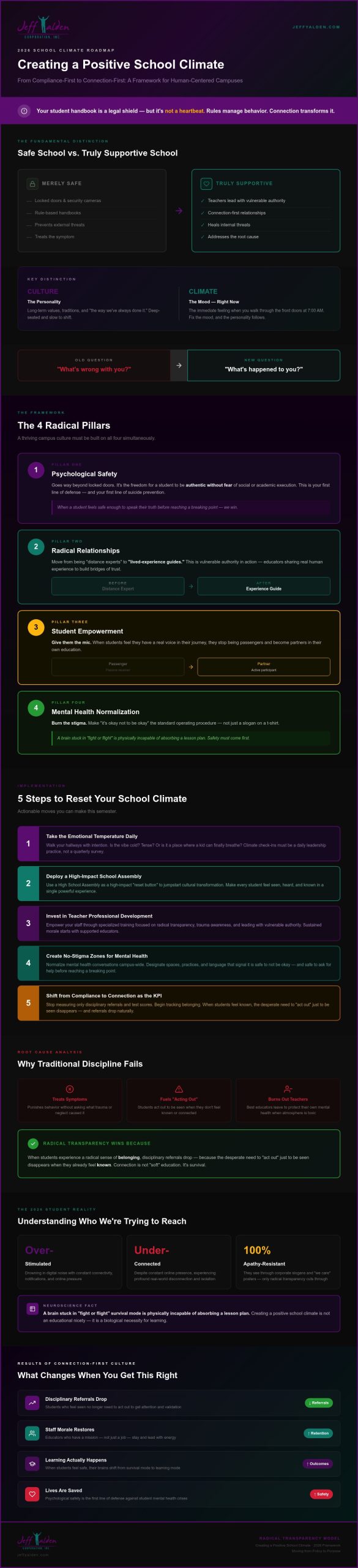
Let’s stop pretending that a list of rules creates safety. It doesn’t. Your student handbook is a legal shield, but it’s not a heartbeat. In 2026, creating a positive school climate means taking the emotional temperature of your hallways every single day. Is it cold? Is it tense? Or is it a place where a kid can finally breathe? I’ve seen too many campuses where the vibe is so heavy it’s hard to focus on anything else. We have to change the air before we can change the grades.
We’ve reached a breaking point. The old discipline-first models are crumbling because they treat the symptom, not the soul. If we want to save our schools, we have to move toward a connection-first approach. This isn’t “soft” education. It’s survival. When students feel a radical sense of belonging, disciplinary referrals drop. Why? Because the desperate need to “act out” just to be seen disappears when they already feel known. It’s about shifting the question from “What’s wrong with you?” to “What’s happened to you?”
There is a massive difference between a school that is merely safe and one that is truly supportive. A safe school has locked doors and security cameras. A supportive school has teachers who lead with vulnerable authority. One prevents external threats; the other heals internal ones. This environment is the foundation for everything else. Without it, student retention slips and teacher burnout becomes an epidemic. Utilizing resources like Focused EDU Staffing Group for reliable teacher placement can alleviate the pressure on existing staff during these transitions. If the atmosphere is heavy, your best educators will walk out the door to save their own mental health. They don’t just want a job; they want a mission that doesn’t drain their spirit.
Climate vs. Culture: Understanding the Heartbeat
Think of culture as the personality of your school. It’s the long-term values, the traditions, and the “way we’ve always done it.” Climate is the mood. It’s the immediate feeling that hits you when you walk through the front doors at 7:00 AM. You can’t change the deep-seated culture of a campus if you aren’t willing to address the toxic climate students and staff endure every hour. Fix the mood, and the personality will follow.
The Lived Experience of the 2026 Student
Our students are drowning in digital noise. They are over-stimulated but under-connected. They see through the corporate slogans and the “we care” posters. Radical transparency is the only tool sharp enough to cut through that apathy. We have to be real about the struggle. Creating a positive school climate is a biological necessity for learning because a brain stuck in “fight or flight” survival mode is physically incapable of absorbing a lesson plan. We must create the safety for them to thrive.
The 4 Radical Pillars of a Thriving Campus Culture
We can’t build a future on a cracked foundation. If your school’s culture is crumbling, it’s because the pillars holding it up are outdated. Creating a positive school climate in 2026 isn’t a mystery. It’s a choice. It requires a radical commitment to four specific areas that transform a building from a place of “attendance” to a place of “belonging.” These pillars define whether your students are just showing up or actually showing up for each other.
- Psychological Safety: This goes way beyond locked doors. It’s the freedom for a student to be authentic without the fear of social or academic execution.
- Radical Relationships: We move from being “distance experts” to “lived-experience guides.” This is the power of vulnerable authority in action.
- Student Empowerment: We give them the mic. When students feel they have a real voice in their journey, they stop being passengers and start being partners in their own education.
- Mental Health Normalization: We burn the stigma. We make “it’s okay not to be okay” the standard operating procedure, not just a slogan on a t-shirt.
These pillars aren’t suggestions. They are the requirements for a campus that wants to do more than just survive the school year. When you lean into these, creating a positive school climate becomes the natural byproduct of your daily interactions. It becomes the heartbeat of the building.
Psychological Safety and Suicide Prevention
A positive climate is your first line of defense. When we create a “no-stigma” zone, we aren’t just making kids feel better; we are saving lives. Suicide prevention starts with the atmosphere. If a student feels safe enough to speak their truth before they reach a breaking point, we win. This is why I focus so heavily on teen suicide prevention programs that integrate directly into the school’s daily rhythm. We have to make help-seeking a sign of strength, not a confession of weakness. It’s about creating a net that catches them before they ever fall.
The Role of Vulnerable Leadership
Change starts at the top. If the administration is closed off, the students will be too. Leaders must lead with transparency. Share your failures. Talk about your own resilience. When you model what it looks like to bounce back, you give your students a roadmap for their own lives. This “real” storytelling is what builds trust in an era of digital noise. If you’re ready to bridge that gap, bringing in a High School Speaker who understands this transparency can be the catalyst you need. It’s time to be human again.
Why Traditional Discipline Fails and Radical Transparency Wins
Let’s get real. You can’t punish a kid into caring. Rules might keep a lid on the chaos for a while, but they don’t change hearts. If your strategy for creating a positive school climate is built on a foundation of “do it because I said so,” you’ve already lost. The “Compliance vs. Connection” debate isn’t just an academic argument. It’s a battle for the soul of your campus. When we demand obedience without offering a relationship, we aren’t leading. We’re just managing. And students in 2026 can smell that lack of authenticity from a mile away.
Kids don’t “act out” because they want to be difficult. They act out because they are in pain. Their behavior is a language. They are screaming through their actions because they don’t have the words to describe the trauma, anxiety, or neglect they face at home. If we only see the disruption and ignore the person, we fail them. A heavy, punitive climate breeds a “culture of silence” where students hide their struggles until they reach a breaking point. But when you shift the focus to connection, the ROI is undeniable. You see disciplinary referrals drop. You see graduation rates climb. You see a campus that finally feels like a community instead of a cage.
Trauma-Informed Approaches to Climate
Every student walks through your doors carrying an invisible backpack. For some, it’s light. For others, it’s stuffed with the weight of a broken home, food insecurity, or deep-seated fear. Punitive measures like “zero-tolerance” policies often re-traumatize the very students who need our help the most. Instead of pushing them away with a suspension, we need to pull them in with a plan. This shift requires specialized trauma-informed teaching professional development. It’s about giving your staff the emotional intelligence to see the struggle behind the stare and respond with compassion instead of conflict.
Breaking the Silence on Campus
The loudest kids in the room get all the attention, but the “quiet” ones are the ones who often slip through the cracks. They disappear into the background while their world falls apart. We have to be intentional about reaching them. A single moment of genuine connection, a simple “I see you,” can change a student’s entire trajectory. We have to be proactive because the culture of silence is the greatest threat to school safety. When we break that silence with radical transparency, we create a campus where no one has to suffer in the dark alone. We make it safe for them to be real, so we can finally help them heal.
5 Actionable Steps to Reset Your School Climate This Semester
You don’t need a three year strategic plan to start creating a positive school climate. You need a spark. You need the courage to stop hiding behind policies and start looking your students in the eye. If the atmosphere on your campus feels heavy, it’s because the connection has been severed. We can’t wait for next year to fix this. Your students are struggling now. Your teachers are burning out now. It’s time for a radical reset that shifts the energy of your building in real time.
- Conduct a Radical Audit: Stop using generic surveys that kids just click through. Ask the hard questions. Ask them if they feel safe enough to fail. Ask them who they would go to if they were in a dark place.
- Launch a Climate Catalyst: Every movement needs a starting point. A high impact event can break the ice and open doors that have been shut for years.
- Prioritize Teacher Wellness: You can’t ask your staff to be emotional anchors for students if they are drowning themselves. Professional development must focus on their humanity first.
- Master Micro Connections: Climate isn’t built in boardrooms; it’s built in the three seconds of eye contact in the hallway and the high five at the door.
- Prepare a Postvention Plan: Don’t wait for a tragedy to decide how you’ll support your community. Having a plan in place before a crisis happens is a fundamental act of love and safety.
The Assembly as a Culture Catalyst
Sometimes you need to shock the system. A high energy, raw, and emotional event can break down walls in 60 minutes that a semester of “character education” classes couldn’t touch. We move from mere motivation to true transformation when we stop talking at students and start talking with them. These high school assemblies serve as the anchor for your new culture. They provide a shared language of vulnerability that allows everyone on campus to finally breathe.
Supporting the Supporters: Teacher PD
Your teachers are the front lines of student well being. If they’re exhausted, the climate will always be “heavy.” We have to provide practical wellness strategies that don’t feel like “one more thing” on a crowded plate. This means building peer support networks where educators can be honest about their own struggles. When we support the supporters, we create a sustainable environment where everyone can thrive. If you’re ready to ignite this change, bring a High School Speaker to your campus and watch the transformation begin today.
Transforming Your Campus: The Jeff Yalden Radical Transparency Model
Perfection is a lie that students in 2026 no longer believe. They aren’t looking for a polished expert with a scripted PowerPoint. They’re looking for a person who has been through the fire and come out the other side. That’s the core of the Jeff Yalden Radical Transparency Model. We stop pretending everything is fine and start being honest about the struggle. When an administrator or a teacher stands up and admits they don’t have all the answers, the walls come down. This vulnerability is the secret sauce for creating a positive school climate that actually lasts. It shifts the power dynamic from “us vs. them” to “we’re in this together.”
My assemblies aren’t just speeches. They are a gut-level reset button for your entire campus. In sixty minutes, we address the silence, the stigma, and the isolation that have been building up for months. We bridge the gap between the front office and the back row of the auditorium. But the goal isn’t just a great hour on a Tuesday. It’s about taking that momentum and turning it into a 365-day culture of connection. We move from a one-time event to a sustainable heartbeat where every student knows they are seen and every teacher feels supported.
Long term sustainability requires more than a feeling. It requires a shared language. After the assembly, the “Real Talk” philosophy stays behind. It becomes the way you handle conflict, the way you start your staff meetings, and the way you check in on the kid who looks like they’re having a bad day. Creating a positive school climate is a daily practice of choosing connection over compliance. It’s about building a community where the “emotional temperature” is warm enough for growth but safe enough for honesty.
The Impact of Lived Experience
I speak from the trenches. My journey through mental health challenges and recovery is what allows me to connect with the “lost” students who feel like they don’t fit the mold. By normalizing the conversation through storytelling and humor, we make it safe for them to breathe again. As a teen mental health speaker, I don’t just share facts; I share a roadmap for survival. We show them that their current struggle isn’t their final destination.
Next Steps for School Leaders
Transformation doesn’t happen by accident. It happens by design. If you’re ready to stop the cycle of burnout and anxiety on your campus, it’s time to take the first step. Booking a climate-shifting assembly is about more than just a date on the calendar. It’s about committing to a new way of being. I also offer follow-up coaching for at-risk youth to ensure the seeds we plant during the assembly have the chance to grow. Bring Jeff Yalden to your school to start the transformation and let’s build a campus where everyone can thrive.
The Future of Your Campus Starts with a Single Choice
You’ve seen the roadmap. You know that creating a positive school climate isn’t about more paperwork. It’s about the radical courage to be human with your students. We’ve explored how connection-first models outperform punitive discipline. We’ve identified the pillars of psychological safety that actually save lives. Now, it’s time to stop reading and start leading. Your students are waiting for someone to be real with them. Your staff is waiting for a reason to feel inspired again. You have the power to change the air in your building today. Don’t let another semester slip by in silence.
I’ve spent over 30 years in the trenches with students and educators. As an expert in suicide prevention and postvention, I’ve had the honor of impacting over 4,000 schools worldwide. I know what it takes to break the silence and bridge the gap. If you’re ready to hit the reset button on your campus energy, I’m here to guide you through it. Book Jeff Yalden for Your Next High School Assembly and let’s build a culture where no one has to struggle alone. You can do this. Your school is worth it.
Frequently Asked Questions
How do you define a positive school climate?
A positive school climate is the emotional heartbeat and immediate “mood” of your campus. It is the collective feeling students and staff experience the moment they walk through the front doors. It isn’t about the rules in your handbook. It’s about the quality of human connection and whether every person in the building feels safe, seen, and heard. When you focus on creating a positive school climate, you are building a foundation where learning is actually possible.
What are the 4 main elements of school climate?
The four main elements are safety, relationships, teaching and learning, and the institutional environment. Safety covers both physical security and the psychological freedom to be authentic. Relationships focus on the trust and “vulnerable authority” between staff and students. Teaching and learning involve the emotional support students receive to grow. The environment is the physical and organizational “vibe” of the school. All four must work together to create a thriving campus culture.
How long does it take to improve a school’s climate?
You can spark a radical shift in sixty minutes, but deep transformation takes a full semester of consistent effort. A high-impact High School Assembly acts as the “reset button” that breaks down walls instantly. However, sustaining that change requires daily micro-connections and a commitment from leadership to stay real and transparent. It is a marathon that starts with a high-energy sprint. You have to keep the momentum alive every single day.
What is the difference between school climate and school culture?
Climate is the “mood” while culture is the “personality” of your school. Culture is built over years through shared values, history, and traditions. Climate is the immediate feeling of the hallways right now. You can’t fix a toxic culture without first addressing the daily climate. Think of it like weather versus climate in nature. One is what is happening today; the other is the long-term pattern you’ve established over time.
How can teachers help improve school climate on a daily basis?
Teachers improve climate through radical transparency and simple micro-connections. It starts with greeting every student at the door and making genuine eye contact. It means being a “vulnerable authority” who isn’t afraid to admit when they don’t have all the answers. These small moments of human connection tell a student they matter. When teachers lead with heart, the entire classroom atmosphere shifts from a place of compliance to a place of true connection.
Can a single school assembly really change the climate of a school?
An assembly serves as a powerful catalyst that jumpstarts the process of creating a positive school climate. It provides a shared emotional experience that breaks the “culture of silence” and opens doors that have been shut for years. While one event won’t fix everything forever, it creates the necessary opening for deeper work. It gives your students and staff a new, honest language of vulnerability to use for the rest of the school year.
What are the first signs of a deteriorating school climate?
Look for a “heavy” atmosphere, rising disciplinary referrals, and high teacher turnover. When students stop making eye contact and staff rooms become centers for venting rather than support, your climate is in trouble. Increased social isolation and a lack of student voice are clear red flags. These signs tell you that the emotional foundation of your school is cracking. It requires an immediate and radical reset to prevent further decline and burnout.
How does school climate affect student mental health and suicide prevention?
A positive climate is the ultimate safety net for suicide prevention. When students feel psychologically safe, they are much more likely to seek help before a crisis reaches a breaking point. A supportive environment normalizes mental health struggles and removes the stigma of “not being okay.” It creates a culture of “vulnerable authority” where students look out for one another. This deep sense of belonging is quite literally a lifesaver for at-risk youth.
