
Nearly 40% of high school students report persistent feelings of sadness, and research shows 69% confide in a classmate long before reaching out to an adult. Yet when educators consider creating a peer support program in high school, fear quickly takes over. You worry about legal liability. You dread students trying to play therapist. And with counselors already drowning under an average national ratio of 372:1, nobody has the bandwidth to manage another failed initiative.
You’re right to protect your staff and your kids. True peer support never asks teenagers to carry clinical weight. Instead, it equips trusted students to serve as frontline eyes and ears who spot silent struggles, break down stigma, and make immediate warm handoffs to professionals. In this guide, you’ll learn how to build a high-impact, sustainable peer support program that empowers students to save lives and transform your school culture.
From cluster-based recruitment to ironclad safety protocols, here is your practical roadmap for launching a student leadership team that creates real, lasting change.
Key Takeaways
- Discover why creating a peer support program in high school transforms campus culture by positioning students as trained first responders, not amateur counselors.
- Master the 5 core pillars of sustainable program design, from administrative buy-in to recruiting diverse student influencers across social cliques.
- Establish rock-solid liability boundaries and warm handoff protocols that protect staff and eliminate the fear of student confidentiality breaches.
- Equip student leaders with advanced warning sign detection that catches silent crises before clinical intervention becomes an emergency.
- Learn how to ignite schoolwide buy-in and destigmatize help-seeking through a high-energy launch assembly that puts your team on the map.
Why Peer Support is the Lifeline Every High School Needs in 2026
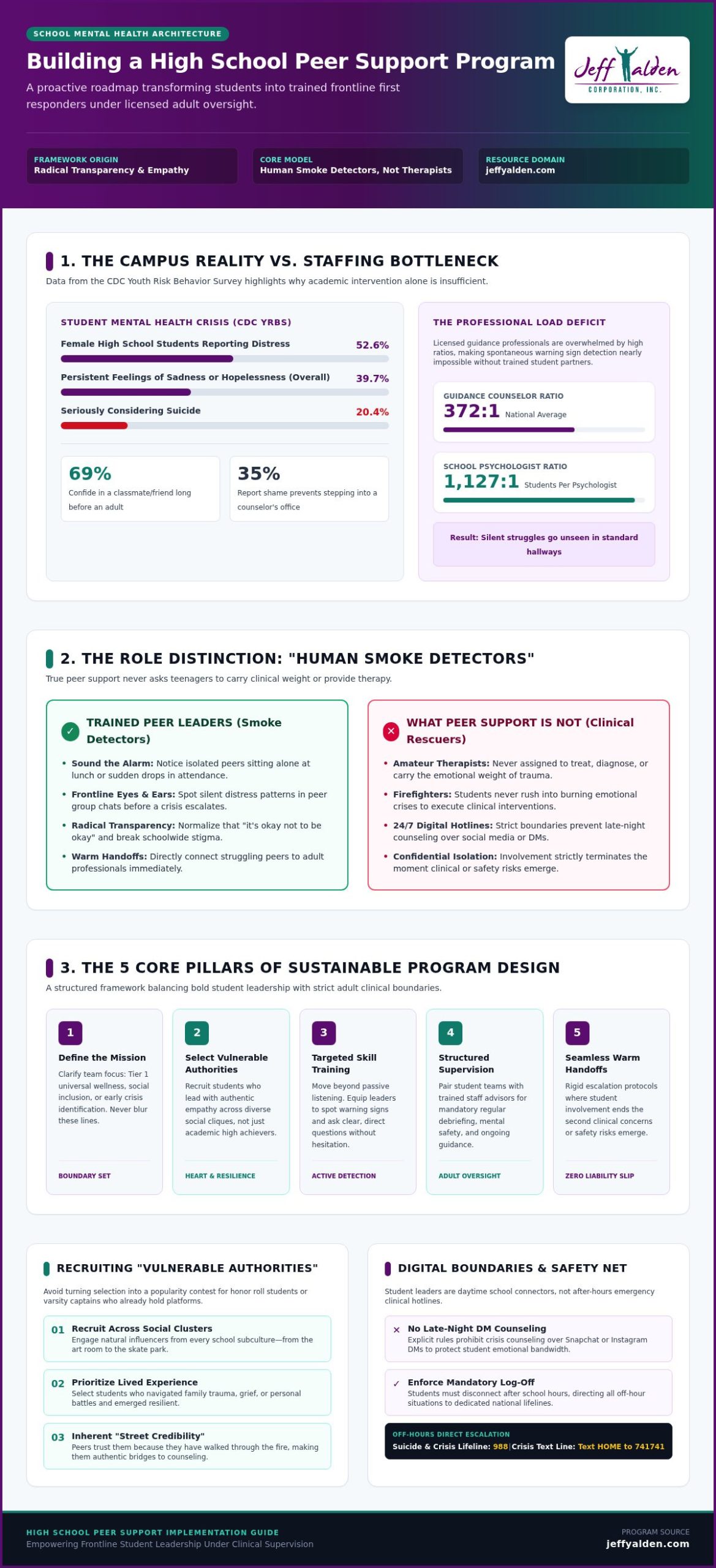
High school corridors carry a heavy silence today. Gen Z and Gen Alpha students face an unprecedented loneliness epidemic, masked by constant digital connection. The CDC’s Youth Risk Behavior Survey highlights this reality: 39.7% of high school students report persistent feelings of sadness or hopelessness, while female distress climbs to 52.6%. With 20.4% seriously considering suicide, academic intervention alone is not enough. Peer support is a structured system where students provide social and emotional backing under licensed adult oversight. It bridges the gap between suffering silently and getting help, serving as the frontline heartbeat for modern teen suicide prevention programs.
Creating a peer support program in high school gives schools a proactive defense. When kids hit a wall, they turn to each other first. Over 69% of teenagers confide in a friend before an adult, while 35% say shame keeps them from stepping into a counselor’s office. Adult guidance counselors face an overwhelming national ratio of 372:1. School psychologists juggle roughly 1,127 students each. Staff cannot catch every warning sign alone; they need trusted student partners.
The “First Responder” Model for Students
Think of student peer leaders as human smoke detectors. They aren’t firefighters rushing into burning buildings to perform clinical rescues. They simply sound the alarm before a quiet flicker turns into a five-alarm blaze. By creating a peer support program in high school, you position teenagers to notice isolated peers at lunch, sudden drops in attendance, or distress in group chats, bridging struggling classmates directly to counselors through structured warm handoffs.
Transforming Campus Culture Through Radical Transparency
Real transformation starts when schools shatter the toxic myth that “everything is fine.” For decades, student assemblies focused on safe, surface-level motivation. That approach fails modern teenagers. Grounded in the philosophy of Jeff Yalden, an experienced teen mental health speaker, radical transparency teaches students that vulnerability is strength. When trained student leaders share their real struggles and admit that it’s okay not to be okay, campus stigma evaporates, turning empathy into a daily reality across every hallway.
Designing Your Program: The 5 Pillars of Success
Building a peer initiative requires an intentional framework, not good intentions alone. Without structure, student enthusiasm quickly evaporates. To succeed, your model needs five core pillars that balance bold student leadership with strict adult boundaries:
- Define the Mission: Clarify whether your team focuses on Tier 1 universal wellness, social inclusion, or early crisis identification. Don’t blur these lines.
- Select Vulnerable Authorities: Recruit students who lead with authentic empathy rather than just academic achievements.
- Targeted Skill Training: Move past passive listening. Teach students how to spot distress patterns and ask clear, direct questions.
- Structured Supervision: Pair student teams with trained staff advisors who provide regular debriefing and ongoing guidance.
- Seamless Warm Handoffs: Build rigid escalation protocols where student involvement ends the second clinical or safety risks emerge.
When creating a peer support program in high school, clinical clinical checklists often miss the human element. Success requires radical transparency, vulnerability, and clear operational boundaries.
Recruiting for Heart and Resilience
Avoid turning your selection process into a popularity contest. Honor roll students and varsity captains already have leadership platforms. Instead, recruit across every social cluster, from the art room to the skate park. Look for students with lived experience, teenagers who navigated family trauma, grief, or personal battles and came out stronger. These “vulnerable authorities” possess genuine street credibility. Classmates trust them because they’ve walked through the fire, making them natural bridges for struggling peers.
Digital Boundaries in a 24/7 World
Modern teens live on screens, which exposes student leaders to burnout. Establish clear rules prohibiting late-night crisis counseling over Snapchat or Instagram DMs. Student supporters are daytime connectors, not an after-hours hotline. Teach them to log off and direct after-hours situations to national crisis resources like 988 or text HOME to 741741. Protecting the emotional bandwidth of your student leaders keeps your program sustainable over the long haul. To equip your staff with the strategies needed to supervise these teams effectively, bringing in expert teacher professional development can establish these boundaries right from day one.
Navigating Liability and Safety: Protecting Students and Staff
Every administrator asks the exact same question before greenlighting student advocates: What happens when a teenager hears something they can’t handle? The fear of liability paralyzes good schools. Yet silence carries far greater risk. In reality, student advocates are never left to hold crises alone. While students aren’t legally mandated reporters under state child abuse laws, adult advisors and counselors are. Creating a peer support program in high school demands establishing an uncompromising “no-secrets” agreement from day one. If abuse, violence, or self-harm enters the conversation, confidentiality vanishes immediately.
Under federal FERPA regulations (34 CFR § 99.36), schools hold clear authority to disclose identifiable student records during health or safety emergencies without prior parental consent. Protecting a student’s life always supersedes privacy concerns. Transparency with families is critical, but it requires delicate handling. Student supporters don’t call parents directly. Instead, they quickly pass information to staff advisors who manage parent notifications and formal district crisis protocols.
The Ethics of Peer Mentorship
Student boundaries must be crystal clear. Peer leaders do not diagnose, give clinical advice, or investigate personal problems. They validate pain and build a bridge. During training, students run real-world role-playing scenarios to master the handoff: “I care about you too much to keep this between us. Let’s walk down to the counselor’s office together right now.” Peer leaders log simple encounter records, noting dates and referrals, without writing subjective clinical interpretations that create district liability.
Self-Care for the Peer Support Team
Carrying the weight of a hurting classmate takes a heavy toll. Seventeen-year-olds are not built to shoulder secondary trauma without relief. When creating a peer support program in high school, structured debriefing is your safety net. Advisors must schedule regular wellness check-ins alongside guidance counselors or trained academic life coaches to unpack secondary stress. If a student supporter hits academic burnout or experiences personal grief, advisors must give them permission to step down temporarily. Leaders must stay healthy to help others heal.
Training Your Team: Moving Beyond Active Listening
Nodding along and repeating words back doesn’t cut it anymore. Traditional active listening is far too passive for today’s high-stakes environment. When creating a peer support program in high school, training must prepare students for raw reality. Peers need practical conversational agility. They must recognize warning signs that teachers overlook in crowded classrooms: sudden silence in group texts, chronic apathy, giving away treasured belongings, or subtle comments about feeling like a burden. Through regular role-play, students build instinctive muscle memory so panic doesn’t freeze them when a friend breaks down.
Mastering Radical Transparency
Empathy requires genuine vulnerability. When student leaders talk openly about their own setbacks, they give others permission to drop their armor. The secret lies in using a “vulnerable share” to validate pain without hijacking the conversation. A trained peer supporter says, “I struggled with overwhelming anxiety last semester, and I know how lonely it feels. You don’t have to carry this by yourself.” Grounding this dynamic in proven frameworks for building resilience in teens ensures students mentor from a place of strength, proving to their classmates that hope and recovery are real.
Crisis Intervention for Peers
When safety is on the line, students must know how to ask the hard question directly without flinching: “Are you thinking about suicide?” Research proves that asking clearly does not plant the idea; it provides instant relief to someone drowning in silence. Peer leaders learn never to leave an at-risk classmate alone, never to promise secrecy, and how to execute an immediate warm handoff to a designated school counselor. If you’re ready to inspire your students and prepare your staff with life-saving crisis intervention tools, bring Jeff Yalden to your campus as a mental health speaker to ignite this movement.
Launching with Impact: Creating a Culture of Support
A quiet launch is the fastest way to kill a student initiative. If your rollout consists of a dull morning announcement or a dusty flyer on a hallway bulletin board, the student body will ignore it. Stigma thrives in the dark, and teenagers spot performative programs instantly. Successfully creating a peer support program in high school requires bold momentum. You must normalize seeking help before asking students to step forward. When schools make noise about mental wellness, students realize they aren’t alone, transforming peer support from an awkward afterthought into an integral part of campus identity.
Visibility fuels credibility. Designate visible branding for your team, whether that means branded hoodies, subtle lapel pins, or active campaigns on school media. Track your impact using measurable markers, such as increases in voluntary counseling referrals, climate survey metrics, and reduced disciplinary rates. When students see their classmates openly championing vulnerability, the entire social dynamic shifts from silent coping to collective strength.
The Kickoff Event Strategy
Igniting real cultural momentum starts in the gym. Bringing in an authentic, high-impact speaker through dynamic high school assemblies breaks the emotional ice across the entire student body. An outside voice with decades of real-world experience strips away the cynicism that teens naturally hold. Toward the end of the event, invite your newly trained peer leaders onto the stage. Standing alongside a respected speaker instantly transfers credibility to them. The student body sees their peers not as snitches or hall monitors, but as trusted allies ready to stand in the gap.
Sustainability: Keeping the Momentum Alive
Longevity determines whether your initiative leaves a legacy or fades away after graduation. Prepare early for the senior exit by running rolling nominations each spring. Pair graduating seniors with sophomore apprentices to pass down institutional wisdom. Keep peer support visible throughout daily school life during advisory periods, homeroom discussions, and lunchtime outreach stations. True sustainability also demands equipping the adult faculty who run the hallways every day. Pairing student advocacy with ongoing professional development for teachers ensures staff know how to spot warning signs, reinforce boundaries, and back their student leaders with unwavering institutional support.
Empower Your Students to Lead the Change
Creating a peer support program in high school isn’t about overburdening your counseling team or asking teenagers to carry clinical trauma. It’s about giving your students a voice and a purpose. When you train authentic peer leaders as frontline connectors, establish ironclad referral boundaries, and launch with unmistakable visibility, you build a protective net beneath your entire student body. You turn isolation into belonging and make asking for help an act of true courage.
You don’t have to build this movement alone. With over 30 years of experience in youth mental health, suicide postvention, and crisis intervention, Jeff Yalden helps schools across the country redefine campus culture through Radical Transparency. His high-energy student assemblies and faculty trainings provide the exact catalyst needed to ignite and sustain student-led advocacy. Bring Jeff Yalden to your school to launch your Peer Support Program! Take the leap today, and watch your campus transform into a community where no student walks in silence.
Frequently Asked Questions
How many students should be in a peer support program?
Aim for roughly 15 to 30 students per 500 enrolled peers, or about 2% to 5% of your total student body. You need enough leaders so every social circle has natural representation, but few enough that advisors can provide tight weekly supervision. Keep the group manageable. If your team grows too fast, advisor debriefs become superficial and at-risk students slip through the cracks without notice.
What is the difference between peer support and peer counseling?
Peer support focuses on social connection, active encouragement, and warm handoffs to adults. Peer counseling implies students diagnose, treat, or provide therapy to their peers. High schools must never permit peer counseling. In a safe peer support model, students act as compassionate listeners and connectors. Their core responsibility ends the second an issue requires clinical assessment, safety intervention, or adult expertise.
How do we handle confidentiality in a peer support program?
When creating a peer support program in high school, confidentiality has clear, non-negotiable boundaries. Student leaders can keep social conversations private, but they must break confidentiality immediately if self-harm, abuse, or violence surfaces. Student advocates sign a strict pledge acknowledging they are not secret keepers for life-threatening crises. They inform their peers upfront: if you are in danger, I will connect you with help.
Do peer supporters need to be certified or licensed?
High school student leaders do not hold clinical licenses or legal certifications. Instead, they complete evidence-based peer curriculum frameworks alongside certified faculty advisors. While several states now recognize formal youth peer credentials for young adults entering the workforce, campus programs rely on structured internal district training. Adult staff supervise every interaction to maintain ethical boundaries and ensure student safety across the entire program.
What should we do if a peer supporter is struggling with their own mental health?
Step them down immediately with grace and zero shame. Peer leaders who face personal crises, academic slumps, or severe stress cannot pour from an empty cup. School advisors should connect the student directly with guidance counselors and give them permission to take a temporary hiatus. Protecting student well-being always comes before program logistics. True leadership models asking for help when you need it most.
How much does it cost to start a peer support program in high school?
Costs vary widely depending on whether you adopt an established national curriculum package, build an in-house model, or bring in outside experts for kickoff events. Established curriculum licensing and advisor training packages often range from a few thousand dollars upward. Most districts fund these initiatives through Title grants, community health partnerships, or state behavioral health grants rather than cutting core departmental funds.
Can peer support programs help prevent school violence?
Yes, substantially. School violence often stems from extreme social isolation, unresolved bullying, or ignored crisis signals. Because students witness social dynamics and online chatter long before teachers do, creating a peer support program in high school establishes an early detection network. When trained peers notice threats or intense alienation, they alert administrators immediately, stopping violence long before it ever escalates into a campus emergency.
How do we get parents to support a peer mentorship initiative?
Host an informational family night and outline your safety guardrails with radical transparency. Parents worry teenagers will shoulder inappropriate adult burdens. Show them the referral protocols, introduce the faculty advisors, and explain that student mentors never provide therapy. When families see that peer support creates a safer, more connected school climate without compromising student privacy or safety, they become your program’s biggest advocates.
