
A school board meeting isn’t just a bureaucratic hurdle; it’s the front line of a battle for your students’ lives. You’ve seen the rising anxiety. You’ve felt the burnout. You’ve lived through the devastating impact of teen suicide on your campus. You’ve tried to speak up, but it feels like your voice gets swallowed by red tape and budget constraints. It’s exhausting to feel ignored when you know exactly what your community needs. We’re going to change that right now. Mastering how to convince school board for a speaker isn’t about begging for a favor. It’s about presenting a solution they can’t afford to ignore.
You already know that our kids are struggling and the status quo is failing them. I’m going to give you a strategic roadmap to turn skepticism into a resounding “Yes” for your next mental health speaker. We’ll leverage 2026 trends in student engagement and use recent legal protections for public comment, like the Boddy v. Grech ruling, to ensure your voice carries weight. This guide breaks down how to weaponize data, navigate board protocols, and position a speaker as a vital tool for transformation rather than just another assembly. It’s time to move from advocate to victor.
Key Takeaways
- Stop pitching “nice to have” assemblies and start presenting mental health speakers as essential solutions for campus liability and student resilience.
- Master the art of how to convince school board for a speaker by backing up radical transparency with the local data administrators are often afraid to face.
- Use our 3-minute blueprint for public comments to turn your limited time at the podium into a high-impact demand for better student well-being.
- Rally a “Unified Front” of parents and teachers to transform individual anxiety into a collective force that demands a vote on the school budget.
- Look for “Transformational Specialists” who lead with lived experience and professional authority to ensure your investment creates lasting change on campus.
The Boardroom Reality: Why ‘Nice to Have’ Speakers Get Rejected
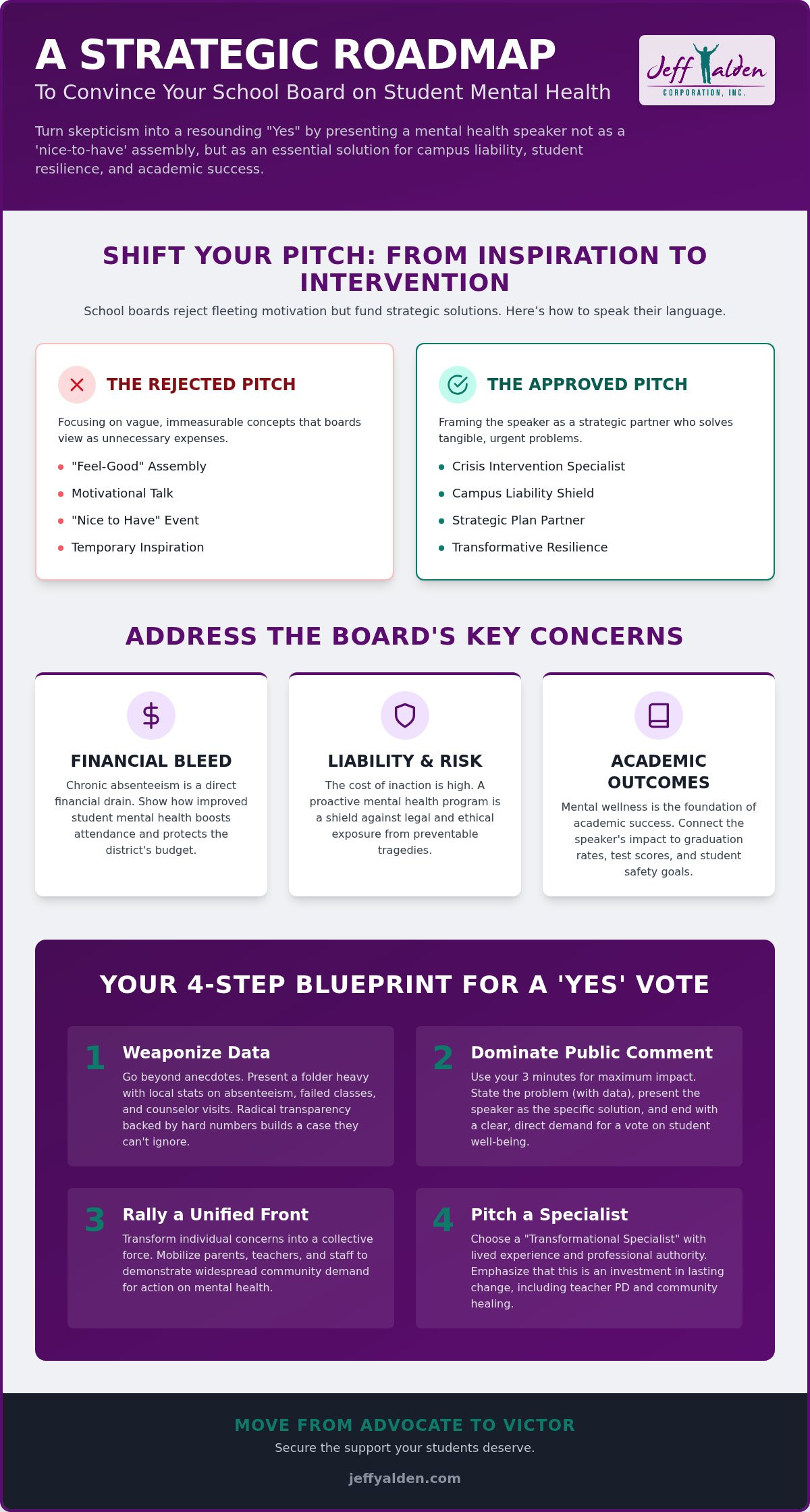
School boards aren’t interested in entertainment. They don’t have the budget for ‘nice to have’ assemblies that leave students feeling good for an hour but change nothing by Monday morning. When a board hears the word ‘motivation,’ they often hear ‘expense.’ When they hear ‘resilience,’ they hear ‘investment.’ Before you walk into that room, understanding your school board is critical to your strategy. They are the ultimate filters for budget, liability, and academic outcomes. You need to stop pitching a guest and start pitching a crisis intervention specialist who understands the weight of these responsibilities. Knowing how to convince school board for a speaker starts with recognizing the power dynamic. The Superintendent manages the daily operations, but the Board manages the long-term vision and the checkbook. If your pitch doesn’t align with their fiscal and legal reality, it’s dead on arrival. You have to speak their language.
Identifying the Board’s ‘Pain Points’ in 2026
In 2026, school funding is tied tighter than ever to student presence. Chronic absenteeism isn’t just a social issue; it’s a financial bleed. When students are too anxious or depressed to show up, the district loses money. Boards are currently staring at the rising cost of ‘doing nothing’ while campus trauma spikes. Mastering how to convince school board for a speaker requires you to show them the numbers they’re already worried about. The liability of silence occurs when a district chooses to ignore escalating mental health warning signs, leaving the school legally and ethically exposed when a preventable tragedy unfolds. You must highlight how a speaker addresses these underlying threats to the district’s stability.
Shifting the Pitch from Inspiration to Intervention
Stop asking for a ‘feel-good’ assembly. Boards reject inspiration because it’s fleeting, but they fund ‘postvention’ experts because they solve immediate, visceral problems. You must frame a Teen Mental Health Speaker as a tactical partner in character education and a direct bridge to your district’s Strategic Plan. This isn’t about a one-off speech. It’s about ‘transformative resilience’ that supports teacher professional development and community healing. Align your request with the district’s goals for graduation rates and student safety. You aren’t just bringing in a voice. You’re bringing in a shield against the burnout and suicide rates that keep administrators awake at night. When you show them that a speaker is a tool for systemic change, the ‘Yes’ becomes inevitable.
Weaponizing Data and Vulnerability: Building a Case They Can’t Ignore
You’ve identified the board’s pain. Now you need to bring the heat. To master how to convince school board for a speaker, you can’t just walk in with a heavy heart. You need a heavy folder. Boards operate on evidence. While your gut tells you the kids are drowning, the board needs to see the water level. Collect the local stats on absenteeism, failed classes, and counselor visits. This data provides the backbone for the “Radical Transparency” they desperately need to hear. Speak the truths that administrators often hide behind “wellness” jargon. If your school is facing a crisis, say it. Use the Teen Suicide Prevention Programs framework to show that real intervention isn’t about pamphlets; it’s about life-saving dialogue. When you highlight the Teacher PD component, you show the board that this isn’t just for the kids. It’s for the staff who are burning out under the weight of student trauma.
The ROI of Student Well-being
Academic performance isn’t just about textbooks; it’s about headspace. You have to connect those dots for the board. A single day of High School Assemblies can spark a culture shift that lasts all year. Look at neighboring districts. If they’ve seen a drop in disciplinary referrals after a speaker, use that. Boards hate being left behind. Showing them that a speaker is an investment in graduation rates makes the budget discussion much easier. This is a core pillar of how to convince school board for a speaker; you prove that mental health is the foundation of academic success. If you want to see how this looks in action, explore the impact of a Teen Mental Health Speaker on campus culture.
The ‘Lived Experience’ Factor
Boards are used to suits. They aren’t used to “vulnerable authority.” They need to understand that students, especially Gen Alpha, tune out polished experts. They respond to the raw, the real, and the “I’ve been there” mentality. Focus on effective communication with a school board by drafting an Impact Statement. Link the speaker’s lived experience directly to your students’ specific struggles. This isn’t a performance; it’s a lifeline. You’re bringing in someone who leads by example and through the sharing of personal imperfections. That vulnerability creates an immediate connection that clinical experts simply can’t match. When you present a speaker’s raw approach as an asset, you show the board you’re serious about engagement, not just attendance.
Dominating Public Comment: The 3-Minute Blueprint for Boardroom Impact
The podium is your stage. The clock is your enemy. You have exactly 180 seconds to shift the energy of the room from apathy to urgency. Most people waste this time. They read from a prepared script in a monotone voice, and the board members check their watches. If you want to master how to convince school board for a speaker, you have to dominate the microphone. This isn’t about being polite; it’s about being effective. Follow this four-step blueprint to ensure your message sticks long after the gavel falls.
- Step 1: The Hook. Start with a visceral student story. Don’t use names, but use the truth. Describe the student who sits in the back of the class, invisible and hurting. Make the board feel the weight of that silence.
- Step 2: The Gap. Identify the specific mental health void on your campus. Is it a lack of resilience? A spike in self-harm? Be precise. Name the monster that’s haunting your hallways.
- Step 3: The Solution. Introduce a Teen Mental Health Speaker as the specific tool to bridge that gap. Explain that this isn’t just a speech; it’s a catalyst for culture change.
- Step 4: The Call to Action. End with a direct request. Don’t ask them to “think about it.” Ask for a specific follow-up meeting with the Superintendent by the end of the week.
Mastering the 3-Minute Clock
You need to use the “Staccato” method. Short. Sharp. Impactful. Long sentences get lost in the acoustics of a boardroom. Never read from a script. Your eyes need to be on the board members, not a piece of paper. Use bulleted “Heart Points” to keep yourself on track. Here is your opening: “Our students aren’t failing because they lack textbooks; they’re failing because they lack a reason to believe they’ll survive the semester.” That is radical transparency. It demands attention. It forces the board to look up from their laptops and see the human cost of their budget decisions.
Handling Boardroom Pushback
Expect resistance. When they say “it’s not in the budget,” remind them that the median cost of a speaker is a fraction of the cost of a single student crisis. If they worry about “raw” language, tell them that’s the only language students actually hear. You have the right to speak. Under the June 2026 Boddy v. Grech ruling, the board cannot silence your viewpoint just because it’s uncomfortable. Use the power of the uninterrupted microphone. Stay calm. Stay focused. Stay raw. Your composure under pressure proves that your cause is grounded in conviction, not just emotion. This is how to convince school board for a speaker when the room feels cold.
The Groundswell Strategy: Rallying Parents and Teachers to Your Cause
A school board can ignore a single email. They can dismiss one frustrated parent as an outlier. But they cannot ignore a room full of people who refuse to leave until they are heard. Knowing how to convince school board for a speaker means realizing that one parent is a noise, but fifty parents are a movement. You need to gather the advocates who see the struggle every day. Start by engaging the Teen Mental Health Speaker supporters in your community. These are the parents who have seen their children struggle and the teachers who are tired of watching their students drift away. When you approach the board as a collective, you’re no longer just asking for a favor. You’re demanding a change in campus culture.
Teachers are your secret weapon. They’re drowning in the fallout of the mental health crisis. If you want to know how to convince school board for a speaker, you have to show them that this isn’t just an extra event. It’s essential Teacher Professional Development. When teachers endorse a speaker, the board sees it as a solution for staff burnout and classroom management. Use student testimonials to drive the point home. Students know when they’re being “handled” by a clinical approach that doesn’t reach them. They want something real. They want someone who speaks their language and understands their pain.
Building the Coalition Before the Meeting
Don’t wait for the meeting to start your advocacy. You need a “Petition with Purpose.” Don’t just gather signatures; gather demands for specific actions. Engage your PTA or PTO as a funding partner. If the board knows the parents are willing to put skin in the game, their financial excuses evaporate. Host a community town hall a week before the board meeting. Align your messaging. Make sure everyone is speaking with one voice and one heart. When the community stands together, the board’s resistance begins to crumble.
The Power of Student Voices
Nothing stops a board member in their tracks like a student leader who speaks with raw honesty. When a student stands up and asks for help Building Resilience in Teens, the room goes silent. Coach these students to be bold. Let them speak about the gap between the school’s “wellness” posters and their actual daily experience. Always ensure student safety and support during the advocacy process. They aren’t props; they are the reason we’re fighting. If you’re ready to bring a transformative voice to your campus, book a High School Speaker today.
The Final Pitch: Choosing a Speaker Who Delivers Transformation, Not Just Talk
You’ve done the work. You’ve gathered the data and rallied the community. Now comes the moment of truth. Picking the wrong person makes the whole process feel like a waste of time. When you’re finalizing how to convince school board for a speaker, you have to present a name that commands respect and delivers results. We call this the ‘Jeff Yalden Standard.’ It isn’t about being polished. It’s about being real. It’s about vulnerability, authority, and radical transparency. Most boards are tired of ‘motivational’ speakers who offer nothing but high-fives and platitudes. They want a ‘Transformational’ specialist who can handle the weight of crisis intervention and postvention. You need someone who has been in the trenches and knows how to lead others out of them.
Your criteria must be non-negotiable. The board needs a partner with documented crisis experience and the ability to lead Teacher Professional Development. This isn’t just about the kids. It’s about the staff who are barely holding it together under the pressure of current student needs. A real speaker provides a ‘Next Day’ plan. They don’t just leave after the assembly. They provide the tools to keep the momentum alive and the campus culture shifting toward resilience. This is the final piece of how to convince school board for a speaker; you’re selling a lasting result, not a 60-minute performance. You’re offering a path from struggle to empowerment.
Vetting for Radical Transparency
Modern teens have a built-in lie detector. If a speaker is too ‘safe,’ they are useless. You need someone who isn’t afraid to go into the trenches of mental health. Check for credentials in suicide postvention and the ability to handle Academic Life Coaching for high-risk students. You need a ‘vulnerable authority’ who leads by sharing their own imperfections. This creates an immediate connection that clinical experts can’t touch. When students see a victor, they start to believe they can be one too.
Sealing the Deal with the Board
Provide a ‘Turnkey’ proposal. Boards love simplicity. Include the logistics, the insurance, and the follow-up plan in one clear document. If they’re still hesitant, suggest a ‘Pilot Program.’ Start with one school. Prove the ROI through improved student engagement and staff morale. Once they see the transformation, the rest of the district will follow. You’ve fought hard for this moment. Don’t settle for talk when you can have transformation. Ready to bring a real voice to your school? Book Jeff Yalden for Your Next Assembly and turn that ‘Yes’ into a victory for your students.
Take Command of Your Campus Culture
You’ve got the roadmap. You know the board’s filters. Now it’s time to act. Remember that school boards don’t fund speeches; they fund solutions to the liability of silence. By weaponizing your local data and dominating your three minutes at the podium, you’re doing more than just making a request. You’re saving lives. Mastering how to convince school board for a speaker is about moving from desperation to strategic authority. You aren’t alone in this fight.
With over 30 years of high school assembly experience and a deep specialization in suicide postvention, I’ve seen the transformation that happens when a community refuses to settle for the status quo. Don’t wait for another crisis to spark a conversation. Voted the #1 Youth Motivational Speaker for High Schools, I’m here to help you turn your boardroom pitch into a resounding victory for your students’ mental health. Bring Jeff Yalden’s Radical Transparency to Your School Board Today. Your voice is the catalyst. Your students are waiting. Let’s get to work.
Frequently Asked Questions
How do I find out when the next school board meeting is?
Check the district website under the “Board of Education” or “Governance” tab. Meeting schedules are public record and are usually posted for the entire year. Look for an “Agendas and Minutes” portal to find the exact time and location. If the information isn’t online, call the Superintendent’s office directly. State laws require public notice of these meetings, so the details must be accessible to you.
Can I show a video of the speaker during my public comment?
Most boards allow visual aids, but you must clear it with the Board Secretary at least 48 hours before the meeting. Public comment is typically limited to three or five minutes, so keep your clip under 60 seconds. A high-energy video of a mental health speaker can be more persuasive than a speech alone. Always verify that your file format is compatible with the boardroom’s AV system.
What if the school board says they don’t have a budget for speakers?
Budget excuses are often a matter of priority rather than a total lack of funds. Point the board toward Title I or Title IV-A federal funds, which are designated for student support and academic enrichment. Remind them that the cost of a speaker is a small fraction of the expense incurred by a single student crisis. Show them that investing in resilience saves the district money in the long run.
How do I handle a principal who is afraid of a ‘raw’ speaker like Jeff Yalden?
Fear usually stems from a desire to maintain a “safe” but ineffective status quo. Show the principal testimonials from other administrators who have seen the “vulnerable authority” approach work. Explain that students tune out clinical, polished presentations. A raw approach isn’t about being controversial; it’s about being relatable. Highlight how this transparency leads to breakthroughs in student engagement that traditional, detached methods simply can’t achieve.
Should I bring students to speak with me at the board meeting?
Yes, student voices are the most powerful tool you have. When students share their lived experience and explain why they need a youth motivational speaker, the board finds it nearly impossible to look away. Ensure the students feel supported and safe before they step to the podium. Their raw honesty about campus culture provides the visceral connection that data alone cannot achieve. It turns a budget request into a necessity.
What are the best grant options for school mental health speakers in 2026?
Look into the School-Based Mental Health Services Grant Program or Project AWARE funds. Many states have introduced specific 2026 mental health block grants to combat rising teen suicide rates. Mastering how to convince school board for a speaker often involves doing the homework on these funding streams first. Presenting a speaker alongside a specific grant makes the decision a “no-brainer” for the board members.
How do I follow up after the board meeting if I haven’t heard back?
Don’t let your momentum die in a silent inbox. Send a professional but urgent email to the Superintendent and Board President within 48 hours. Attach a summary of your “Heart Points” and any student data you presented. Request a specific date for a follow-up discussion. Persistence is key when learning how to convince school board for a speaker. If they stay silent, rally your parent coalition for a second appearance.
Is it better to speak at a public hearing or a regular board meeting?
Regular board meetings are best for specific funding requests, while public hearings on the budget are ideal for long-term advocacy. Regular meetings allow you to target decision-makers when they are focused on operational votes. If you want a speaker booked for the next semester, get on the agenda of a standard meeting. This ensures your request is tied to a specific timeline rather than a general discussion.
