
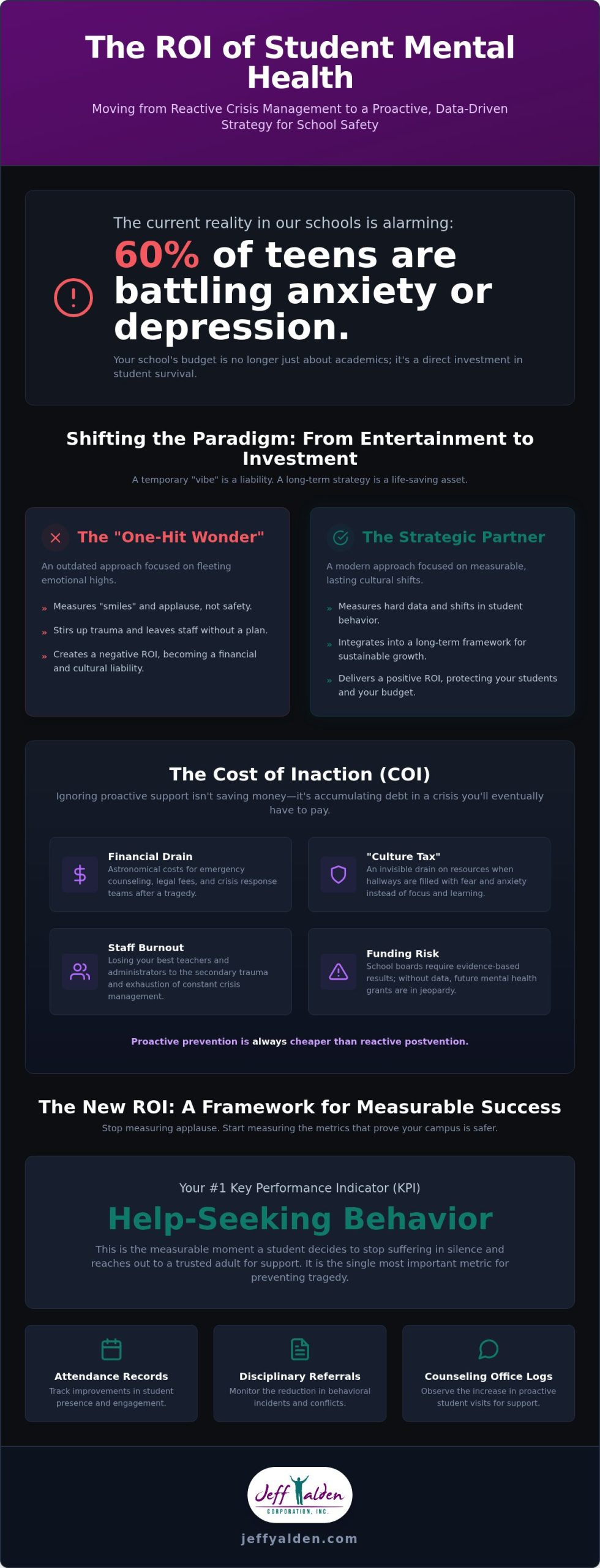
Your school budget isn’t just a spreadsheet. It’s a reflection of your students’ survival. Right now, you’re staring at numbers that don’t add up and a student body where 60% of teens are battling anxiety or depression. You’re tired of “entertainment” that feels good for an hour but leaves your culture exactly where it started. You need a transformation that you can actually prove to your board. That’s why calculating the ROI of a mental health speaker is about more than money; it’s about moving from reactive crisis management to proactive healing.
I know the pressure you’re under to justify every cent while student crises continue to rise. I’m going to give you a clear framework to quantify the life-saving impact and cultural shift that a dedicated expert brings to your halls. We’ll explore the true Cost of Inaction and the specific data you need to present to stakeholders and parents. It’s time to stop guessing and start building a resilient campus culture that protects your students and your investment for the long haul.
Key Takeaways
- Stop measuring “smiles” and start measuring safety. Learn why traditional happiness surveys fail and how to define true ROI through campus culture shifts.
- Calculate the heavy Cost of Inaction (COI) that hits when you wait for a crisis. We’ll break down the hidden expenses of emergency counseling and administrative burnout.
- Master a clear framework for calculating the ROI of a mental health speaker that provides the hard data you need for stakeholders and parents.
- Identify “Help-Seeking Behavior” as your primary metric for success. Discover how to track the moment a student decides to stop suffering in silence and reaches out for support.
- Leverage radical transparency to eliminate student “tune-out.” See how a speaker who stays in the trenches long after the assembly delivers a return that changes the heart of your school.
Beyond the Applause: Defining Mental Health ROI for Schools
The applause dies down. The lights go up. You’re left in a quiet gym, wondering if that check you just signed actually bought anything more than sixty minutes of attention. In the past, we called that a success. We looked at the “vibe” of the room and hoped for the best. But hope isn’t a strategy. In 2026, calculating the ROI of a mental health speaker is a survival skill for administrators. You have a budget to protect and lives to save. You can’t afford to guess anymore.
We have to stop treating student wellness like a line-item expense. It’s the most critical strategic investment your district will ever make. Traditional “happiness surveys” fail because they measure a fleeting emotional high, not a permanent shift in campus safety. They don’t tell you if a student decided to put down a weapon or tell a counselor about their self-harm. Mental Health ROI is the reduction in crisis-related costs and the increase in student help-seeking behavior.
If you aren’t tracking the data, you’re just throwing money at a tragedy waiting to happen. True ROI shows up in your attendance records, your disciplinary referrals, and your counseling office logs. It’s the measurable return on student wellness that keeps your school functional and your community whole.
The Difference Between Impact and ROI
Impact is the emotional resonance felt in the gym. It’s the tears, the silence, and the raw connection. That matters. It’s the spark. But ROI is the data that follows that spark. Many “one-hit-wonder” speakers actually create a negative ROI. They stir up deep trauma, trigger heavy emotions, and then hop on a plane, leaving your staff to pick up the pieces without a plan. That’s not help. That’s a liability. To see a real return, you need a teen mental health speaker who integrates into a long-term framework. You need a program that turns an emotional moment into a year of measurable growth.
Why School Boards Demand ROI Data Now
The landscape has shifted. By 2026, “evidence-based” isn’t just a buzzword; it’s a requirement for survival. Your board is under immense pressure to show accountability for every federal and state mental health grant. They want to see how wellness initiatives directly affect the impact of student mental health on academic success. If you can’t prove that your speaker moved the needle on student safety, you won’t get that funding next year. ROI data is your greatest ally. It allows you to walk into a board meeting with hard numbers that justify recurring funding. It proves that you aren’t just “doing something” about mental health. You are solving the problem.
The Cost of Inaction (COI): What Schools Lose Without Proactive Support
Let’s talk about the bill you’re currently paying without even knowing it. It’s called the Cost of Inaction (COI). When administrators look at calculating the ROI of a mental health speaker, they often focus on the speaker’s fee as an isolated expense. That’s a dangerous mistake. You have to look at the other side of the ledger. What does it cost your district when a student attempts suicide? What is the price tag on a campus-wide trauma response that lasts for months? Doing nothing isn’t a neutral choice. It’s the most expensive decision you can make.
You’re already paying for mental health; you’re just paying for it at the wrong end of the timeline. You’re paying in crisis counseling hours, astronomical legal fees, and the crushing weight of administrative burnout. There’s also the “Culture Tax.” This is the invisible drain on your resources when your hallways are filled with fear instead of focus. When your staff is constantly putting out fires, they aren’t teaching. When you tell me, “We can’t afford a high-level speaker right now,” I hear that you’re willing to pay for the catastrophe later. Proactive prevention is always ten times cheaper than reactive postvention.
The Financial Weight of a Campus Crisis
Reactive measures are a financial black hole. When a tragedy happens, you’re forced to bring in emergency teams at premium rates. You lose your best teachers because they can’t handle the secondary trauma of a broken campus. Implementing proactive teen suicide prevention programs is a strategic move to stop that bleeding before it starts. Prevention is an investment that builds resilience; postvention is a debt that your community may never fully repay. If you want to stop the cycle of crisis management, it’s time to bring in a veteran voice who knows how to reach students before they reach a breaking point.
Absenteeism and Academic Decline
I want to be real with you about the bottom line because your board cares about the numbers. Mental health is directly tied to your Average Daily Attendance (ADA) funding. When students are in survival mode, they don’t show up. When they do show up, they can’t learn. There are massive economic benefits of school-based mental health support that go far beyond just “feeling better.” We’re talking about protected graduation rates and stabilized test scores. You can’t teach a brain that doesn’t feel safe. Calculating the ROI of a mental health speaker means recognizing that wellness is the foundation of every academic achievement your school aims to reach.
Measuring the Unmeasurable: Quantitative vs. Qualitative KPIs
How do you measure a life saved? It feels like an impossible question. When you’re calculating the ROI of a mental health speaker, you might feel like you’re trying to weigh a cloud. But here’s the truth: you can measure transformation. You just need to look in the right places. For 2026, I’m advocating for a dual-track measurement system. We need the cold, hard numbers for the board, and we need the raw, human stories for the community. If you only track one, you’re missing half the story.
One track is about the data. The other is about the pulse of your hallways. You need a framework that respects the complexity of the human experience while satisfying the demand for accountability. This isn’t just about spreadsheets; it’s about proving that your investment is actually moving the needle on student safety and wellness.
Quantitative Metrics for School Leaders
Let’s talk about the numbers that don’t lie. The most powerful quantitative metric you have is “Help-Seeking Behavior.” After an assembly, you should see an immediate spike in self-referrals to the guidance office. Don’t let that scare you. That spike is the sound of students choosing life. It means the speaker successfully lowered the barrier to entry for professional support. It means the silence is finally breaking.
You also need to monitor your disciplinary referrals. Many “behavior problems” are actually mental health crises in disguise. When students learn how to process their pain, the acting out decreases. Finally, look at the usage rates of your school-provided wellness resources. Are they clicking the links? Are they using the district apps? If those numbers go up after the event, your speaker investment is paying off in real-time engagement.
Qualitative Metrics: The Culture Shift
This is where we measure the “Heart ROI.” It’s about the normalization of mental health. You know it’s working when the “code of silence” begins to crumble. You see it in the way students treat each other in the cafeteria. You hear it in the way they speak to their teachers. These high school assemblies aren’t just events; they are cultural resets that empower bystander intervention and peer-to-peer support.
You turn a student testimonial into a qualitative data point by categorizing the specific emotional breakthrough, like a shift from suicidal ideation to seeking professional help, and recording it as a verified intervention within your safety reports. When a student says, “I was going to give up, but today I chose to stay,” that isn’t just a nice comment. It is a documented success in your prevention strategy. Analyzing these shifts gives you the narrative you need to prove that your school is becoming a safer, more resilient place for everyone.
A Step-by-Step Framework for Calculating Your Speaker Investment
Let’s get into the trenches. You need a process that turns abstract feelings into a concrete report for your stakeholders. Calculating the ROI of a mental health speaker starts long before the assembly begins and continues long after the speaker leaves the parking lot. It is a methodical approach to tracking human transformation. You aren’t just buying a speech; you’re investing in a cultural pivot. If you want to prove the value, you have to follow the trail of the data.
Step 1: Establish your baseline. You can’t measure growth if you don’t know your starting line. Pull your data from the last twelve months. Look at crisis incidents, Average Daily Attendance (ADA), and anonymous student sentiment surveys. This is your “before” picture. Without it, your “after” is just a guess.
Step 2: Evaluate specialized expertise. ROI depends on using the right tool for the job. Are you looking for a general motivational boost, or do you need a specialist in suicide postvention? A speaker who understands the nuances of crisis intervention provides a higher return because they address the specific wounds of your community. They don’t just talk; they heal.
Step 3: Execute post-event tracking. Set benchmarks at 30, 60, and 90 days. Are self-referrals still higher than the baseline? Is the language the speaker used still being echoed in the hallways? This is how you measure the “stickiness” of the message. If the impact disappears in a week, the ROI is zero.
Step 4: Calculate the “Prevention Dividend.” This is the big one. Estimate the cost of a single averted crisis, including emergency staffing, legal fees, and community trauma response. If your speaker prevents even one major incident, the dividend pays for the event ten times over. It’s the smartest financial move you can make for your district.
Setting Realistic Benchmarks for 2026
Don’t expect a 100% reduction in student struggles overnight. That isn’t how healing works. In 2026, we define success as an increase in dialogue, not a decrease in complexity. We want students to bring their mess into the light. To sustain this momentum, you must pair your assembly with trauma-informed teaching professional development. This ensures your staff is equipped to handle the increased help-seeking behavior that a great speaker triggers. It turns a moment into a movement.
Evaluating the “Speaker Quality” Variable
There is a massive ROI difference between a “performer” and a “specialist.” A performer gives a great show. A specialist provides a lifeline. Radical transparency and lived experience are the drivers of retention. When a speaker is real and raw, students don’t tune out; they tune in. They remember the message because they believe the messenger. If you’re ready to move beyond the performance and start the work of real healing, you should connect with a speaker who leads with radical transparency today. The return on a life saved is infinite.
The Jeff Yalden Difference: Why Radical Transparency is the Ultimate ROI Driver
You’ve seen the metrics. You’ve built the framework. Now, you need the right messenger. When you’re calculating the ROI of a mental health speaker, the most volatile variable is the speaker’s ability to actually connect. Students have a high-speed detector for anything that feels fake or forced. If they sense a scripted performance, they tune out in seconds. Jeff Yalden eliminates the tune-out factor through radical transparency. He doesn’t stand on a pedestal; he stands in the gap with them. This “Real and Raw” approach is the ultimate ROI driver because it builds immediate trust, ensuring that the message actually takes root in the hearts of your students.
Jeff doesn’t just deliver a keynote and disappear. He stays until the last student is heard. He listens to the stories that have been buried under layers of academic pressure and social media noise. This is where the immediate crisis intervention happens. With over 30 years of experience in high school assemblies, Jeff knows how to navigate the heaviest topics without re-traumatizing your students. He provides a safe harbor in the middle of the storm. This veteran expertise is what prevents a well-intentioned assembly from turning into a liability. He knows the signs of a student in crisis because he has seen them for three decades. That experience is your greatest insurance policy.
From Assembly to Life Coaching
The transition from a high-impact assembly to ongoing support is where true transformation happens. This shift mirrors the world of elite athletics, where resources like Golf State of Mind demonstrate that specialized mental game training is essential for maintaining performance and resilience when the stakes are highest.
Booking for Impact and Accountability
When you are in the middle of a high-stakes crisis, you don’t need a cheerleader. You need a guide who has walked through the fire. Jeff is the choice for leaders who demand accountability and measurable change. You get the peace of mind that comes with a “vulnerable authority” on your campus. He leads by example, sharing his own struggles to give your students permission to share theirs. This transparency is the bridge to a safer school. It’s time to stop the cycle of silence and start the process of healing. Book Jeff Yalden for Your 2026 School Assembly and transform your campus today.
Take the Lead on Student Wellness Today
Calculating the ROI of a mental health speaker isn’t just about balancing a ledger. It’s about deciding that your students’ lives are worth more than the status quo. We’ve explored how to move from reactive crisis management to a proactive culture of help-seeking. You now have the framework to prove to your board that prevention is the only way forward. Don’t let the fear of a tight budget stop you from taking action. The Cost of Inaction is simply too high to ignore.
Jeff Yalden brings 30 years of radical transparency to your campus. As a specialist in suicide postvention, he provides the vulnerable authority that students trust. He doesn’t just speak; he stays until the work is done. You can transform your school culture and give your students the lifeline they need right now. It’s time to move beyond the numbers and focus on the human impact that lasts long after the final bell rings.
Invest in Your Students: Book Jeff Yalden for Your Next Assembly
Your students are waiting for someone to be real with them. You have the power to change their story and build a resilient future. Let’s start the work together.
Frequently Asked Questions
How do you calculate the ROI of a mental health speaker?
You calculate it by weighing the initial investment against the “Cost of Inaction,” which includes the heavy price of emergency crisis counseling and administrative burnout. Calculating the ROI of a mental health speaker requires a dual-track approach that measures both immediate help-seeking behavior and long-term cultural shifts. It’s about identifying the “Prevention Dividend” that keeps your school running and your students safe.
Is a one-day mental health assembly worth the cost?
A single day is worth the investment if it serves as a catalyst for a permanent cultural shift rather than a standalone performance. A high-impact assembly breaks the “code of silence” and opens the door for students to access existing school resources. When the speaker stays to talk with students and provides follow-up materials, the single day creates a ripple effect that lasts the entire school year.
How can I justify a mental health speaker to my school board?
Present the speaker as a strategic investment in campus safety and academic stability rather than an extracurricular expense. Use data from 2026 showing that nearly 60% of teenagers report experiencing mental health challenges to highlight the urgent need for professional intervention. Show the board how proactive prevention protects the district’s funding and reduces the likelihood of high-cost legal or crisis responses.
What are the best KPIs for measuring student mental health programs?
Focus on “Help-Seeking Behavior” by tracking the number of self-referrals to the guidance office immediately following an event. Other critical KPIs include a reduction in disciplinary referrals for mental-health-related behaviors and increased engagement with school wellness resources. These metrics provide the quantitative proof that students are moving from survival mode into a proactive mindset.
What is the difference between a motivational speaker and a mental health specialist?
A motivational speaker focuses on temporary inspiration and high-energy performance; a mental health specialist focuses on clinical safety, crisis intervention, and long-term resilience. Specialists bring lived experience and specialized training in areas like suicide postvention to ensure the assembly doesn’t re-traumatize vulnerable students. They provide a “vulnerable authority” that prioritizes student safety over simple entertainment.
Can a mental health speaker actually prevent a school crisis?
Yes, by lowering the barrier for students to report concerns and seek help before a situation escalates into a catastrophe. Speakers who lead with radical transparency give students the language and the courage to stop suffering in silence. By normalizing these conversations, you create a campus-wide early warning system where peers look out for one another and intervene early.
How much does a high-quality mental health speaker cost in 2026?
High-quality speakers vary in cost based on their experience, the duration of the engagement, and the level of crisis specialization they provide. While fees fluctuate across the industry, the investment should be weighed against the catastrophic costs of emergency postvention and community trauma. Focus on the value of a veteran who stays in the trenches with your students rather than just the initial price tag.
What happens if we don’t invest in mental health speakers for our students?
You pay the price in high absenteeism, declining test scores, and the constant risk of an unmanaged campus crisis. Reports from 2025 and 2026 show that 60% of youth with major depressive episodes do not receive any treatment. Ignoring this reality doesn’t make it go away; it just makes the eventual crisis more expensive and more damaging to your community’s trust.
