
What helps students facing serious challenges feel seen, rather than hearing another speech that tells them to try harder? Finding an at-risk youth motivational speaker who connects without reducing students to a label takes more than a big personality. It calls for empathy, relevant experience, and a message that respects the different realities young people face.
One assembly can’t solve every challenge a student carries. But the right speaker can open a conversation about resilience, mental health, and asking for support. Jeff Yalden has worked with young people since 1992, combining motivational speaking with teen mental-health awareness and experience reaching high school audiences.
This guide explains how to choose a speaker who can engage students and staff while treating young people with dignity. You’ll learn how to assess audience fit, shape a respectful message, and connect an assembly with staff development and school culture. The value of a presentation depends not only on what happens on stage, but also on how the school continues the conversation.
Key Takeaways
- Use “at-risk” to describe circumstances, not a student’s identity. A respectful approach recognizes each young person’s strengths and needs.
- Look beyond big promises when choosing an at-risk youth motivational speaker. Assess audience fit, honest messaging, relevant experience, and opportunities for staff involvement.
- Set a clear purpose for the assembly and prepare staff to reinforce its message before and afterward.
- Connect a student presentation with educator support and school-culture efforts so the conversation can continue beyond the event.
- Explore how Jeff Yalden’s youth motivational assemblies, teen mental-health presentations, and staff professional development can support a more connected school community.
What Does “At-Risk Youth” Mean in a School Setting?
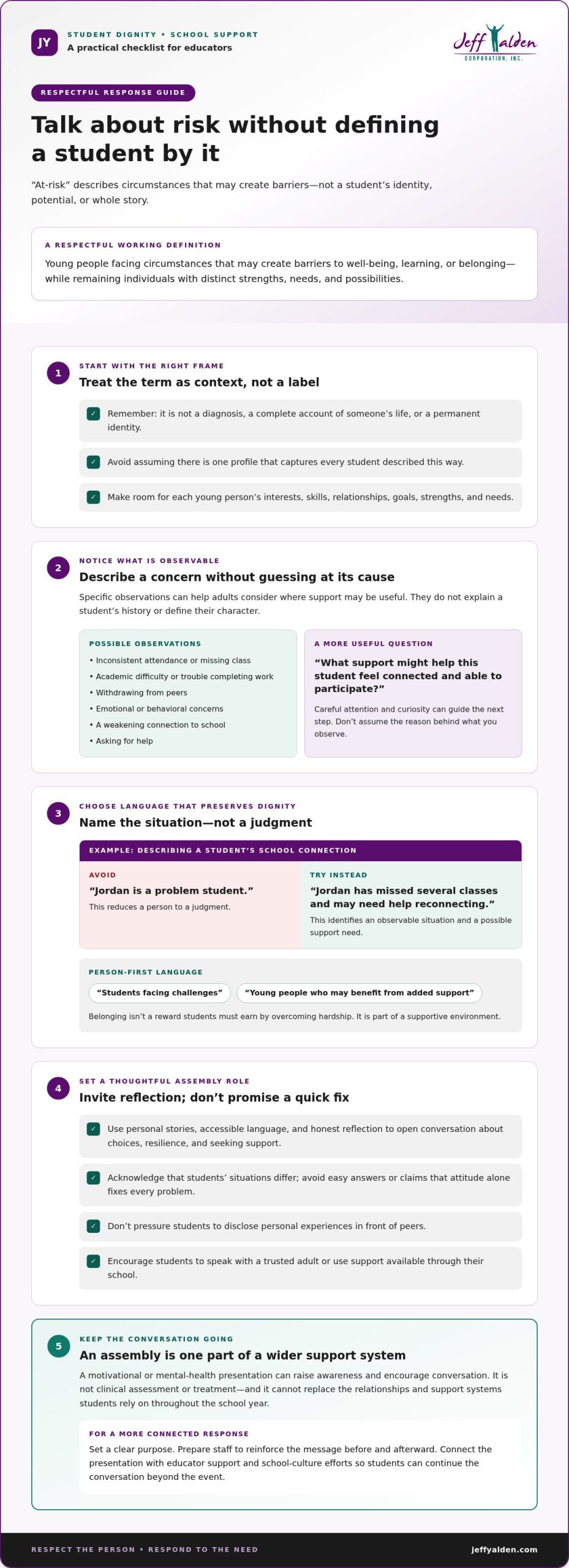
“At-risk” can describe circumstances that may make a student’s path through school or toward adulthood more challenging. It isn’t a diagnosis, a complete account of a person’s life, or a permanent identity. There is no single profile that captures every student described this way. A young person may be dealing with inconsistent attendance, academic difficulty, emotional or behavioral concerns, or a weakening connection to school. These observations can help adults notice where support may be useful, but they don’t define a student’s character or potential.
A respectful working definition: “At-risk youth are young people facing circumstances that may create barriers to well-being, learning, or a sense of belonging, while remaining individuals with distinct strengths, needs, and possibilities.” For a broader overview of the definition of at-risk youth in education, see the general discussion of the term and factors that may be associated with it. Treat any definition as a starting point, not a label to attach to a student.
This distinction changes how a school responds. Rather than assuming what a student needs based on a category, focus on what staff can observe and learn: a student is missing class, struggling to complete work, withdrawing from peers, or asking for help. The reasons may vary, so adults shouldn’t guess at a student’s history. Careful attention and curiosity can guide the next step: What support might help this student feel connected and able to participate?
How Can Schools Talk About Risk Without Defining a Student by It?
Use person-first language such as “students facing challenges” or “young people who may benefit from added support.” Describe a specific concern without turning it into a verdict. “Jordan has missed several classes and may need help reconnecting” names an observable situation. “Jordan is a problem student” reduces a person to a judgment.
Language also shapes expectations. Make room for students’ interests, skills, relationships, and goals, not just the obstacles they face. Belonging isn’t a reward students have to earn by overcoming hardship. It’s part of a supportive environment that can help them engage, ask for help, and see room for growth.
What Can a Motivational Speaker Contribute?
A speaker can use personal stories, accessible language, and honest reflection to invite students into a conversation about choices, resilience, and seeking support. A thoughtful at-risk youth motivational speaker can help students feel included without singling anyone out. The goal is to create room for reflection, not to promise that one speech will change a student’s life.
Keep the speaker’s role clear. A motivational assembly or mental-health presentation can raise awareness and encourage students to speak with trusted adults, but it isn’t clinical assessment or treatment. It also can’t replace the relationships and support systems students rely on throughout the school year. An assembly is most useful when its message fits the school’s purpose and educators are prepared to continue the conversation afterward.
Why Authentic Connection Matters More Than a Motivational Slogan
A slogan can sound powerful from a stage and still feel distant to a student having a hard day. If a message implies that attitude alone fixes every problem, students may hear blame instead of encouragement. Students can also disengage when a speaker makes assumptions about their lives or talks at them rather than to them. Connection starts with respect: recognize that students bring different experiences into the room, and don’t suggest one story or phrase fits everyone.
Honest storytelling can make a message feel human. A speaker can share struggle and reflection without turning pain into entertainment or claiming to know exactly what every student feels. Pair stories with direct, accessible language and questions that let students think for themselves. Don’t pressure students to disclose personal experiences in front of peers. Attention is an opening, not proof that a student is ready to talk or that an assembly has changed their circumstances.
What Makes a Message Feel Real to Teenagers?
Specific, relatable moments tend to land better than a lecture built from slogans. A speaker might describe facing a setback, making a choice, and learning to reach out, while acknowledging that students’ situations differ. Speak to teenagers with warmth and energy, not down to them. Don’t minimize serious challenges with easy answers. A credible at-risk youth motivational speaker invites students into the conversation without demanding a particular response.
How Can Motivation Fit Within Mental-Health Awareness?
Motivation and mental-health awareness can work together when the message presents asking for help as a strength, not a failure. Encourage students to talk with a trusted adult or use support available through their school. Keep the speaker’s role clear: an assembly can encourage reflection and open conversation, but it doesn’t provide clinical assessment or treatment. For a closer look at presentations centered on teen well-being, explore this guide to teen mental health speakers.
Resilience isn’t a switch a speech flips. It can develop through reflection, supportive relationships, and access to appropriate school resources. That’s why an assembly works best as one part of a broader effort, with educators ready to listen and reinforce a respectful message afterward.
Inspiration can start a conversation; ongoing support gives students somewhere to take it. Schools looking for a speaker who connects motivation with teen mental-health awareness can explore Jeff Yalden’s school assemblies.
Evaluating At-Risk Youth Speakers for Your School
Choosing a speaker isn’t just about finding someone who can hold a room. Start by defining the event’s purpose: Do you want to strengthen student connection, introduce a conversation about mental health, or support a wider school initiative? Then assess how the speaker’s approach fits your students, setting, and goals. A clear framework helps your team look past polished slogans and focus on what the presentation will bring to the school community.
Use these areas to guide your evaluation:
| Area | What to assess | Signs of a strong fit |
|---|---|---|
| Audience fit | Who is the presentation designed for? | The speaker can address the age group and school setting without treating students as a uniform audience. |
| Message | What ideas or actions will students take away? | The content encourages reflection, connection, and reaching out for support without judgment or overpromising. |
| Experience | What relevant work has the speaker done with young people and schools? | Experience is described clearly and relates to the audience and event purpose. |
| Staff involvement | How can educators connect the presentation to school efforts? | The event can align with staff communication and existing student-support priorities. |
| Follow-through | What happens after the assembly? | The school has a practical way to continue the conversation and point students toward appropriate support. |
What Should Schools Look for in the Speaker’s Message?
Look for language that recognizes challenges without turning them into spectacle. A thoughtful message doesn’t assume what a student has experienced or suggest determination alone resolves every hardship. It gives students room to reflect, consider their choices, and connect with trusted people. Claims about impact should be specific and appropriately attributed, such as a clearly identified testimonial, rather than framed as a guaranteed result for every student.
Consider whether the speaker makes clear that a presentation is not clinical assessment or treatment. That boundary helps students understand the speaker’s role and keeps the school’s support systems central.
How Can a School Judge Experience and Audience Fit?
Relevant experience means more than being comfortable on stage. Consider a speaker’s work with student audiences and school communities, then match the presentation to its intended audience. An assembly for students may call for a different focus and language than a session for educators. Jeff Yalden has delivered over 4,500 high-school assemblies since 1992, bringing extensive experience speaking with high school audiences.
Before choosing a presentation, write down the event’s goal and who will attend. Use those two anchors to assess whether the speaker’s focus, tone, and experience fit the occasion. Schools considering a student-centered assembly can explore Jeff’s high school assembly programs as part of that evaluation. A closer look at Jeff Yalden’s school speaking work can help your team connect the presentation to its broader purpose.
How to Prepare Students and Staff for a Meaningful Assembly
A thoughtful assembly begins before students enter the room. Preparation helps the presentation fit the school’s goals and gives staff a shared plan for supporting students afterward. Keep the planning practical and coordinated. Administrators, counselors, teachers, and other relevant staff should understand the event’s purpose, the language being used, and where students can turn if the conversation raises a concern.
- Define the goal. Decide what you want students to consider or learn, who will attend, and which topics need careful handling. A clear goal keeps the presentation focused.
- Prepare staff. Share the purpose and key themes with relevant educators and counselors. Agree on how students can reach trusted school staff after the assembly.
- Introduce the event. Explain plainly why the school is holding the assembly. Avoid language that labels or singles out particular students or groups.
- Plan follow-through. Decide how staff will invite reflection, respond to questions, and connect students with appropriate school support.
What Should School Leaders Do Before the Presentation?
Make the event’s purpose clear to adults first. Identify the audience, intended takeaways, and sensitive topics that may arise, then coordinate messaging so students don’t hear conflicting explanations. Counselors and teachers should know where students can go if they want to talk afterward. A simple introduction can set a respectful tone: explain the assembly’s focus, invite students to listen and reflect, and make clear that nobody will be asked to share personal experiences publicly.
Preparation matters especially when the subject is emotionally charged. If suicide prevention is a central goal, align the presentation with the school’s support pathways and review teen suicide prevention programs as part of planning. Include this focus when it fits the assembly’s purpose, rather than adding sensitive material without a clear reason.
How Can Staff Keep the Conversation Going Afterwards?
Give students room to reflect without pressuring them to disclose. A teacher or advisory group might offer a brief discussion prompt such as, “What makes it easier to ask someone for support?” Staff can also remind students which trusted adults and school resources are available. Keep responses consistent across classrooms, and direct individual concerns through the school’s established support processes.
Follow-through can extend beyond one event. Staff professional development can help educators connect the presentation’s message to their interactions with students. School-culture consulting can support broader efforts to build belonging and communication. These efforts complement, rather than replace, the everyday relationships and resources students need.
A well-prepared at-risk youth motivational speaker assembly has a clear place in a school’s wider support plan. To plan an assembly that aligns with your students and school community, work with Jeff Yalden on a school assembly.
How Jeff Yalden Supports Students and the Wider School Community
A school assembly can open the door to honest conversation. Jeff Yalden’s youth motivational assemblies and teen mental-health presentations speak directly to students about challenges, choices, resilience, and reaching out for support. The aim isn’t to label young people or suggest one presentation can solve every problem. It’s to offer a direct, human message that students and educators can carry into the conversations that follow.
Jeff has worked with young people since 1992 and delivered over 4,500 high-school assemblies. As the Life Coach on MTV’s MADE, he reached 70 million viewers. His experience spans school audiences and a broad public platform, while the school’s goals and student community remain central to planning a presentation.
What Experience Does Jeff Bring to Student Audiences?
Student audiences need more than a polished stage presence. Jeff’s school assembly work combines motivation with teen mental-health awareness. His presentations are not clinical assessment or treatment; they can open a conversation and encourage students to reflect on how they might seek support.
Testimonials can offer a personal glimpse into how a message landed. A student’s words should be clearly attributed and understood as that individual’s experience, not a guaranteed result for every student or school. Each audience is different, and the school’s follow-through and ongoing relationships still matter.
How Can Schools Take the Next Step?
Start with three questions: Who will be in the room? What do you want the presentation to address? What conversation should continue after the event? Clear answers help school leaders shape an assembly around student needs and connect it with educators’ wider work.
Depending on the school’s goals, that work may include a student assembly, a presentation for staff, or school-culture consulting. Staff professional development can help educators carry the presentation’s themes into daily interactions. School-culture consulting can support a broader conversation about how the community builds connection and belonging. These efforts can work alongside one another without promising a particular outcome.
If you’re looking for an at-risk youth motivational speaker, bring your audience, goals, and questions into the planning conversation. Jeff’s experience can help shape a presentation around your school community and the message you want students and staff to consider.
Bring Jeff Yalden to your school and start a conversation about a presentation that fits your students and school community.
Make the Next Conversation Count
Your next step can start with one clear intention: What do you want students to think about, and how will your school keep the conversation open afterward? That purpose can guide the presentation and help staff connect its message to the support and relationships students can turn to every day.
The right at-risk youth motivational speaker can bring energy and honesty to the moment, while your school community helps carry the conversation forward. A meaningful assembly isn’t a finish line. It can be a starting point for listening with care, strengthening belonging, and reminding young people that asking for support is welcome.
Ready to shape a presentation around your students and school’s goals? Start planning a school presentation with Jeff Yalden. Your next conversation can create space for students to feel heard, respected, and encouraged.
Frequently Asked Questions
How can a motivational speaker connect with at-risk students?
A speaker can build connection by speaking plainly, sharing relevant stories without claiming every student has the same experience, and respecting different perspectives. For example, a story about asking for help can invite reflection without asking students to reveal anything personal. An at-risk youth motivational speaker should let students consider the message in their own way, rather than relying on pressure, shame, or promises of instant change.
Can a school assembly help students facing mental-health challenges?
Yes. An assembly can introduce mental-health topics, reduce the sense that students must stay silent, and encourage them to seek support from trusted adults. Its value also depends on how the school handles questions and concerns afterward. Make support pathways clear before the event, then reinforce them in the days that follow. A presentation can contribute to a supportive environment, but it can’t guarantee a particular response or outcome.
What should a school look for in an at-risk youth motivational speaker?
Look for a speaker whose message fits the students’ age group and the school’s purpose, and whose language avoids blame and stereotypes. Assess whether the presentation offers useful reflection rather than a one-size-fits-all solution. Consider whether the speaker’s experience relates to student audiences and whether the event can connect with staff support. Clear boundaries matter too: motivation and mental-health awareness aren’t clinical care.
How can teachers support students after a motivational assembly?
Teachers can offer a low-pressure opportunity to reflect, such as a short written response or an advisory discussion with an option to pass. Keep prompts focused on ideas, not personal disclosures. For instance, students might identify one trusted adult or one way to support a peer. If a student asks to talk privately, respond calmly and follow the school’s usual process for connecting them with appropriate staff.
Is a motivational speaker a replacement for counseling or clinical care?
No. A motivational speaker can share a message, raise awareness, and encourage students to reach out, but that role is different from clinical assessment or treatment. Students who need individualized mental-health care should be connected through the school’s established support procedures and appropriate professionals. Make this distinction clear in event introductions and follow-up materials. An assembly can complement a school’s support efforts, not take their place.
How can a school include staff in a student assembly program?
Involve educators in planning before the event. Administrators can explain its purpose, counselors can clarify student support pathways, and teachers can connect the presentation’s themes to classroom or advisory conversations. Staff professional development can also help educators consider how the message relates to everyday interactions with students. Afterward, share consistent guidance about where students can turn so the assembly feels connected to the wider school community.
