
What if the greatest predictor of your teen’s future isn’t their GPA, but the people they choose to hang out with on a Friday night? It’s a heavy thought. You see them lost in their screens for five hours a day. You watch the digital drama drain their energy. You feel that gut-wrenching helplessness when you realize you can’t pick their friends for them. I’ve been there, and I know the stakes are sky-high. Helping teens build healthy friendships is about more than just social skills; it’s about survival in a world that often feels designed to tear them down.
You want them to find a tribe that actually has their back. You want to stop worrying about toxic influences and start seeing them thrive. I’m going to show you how to guide your teen toward peer groups that build resilience, foster mental health, and provide a foundation for life-long success. We’ll dive into the reality of 2026 social dynamics, from AI-driven isolation to the power of radical kindness. This isn’t just about making friends. It’s about building a life where they feel seen, supported, and unstoppable. Let’s get to work.
Key Takeaways
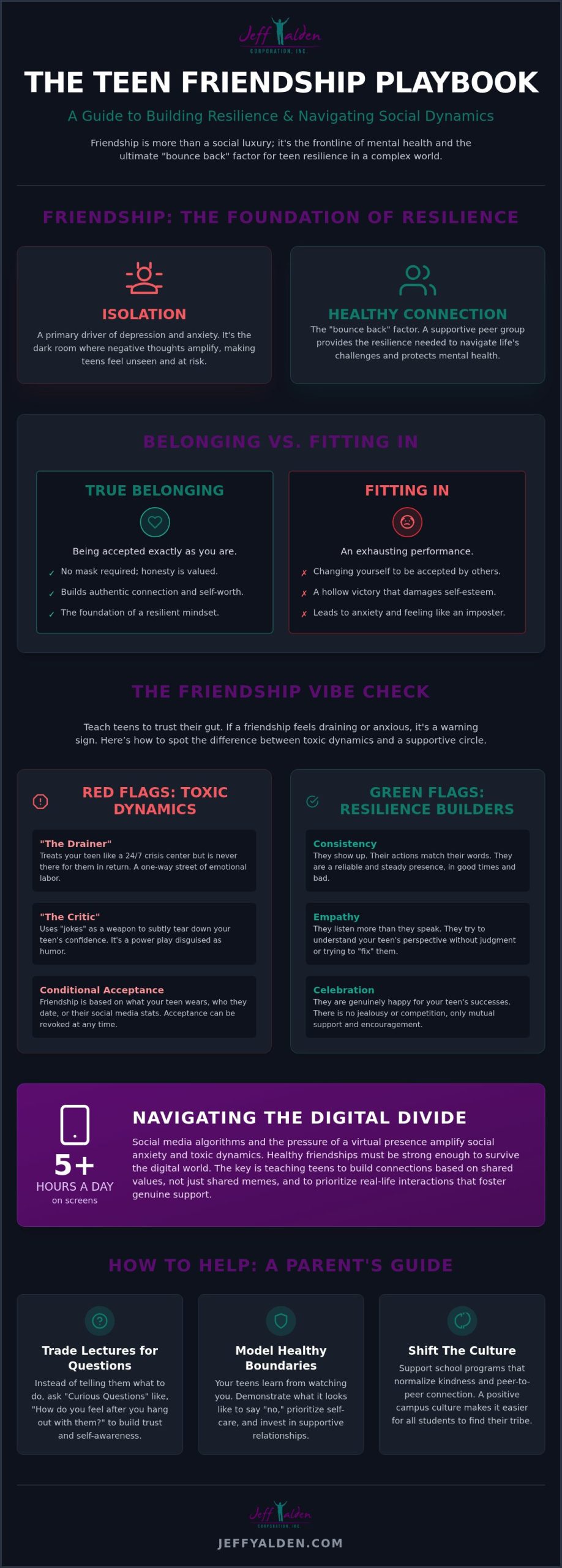
- Friendship isn’t just a social luxury; it is the frontline of mental health and the ultimate “bounce back” factor for teen resilience.
- Stop guessing and start seeing. Use radical transparency to call out toxic peer dynamics and identify the green flags of a truly supportive inner circle.
- Navigate the 2026 digital divide by helping teens build healthy friendships that survive social media algorithms and the pressure of virtual presence.
- Trade the lectures for “Curious Questions” to build a bridge of trust and model the healthy boundaries your teen needs to thrive.
- Learn how shifting campus culture through high-energy school programs can normalize kindness and turn the tide for an entire student body.
Why Healthy Friendships are the Foundation of Teen Resilience
Friendship isn’t a luxury. It’s a lifeline. When we talk about helping teens build healthy friendships, we’re talking about building a wall of protection around their mental health. I’ve seen it firsthand. A teen who feels isolated is a teen at risk. Isolation is one of the biggest drivers of depression and suicide. It’s the dark room where negative thoughts get loud. But a healthy circle? That’s the “bounce back” factor. It’s the resilience they need when life hits hard. It’s the difference between sinking and swimming when the pressure of being a teenager becomes overwhelming. If you want your teen to be resilient, look at who they’re surrounding themselves with. Their tribe is their future.
The Science of Belonging vs. Fitting In
There is a massive difference between fitting in and truly belonging. Fitting in is exhausting. It’s a performance. It’s changing your clothes, your music, and your values just to be accepted. It’s a hollow victory. Belonging is different. It’s being accepted exactly as you are; no mask required. During this critical developmental shift, the teen brain is literally wired to prioritize peer approval over everything else. They aren’t trying to be difficult. They’re trying to find their place. Resilience is the byproduct of a supportive peer circle. When they have a tribe that values them for their heart, they can handle the weight of the world. Fitting in is the enemy of authentic connection because it demands perfection, while belonging only asks for honesty.
How Quality Connections Prevent Crisis
Friends are the first responders. They see the subtle changes in mood. They notice the withdrawal from social life or the sudden shift in energy long before a parent or teacher notices. They are the eyes and ears on the ground. This is why I advocate for teen suicide prevention programs that focus on peer-to-peer connection. One true friend can change the entire trajectory of a life. One person saying, “I see you, and I’m here,” can be the difference between a crisis and a recovery. Helping teens build healthy friendships means giving them the tools to not only find good people but to be the kind of friend who saves a life. We need to stop focusing on popularity and start focusing on depth. Depth is what keeps our kids safe. It’s what gives them a reason to keep going when things get dark.
Red Flags vs. Green Flags: Identifying Toxic Peer Dynamics
We need to talk about the “Vibe Check.” It’s not just a slang term; it’s a survival mechanism. Helping teens build healthy friendships requires us to teach them to trust their gut. If they feel drained, anxious, or “less than” after hanging out with someone, that’s not a friendship. That’s a warning. We have to be radically transparent about what toxicity looks like. It’s not always a massive blow-up. Usually, it’s a slow leak. It’s the constant manipulation or the feeling that acceptance is conditional on how they dress or who they talk to online. The impact of social media on teens often amplifies these red flags, making the drama feel inescapable and the pressure to perform constant.
The Anatomy of a Toxic Friendship
Toxic friends come in many forms, but two are the most dangerous. First, there’s “The Drainer.” This is the person who treats your teen like a 24/7 emotional crisis center but vanishes the moment your teen needs support. Then, there’s “The Critic.” This friend uses “humor” as a weapon, tearing others down under the guise of “just joking.” It’s a power play. Why do teens stay? Fear. The fear of being alone is often louder than the pain of being mistreated. They’d rather be in a bad group than no group at all. We have to help them realize that being alone for a season is better than being destroyed by the wrong people. Stop making excuses for people who treat you like an option.
Green Flags: The Resilience Builders
A green flag friend is someone who makes you feel safe in your own skin. It’s that simple. In a healthy dynamic, there is mutual respect and the freedom to say “no” without the fear of being ghosted or mocked. These are the resilience builders. They provide accountability. A real friend will call you out when you’re making a mistake because they actually care about your future. They don’t want to see you fail. Helping teens build healthy friendships means looking for these traits:
- Consistency: They show up when they say they will.
- Empathy: They listen more than they speak.
- Celebration: They are genuinely happy when you succeed.
Teaching your teen to identify these flags early saves years of heartache. It changes their standards for life. If you feel like your teen is stuck in a cycle of bad influences, working with a teen life coach can help them rebuild their confidence and set higher standards for their inner circle. It’s about empowering them to choose people who fuel their fire instead of those who put it out.
The Digital Divide: Navigating Friendships in the Social Media Age
The screen isn’t just a window anymore. In 2026, it’s the actual room where your teen lives their life. We have to stop pretending that “online” isn’t “real life.” To a teenager today, their virtual presence is often more significant than their physical one. This shift changes everything about how they connect. Algorithms don’t just suggest music; they curate social circles. They decide who your teen sees and who they ignore. This creates a trap of performative friendship where loyalty is measured in likes and comments rather than actual support. Research on social media and teen friendships shows that these online interactions can be a double-edged sword, providing a sense of belonging while simultaneously ratcheting up social stress.
Helping teens build healthy friendships in this landscape requires radical honesty about the digital fallout. Cyberbullying isn’t just a mean comment in a hallway; it’s a permanent, viral record of pain. We need to help them navigate this minefield without losing their souls to the scroll. It’s about recognizing that a digital connection is a tool, not a replacement for the heart-to-heart moments that build true resilience.
Authenticity in an AI-Driven World
AI and deepfakes are the new frontier of social anxiety. How do you trust a friend when you aren’t even sure if the video they sent is real? This is why I advocate for “Radical Reality.” We have to prioritize face-to-face vulnerability. Encourage your teen to do a digital detox, not as a punishment, but as a friendship-building exercise. Real connection happens when the phones are face down on the table and the filters are off. Authenticity is the only currency that matters when the world is full of AI-curated perfection.
The Pressure of Constant Connectivity
Then there’s the “Read Receipt” anxiety. The pressure to respond instantly is a massive drain on mental health. It creates a culture of constant connectivity that leaves no room for peace. Helping teens build healthy friendships means teaching them to set boundaries with their devices. They need to know it’s okay to be unavailable. They need to know that a real friend won’t walk away just because they didn’t text back in thirty seconds. If you want to dive deeper into how this digital stress impacts their well-being, listen to a teen mental health speaker who gets it. We have to break the cycle of 24/7 social noise to let real relationships breathe.
Coaching Your Teen: Strategies for Parents and Educators
Stop the lecture. Right now. When you start preaching about “bad influences,” your teen’s brain clicks off. They don’t hear your wisdom; they hear a wall. Helping teens build healthy friendships starts with a shift in how you communicate. You have to trade the judgment for the “Curious Question.” Instead of saying, “That kid is trouble,” try asking, “How do you feel when you’re hanging out with them?” or “What’s the best part of that group?” Let them reach the conclusion. When they own the realization, it sticks. When you force it, they fight back just to prove their independence.
You also have to look in the mirror. Are you modeling healthy boundaries in your own adult friendships? If you let people drain your energy or treat you like an option, your teen is watching. They learn what’s acceptable by seeing what you tolerate. Show them that it’s okay to walk away from people who don’t respect your time or your heart. Give them a “Safe Exit” strategy too. Create a code word or a specific emoji they can text you when they’re in a situation that feels wrong. No questions asked. No “I told you so.” Just a ride home and a safe place to land.
The “Vulnerable Authority” Approach
I’ve been the guy with the wrong crowd. I’ve made the mistakes that led to the dark places. Sharing your own past friendship failures builds a bridge of trust that “perfect” advice never could. Real and raw beats polished every time. Tell them about the time you felt invisible. Tell them about the friend who betrayed you. It humanizes you. It teaches them that their value isn’t tied to their social circle. Their worth is inherent; the people they choose should simply be the ones who recognize it.
Navigating the Difficult Conversations
It’s a gut punch when you genuinely dislike your teen’s friends. But banning them often backfires. It creates a “us vs. the world” mentality that bonds them closer to the toxic influence. Stay close instead. Keep your house as the “hangout spot” so you can see the dynamics firsthand. If your teen is in the “I have no friends” phase, don’t dismiss it as drama. To them, it’s a crisis of belonging. This is where an academic life coach for high school students can step in to build the social confidence and resilience they need to find their tribe.
If you’re ready to change the narrative and give your teen the tools to thrive, it might be time for a different perspective. Reach out to a teen life coach today to start building the foundation for a stronger, more confident future.
Transforming Campus Culture: How a Motivational Speaker Can Help
One moment can change everything. You can spend months trying to reach one kid in your office, or you can shift the entire energy of a school in sixty minutes. That’s the power of the collective experience. When an entire student body sits in a gym and hears the raw, unfiltered truth, the walls come down. Helping teens build healthy friendships isn’t just a private conversation; it’s a campus-wide mission. We need to move past the polite “be kind” posters and get into the real work of normalizing mental health struggles. When students see a speaker stand on stage and be radically transparent about their own imperfections, it gives them permission to do the same. It turns a culture of silent bystanders into a movement of active upstanders who actually look out for one another.
This is the Jeff Yalden effect. It’s high-energy. It’s visceral. It’s a wake-up call that reminds every student they aren’t alone in their anxiety or their search for belonging. By addressing the social narrative head-on, we break the cycles of isolation that lead to crisis. We create a space where kindness isn’t just a suggestion; it’s the standard. We stop the drama before it starts because we’ve built a foundation of mutual respect.
Beyond the Speech: Sustaining Change
A great assembly is a spark, but you need a plan to keep the fire burning. Integrating core friendship themes into high school assemblies is just the first step. To sustain that shift, we have to equip the adults on the frontline. Professional development for teachers is critical for spotting social isolation before it turns into a tragedy. We have to build a “Radically Transparent” campus where it’s finally okay to not be okay. When the staff and the students speak the same language of resilience, the whole culture transforms. Helping teens build healthy friendships becomes part of the school’s DNA, not just a once-a-year event. It becomes the pulse of the building.
Take Action for Your Students
The urgency is real. We can’t afford to wait until a crisis hits to start talking about connection. Waiting is a gamble with lives. We need to empower our student leaders right now to be the catalysts for change. They are the influencers on the ground. When they lead with empathy, the rest of the school follows. It’s time to stop reacting and start leading. Bring a teen motivational speaker to your school to start the conversation that saves lives and builds a legacy of support. Let’s give these kids the tribe they deserve. The time to act is today. Let’s make it happen.
Take the Lead: Build the Tribe Your Teen Deserves
The stakes have never been higher. You now have the tools to spot the red flags of toxic dynamics and the green flags of life-changing support. Remember that helping teens build healthy friendships isn’t just about social skills; it’s a core component of suicide prevention and long-term mental health. We’ve talked about navigating the digital divide and trading lectures for curious questions. Now, it’s time to put those strategies into motion. Whether you’re a parent at home or a leader in a school, you have the power to shift the narrative from isolation to authentic belonging.
Transformation doesn’t happen by accident. It happens with intention and a guide who has been in the trenches. With over 30 years of experience and a specialty in crisis intervention, I use radical transparency to connect with Gen Z and Alpha in a way that actually sticks. Let’s change your campus culture together. Book Jeff Yalden for Your Next High School Assembly and start the movement of kindness your students need. You’ve got this. Your teen has got this. Let’s get to work.
Frequently Asked Questions
How can I tell if my teen’s friends are toxic?
Look for the “drainers” and “critics” in their circle. If your teen feels anxious, less confident, or emotionally exhausted after hanging out, it is a major red flag. Toxic friends use manipulation and conditional acceptance to maintain power. Watch for peers who only take and never give back. If your teen feels like they have to perform to be accepted, that is not a healthy circle. Trust your gut and teach them to trust theirs.
What should I do if my teen is being excluded from their social group?
Validate their pain immediately without dismissing it as simple drama. Rejection feels like a physical injury to the developing teen brain. Help them find a different outlet where they can experience belonging based on shared interests rather than social status. This is a critical season for building resilience. Encourage them to look for “Green Flag” individuals outside that specific group. Sometimes, a clean break is the only way to find a tribe.
Is it normal for teens to have “online-only” friends in 2026?
Yes, it is the standard reality for most students today. Virtual presence is often more real to teens than face to face time. While these connections provide belonging, they also bring digital stress and “read receipt” anxiety. Helping teens build healthy friendships in this space means teaching them to distinguish between performative likes and actual support. Encourage them to supplement these digital bonds with real world interactions whenever possible to prevent the isolation that leads to crisis.
How do I talk to my teen about peer pressure without sounding like I’m lecturing?
Stop the preaching and start asking “Curious Questions.” Instead of telling them what to do, ask how they feel when they are pressured to make certain choices. Share your own past mistakes with radical transparency. When you are “real and raw” about your own failures, you build a bridge of trust. They will listen more when they see you as a lived experience guide rather than a distant authority figure who has forgotten the struggle.
Can a school assembly really change how students treat each other?
A high energy assembly sparks a collective shift in campus culture. It normalizes mental health conversations and moves students from being bystanders to upstanders. When a teen motivational speaker uses radical transparency on stage, it breaks down the walls of isolation. It is about creating a “Radically Transparent” campus where kindness is the standard. One hour of raw truth can start a movement that saves lives and transforms how students connect every single day.
What are the early warning signs that social isolation is affecting my teen’s mental health?
Watch for sudden withdrawal from activities they used to love and a shift in sleep or eating habits. If they are online “almost constantly” but seem more lonely, that is a major warning sign. Social isolation is a primary risk factor for depression and suicide. Look for a persistent “flat” affect or increased irritability. These are signals that the lack of a supportive peer circle is draining their resilience and they need support.
How do I encourage my teen to be a “Green Flag” friend to others?
Teach them that a real friend is a “resilience builder.” This means practicing accountability and calling people out because they care about their future. Encourage them to be the person who listens more than they speak and celebrates others’ successes. Model these boundaries in your own life. Show them that being a safe place for someone else is a position of strength. A Green Flag friend makes others feel safe in their own skin.
Is it helpful to hire a youth life coach for social anxiety?
Absolutely. A youth life coach provides the personalized tools and confidence that a teen might not accept from a parent. Coaching focuses on building life skills and resilience for real world success. It helps teens navigate social anxiety by setting high standards for their inner circle and learning to manage digital stress. This is proactive mentorship designed to help them find their voice and build a foundation for life long success without the clinical feel.
