
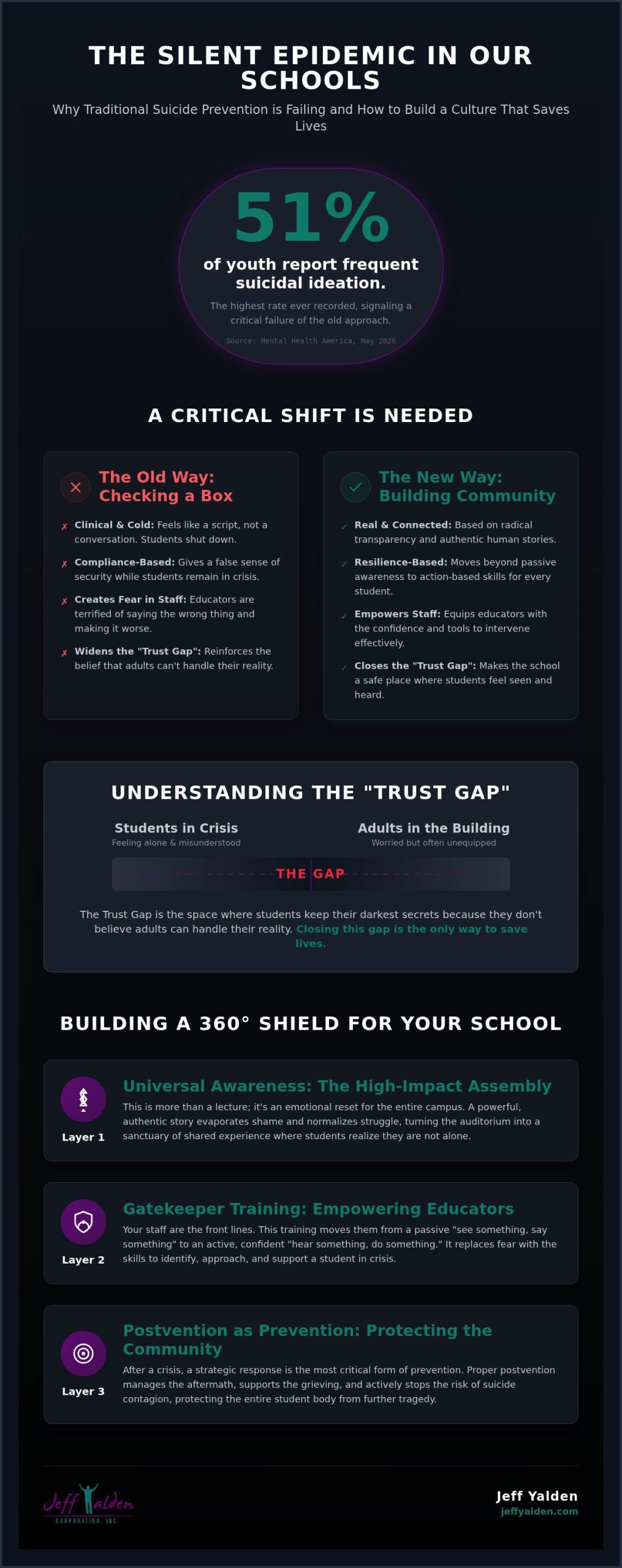
In May 2026, Mental Health America revealed a staggering reality. Over 51% of youth surveyed reported frequent suicidal ideation. That is the highest rate ever recorded. It tells us one thing. The old, clinical approach is failing. Most suicide prevention programs for high schools feel like a boring checkbox. They are too dry for students and too scary for staff. You are likely tired of programs that feel safe but produce zero change. You want your students to feel safe enough to speak up. You want your staff to feel equipped, not terrified, when a crisis hits.
I understand that fear because I have lived it. This is about moving beyond the status quo to embrace radical transparency and student resilience. You are going to learn how to build a culture where checking the box is a thing of the past. We will dive into why immediate postvention support is a non-negotiable and how to implement suicide prevention programs for high schools that actually save lives. It is time to stop being clinical and start being real. Let’s change the narrative together.
Key Takeaways
- Learn how to build a multi-layered safety net that replaces passive awareness with action-based resilience for every student.
- Identify why the most effective suicide prevention programs for high schools prioritize gatekeeper training to help staff see what others miss.
- Discover the secrets to fostering a culture of radical transparency where trust is the foundation for student safety.
- Realize why postvention is actually the most critical form of prevention for stopping the risk of suicide contagion in your community.
- See how combining high-impact assemblies with teacher professional development creates a 360-degree shield for your school.
What Are Suicide Prevention Programs for High Schools in 2026?
Suicide prevention programs for high schools in 2026 are no longer just a set of slides or a guest speaker once a year. They are a multi-layered safety net. This net catches kids before they hit the ground. For years, we focused on “awareness.” We told kids what the signs were. But awareness isn’t enough anymore. We need action-based resilience. Students in 2026 are dealing with a digital world that never sleeps. They are more connected than ever through screens but feel completely alone in their rooms. Social isolation is the silent killer. A real program addresses this head-on. It builds a bridge across the digital divide and creates a space where students feel seen. It isn’t about teaching a lesson. It’s about building a culture where trust is the primary currency.
The landscape of teen mental health has shifted dramatically. When looking at Youth suicide statistics and risk factors, it becomes clear that the pressures on our teens have evolved. We are seeing a record high in self-reported suicidal ideation, even as some death rates fluctuate. This means our students are hurting, and they are telling us through their behavior. Effective suicide prevention programs for high schools must focus on digital wellness and the specific trauma of social comparison. We have to move past the idea that a pamphlet can solve a gut-level crisis. The best program is the one that students actually believe in.
The Traditional vs. The Radical Approach
The traditional approach is clinical. It’s cold. It focuses on referral forms and warning signs that look like a grocery list. This doesn’t work for a sixteen-year-old who is hurting. Radical prevention is different. It’s about connection. It’s about vulnerability. You have to break the silence by being real. High schoolers can smell a clinical script from a mile away. They shut down when they feel like a case file. They open up when they see a human being who isn’t afraid to be messy. We must move from a model of “identifying patients” to a model of “building community.”
Why ‘Checking the Box’ Isn’t Saving Lives
Compliance-based mental health education is dangerous. It gives administrators a false sense of security while students remain in crisis. Canned presentations are white noise to a generation raised on authentic content. They want raw stories. They want the truth. If your program feels like a mandatory lecture, you’ve already lost them. There is a massive Trust Gap between students and administrators. The Trust Gap is the space where students keep their darkest secrets because they don’t believe the adults in the building can handle their reality. Closing that gap is the only way to save lives. It’s time to stop worrying about the liability and start worrying about the kids.
The 3 Essentials of a Comprehensive High School Prevention Program
You cannot build a safety net out of thin air. It takes a deliberate, three-pronged attack to protect a campus. Effective suicide prevention programs for high schools don’t just happen. They are engineered through trust and preparation. We have to stop guessing and start implementing what works. This means reaching every student, equipping every adult, and having a battle plan for the worst-case scenario. If one of these pillars is missing, the whole structure collapses. We are talking about lives here. There is no room for half-measures or “good enough” efforts. For a deeper look at how to integrate these pillars, explore teen suicide prevention programs that prioritize this level of radical connection.
Universal Awareness: The Power of the Assembly
It starts with the energy in the room. If the energy is off, the message is dead on arrival. Universal prevention is about reaching every single soul in the building at the same time. This is where high-impact assemblies change the game. A high-energy speaker doesn’t just talk. They reset the campus emotional baseline. They take the “clinical” and make it “human.” When a speaker shares a real story of struggle and victory, the shame in the room evaporates. Students realize they aren’t the only ones hurting. This normalization is the first step toward safety. It turns the assembly hall into a sanctuary of shared experience rather than a lecture hall of statistics.
Gatekeeper Training for Staff and Educators
Your teachers are on the front lines every single day. They see the subtle shifts in behavior that a once-a-year visitor will never catch. But most educators are terrified. They are afraid of saying the wrong thing and making it worse. We have to move them beyond “see something, say something.” That is too passive. We need them to “hear something, do something.” This requires specialized trauma-informed teaching professional development. When a teacher feels equipped, they don’t panic when a student opens up. They lean in. They become the bridge between a student’s pain and the help they need. If you want your staff to find that confidence, consider bringing in Teacher Professional Development that actually sticks.
The final essential is crisis response. You must have a plan before the unthinkable happens. This means knowing exactly who handles the communication, how the “safe rooms” are staffed, and how to support the student’s inner circle. If you are trying to figure out your response while the building is in shock, you are already behind the curve. A comprehensive suicide prevention programs for high schools strategy ensures that every adult knows their role long before the alarm sounds. Preparation is the ultimate form of protection.
Building a Culture of Resilience: Moving Beyond the Curriculum
A curriculum is just a document. It’s a set of rules and objectives that looks good in a binder but often fails to reach the heart of a student sitting in the back of the room. You can have the most expensive suicide prevention programs for high schools in the world, but if your students don’t trust the people delivering the message, you are wasting your time. Trust is the foundation. Without it, the curriculum is just white noise. We have to foster an environment where “it’s okay to not be okay.” This isn’t a slogan for a poster. It’s a commitment to being real when things get dark. When students know that their pain won’t be met with a referral form or a clinical lecture, they start to talk. That is where life-saving work begins.
One of the biggest hurdles I hear from administrators is the fear of “contagion.” They worry that talking about suicide will plant the seed or trigger a wave of attempts. This is a myth. It’s a dangerous one. Silence is what creates contagion because it keeps the pain in the dark where it can grow. When we bring it into the light, we take away its power. We give students a map out of the woods. Student leadership plays a massive role here. Peers listen to peers far more than they listen to adults. Your student leaders are your early warning system. When they are trained to spot the signs and lead with empathy, the culture shifts from the bottom up. They normalize the struggle so no one has to suffer in isolation.
Radical Transparency: The New Standard
Radical transparency means leading with your scars, not your trophies. It is the opposite of the “perfect” persona we often demand from kids in the classroom. Administrators and staff must model this first. When you share your own struggles with resilience, you build a bridge that students are willing to cross. Transparency dismantles the stigma of the “perfect student” by proving that human imperfection is not a failure of character. It shows them that you can be successful and still struggle with your mental health. This honesty is what earns the trust required for suicide prevention programs for high schools to actually work.
Character Education and Life Skills
Prevention is about more than just crisis management. It is about building resilience in teens before the crisis hits. We need to teach students how to “fail forward.” We have to show them that emotional regulation is a skill that can be learned, just like math or history. Character education isn’t about being “nice.” It’s about being strong enough to handle the weight of the world. Life is going to be hard. We don’t do kids any favors by pretending it isn’t. By teaching life skills and emotional grit, we give them the tools to bounce back when the world feels heavy. This proactive approach turns a school from a place of academic stress into a community of resilient victors.
Postvention is Prevention: Managing the Aftermath of a Crisis
Postvention is a heavy word. It sounds like an autopsy report or a clinical file. In reality, it is the most aggressive form of suicide prevention programs for high schools available today. Postvention is the care provided after a suicide to promote healing and reduce the risk of more deaths. It is about containing the fire. If you don’t handle the aftermath with radical transparency and clinical precision, you leave the door wide open for “contagion.” This isn’t just a theory. It is a psychological reality where one death makes the idea of suicide feel more “accessible” to other struggling students. How you respond in the wake of a tragedy determines the safety of your entire student body for months to come.
The first 48 hours are a blur of shock and panic. You must be the calm in the storm. School leaders often feel the weight of the entire community on their shoulders. But you don’t have to carry it alone. You need an outside expert because your staff is hurting too. You cannot lead a “hard conversation” when you are fighting back your own tears. Bringing in an outside authority who understands this terrain can save your campus from a secondary crisis. It allows the adults in the building to grieve while ensuring the students receive the specialized support they need.
The Postvention Checklist for School Leaders
You need a battle plan. First, verify the facts. Do not let the rumor mill on social media run your school. Wait for official confirmation from the family or law enforcement before making any announcements. Second, coordinate with the family. This is a delicate dance. You must respect their grief while prioritizing the safety of every other student in the building. Third, provide immediate, safe spaces for students to grieve. These rooms should be staffed by professionals who can facilitate tears without glorification. We honor the life, but we never romanticize the choice.
Long-Term Healing and Monitoring
The work doesn’t end after the funeral. You have to identify the “at-risk” circles. These are the close friends, the teammates, and the students who have their own history of trauma. They are the ones most likely to be triggered by the loss. Memorials and anniversaries are landmines. If you make them too big, you risk romanticizing the death. If you ignore them, you risk making students feel like their friend didn’t matter. It is a balance that requires a steady hand. This is often the most effective time to bring in a teen mental health speaker. An outside expert can facilitate campus-wide healing that feels authentic rather than clinical.
Your staff and students deserve a path forward that leads to hope. If you need someone to help your community navigate the darkness of the aftermath, bring in a Mental Health Speaker who can lead your students from pain back to resilience.
Choosing the Right Program: Why Jeff Yalden’s Approach Works
Most suicide prevention programs for high schools fail because they lack heart. You can follow every federal guideline, including the Evidence-Based Youth Suicide Prevention Act of 2026, but if the messenger is clinical, the kids won’t listen. Jeff Yalden is the messenger they’ve been waiting for. He leads with his scars. He doesn’t stand on a stage as a distant expert. He stands as a lived-experience guide. This is the “vulnerable authority” approach. It bridges the gap between the administration’s goals and the students’ reality. Jeff provides suicide prevention programs for high schools that prioritize connection over compliance. It’s not just a speech. It’s a 360-degree model that combines student assemblies, teacher professional development, and community engagement. This isn’t about a one-time event. It is about a total campus transformation.
The 2026 landscape is shifting fast. With $69.1 million in SAMHSA grants announced in March 2026, the resources are finally available to do this right. The question is how you use them. You need a partner who understands that a great program with a bad messenger is a wasted opportunity. Jeff’s “Real, Raw, and Relevant” communication style cuts through the noise. It reaches the kids who have checked out. It empowers the teachers who feel overwhelmed. It brings the community together in a shared mission of hope. We don’t just talk about the problem. We provide the tools to build a culture of victors.
Impact Beyond the Assembly Hall
The message doesn’t end when the bell rings. Jeff’s work as a youth life coach ensures that the resilience built during the assembly has a place to grow. This is about the ripple effect. One day on campus can change the trajectory of a student’s life, but the follow-up sustains it. Schools that have moved from a state of crisis to a culture of resilience report that the “real, raw, and relevant” nature of this approach is what made the difference. They stopped checking boxes and started saving lives. Students feel safe to come forward because they finally see an adult who understands their pain without judging it.
Booking a Life-Saving Experience
Administrators are busy. I know you have a million things on your plate. That is why the process is built for ease. We don’t do “canned” presentations. Every program is customized to your school’s current climate. Whether you are dealing with a recent tragedy or trying to prevent one, the approach is tailored to your needs. With over 30 years of experience, Jeff knows how to navigate the complexities of high school life. This is a partnership, not just a booking. It is a commitment to your campus culture. Stop settling for “safe” programs that don’t produce results. It is time to bring Jeff Yalden to your school to start the conversation.
Transform Your School from Crisis to Resilience
The time for passive awareness is over. Your students are asking for more than a lesson plan; they are asking for a lifeline. By embracing radical transparency and treating postvention as a primary tool, you can close the trust gap on your campus. We’ve seen that effective suicide prevention programs for high schools must be built on real connection rather than clinical scripts. It’s about creating a culture where every student feels safe enough to be vulnerable and every staff member feels equipped to lead. This is how we move from a state of fear to a community of victors.
You don’t have to navigate this alone. With over 30 years of boots-on-the-ground experience in high schools, I have dedicated my life to crisis intervention and postvention. My approach resonates with Gen Z and Gen Alpha because it’s real, raw, and unapologetically honest. We’ll work together to customize a program that meets your school’s specific needs and transforms your campus culture from the inside out. You have the power to change the narrative and save lives. Let’s get to work.
Book Jeff Yalden for Your High School Suicide Prevention Program and start building a safer future for your students today.
Frequently Asked Questions
What are the most effective suicide prevention programs for high schools?
The most effective programs are those that combine universal student assemblies with deep gatekeeper training for staff. You need a multi-layered approach that prioritizes radical transparency and student resilience over simple awareness. Programs that only focus on clinical warning signs often fail to engage teens. The best models in 2026 use a “vulnerable authority” figure to bridge the trust gap and create a campus culture where asking for help is normalized.
How do you implement a suicide prevention program without causing ‘contagion’?
You prevent contagion by focusing on resilience and hope rather than romanticizing the method of death. Talking about suicide doesn’t plant the seed; silence and shame do. Effective suicide prevention programs for high schools use safe messaging that honors the struggle while providing a clear map to help. We lead with the truth that pain is temporary and that there is a way out that doesn’t involve a permanent choice.
What is the difference between prevention and postvention in a school setting?
Prevention is the work you do to stop a crisis before it starts. Postvention is the specialized care you provide to a community after a suicide has occurred. Think of prevention as the shield and postvention as the medicine. In a school setting, postvention is actually a critical form of prevention because it contains the risk of contagion and helps students process their grief in a safe, guided way.
How can teachers identify warning signs that a student might be suicidal?
Teachers should look for a significant shift in a student’s baseline behavior. This includes social withdrawal, a sudden drop in academic performance, or giving away prized possessions. Sometimes the signs are verbal, like a student saying they “won’t be around much longer.” Gatekeeper training is essential here because it teaches staff to hear what students aren’t saying and gives them the confidence to ask the hard questions without fear.
Why is a motivational speaker effective for teen mental health?
A speaker resets the emotional baseline of the entire campus in a single hour. High schoolers are often tired of clinical lectures and “canned” presentations. They want raw stories and authentic connection. A speaker who leads with their own scars can break through the walls that students build around themselves. It turns a dry topic into a shared human experience, making it safe for students to finally speak up about their own pain.
How much do high school suicide prevention programs typically cost?
Costs vary based on the depth of the program and whether you are booking a single assembly or a full district-wide model. Many schools now utilize federal and state funding to cover these life-saving initiatives. For example, SAMHSA announced $69.1 million in grants for mental health and suicide prevention in March 2026. Investing in a professional program is a strategic move that saves lives and builds a sustainable culture of safety.
What should a school do immediately after a student suicide?
You must verify the facts and coordinate with the family’s wishes within the first 48 hours. Provide immediate safe spaces for students to grieve and bring in an outside expert to facilitate the hard conversations. This allows your staff to grieve while ensuring the student body is supported by someone who understands the terrain of crisis intervention. Quick, transparent communication is the best way to stop the rumor mill and keep students safe.
Can suicide prevention be integrated into existing character education programs?
Absolutely. Suicide prevention programs for high schools work best when they are woven into the fabric of character education and life skills. Teaching students how to “fail forward” and regulate their emotions builds the grit they need to handle life’s challenges. When you link prevention to resilience, you aren’t just stopping a tragedy; you are equipping students with the tools they need to be victors in their own lives.
