
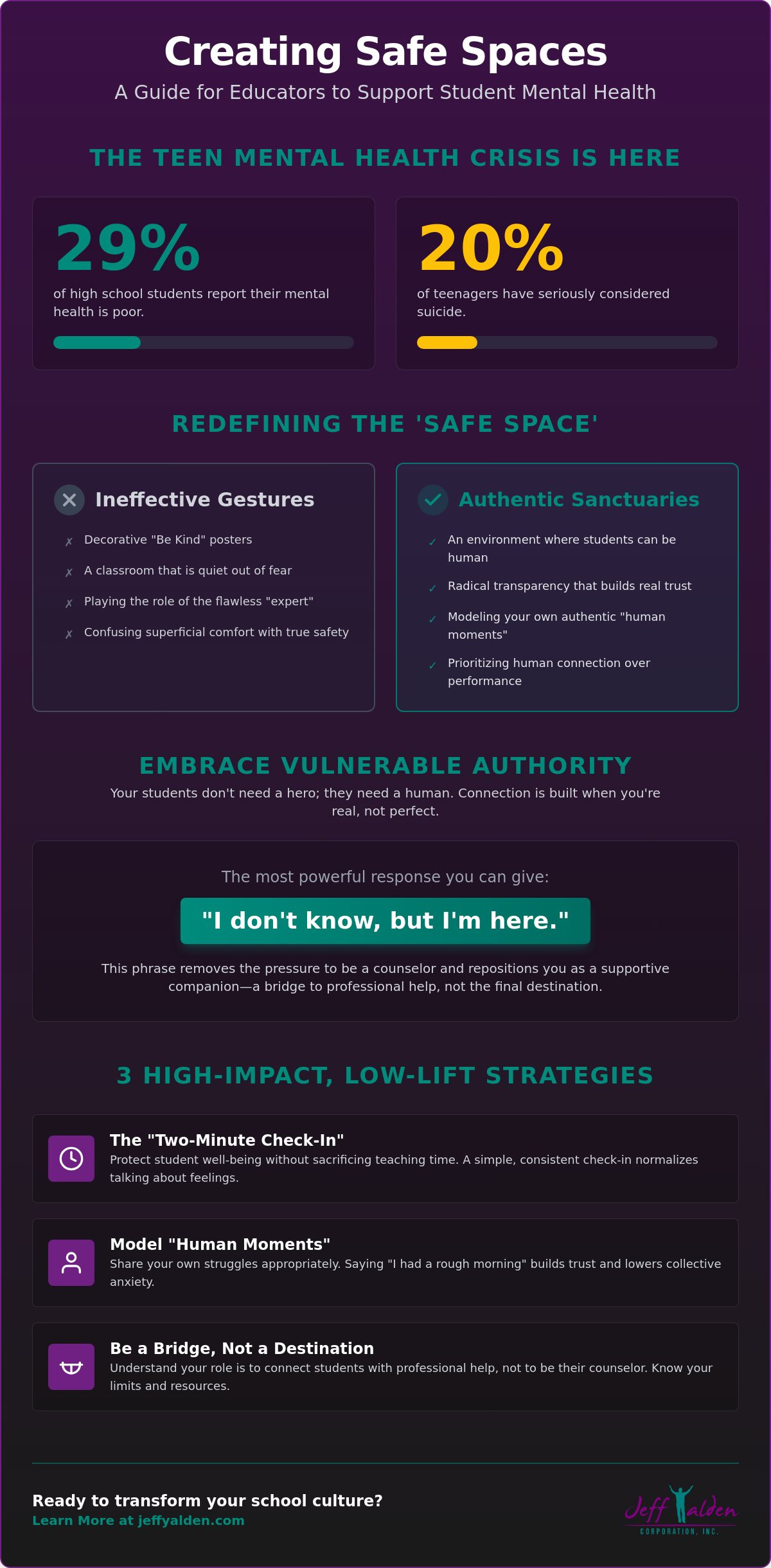
What if the most impactful lesson you deliver this year has nothing to do with your curriculum and everything to do with your courage? You’re standing on the front lines of a crisis where 29% of high school students report their mental health is poor. The pressure is suffocating. You’re expected to meet rigorous standards while knowing that 20% of the teenagers in your seats have seriously considered suicide. It’s terrifying to feel like you aren’t expert enough to help. However, creating a safe space for mental health conversations in the classroom doesn’t require a clinical license. It requires you to show up as a human being first.
I know the weight you’re carrying. You want to help, but you’re afraid of triggering a crisis you can’t handle. This article is your radical guide to moving past that fear. You’ll learn how to transform your classroom into a life-saving sanctuary through radical transparency and vulnerable authority. We’re going to dive into practical check-in strategies and the confidence you need to handle real talk. We’ll explore how to build a culture where every student feels truly seen and supported. It is time to lead with your heart as much as your head.
Key Takeaways
- Ditch the decorative posters. Real safety is an environment where students feel empowered to take off their masks and be human.
- Stop playing the perfect expert. Modeling your own “human moments” is the fastest way to lower collective anxiety and build trust.
- Master the art of creating a safe space for mental health conversations in the classroom by positioning yourself as a bridge to help, not the final destination.
- Discover high-impact, low-lift strategies like the “Two-Minute Check-In” that protect student well-being without sacrificing your teaching time.
- Learn how to drive campus-wide change by moving from one safe classroom to a culture of radical transparency that supports every student.
Beyond the Poster: What a ‘Safe Space’ Actually Looks Like in 2026
Forget the “Be Kind” stickers. They’re just wallpaper. In 2026, students see right through performative gestures. Creating a safe space for mental health conversations in the classroom isn’t about your interior design choices. It’s about the energy you bring into the room. It’s about building an environment where the “mask” can finally come off. We’re talking about a space where a kid doesn’t have to pretend they’re “fine” just to survive the period. When you allow students to be their raw, unfiltered selves, you aren’t just teaching; you’re throwing a lifeline.
Educators often mistake a quiet classroom for a focused one. That’s a dangerous assumption. Sometimes, that silence is the sound of thirty kids drowning in their own thoughts. A quiet room can be the most treacherous place for a struggling student because it reinforces the toxic idea that their pain is something to be kept private. Silence is a wall. Transparency is the sledgehammer.
Defining your “Safe Space Posture” requires three things: consistency, transparency, and the courage to be real when it would be easier to be “professional.” You have to show up the same way every single day so they know you’re a stable foundation. A safe space is a living agreement between teacher and student that prioritizes human connection over academic performance.
The 2026 Reality: Why Silence is No Longer an Option
The tide of teen anxiety is rising faster than we can build dams. Digital isolation has turned bedrooms into echo chambers of comparison and despair. We can’t ignore it anymore. When we stay silent about the elephant in the room, we send a loud message that mental health is a shameful secret. You are often the only “trusted adult” these students see for seven hours a day. The intersection of mental health in education isn’t just a theory; it’s the front line of your job description. If we don’t talk about it, we’re complicit in the stigma.
Safety vs. Comfort: Understanding the Difference
Don’t confuse safety with comfort. Stagnation happens in “fake” comfort where everyone smiles and no one says anything true. Growth happens in safe discomfort. Being “nice” isn’t the same as being a safe harbor. A safe harbor is strong enough to hold the storm. It means setting the stage for radical honesty in the first five minutes of class. You are creating a safe space for mental health conversations in the classroom by proving that you can handle the truth, no matter how heavy it feels. It’s about being a leader who isn’t afraid of the dark.
Vulnerable Authority: Why Your Students Need You to Be Real, Not Perfect
Stop trying to be the hero. Your students don’t need a savior; they need a guide who knows what it’s like to be lost. You’ve likely been told that you need to have all the answers to maintain control. That’s a lie. In fact, it’s the “Expert Trap” that kills connection. When you act like your life is a series of perfect wins, you create a distance that no lesson plan can bridge. Creating a safe space for mental health conversations in the classroom starts the moment you admit that you struggle too. It’s about modeling the mess. When you share a “human moment,” you aren’t losing your authority. You’re gaining trust. You’re lowering the collective anxiety of thirty teenagers who are terrified of making a single mistake.
The most life-saving response you can give isn’t a clinical solution. It’s five simple words: “I don’t know, but I’m here.” This response is a massive relief for both you and the student. It removes the pressure to be a counselor and puts the focus back on being a companion. Vulnerability isn’t a liability; it’s the most powerful tool you have for building resilience in teens.
Breaking the ‘Teacher Mask’
Don’t mistake transparency for oversharing. Your students aren’t your therapists, and they shouldn’t carry your trauma. Purposeful transparency is different. It’s saying, “I had a rough morning, and my energy is a little low today. Let’s give each other some extra grace.” This small admission shifts the dynamic from “me vs. them” to “we’re in this together.” It teaches them how to navigate a bad day without spiraling. You are showing them that it’s possible to be struggling and successful at the same time. This is how you build a culture of mutual respect instead of a hierarchy of fear. If you want to model this type of personal growth—perhaps by overcoming the hurdle of understanding a second language but struggling to speak it—you can check out Amidon Spanish to help you find your voice.
The Science of Connection
There is a biological reason why this works. Every student has a “safety switch” in their brain. If a student feels threatened, judged, or unseen, their prefrontal cortex effectively shuts down. They can’t learn your history dates or math formulas because their amygdala is screaming for survival. A student who feels seen is a student who can actually pass your test. When you show up as a regulated, calm adult, you act as a biological thermostat for a dysregulated room. Evidence-based research on Calming Spaces in Schools and Classrooms confirms that emotional safety is the absolute foundation of academic achievement. If you want better grades, start with better connections. If you feel your school needs a spark to start these deeper talks, bringing in a teen mental health speaker can help break the ice for everyone.
The Teacher vs. Counselor Dilemma: Knowing Your Role (and Your Limits)
You aren’t a doctor. You aren’t a clinical psychologist. Honestly? Your students don’t expect you to be. One of the biggest hurdles in creating a safe space for mental health conversations in the classroom is the paralyzing fear that you’ll overstep your bounds and do more harm than good. Let’s clear the air right now. You are the bridge, not the destination. Your job isn’t to fix the broken parts; it’s to hold the light while they find their way to the professional who can. The Compassionate Border is the sacred line where your empathy ends and professional intervention begins to ensure the student stays alive.
We need to talk about the “Referral Gap.” This is that high-stakes 48-hour window between a student opening up to you and their first actual appointment with a counselor. This is where the real work of creating a safe space for mental health conversations in the classroom happens. You are the one keeping them anchored during that wait. You aren’t “treating” them. You’re simply proving that they aren’t alone in the dark. However, you must have the courage to stop the conversation the moment it shifts from a “human moment” to a clinical crisis.
The Role Comparison: Teacher vs. Counselor
Understanding the difference between your role and the counselor’s role is a massive relief. It takes the weight off your shoulders. Consider these distinctions:
- Teacher: You normalize the struggle. You validate their feelings. You observe their daily patterns. You model what resilience looks like in real time.
- Counselor: They diagnose. They treat. They provide the deep clinical intervention required for long-term healing.
Your power lies in your proximity. You see the subtle shifts in mood, the sudden drop in participation, and the change in hygiene that a counselor might miss. Your observation is a counselor’s most valuable asset. You’re the scout on the front lines providing the intel they need to do their job effectively.
When to Step Back: The Safety Protocol
When do you stop? You stop the moment you hear words like “hopeless,” “burden,” or “done.” You stop the moment they mention a plan or you see signs of self-harm. This isn’t about being a snitch. It’s about being a lifesaver. You end the talk by looking them in the eye and saying, “I care about you too much to keep this a secret.” This isn’t a betrayal of trust; it’s the ultimate act of love. If you’re looking for specific crisis frameworks to bring to your school, see our teen suicide prevention programs for crisis protocols that actually work.
5 Radical Strategies to Normalize Mental Health in Your Daily Lessons
You must also commit to reframing “behavior” as “communication.” When a student acts out, puts their head down, or misses three assignments in a row, they’re sending a signal. A radical shift in classroom management means looking past the defiance to find the distress. Instead of a referral, try a “Two-Minute Check-In.” Use non-verbal cues to gauge the room. If you want to equip your staff with these mindset shifts, our Teacher Professional Development programs provide the hands-on training to make it happen.
Don’t stop there. Integrate emotional vocabulary into your standard academic curriculum. If you’re teaching English, analyze a character’s coping mechanisms. If you’re in a history class, discuss the collective trauma of a post-war era. Use the “Final Five” to end every class. Spend the last five minutes focusing on self-care, resilience, or a simple breathing exercise. It shows them that their well-being isn’t an “extra”; it’s the foundation of everything else.
The Non-Verbal Sanctuary
Lower the barrier to entry with non-verbal check-ins. Use a “Fist to Five” system where students hold up fingers to show their energy level. Zero means they’re empty; five means they’re soaring. This allows a struggling student to be honest without having to find the words. Your greeting at the door matters too. A real, eye-contact greeting tells them they exist. Create a physical environment that feels like a home, not a clinical institution. Soft lighting or a dedicated “quiet corner” can transform the room’s energy instantly.
The Language of Validation
Your words are your most powerful tools. Replace the accusatory “What’s wrong with you?” with the curious “What’s going on for you?” This shift removes the shame and opens the door for honesty. You can validate a student’s feelings without agreeing with their behavior. Say, “I can see you’re incredibly frustrated, and that makes sense, but we can’t throw the books.” For your quiet, withdrawn students, use the “I see you” technique. A simple sticky note on their desk that says “I noticed you worked hard today” can be the only positive interaction they have all day. Creating a safe space for mental health conversations in the classroom is built on these tiny, consistent moments of recognition.
Transforming Your School Culture: The Power of Professional Advocacy
Your classroom shouldn’t be the only place where your students can finally breathe. You’ve done the heavy lifting. You’ve modeled the struggle and built the bridge. But if your room is an island of safety in a sea of institutional coldness, the whiplash will eventually break your students’ trust. Creating a safe space for mental health conversations in the classroom is a powerful start, but the ultimate goal is a campus-wide culture of radical transparency. We need to move every hallway, cafeteria, and front office from “crisis mode” to “connection mode.” This isn’t just a policy change. It’s a heart change that requires every adult on campus to buy into the mission.
One person can’t carry the weight of an entire generation’s anxiety alone. Scaling this safety means advocating for a common language across your school. When every teacher understands how to validate a student’s pain without judgment, the “Referral Gap” we discussed earlier begins to shrink. The goal is to make mental health as normal to talk about as a Friday night football game. It starts with leadership that isn’t afraid to be real.
The Impact of a School-Wide Mental Health Assembly
Sometimes you need a catalyst to break the ice. A single, high-energy event can give an entire campus a common vocabulary for struggle almost overnight. This is why a professional teen mental health speaker is so effective. They step onto that stage and say the things that everyone is thinking but no one is saying. It gives students permission to be human. The Jeff Yalden approach to high school assemblies isn’t about a “feel-good” speech. It’s about a radical, raw confrontation with the truth that builds immediate resilience. The ripple effect of these assemblies makes your classroom work ten times easier because the stigma has already been shattered at scale.
Investing in the Educators
We can’t ask you to hold your students’ pain if no one is holding yours. Professional advocacy means demanding that your school invests in the people on the front lines. Comprehensive trauma-informed teaching professional development is the absolute foundation of a safe school. It equips your staff to handle the “raw and real” conversations without falling into the trap of secondary traumatic stress. You need tools to protect your own peace while you’re holding the space for theirs. Burnout happens when you feel alone in the fight. Connection happens when the whole school stands together. Are you ready to bring this radical shift to your campus? Book Jeff Yalden for your next PD or assembly and let’s start the transformation today.
Lead the Change Your Students Need Today
The time for posters and performative silence is over. Your students are waiting for a leader who has the courage to be human first. You’ve seen that vulnerability isn’t a weakness; it’s the bridge to trust. By setting clear boundaries and integrating radical check-ins, you’re doing more than just teaching. You’re saving lives. Creating a safe space for mental health conversations in the classroom is a daily commitment to seeing the person behind the desk. It’s about proving that their pain has a place in your room.
You don’t have to carry this mission alone. If you’re ready to shatter the stigma across your entire campus, it’s time for a professional spark. Jeff Yalden brings 30+ years of raw and real experience to high schools as a specialist in suicide prevention and crisis postvention. Voted Youth Speaker of the Year by his peers, Jeff knows how to reach the hearts that others can’t. Bring Jeff Yalden to your school for a life-changing mental health assembly or teacher PD. Let’s stop the silence and start the connection. You have the power to change the story for every kid in your room. Keep showing up. Keep being real.
Frequently Asked Questions
What should I do if a student discloses self-harm in front of the whole class?
Acknowledge their courage immediately but move the conversation to a private setting as quickly as possible. You should validate their feelings without making it a public spectacle. Once you are in a private space, follow your school’s mandatory reporting protocol and stay with the student until a counselor or administrator takes over. Your calm response prevents panic while ensuring the student’s immediate physical safety is the top priority.
How can I find time for mental health talks with a packed curriculum?
You don’t need a separate class period; you need small, intentional moments woven into your existing routine. Use the first two minutes of class for a quick check-in or the last five for a resilience exercise. These tiny shifts are the key to creating a safe space for mental health conversations in the classroom without losing academic ground. It is about the quality of connection, not the quantity of time spent.
Is it legal for a teacher to talk about mental health in the classroom?
Yes, talking about mental health is legal and increasingly mandated by state legislation across the country. For example, South Carolina and Minnesota have enacted laws requiring mental health instruction starting in the 2026-2027 school year. You are acting as an educator and a mandated reporter, not a clinical therapist. As long as you stay within your role of observing and educating, you are fulfilling your professional duty to support student well-being.
What are the first signs of a mental health crisis in a high school student?
Look for drastic changes in a student’s baseline behavior, such as sudden withdrawal, hygiene neglect, or intense irritability. If a student who is usually vocal becomes silent or their academic performance plummets overnight, pay close attention. These shifts are the red flags that signal a deeper struggle. Your daily proximity allows you to catch these changes before they escalate into a full-blown crisis, making your observation a vital asset for the school.
How do I handle a student who uses ‘mental health’ as an excuse for bad behavior?
Hold the line with empathy by separating the student’s feelings from their actions. You can validate that they are feeling overwhelmed while still maintaining your classroom standards for conduct. Say, “I hear that you are struggling, and we can work on a plan for that, but disrupting the lesson isn’t acceptable.” Accountability is actually a form of safety. It shows them that you care enough about their future to keep them on track.
Can a single classroom really make a difference if the rest of the school is toxic?
Absolutely, because your classroom might be the only place that student feels truly seen for the entire seven-hour day. You are the eye of the storm. While you should advocate for campus-wide change, never underestimate the power of your own four walls. You are creating a safe space for mental health conversations in the classroom that can serve as a life-saving sanctuary for a teenager who is currently drowning in silence.
What do I say to a student who is clearly struggling but refuses to talk?
Let them know that you see them and that your door is always open whenever they feel ready. Don’t force the conversation; force the connection. A simple note on their desk or a “glad you are here” at the door can do more than a forced interrogation. Sometimes, the most powerful thing you can do is sit in the silence with them until they feel safe enough to find their own voice.
How do I protect my own mental health while supporting my students?
Set firm emotional boundaries and prioritize your own recovery time once the school day ends. You can’t pour from an empty cup. Holding space for student trauma is heavy work, and you need a support system of your own to stay resilient. Practice radical self-care and utilize your school’s employee assistance programs when you feel the weight. Your personal well-being is the foundation of the safety you provide for your students.
