
What if student leadership has less to do with holding a title and more to do with how teens treat one another when nobody’s watching? A youth leadership development speaker can help make that idea real, but an inspiring assembly needs to connect with students’ everyday choices. You want more than a burst of energy that fades by the next school day. You want a message that feels relevant to teens’ lives, strengthens belonging, and gives students a reason to show up for one another.
Start with a clear purpose. Leadership can mean taking responsibility, speaking up with care, and staying resilient when life gets hard. In this article, you’ll learn what a speaker can contribute, how to shape a meaningful school event, and how to connect the message with your school’s culture. Jeff Yalden brings leadership into the wider conversation about resilience and student well-being through school programs for students and professional development for educators. One assembly won’t solve everything, but honest conversation and a shared language for responsibility, resilience, and support can help a school take a meaningful next step.
Key Takeaways
- A youth leadership development speaker can help students connect leadership with everyday choices, communication, and responsibility.
- Use a speaker’s story to invite student reflection, not to position anyone else as the hero of their growth.
- Match the event’s message and participation style to your students’ ages, school goals, and current context.
- Prepare educators and students with clear goals, relevant context, and a plan for reflection after the event.
- Explore how Jeff Yalden connects leadership with resilience and student well-being through middle and high school assemblies and educator professional development.
What Does a Youth Leadership Development Speaker Actually Help Students Do?
A student council title can create opportunities, but it doesn’t automatically teach someone how to lead. Students need room to reflect, make choices, and practice showing up for others. A youth leadership development speaker can use motivation and honest conversation to help students connect leadership ideas with actions they can take in daily school life.
Student leadership is taking responsibility for your choices, building respectful relationships, and taking everyday action that helps your community. It isn’t the same as popularity, authority, or perfection, and it doesn’t require an elected role. Leadership can be quiet. It might begin with noticing who’s being left out, listening before reacting, or admitting a mistake and taking steps to put it right.
What student leadership looks like beyond elected roles
Picture a group project where one person’s ideas keep getting ignored. A student can lead by making space for that classmate to speak, helping the group hear different perspectives, and keeping everyone focused on the shared task. A teen might also check in on a peer who seems alone, then connect them with a trusted adult when support is needed.
These moments call for initiative, inclusion, and accountability, not a microphone or a crowd. Some students lead by speaking up; others lead by listening closely, following through, or helping a team recover after a setback. Exploring the broader idea of Youth Leadership can offer helpful context, but meaningful examples often happen in ordinary interactions at school.
Why schools bring in a youth leadership speaker
A speaker can give students and educators a shared starting point for discussing values: What does respect look like here? How do we respond when someone is struggling? What does taking responsibility sound like after a conflict? Through stories and reflection, a youth leadership speaker can make these questions feel immediate and invite students to consider the choices they control.
Leadership also connects with resilience and belonging. A student who feels seen may be more willing to contribute; a student who learns to ask for help can make it easier for others to do the same. A school assembly can open these conversations, but it can’t transform campus culture on its own. Its value grows when the message connects with how adults and students treat one another afterward. For more on that connection, explore high school assemblies and campus culture.
How a Youth Leadership Speaker Turns Motivation Into Real-World Skills
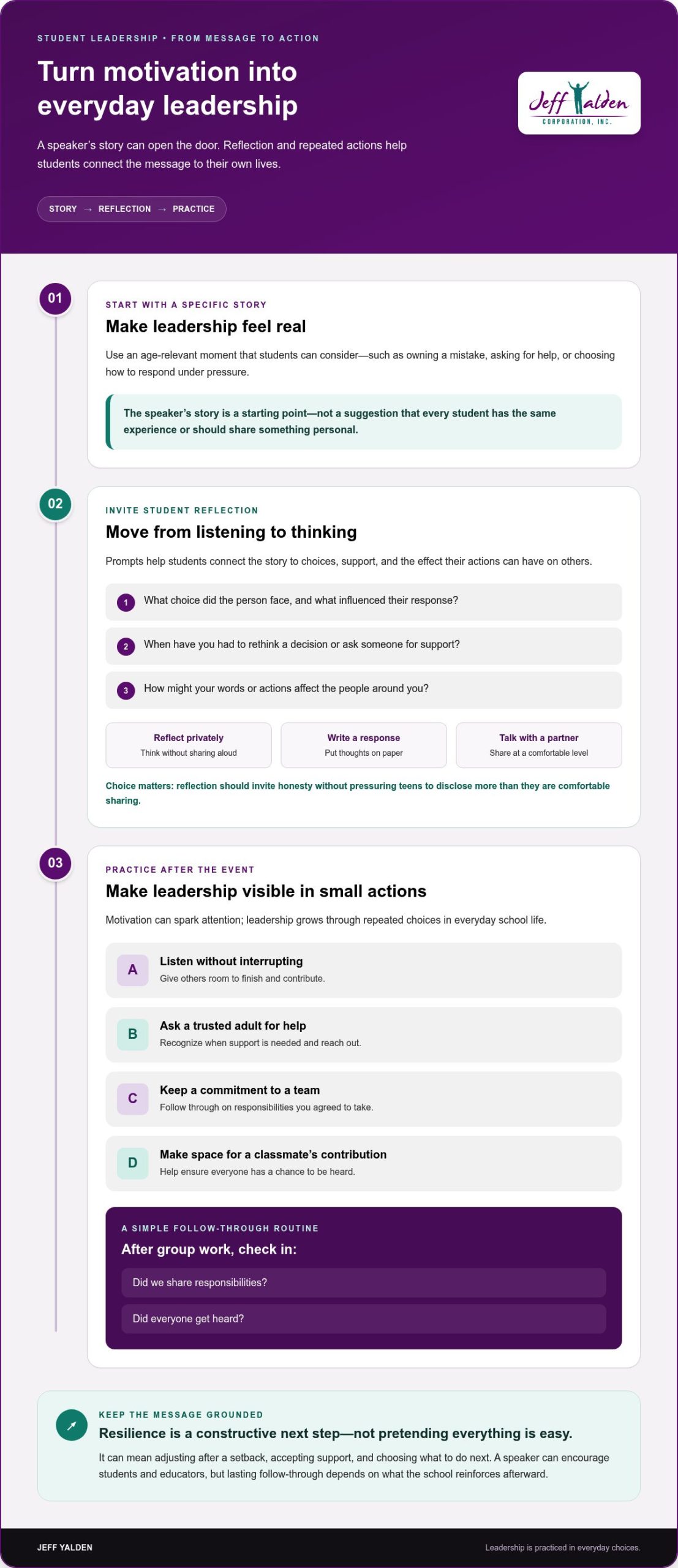
A powerful story can open a door. The next step is helping students decide what they’ll do with what they heard. A youth leadership development speaker can use personal experience to make ideas about choices, communication, and responsibility feel real, then invite students to connect those ideas to their own lives. The speaker isn’t the hero of the students’ story. The goal is to help them recognize where they have agency and identify a possible next step.
From personal story to student reflection
Specific, age-relevant stories give students something concrete to consider: a moment when someone had to own a mistake, ask for help, or choose how to respond under pressure. The story should make room for different experiences. It shouldn’t suggest that every student has faced the same hardship or needs to share something personal.
Reflection prompts can turn listening into thinking:
- What choice did the person face, and what influenced their response?
- When have you had to rethink a decision or ask someone for support?
- How might your words or actions affect the people around you?
Students can reflect privately, write a response, or discuss a prompt with a partner. Choice matters. A meaningful session invites honesty without pressuring teens to disclose more than they’re comfortable sharing.
Leadership skills students can practice after the event
Motivation can spark attention; leadership grows through repeated actions. Students can practice listening without interrupting, asking a trusted adult for help, keeping a commitment to a team, or making sure a classmate has a chance to contribute. These small actions matter.
Make follow-through visible by connecting one skill to an existing routine. A class might end group work with a quick check-in: Did we share responsibilities? Did everyone get heard? A student group might review whether members completed agreed tasks. Educators can reinforce the same language in everyday conversations, helping students see that leadership isn’t limited to the assembly stage.
Resilience supports this practice. It can mean adjusting after a setback, accepting support, and choosing a constructive next step, not pretending everything is easy. Explore building resilience in teens for more on how that theme connects with student growth.
A speaker can encourage students and educators, but no single event can guarantee changed behavior. Follow-through depends on what a school reinforces afterward. Jeff Yalden’s school assembly programs contribute to the wider conversation about motivation, resilience, and student well-being.
How to Assess a Youth Leadership Speaker for Your School’s Goals
Start with your school’s needs, not a speaker’s big promises. Are students working on peer connection, student voice, responsibility, or resilience? Decide what a successful session could reasonably support, then consider grade level, school culture, accessibility, and the emotional tone that will fit this audience. A youth leadership development speaker should help your school bring its goals into focus, not promise instant change.
Compare the experience, not just the pitch
Use this framework to assess how the session fits your students and what could happen afterward:
| Consider | What to look for | Question for your team |
|---|---|---|
| Audience fit | Language, examples, and tone suited to students’ ages and context | Will middle or high school students recognize their lives in the message? |
| Message | A clear connection to your stated leadership goals | What idea should students be able to discuss afterward? |
| Participation | Ways to engage or reflect without pressuring students to disclose personal experiences | Can students take part in a way that feels accessible and respectful? |
| Reinforcement | Practical opportunities to revisit the message through school routines | Where can educators connect the session to existing activities? |
Clarify the format and the evidence
An assembly can introduce a shared message to students. Educator professional development gives teachers and staff space to connect themes with their work supporting students. Ongoing student support comes through the relationships, routines, and resources a school builds over time. These approaches can complement one another, but they aren’t interchangeable.
Jeff Yalden’s school assemblies are direct and personal, connecting motivation with student well-being. His work also includes educator professional development related to student mental health and well-being. To assess fit, focus on whether the approach aligns with your audience and goals. Attention and enthusiastic feedback can show how a session landed in the moment; neither proves lasting behavior change. Testimonials can offer perspective, but they don’t guarantee outcomes for your school.
Look for thoughtful follow-through
After the event, invite students and educators to share brief reflections: What stood out? What’s one idea worth revisiting? Bring those responses into an existing leadership group, advisory period, or classroom conversation. A speaker can open a door, while school relationships and ongoing support help students keep exploring what they heard.
For schools considering a direct, well-being-centered approach, Jeff Yalden’s school and educator programs connect student assemblies with conversations among staff.
How to Prepare Students and Staff for a Leadership Speaker Event
A strong event starts before the speaker takes the stage. Give the visit a clear purpose, prepare students for the conversation, and make sure staff know how to support them afterward. That groundwork helps a youth leadership development speaker connect with your school’s context without placing unrealistic expectations on a single session.
Before the event: define the purpose and prepare the room
Use this sequence to plan with care:
- Set one or two goals. Choose a focus, such as giving students shared language for responsibility or resilience. Keep the aim specific enough to guide the event.
- Gather relevant context. Ask educators about grade-level needs, school priorities, and themes students are discussing. Share only what’s useful for planning. Don’t pass along identifiable student stories or private details.
- Frame the session for students. Explain what the speaker will discuss, why it connects to school life, and how students can participate. Make clear that listening or reflecting privately are valid ways to take part.
- Coordinate staff roles and support. Decide who will welcome the speaker, help students feel settled, and respond if someone wants to talk afterward. Remind staff of the school’s existing support pathways, especially if the session touches on emotionally sensitive topics.
- Match the approach to the age group. Use language and context appropriate for your students. Share relevant guidance with educators so the framing feels grounded in the school’s culture.
Preparation checklist: set a realistic goal, brief students clearly, protect privacy, coordinate staff, and plan how to revisit the message.
After the event: turn a message into shared practice
Give students a chance to pause before the day moves on. Invite them to name one realistic action they could take in their school community, such as following through on a group commitment or making space for another student’s voice. Let students choose how they respond; public sharing shouldn’t be the price of participation.
Then bring the theme into an existing advisory period, classroom conversation, or student-group meeting. Educators can ask what stayed with students and where the idea connects to daily school life. If the discussion raises a concern, use the school’s established support pathways rather than expecting the assembly to address individual needs.
Leadership, resilience, and student well-being often meet in honest conversations about how teens are doing and how they can support one another. Explore teen mental health speaker insights for related context. Jeff Yalden’s school assemblies and educator professional development help schools bring these themes into a shared conversation. Explore Jeff Yalden’s school programs as you plan an event that fits your students and staff.
How Jeff Yalden Connects Student Leadership With Resilience and Well-Being
Leadership isn’t only about stepping forward. It’s also about knowing when to listen, making a thoughtful choice under pressure, and asking for support instead of pretending everything is fine. For students, those actions connect leadership with resilience and well-being: how they care for themselves, communicate honestly, and show up for the people around them.
A school assembly grounded in real student experience
Jeff Yalden delivers middle and high school assemblies that connect with students through direct, personal storytelling and a candid, energetic approach. His work addresses motivation, resilience, and teen mental health, themes that can help students consider their choices and how they contribute to their school community.
The point isn’t to tell students they must handle every challenge alone. It’s to make room for honest reflection: What can I do when I hit a setback? Who can I talk to when I need support? How can I help create a community where people feel included? A youth leadership development speaker can raise these questions and encourage students to think about their role. An assembly can begin a conversation, but it can’t guarantee what each student will do next or replace the ongoing relationships that support them.
Connect students, educators, and the wider community
Students hear a message in the assembly. Educators can help carry its ideas into everyday school life. Jeff also provides professional development for teachers and staff related to student mental health and well-being, giving adults space to consider how these themes connect with their support for students. That work complements, rather than replaces, the relationships and resources already present in a school.
Community programs can extend the conversation beyond the student audience, bringing more adults into shared discussions about resilience and well-being. When students and the adults around them use common language for responsibility, asking for help, and supporting one another, leadership becomes part of a wider school and community conversation, not just a moment onstage.
One event can open the door. Educators, families, and existing support systems continue the work through their daily connection with young people. A grounded approach to a school assembly invites students to reflect, gives adults a chance to reinforce the conversation, and leaves room for growth without promising instant change.
If your school is shaping a conversation around student leadership, resilience, or well-being, explore Jeff Yalden’s programs and start a discussion about your school’s goals.
Make Student Leadership Part of Everyday School Life
Leadership takes shape in everyday choices: listening, taking responsibility, asking for support, and helping others feel they belong. A youth leadership development speaker can help students and educators open that conversation, but progress comes from revisiting it in school life. Set a clear purpose for the event, prepare students and staff, and connect the message to the relationships and routines already supporting your community.
Jeff Yalden provides middle and high school assembly programs focused on themes that include resilience and student well-being. Teacher professional development and community programs can complement student-facing events, extending the conversation beyond the assembly. No single event can promise lasting change, but it can offer a meaningful starting point for reflection and shared action.
Jeff Yalden’s school programs can support a direct, student-centered conversation about your goals and the experience you want to create. Explore Jeff Yalden’s school programs as you plan for a school culture where students are encouraged to lead with care, courage, and responsibility.
Frequently Asked Questions
What does a youth leadership development speaker do?
A youth leadership development speaker helps students connect leadership ideas with choices they can make in everyday school life. Through stories, reflection, and practical examples, a session might explore responsibility, communication, resilience, and how students support one another. The speaker can give a school community shared language and a starting point for discussion. Educators and students continue that work through their relationships and routines after the event.
How is a youth leadership speaker different from a motivational speaker?
A youth leadership speaker connects inspiration more directly to how students communicate, make decisions, and take responsibility. A motivational speaker may focus broadly on encouragement or persistence, while a leadership-focused session can invite students to consider how they contribute to a team or school community. The approaches can overlap. What matters is whether the session’s message fits your school’s goals and gives students something practical to reflect on.
Can a speaker help develop student leadership skills?
A speaker can introduce leadership skills and encourage students to practice them, but a single event can’t guarantee lasting behavior change. Students might leave with a clearer idea of how to listen, include others, keep commitments, or ask for support. For those ideas to grow, educators can connect them to existing classroom routines, student groups, and everyday opportunities to take responsibility. Leadership develops through practice, feedback, and relationships over time.
What should a school look for in a youth leadership speaker?
Look for a speaker whose message fits your students’ ages, school goals, and current context. Consider whether the tone feels appropriate, how students can participate, and whether the session invites reflection without pressuring personal disclosure. Also plan how staff can reinforce the themes afterward. A speaker’s energy can help engage students, but testimonials or audience reactions shouldn’t be treated as guarantees of lasting outcomes at your school.
How can schools keep leadership lessons going after an assembly?
Give students a chance to reflect soon after the assembly, then revisit the ideas through routines already on the school calendar. An advisory group might discuss one practical way to show responsibility; a student team might reflect on how members shared tasks or heard one another. Educators can use consistent language around resilience, inclusion, and asking for help. These follow-up conversations help connect the event’s message with daily school life.
Can a youth leadership speaker also address student resilience and mental health?
Yes. Leadership can connect naturally with resilience, honest communication, belonging, and supporting peers. Jeff Yalden’s middle and high school assembly programs address student well-being, resilience, and teen mental health, alongside motivation. He also provides teacher professional development related to student mental health and well-being. These school conversations can complement educators’ ongoing relationships with students and the support systems already in place.
How do you measure the impact of a student leadership speaker?
Start by defining what the school hopes the event will support, such as shared language around responsibility or student reflection on leadership. Gather immediate feedback from students and educators about what resonated and what they plan to revisit. Later, discuss whether the message has been incorporated into existing activities. These steps help assess engagement and follow-through, but they don’t prove that one speaker caused lasting changes in student behavior or school culture.
Planning a student leadership event? Explore Jeff Yalden’s school programs to take the next step.
