
What if the question you’re afraid to ask is the one that helps a student feel less alone? If a young person seems distressed, it’s natural to worry that saying the wrong thing, or asking directly about suicide, could make matters worse. But a calm, compassionate question won’t plant the idea. It can open the door to an honest conversation. Knowing how to talk to students about suicide starts with listening without judgment and taking what they say seriously.
You don’t need perfect words. You do need a plan. This guide will help you begin a direct, caring conversation, respond if a student tells you they may be at risk, and connect them with appropriate support. You’ll also learn how to handle confidentiality concerns while following your school’s safeguarding procedures.
We’ll walk through what to say, what to avoid, and when to involve designated school staff, caregivers, or emergency support. Most important, you’ll see why this conversation shouldn’t be carried alone. A steady adult can help a student take the next step toward support, and school-wide education can help staff respond with greater confidence and consistency.
Key Takeaways
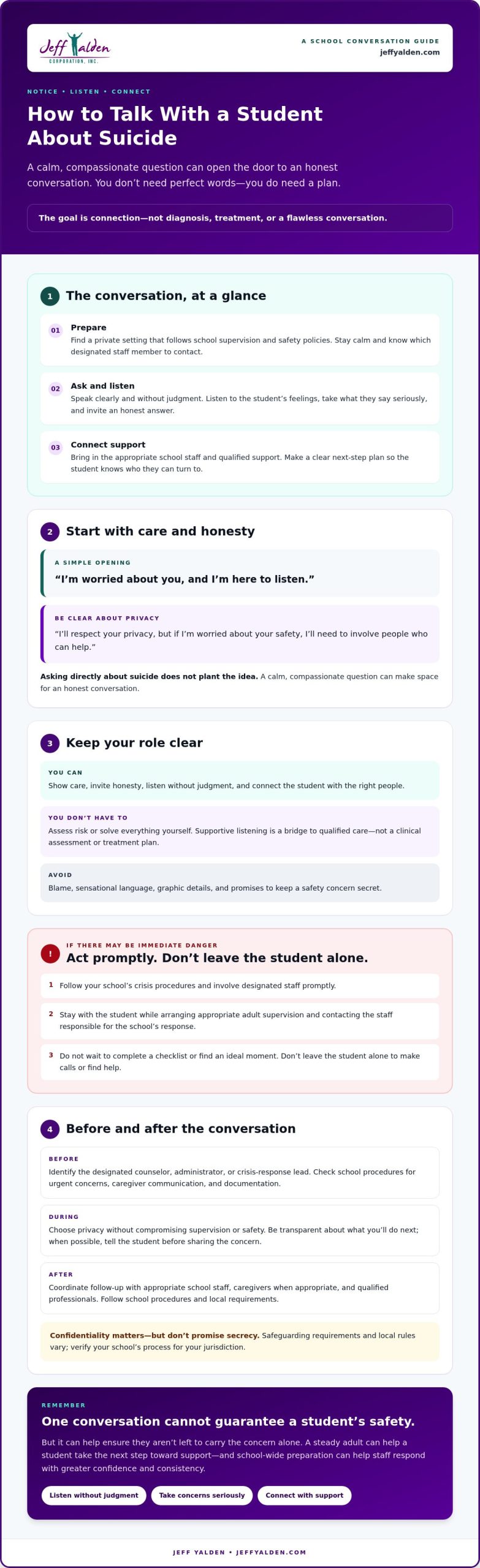
- Prepare by choosing a private setting, staying calm, and knowing which designated school staff member to contact.
- Learn how to talk to students about suicide with clear, nonjudgmental questions that invite an honest answer.
- If a student may be in immediate danger, follow school crisis procedures, involve designated staff promptly, and ensure the student is supervised.
- Understand how to coordinate follow-up with appropriate school staff, caregivers when appropriate, and qualified professionals.
- Build a consistent next-step plan so the student knows who they can turn to for support.
Why talking with a student about suicide can matter
You may notice a student pulling away, hear a troubling comment, or simply feel that something isn’t right. Then the questions hit: What should I say? What if I make it worse? You don’t need all the answers before reaching out. This guide offers practical language and a framework for helping the student connect with support.
A supportive conversation is a first step, not a diagnosis or treatment plan. It means listening without judgment, asking clearly about what’s going on, and connecting the student with the right people. One conversation cannot guarantee a student’s safety, but it can help ensure they aren’t left to carry the concern alone. Broad suicide prevention strategies include connecting people with care and support, alongside approaches that strengthen coping and address risk factors.
What a supportive suicide conversation is, and is not
As you consider how to talk to students about suicide, keep your role clear: you can show care, invite honesty, and bring in trained support. You don’t have to assess risk or solve everything yourself. The National Institute of Mental Health’s ASQ guidance describes screening as a way to identify when further assessment is needed, not as a replacement for that assessment. Supportive listening builds a bridge to qualified care; it isn’t clinical assessment.
Stay focused on the student’s feelings and immediate need for support. Avoid blame, sensational language, and graphic details. Don’t suggest that one perfect phrase can guarantee safety. The goal is connection and a clear next step, not a flawless conversation.
Who should start the conversation at school?
The adult who notices a concern or has the student’s trust can begin. That might be a teacher, coach, counselor, or administrator, depending on the situation. A trusted adult can listen, then promptly involve the school’s designated support staff so the next steps don’t depend on one person’s judgment alone. Follow your school’s procedures, including its guidance on sharing concerns with caregivers and other appropriate supports.
Schools can strengthen their response before a crisis by preparing staff to recognize concerns and respond consistently. Broader teen suicide prevention programs can help build a shared approach across the school community, alongside qualified professional care. They don’t replace it. The conversation matters because it can turn a moment of worry into a moment of connection, helping a student reach the support they need.
How to prepare before asking a student about suicide
Preparation doesn’t mean waiting until you have the perfect words. It means making the conversation as calm, private, and supported as circumstances allow. Before approaching the student, take a breath, identify the staff member who should be involved, and consider where you can speak without drawing an audience. If you suspect immediate danger, don’t wait to complete a checklist or find an ideal moment. Follow your school’s crisis procedures and involve designated support promptly.
Choose the time, place, and first words
Look for a private setting that still follows school supervision and safety policies. Avoid raising a sensitive concern in front of classmates or turning it into a public disclosure. Keep your opening simple: “I’m worried about you, and I’m here to listen.” You don’t need a speech. A steady voice and genuine attention can help the student feel able to speak.
Before you begin, remember: listen, stay with the student, and connect support. If the student may be in immediate danger, stay with them while arranging appropriate adult supervision and contacting the staff responsible for the school’s response. Don’t leave them alone to make calls or find help. The Office of Justice Programs’ Preventing Suicide: A Toolkit for High Schools offers schools guidance for building protocols to identify and assist students at risk.
Know your role and the school’s support pathway
Before asking a student about suicide, know who to contact: the designated counselor, administrator, or crisis-response lead. Check your school’s procedures for urgent concerns, caregiver communication, and documentation. Safeguarding requirements and local rules vary, so verify the process for your jurisdiction rather than relying on assumptions or another school’s protocol.
Be honest about confidentiality. You might say, “I’ll respect your privacy, but if I’m worried about your safety, I’ll need to involve people who can help.” Don’t promise to keep a safety concern secret. Explain what you’ll do next and, when possible, tell the student before you share the concern. That transparency can help them understand that bringing in support is an act of care, not punishment.
Staff are better prepared when they have space to build shared skills and practice compassionate responses. Trauma-informed teacher professional development can support a more consistent approach across a school. Explore teacher professional development as one educational resource for supporting student mental health. It complements, but doesn’t replace, the school’s response procedures or qualified clinical care.
What to say when asking a student about suicide
When you’re worried, plain language is kinder than hinting. You don’t need a perfect script. You need a calm, clear question, then the patience to hear the answer. A student may need a moment before responding. Let the silence breathe.
Ask directly without judgment or euphemisms
You might say, “I’ve noticed you seem overwhelmed, and I care about you. Are you thinking about suicide?” Use the word suicide rather than vague phrases like “doing something” or “hurting yourself,” which can mean different things to different people. Ask gently, then listen without rushing to fill the pause.
If you fear that asking will put the idea in a student’s mind, take heart: the National Institute of Mental Health says asking directly about suicide does not increase suicidal thoughts or behavior. NIMH’s suicide frequently asked questions offers more guidance. A direct, compassionate question doesn’t create the risk; it gives a student room to tell you what they’re facing.
Listen, validate, and avoid harmful responses
After asking, stay present. You could respond with:
- “Thank you for telling me. I’m glad you didn’t have to keep that to yourself.”
- “That sounds incredibly hard. I want to understand what support would help right now.”
- “You don’t have to figure out the next step alone. Let’s connect with someone who can help.”
Gentle follow-up questions can help you understand the student’s immediate needs without turning the conversation into an interrogation. Try, “What’s been feeling hardest lately?” or “Who helps you feel supported?” Don’t ask for graphic descriptions or method details. If the student shares information suggesting immediate danger, pause the conversation and follow your school’s crisis procedures.
Avoid phrases like “You have so much to live for,” comparisons with other people’s struggles, quick-fix advice, or promises to keep everything secret. Those responses can make a student feel dismissed or responsible for comforting you. Keep their dignity at the center. Your task is to hear them and connect them with appropriate support, not to assess or treat them yourself.
Schools also need plans for a different and deeply difficult situation: responding after a student suicide loss. The SPRC and AFSP’s After a Suicide: A Toolkit for Schools addresses that postvention work. It serves a distinct purpose from an individual conversation, but helps schools plan for care across the wider community.
What to do if a student says they may be suicidal
Take the disclosure seriously. Stay calm, thank the student for telling you, and shift from conversation to action. Your job isn’t to decide alone how much danger they’re in or manage a crisis without help. Follow your school’s response procedures and promptly involve the designated crisis lead or other responsible staff.
Respond to immediate danger and make a safe handoff
If you suspect immediate danger, don’t leave the student alone. Stay with them, or make sure a responsible adult remains with them while you contact the school’s crisis-response staff. Follow local procedures for involving caregivers and emergency services. Don’t try to conduct a clinical risk assessment yourself or send the student off alone to find help.
Be clear and steady: “I’m glad you told me. I’m going to stay with you while we bring in someone who can help.” Then make a direct handoff. Share the student’s words and your concern with the staff responsible for coordinating the response, following your school’s policy. The student should know who is taking over and what will happen next.
Connect the student with qualified crisis or mental health support. In the United States, call or text 988 for the Suicide & Crisis Lifeline; use emergency services if danger is immediate. Outside the United States, verify the appropriate local crisis and emergency contacts before a crisis occurs. A school assembly or educational program can support prevention, but it isn’t a substitute for clinical assessment or emergency care.
Protect trust while involving the right people
Don’t promise secrecy. Explain, in language the student can understand, why you need to share the concern: “I care about your safety, so I need to tell the people who can help us make a plan.” Share information with the appropriate people according to school policy and applicable local requirements. Rules for caregiver notification and reporting vary by jurisdiction, so staff should verify the procedures that apply to their school.
Once urgent needs are addressed, the school’s response may include coordinated follow-up and wider community support. Keep individual crisis support distinct from broader youth suicide postvention guidelines, which address how a school responds after a suicide loss. Both require planning, but one does not replace the other.
Preparation helps staff make a steady handoff instead of improvising under pressure. Explore teacher professional development for student mental health to help your school prepare for compassionate, consistent conversations. This educational support complements designated school staff and qualified clinical care.
How schools can keep supporting students after the conversation
The conversation is a beginning, not the whole response. Once immediate concerns have been addressed, the student still needs a clear path back to support. Coordinated follow-up can help them know who to approach, what to expect, and how school staff will stay connected. Keep the plan grounded in school procedures and the student’s circumstances, not promises about outcomes.
Build a clear, compassionate follow-up plan
Work with the student and designated school staff to identify a trusted adult they can approach and agree on a next check-in. Make the plan practical: where can the student find that adult, and what can they do if they need support sooner? Coordinate with caregivers when appropriate and with qualified professionals involved in the student’s care, following school policy and applicable local requirements.
Consistency matters. A brief, planned check-in can show the student that support hasn’t disappeared after the first conversation. Protect their privacy by sharing only the information needed with people responsible for their safety and care. Be clear about who will know, and avoid discussing the student’s disclosure with staff or peers who don’t need that information.
As you consider how to talk to students about suicide, remember that follow-through is part of the care. Don’t guarantee that everything will be fine. Focus on what you can do: listen, maintain the agreed connection, and help the student reach appropriate support if their needs change.
Prepare the wider school community
Students are better supported when staff know how to respond consistently. Teacher professional development can help educators practice compassionate language, understand referral and escalation pathways, and recognize the limits of their role. That preparation helps adults avoid improvising alone when a student reaches out.
School assemblies and age-appropriate programs can also help normalize talking about mental health and seeking help, without asking students to share personal experiences in public. Jeff Yalden’s high school and middle school assembly programs, along with teacher professional development, are educational options schools can consider as part of broader prevention efforts. They complement designated school staff and qualified clinical support; they are not emergency response or treatment.
A student should leave the conversation knowing the next step and who will help them take it. Schools can strengthen that connection through careful follow-up, clear staff roles, and a community where asking for support is treated with respect.
Make the Next Conversation a Supported One
You don’t need perfect words to make a difference. Knowing how to talk to students about suicide means asking clearly, listening without judgment, and connecting the student with appropriate support. If they may be in immediate danger, follow your school’s crisis procedures and involve designated staff promptly. Then make sure there’s a clear next step, including a trusted adult the student can approach and a plan for follow-up.
Support also grows when the whole school is better prepared. Jeff Yalden’s school assembly programs address teen mental health, suicide prevention, and resilience. Educator professional development helps staff prepare to discuss student well-being with care and consistency. These educational programs complement school safeguarding procedures and qualified clinical support. They don’t replace emergency response or treatment.
Help your school build a more confident, compassionate approach. Explore Jeff Yalden’s school programs and educator support. One steady conversation, backed by the right people, can help a student take the next step toward support.
Frequently Asked Questions
Is it okay to ask a student directly if they are thinking about suicide?
Yes. Ask calmly and without judgment, using clear words such as, “Are you thinking about suicide?” Then pause and listen to the student’s response. Guidance from the National Institute of Mental Health supports asking directly rather than relying on hints or euphemisms. A direct question is not a clinical assessment. If you’re concerned the student may be in immediate danger, stay with them and follow your school’s crisis-response process.
Can asking about suicide put the idea in a student’s head?
No. The National Institute of Mental Health says asking someone about suicide does not increase suicidal thoughts or behavior. A clear, compassionate question can give a student an opening to talk about what they’re experiencing and receive support. It can’t guarantee safety or determine what care is needed. Listen carefully, take the answer seriously, and involve designated school staff or mental health professionals when appropriate.
What should I say if a student tells me they are thinking about suicide?
Stay calm, listen without judgment, and thank them for telling you. You might say, “I’m glad you told me. You don’t have to handle this alone.” Don’t promise secrecy or leave the student to manage the next step alone. Follow school crisis procedures and promptly involve the designated support person. If immediate danger may be present, ensure responsible adult supervision and seek emergency help according to local guidance.
Should I promise to keep a student’s suicidal thoughts confidential?
No. Be honest and caring: explain that you can’t keep safety concerns secret because you may need to involve people who can help. Where appropriate, tell the student what you need to share and include them in how that happens. Follow your school’s policies and local requirements, since specific obligations vary. Share information only with people who need it to support the student’s safety and care.
What if a student says they are not suicidal but I am still worried?
Keep the conversation open and calmly explain what you’ve noticed, such as a change in mood, behavior, or connection with others. A student’s denial doesn’t automatically resolve your concern, but you shouldn’t try to assess risk on your own. Consult the designated school counselor or crisis lead, document and share concerns according to school policy, and make sure the student knows which trusted adult they can approach for support.
When should a school call 988 or emergency services?
In the United States, call or text 988, or use its chat service, to connect with the Suicide & Crisis Lifeline. If there’s immediate danger or an emergency, follow school procedures and contact emergency services. Educators shouldn’t make this decision alone; involve the designated school response staff. Outside the United States, check the correct local crisis and emergency contacts before relying on this guidance, as services and procedures differ by location.
