
The bell rings, the room clears, but one student lingers at their desk. They look up, eyes glassy, and whisper the words that make your heart stop: “I don’t think I can do this anymore.” In that split second, the room feels cold. Your stomach knots. You’re hit with the paralyzing fear that one wrong word might push them over the edge. This is the raw reality where suicide prevention training for teachers stops being a checkbox and starts being a lifeline.
It’s okay to feel that weight. You’re human, and the pressure of balancing mandatory reporting with the sacred trust of a student is emotionally draining. I’ve spent three decades navigating these crises, and I’m here to tell you that you don’t have to be perfect; you just have to be present. This guide moves you past the panic into a clear, step-by-step protocol rooted in radical transparency. You’ll learn how to communicate directly, manage the “warm handoff” to professional care, and protect your own mental health while saving a life. We are moving from fear to focused action, right now.
Key Takeaways
- Replace paralyzing panic with radical transparency by prioritizing human connection and steady non-verbal cues during the critical first seconds of a student disclosure.
- Master the direct questioning script to ask “Are you thinking about suicide?” with confidence, removing the guesswork and fear from high-stakes moments.
- Navigate your 2026 legal duties through comprehensive suicide prevention training for teachers that bridges the gap between mandatory reporting and student trust.
- Execute a “warm handoff” to ensure students reach professional care safely without feeling abandoned or simply passed off through the system.
- Transition from reactive crisis management to a proactive campus culture by integrating expert-led mental health assemblies that normalize these life-saving conversations.
The First Seconds of Disclosure: Responding with Radical Transparency
The moment a student looks you in the eye and says they want to die, the world stops. Your heart hammers against your ribs. Your brain starts cycling through every legal seminar you’ve ever attended. Stop. Breathe. In these first few seconds, your role isn’t “administrator” or “mandatory reporter.” It’s “human.” I’ve spent thirty years in these high-stakes rooms, and I’m telling you: suicide prevention training for teachers isn’t just about learning the signs; it’s about mastering the reaction. You are the first responder in a mental health emergency. How you show up in the first sixty seconds dictates whether that student feels safe enough to stay or desperate enough to run.
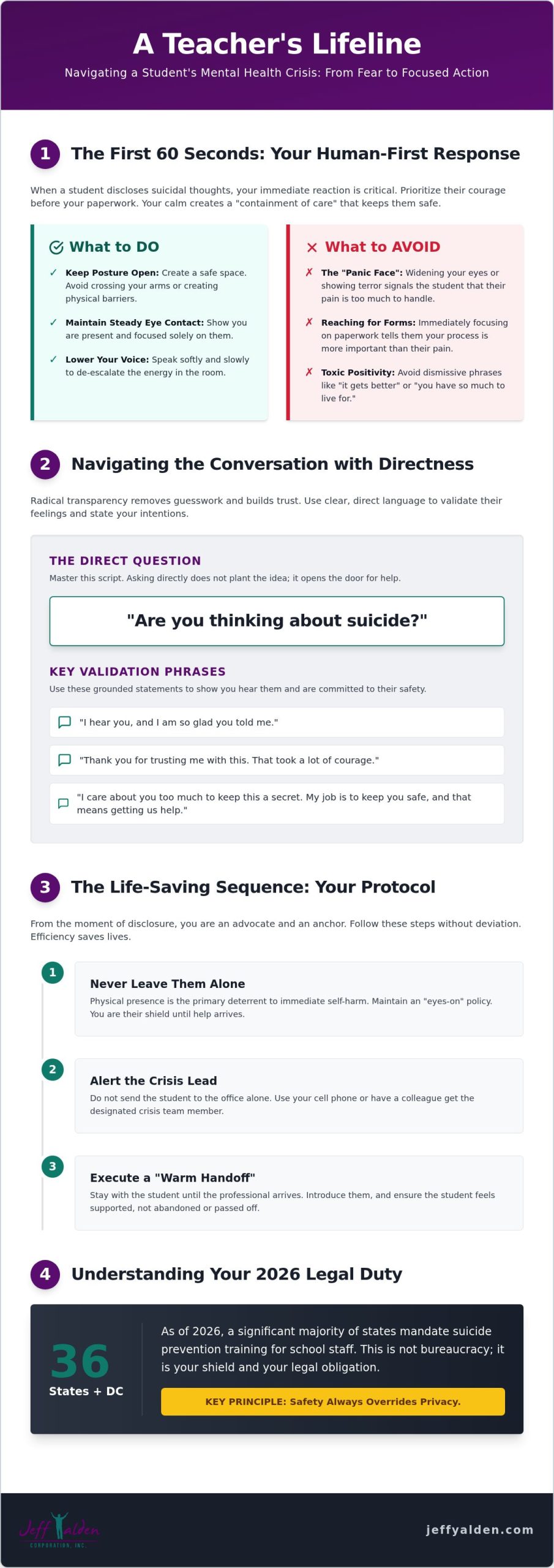
The “Human First” rule means you prioritize their courage before your paperwork. They just handed you the heaviest secret of their life. If you immediately reach for a referral form or start reciting district policy, you’ve lost them. They need to know you can handle their pain without flinching. This is where you avoid the “Panic Face.” If your eyes widen in terror or you start pacing, the student receives a silent message: “I am too much for you to handle.” Instead, ground yourself. Your calm becomes their containment. You are creating a “containment of care” that keeps them tethered to the present until the professional handoff happens. Watch your body language closely:
- Keep your posture open: Don’t cross your arms or create physical barriers.
- Maintain steady eye contact: Avoid darting your eyes toward the door or your phone.
- Lower your voice: Speak softly and slowly to de-escalate the room’s energy.
Validating the Disclosure Without Judging
Validation is your strongest tool. Use grounded, simple language like, “I hear you, and I am so glad you told me.” Avoid the trap of toxic positivity. Telling a suicidal student “it gets better” or “you have so much to live for” feels like a dismissal of their current agony. It shuts the door. Radical transparency is the bridge between a student’s secret fear and the life-saving help they deserve. It means being 100% real about what happens next. You aren’t a therapist, and you shouldn’t pretend to be. You are a lived-experience guide who is fiercely committed to their safety.
The Non-Negotiable: Never Leave Them Alone
This is the hardest part of Suicide prevention strategies in a school setting. When a student begs you, “Please don’t tell anyone,” you must be radically transparent. You say: “I care about you too much to keep this a secret. My job is to make sure you stay safe, and that means I’m going to get us some help.” From this moment on, you do not leave their side. Physical presence is the primary deterrent for immediate self-harm. You maintain an “eyes-on” policy. If you need to call the office, use your cell phone or have another student grab a colleague. You stay in their line of sight until a member of the crisis team arrives. You are their advocate, their anchor, and their shield.
Mandatory Reporting and School Protocols: Your 2026 Legal Duty
As of late 2026, the legal landscape for educators has never been more demanding or more vital. Thirty-six states and the District of Columbia now mandate specific training for school staff. This isn’t just another bureaucratic hurdle to clear for your license renewal. It is your shield. When a student discloses ideation, your legal duty is crystal clear: you must report. There is no middle ground. There is no waiting to see if they are serious. According to CDC’s suicide prevention resources, a multi-layered school approach is the only way to ensure students don’t fall through the cracks of a fragmented system. You are a critical layer in that defense.
Many teachers fear that reporting will trigger a cold, clinical process that traumatizes the student. That is why suicide prevention training for teachers focuses on the “how” just as much as the “what.” You aren’t just filing a report; you are initiating a life-saving sequence. Safety always overrides privacy. While FERPA protects educational records, it contains specific exceptions for health and safety emergencies. Suicidal ideation is a Tier 1 emergency. Confidentiality never applies when a life is on the line. Every second you spend debating whether to tell is a second the student remains at risk.
The Step-by-Step Reporting Chain
Efficiency saves lives. First, stay with the student. Never send them to the office alone. Alert your designated crisis lead via a discreet text or by having a colleague step into your room. Second, physically escort the student to the school counselor or psychologist. This is the “warm handoff” we will dive into later. Third, notify your administration immediately. Following your trauma-informed teaching professional development protocols ensures that the handoff is handled with dignity rather than panic. You are passing the baton to the experts while remaining their primary advocate.
Navigating the Confidentiality Trap
Students will often beg you for secrecy. They might say, “If you tell, I’ll never trust you again.” That is a heavy burden to carry. Use your voice of vulnerable authority. Tell them directly: “I care about you too much to keep a secret that could hurt you.” You aren’t breaking a promise; you are keeping a person. In the world of education, there is a legal and ethical distinction between privacy and professional secrecy. Breaking that silence to get them help is the highest form of mentorship. It shows them that their life is more valuable than their temporary approval. If you feel overwhelmed by these high-stakes moments, bringing in Teacher Professional Development can help your entire staff align on these protocols.
Once the student is safely in the care of the crisis team, your job shifts to documentation. Record the “who, what, when, and where” of the disclosure while the details are fresh. Be objective. Use the student’s exact words. This document protects the student, the school, and your professional standing. It closes the loop on your legal duty and allows the clinical team to take over with a clear picture of the crisis.
Navigating the Conversation: Specific Scripts for Educators
Most training tells you what to look for, but they leave you hanging when it’s time to actually open your mouth. You don’t need a PhD to save a life. You need courage. You need the “Vulnerable Authority” voice. This means you aren’t a cold clinical observer; you’re a leader who isn’t afraid to walk into the fire with them. When a student is drowning in ideation, they don’t need a lecture. They need a witness. They need to know that you can hear their darkest thoughts without looking for the exit. This is the core of effective suicide prevention training for teachers: moving from passive observation to active, fearless dialogue.
The most dangerous thing you can do is dance around the topic. Don’t use euphemisms like “hurting yourself” or “doing something silly.” Be direct. Ask the question: “Are you thinking about suicide?” It feels like a punch to the gut the first time you say it. Do it anyway. Research shows that asking directly does not plant the seed. It actually provides an immediate sense of relief. It tells the student, “I see you. I can handle this. You don’t have to carry this alone anymore.” You are providing a containment of care by proving that the word itself doesn’t scare you.
Direct and Compassionate Questioning Scripts
If a student says, “I just want the pain to stop,” don’t panic. Validate it. Try saying: “I can see how much you’re hurting, and I’m so glad you’re sharing this with me. When the pain gets this heavy, do you ever have thoughts of ending your life?” If they say yes, move to intent. Ask: “Do you have a plan for how you would do that?” These aren’t just questions; they are lifelines. You’re proving that you are present, grounded, and ready to act as their advocate until you reach a professional.
Phrases to Avoid at All Costs
We often reach for comfort, but in a crisis, comfort can feel like a cage. Avoid the “No-Go” list. Never say, “Think about how your family would feel.” This is a guilt trip, not a rescue. For many students, family is the source of the trauma. Adding guilt to their existing pain only makes the burden heavier. Similarly, the “You have so much to live for” trap is a fast track to shut down. To a student in a dark hole, that phrase feels like a lie. It dismisses their current agony. Instead of telling them how they should feel, use reflective listening. Say: “It sounds like you feel completely trapped right now.”
Finally, ditch the “I know how you feel” fallacy. You don’t. Even if you’ve struggled, their reality is theirs alone. Your job isn’t to compare stories; it’s to be the anchor. This level of direct communication is what transforms standard suicide prevention training for teachers into a professional, life-saving protocol. You are the bridge. Stay on it with them until they are safe.
The Warm Handoff: Safe Transition to Professional Care
You’ve done the hard work. You sat in the fire. You asked the terrifying questions and you didn’t flinch. But the mission isn’t over yet. Now comes the “Warm Handoff.” Most suicide prevention training for teachers tells you to simply “refer the student.” That’s too clinical. It’s too cold. A referral feels like being dropped. A warm handoff is an intentional, physical act of advocacy that ensures the student never feels passed off like a problem to be solved. You are the bridge between their crisis and the clinical care they need. You stay on that bridge until they are safely on the other side.
Your professional authority meets your radical transparency here. You’re a lifeline now. The transition needs to be seamless. If you handle this part with panic, the student will pull back. If you handle it with a calm, focused presence, they will follow your lead. This is about maintaining the “containment of care” we established earlier. It’s about being the person who says, “I’m with you,” and actually meaning it until the very last second of the handoff. This level of dedication is what makes suicide prevention training for teachers a life-saving reality rather than just a policy.
Executing the Physical Transition
Never, under any circumstances, send a student to the office alone after a disclosure. I don’t care if they seem “fine” or if they promise they’re going straight there. The moment they leave your sight, the “shame storm” kicks in. The weight of what they just told you can become overwhelming. They might bolt. They might go to the bathroom to harm themselves. You walk with them. This is the final act of immediate advocacy. When you arrive at the counselor’s office, introduce them as a partner in this mission. Stick to the facts of the disclosure. What did the student say? What were their exact words? Your job isn’t to diagnose; it’s to report the raw truth. Say something like, “This is Mr. Miller, and he is the expert who knows how to help us navigate this next part.” Once the handoff is complete, set a reminder for a 24-hour follow-up. A simple “I’m glad you’re here today” the next morning can be the anchor that keeps them coming back.
The Educator’s Post-Crisis Recovery
When that office door finally closes and the student is in professional hands, you are going to hit a wall. It’s called the Adrenaline Dump. Your hands might shake. Your chest might feel tight. You might feel a sudden, crushing wave of exhaustion. This is normal. You just absorbed another person’s trauma, and your body is reacting to the high-stakes stress. Don’t ignore it. Secondary trauma is real, and it is the price we pay for being “vulnerable authorities” in our schools. You cannot pour from an empty cup. Your mental health is the foundation for your classroom’s safety.
Seek support immediately. Don’t carry the weight of that disclosure home with you. Talk to your own teen suicide prevention programs network or a trusted colleague. If you’re a district leader and you want your staff to feel this level of confidence and support, it’s time to bring in professional Teacher Professional Development to build a culture of resilience. You’ve saved a life today. Now, make sure you take the time to save your own peace of mind.
Beyond the Crisis: Building a Proactive Campus Culture
Emergency protocols are vital. We’ve already covered the high-stakes terror of disclosure and the legal weight of reporting. But if you only focus on the fire, you’ll spend your entire career smelling like smoke. It’s time to build a school environment that doesn’t catch fire in the first place. Moving from reactive crisis management to a proactive campus culture is where the real transformation happens. This is why suicide prevention training for teachers shouldn’t be a one-time compliance check. It must be a 365-day commitment to radical transparency and human connection.
Prevention isn’t a single event. It’s the atmosphere of your hallways. It’s the way your staff looks at students. When we move beyond the “if” and “when” of a crisis, we start building a foundation that supports every soul in the building. This is about shifting the energy from fear to empowerment. It’s about showing up as a “vulnerable authority” every single day, not just when the sirens are blaring. You are the heartbeat of the school; your energy dictates the safety of the room.
Normalizing Mental Health in the Classroom
Normalizing mental health starts in the classroom, not just the counselor’s office. It lives in the daily check-ins. It thrives in the way you talk about struggle. When you prioritize building resilience in teens as a core character value, you give them the tools to handle the “suck” before it becomes a catastrophe. Create a stigma-free zone. Show your students that it’s okay to struggle. When the adults in the building lead with vulnerability, students find the courage to speak their truth. You are creating a space where silence is no longer the default setting.
Investing in Long-Term Staff Resilience
Staff professional development is the most important investment a district can make in 2026. You can’t lead where you won’t go yourself. We need to train the whole staff; from the front office to the cafeteria; to recognize that they are all “trusted adults.” This is the core of the Jeff Yalden Approach. It’s real. It’s raw. It’s resilient. We don’t hide behind clinical jargon or detached statistics. We use high school assemblies to break the silence and bridge the gap between students and staff. A powerful teen mental health speaker series doesn’t just entertain; it shifts the tectonic plates of your school’s culture. It provides the suicide prevention training for teachers that actually sticks because it’s rooted in shared human experience.
Build a network where no single teacher carries the burden of a student’s life alone. We are a team. We are a front line. We are a community that refuses to let our kids struggle in the dark. Ready to transform your school culture from the inside out? Book Jeff Yalden for your next staff PD or assembly. Let’s move past the paperwork and start saving lives together.
Turning Fear Into Focused Action
You’ve moved from the paralyzing terror of a student disclosure to a professional, life-saving protocol. You now know that radical transparency isn’t just a buzzword; it’s the bridge that keeps a student safe until they reach professional care. By mastering direct scripts and the “warm handoff,” you’ve transformed your role from a passive reporter to a fierce advocate. Effective suicide prevention training for teachers is about more than just checking a box for 2026 mandates; it’s about building a campus where struggle is met with immediate, human connection.
Don’t carry this weight alone. With over 30 years of high school assembly expertise, I specialize in suicide prevention and postvention that actually resonates with Gen Z and educators alike. I’m here to help you bridge the gap between staff and students with a real, raw approach that saves lives. Bring Jeff Yalden to your school to train your staff and inspire your students today. You are the anchor in their storm. Your presence is the first step toward their victory. Keep showing up.
Frequently Asked Questions
Am I legally required to report a student who mentions suicidal thoughts?
Yes, you are a mandatory reporter. In 2026, state laws and district policies are stricter than ever. If a student hints at ideation, your legal and ethical duty is to initiate the reporting chain immediately. Never try to assess the risk level yourself; that’s the job of the clinical team. Your role is to be the bridge to professional care, not the final judge of the situation.
What if a student only tells me because I promise not to tell anyone else?
You cannot keep that promise, and you must be radically transparent about that from the start. Tell them directly, “I care about you too much to keep a secret that could hurt you.” Breaking that trust to save a life is the ultimate act of mentorship. It shows the student that their safety is infinitely more important to you than your popularity or their temporary approval.
Should I call the student’s parents as soon as they disclose to me?
No, you should follow your school’s specific crisis hierarchy first. Usually, the school counselor or principal handles parent notification to ensure it’s done safely and with clinical resources ready. Your immediate, non-negotiable job is the warm handoff to the school’s mental health professional. Let the designated crisis team manage the communication with the family while you focus on the student in front of you.
What are the most common warning signs of teen suicide that teachers miss?
A “sudden peace” is often the most dangerous sign. If a student who has been struggling or depressed suddenly seems happy or calm, they may have made the decision to end their life. Other missed signs include giving away prized possessions or using subtle “goodbye” language in class assignments. Ongoing suicide prevention training for teachers helps you spot these quiet, life-threatening shifts before they escalate into a crisis.
How do I handle the rest of my class while I am dealing with a student in crisis?
Discretion and quick communication are your best tools. Use a pre-arranged signal with a neighboring teacher or use your classroom phone to alert the office. You must maintain a direct line of sight with the student in crisis at all times. If you have to move the student, ensure a colleague or administrator has taken over the “eyes-on” policy so the rest of your class remains supervised and safe.
What is the difference between suicidal ideation and a concrete suicide plan?
Ideation is the general thought of wanting to die or “disappear,” while a plan involves a specific method, time, and location. Both are Tier 1 emergencies. Never assume ideation is less serious than a plan. One often leads to the other in a matter of seconds, which is why every disclosure requires an immediate professional referral and a warm handoff.
How can I support a student when they return to school after a mental health crisis?
Focus on a warm welcome rather than an academic catch-up. Coordinate with the counselor to reduce their workload for the first week and check in daily with a simple, “I’m so glad you’re here today.” This proves you are still their advocate. It builds the resilient school environment where students feel safe to return and continue their journey toward wellness.
Can a high school assembly really help prevent suicide on campus?
Yes, because it shatters the silence that allows ideation to grow in the dark. A high-energy, transparent assembly normalizes the conversation and empowers students to seek help for themselves and their friends. It serves as the front line of suicide prevention training for teachers and students alike, turning a clinical requirement into a shared, heart-centered mission.
