
What if the most meaningful Suicide Prevention Month activity isn’t an event at all, but a student knowing exactly which adult they can turn to? The strongest suicide prevention month school ideas make support visible before, during, and long after September. A poster or assembly can start a conversation, but students also need clear routes to help and adults prepared to listen.
You’re right to want more than a one-day awareness moment. Talking about suicide with students can feel daunting, and good intentions alone don’t create follow-through. Your school can approach the month with care: choose age-appropriate activities, use compassionate language, and connect each awareness effort to real support.
Here, you’ll find practical ways to build connection across campus, help students identify trusted adults, and sustain support throughout the school year. We’ll look at student activities, staff readiness, and how an assembly can fit into a coordinated, year-round effort. September can be a starting point, not a finish line.
Key Takeaways
- Choose suicide prevention month school ideas that fit students’ ages and connect awareness to a clear next step for support.
- Make participation voluntary, with private alternatives to public sharing or personal disclosure.
- Assess each activity for accessibility, privacy, staffing, and whether students can use what they learn.
- Coordinate administrators, counselors, teachers, communications staff, and student partners so everyone understands their role.
- Bring student activities, staff learning, family communication, and any assembly together as parts of a broader school effort.
Why School Prevention Ideas Must Lead to Real Support
September is Suicide Prevention Awareness Month, a chance for schools to strengthen connection, help-seeking, and access to support throughout the year. The observance matters most when it points beyond a calendar date. A display, discussion, or assembly can open a door, but students also need to know where that door leads: which trusted adults they can approach and how to access established school support.
Campaign wording and materials can change. Before printing posters, sharing messages, or planning events, review current guidance from the relevant campaign source, such as the SAMHSA toolkit, and make sure the language is current and appropriate for your school community. For a broader foundation, explore general suicide prevention strategies, then consider how school activities can connect students with support already in place.
A meaningful school observance links awareness to support students can identify, access, and continue using after September ends.
What makes a school observance meaningful?
Start with purpose, not decoration. Before choosing among suicide prevention month school ideas, decide what students should be able to do afterward. If your goal is help-seeking, make trusted adults and school support routes easy to identify. A resource display, for example, can name the people or offices students can approach, where to find them, and what to do next. Keep the information clear, accurate, and consistent with your school’s procedures.
Then plan for follow-through. Decide who will maintain resources, answer questions, and connect students with appropriate school responders. No campaign can prevent every crisis, and an activity should never suggest otherwise. The goal is to make connection and help-seeking more visible while reinforcing the support systems students can turn to beyond a single event.
How can schools approach the topic with care?
Use direct, compassionate, non-sensational language. Avoid graphic details, dramatic imagery, or messages that could shame students for struggling. Keep activities age-appropriate, and don’t require students to share personal experiences publicly. Students should be able to participate, observe, or choose an alternative without explaining private feelings or experiences.
Prepare adults before inviting conversation. Staff should know how to respond calmly if a student raises a personal concern, listen without judgment, and follow the school’s established procedures rather than trying to manage the situation alone. Confirm in advance which designated school responders handle urgent concerns and how staff should reach them. District policies and student-support procedures should guide activities, communications, and follow-up. Local protocols matter.
This preparation makes the message credible. Students see that the adults leading an awareness activity are ready to respond with care, not just talk about support. That consistency connects a September message to a school culture where asking for help feels possible throughout the year.
Suicide Prevention Month School Ideas Students Can Join Safely
The most useful suicide prevention month school ideas don’t ask students to perform hope or tell personal stories. They give students practical ways to recognize connection, find support, and contribute on their own terms. Invite students to help choose formats that feel relevant, while adults review materials, prepare staff, and take responsibility for responding to concerns.
Keep every activity tied to a real support option. A school activity matters when it helps students find a trusted person, a clear next step, or a practical route to support.
Which student activities can build connection?
Choose activities that fit naturally into the school day and don’t require students to disclose private experiences. For example, an advisory activity can help students identify trusted adults and places to seek support. Make sure names and locations are accurate, and give students a private way to keep the information for themselves.
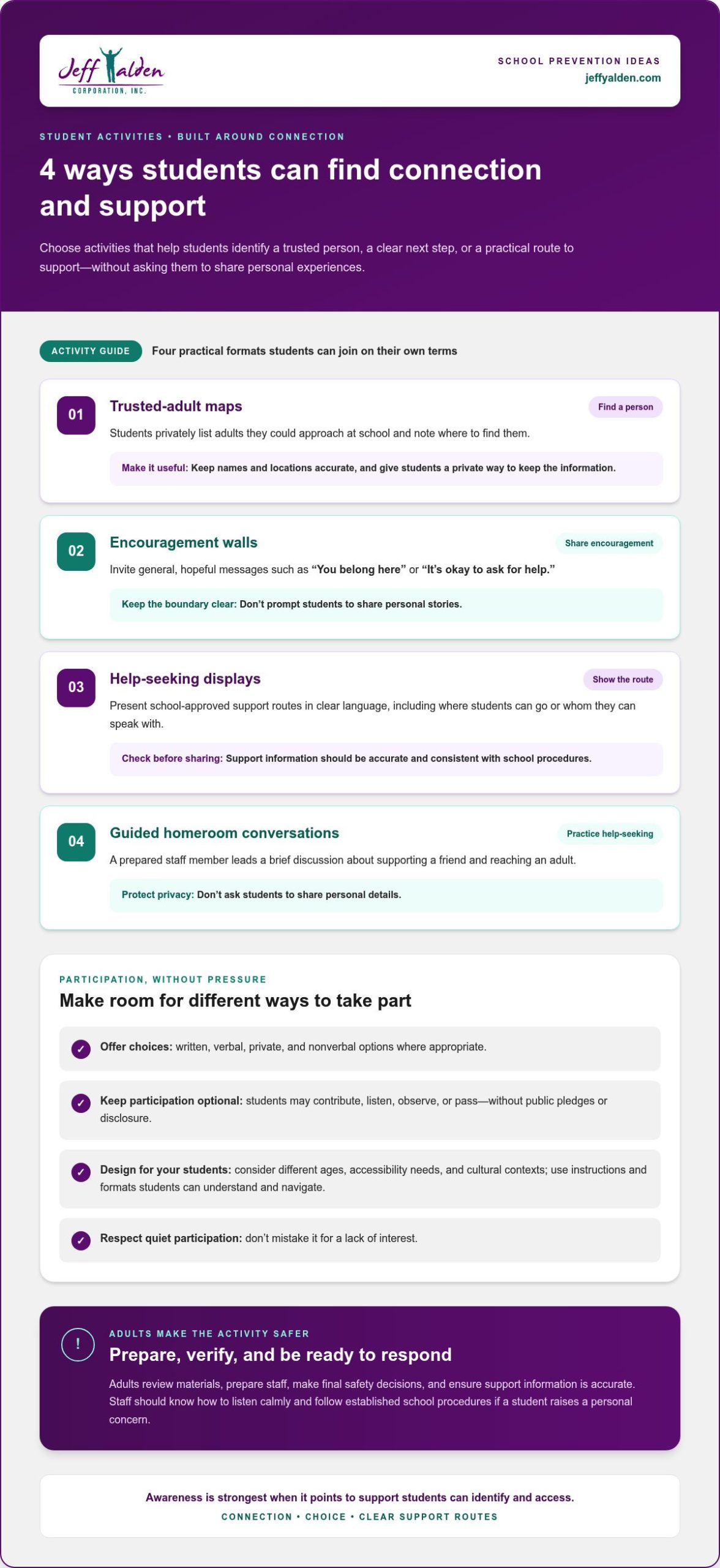
- Trusted-adult maps: Students privately list adults they could approach at school and note where to find them.
- Encouragement walls: Invite students to add general, hopeful messages such as “You belong here” or “It’s okay to ask for help.” Don’t prompt personal stories.
- Help-seeking displays: Show school-approved support routes in clear language, including where students can go or whom they can speak with.
- Guided homeroom conversations: A prepared staff member can lead a brief discussion about supporting a friend and reaching an adult, without asking students to share personal details.
Student partners can suggest formats, wording, and ways to make an activity welcoming. Adults should make the final safety decisions, ensure support information is accurate, and be prepared to respond if a student asks for help.
How can schools make participation inclusive?
Offer more than one way to take part. Some students may enjoy contributing to a shared display; others may prefer writing privately, listening, or passing. Design activities for different ages, accessibility needs, and cultural contexts, and don’t mistake quiet participation for a lack of interest. Choice lets students engage without pressure.
- Provide written, verbal, private, and nonverbal options where appropriate.
- Use accessible instructions and formats students can understand and navigate.
- Make participation optional, without public pledges, contests, or requests to disclose personal experiences.
- Give students a discreet way to find the school’s support information without explaining why they need it.
Before an activity begins, staff should know which designated school responders handle concerns and how to follow district procedures. If a student shares something worrying, respond calmly and connect them with the appropriate adult rather than promising secrecy or trying to manage it alone.
A student assembly can create space for an honest, age-appropriate conversation when it’s part of a wider school effort. Learn about Jeff Yalden’s student assemblies and plan the event alongside clear school support routes and follow-up.
How to Choose School Activities That Go Beyond Awareness
A visible message can start a conversation, but it can’t show a student where to go next. Strong suicide prevention month school ideas pair awareness with practical ways to find support and follow the school’s established procedures. The aim isn’t to label an activity as a clinical intervention or promise an outcome. It’s to make information clearer, connection easier to recognize, and next steps easier to find.
Awareness activity or support pathway: what is the difference?
Awareness activities share messages or invite students to learn. Support pathways make help-seeking more concrete by showing students how to reach trusted adults and established school resources. Schools can combine the two: use a campaign message to prompt conversation, then make the relevant support route visible. The message raises awareness; designated school responders and existing support systems handle student concerns.
Use this distinction to test an idea before adding it to the calendar. Ask: “If a student connects with this message, will they know what they can do next?” If the answer is no, pair the activity with a clear, school-approved route to support. Visibility matters, and so does the path behind it.
Which ideas fit your school community?
There’s no single format that fits every campus. A short classroom activity may suit one age group, while a school-wide message can reach more students but requires coordination and a reliable follow-through plan. Compare options against your school’s actual capacity. Consider whether students can participate comfortably, whether staff can support the activity, and what will happen if a student asks for help.
| Activity format | Audience and preparation | Participation and follow-through |
|---|---|---|
| Awareness messages | Can reach a broad school community; staff should review wording and placement. | Students can read without speaking publicly; pair messages with a clear route to school support. |
| Guided learning | Can be adapted by age and delivered in a class or advisory setting; requires prepared staff. | Offer ways to listen or participate without sharing personal experiences; identify who can respond to concerns. |
| Support navigation | Focuses on how to find established school resources; confirm details with the relevant staff. | Provide discreet, accessible information and explain the next step in plain language. |
Before choosing, consider student age, school size, staff capacity, accessibility needs, and support structures already in place. A smaller activity may be easier to manage when staff time is limited; a broad campaign may need more coordination to keep messages consistent and support information easy to find. Don’t claim an activity prevents suicide unless reliable evidence supports that exact claim for that specific activity.
For broader context on school programming, explore this teen suicide prevention program guide. Use it to inform planning, then match each activity to your students, your school’s procedures, and a real next step for support.
A Practical September Plan for Schools and Staff
A steady plan turns good intentions into coordinated action. Before choosing among suicide prevention month school ideas, decide who is responsible for each step, how student questions will be handled, and what support information needs to remain visible after September. Use the sequence below as a starting point, then adapt it to district procedures and your school community.
What should school leaders prepare before September?
Bring counselors, administrators, teachers, communications staff, and student partners into planning early. Counselors and designated support staff can guide referral and response details; administrators can coordinate decisions; teachers can help activities fit the school day; communications staff can review messages; and students can offer perspective on what feels accessible. Adults remain accountable for safety, privacy, and follow-through.
- Coordinate. Agree on the purpose, audience, roles, and activities. Identify the staff members responsible for answering questions and responding to concerns.
- Prepare. Review district communication, referral, privacy, and crisis-response procedures. Prepare staff to respond calmly to student questions and clarify who handles urgent concerns.
- Engage. Invite students to help shape age-appropriate activities and messages. Keep participation voluntary, with options that don’t require personal disclosure.
- Share support routes. Make school-approved information easy to find and understand. Check that names, locations, and next steps are accurate and consistent with school procedures.
- Follow up. Schedule a check-in after activities, keep support information visible, and gather feedback to guide future planning.
SAMHSA materials can help with campaign messages and resources, but don’t assume last year’s assets or themes are current. Review the current-year toolkit before using a theme, message, or campaign item, then adapt it to your school’s communication practices. A national resource can inform your plan; district procedures should guide how it works on campus.
How can schools carry the work beyond the month?
Put follow-up on the calendar rather than leaving it to chance. A counselor or designated staff member might revisit support routes in a later advisory period, while communications staff keep approved information available through school channels. Ask students and staff what was clear, useful, or difficult to access. Seek feedback on the activity, not private accounts of students’ mental health.
Use this adaptable checklist before launch:
- Responsibilities are assigned, and staff know the designated responders.
- Activities, messages, and support information align with district procedures.
- Participation is accessible and doesn’t pressure students to share personal experiences.
- Follow-up and feedback are planned beyond September.
Staff learning can help educators respond consistently. Jeff Yalden provides teacher and staff professional development to support staff readiness alongside existing student-support systems.
Bring Students, Staff, and the Wider School Community Together
Students hear messages in more than one place: in the classroom, from a trusted adult, at home, and across the broader school culture. When those messages reinforce one another, suicide prevention month school ideas can become part of a wider effort to make help-seeking easier to understand, not just a September campaign.
How can staff and families support a consistent message?
Start with clear, school-approved information. Give staff and families the same practical guidance about the school’s support routes, who students can approach, and how adults should respond if a concern comes up. Keep communication calm and direct. Families need to understand how the school talks about student well-being and where its established supports fit.
Consistency doesn’t mean asking everyone to use the exact same words. It means avoiding mixed signals. Teachers can make room for caring conversations, while family communications can reinforce that students deserve to be heard and supported. Remind adults to respect student privacy: share information about support options without asking young people to disclose personal experiences in a group or through public activities.
Staff learning matters, too. A teacher may be the first adult a student approaches, but they shouldn’t have to guess what to do next. Make sure staff understand the school’s established routes for student support and know which designated responders handle concerns. That shared understanding connects a caring conversation to the right next step.
Where can an assembly or staff presentation fit?
A student assembly can create a shared moment for an honest, engaging conversation about mental health and resilience. Jeff Yalden’s assemblies bring a passionate, real approach to normalizing these conversations with students. A staff presentation can complement the assembly by helping adults build shared language and readiness to respond in ways that align with school procedures.
An assembly is one piece, not the whole plan. Connect it to the school’s support systems before the event, make support routes clear to students afterward, and plan how staff will continue the conversation. Families can receive relevant, school-approved information, while teachers and student partners help carry the message into everyday school life. No speaker or event can replace ongoing relationships and established supports.
For related programming context, explore this teen mental health speaker guide. It can help school teams consider how a speaker fits within a broader approach that includes staff, families, and student-support systems.
If your school is planning a coordinated September effort, explore Jeff Yalden’s school programs. Begin by identifying the event’s purpose, the adults who will support students, and the follow-up that will keep connection alive after the assembly ends.
Make September the Start of What Comes Next
The most important next step isn’t planning a bigger event. It’s deciding how your school will keep connection and support present after September. Choose one follow-up action your team can sustain, then assign someone to own it. Small, consistent steps can keep help-seeking visible in everyday school life.
The right suicide prevention month school ideas should fit your students, support your staff, and connect with the systems already in place. An assembly can help open an honest conversation, especially when paired with staff learning, clear support routes, and thoughtful follow-through. Jeff Yalden has delivered over 4,500 high-school assemblies since 1992 and spoken across all 50 U.S. states, every Canadian province, and 49 additional countries. That experience informs his work with schools without replacing their student-support systems.
Plan your school’s effort with Jeff Yalden’s school programs. Connect a student assembly with staff learning, clear support routes, and follow-up that keeps the conversation going beyond September.
Frequently Asked Questions
When is Suicide Prevention Month, and how can schools observe it?
Suicide Prevention Awareness Month is observed each September. Schools can use the month to invite students and families into thoughtful conversations, share school-approved support information, or include age-appropriate learning in advisory periods. For 2026 campaign language or materials, review current guidance before publishing or distributing them. Choose an approach that fits your school calendar and community, and plan how students can find support after an activity ends.
Can students lead Suicide Prevention Month activities at school?
Yes, students can help shape or lead suitable activities, with adults responsible for safety, accurate information, and support. For example, a student group might suggest welcoming language for a school display or help plan a peer connection activity. Give students clear boundaries: they aren’t responsible for assessing risk, handling a crisis, or supporting a peer alone. Make sure an adult contact is known before any activity begins.
Should schools hold a moment of silence for Suicide Prevention Month?
A moment of silence is an option, but it isn’t right for every school or student. Consider how the choice may affect students with personal experiences of suicide or loss, and don’t ask anyone to explain their participation. If you hold one, explain its purpose in advance, offer a quiet alternative, and make support information available. A reflective activity focused on connection may be a better fit for some communities.
How can schools include families in Suicide Prevention Month?
Invite families to take part without placing responsibility for student safety on them. A school might share a short, approved message explaining how students can approach school support staff, then offer a family discussion about how to listen when a young person is having a hard time. Keep communications respectful of student privacy, avoid asking families to disclose personal experiences, and provide information in accessible formats for your community.
What should a school do if a student asks for help during an activity?
Respond calmly, listen without judgment, and connect the student promptly with the designated school responder by following district procedures. Don’t promise to keep a safety concern secret or try to handle it alone. If the student may be in immediate danger, activate the school’s crisis or emergency response process. In the United States, students or adults can also call or text 988 for crisis support.
Are social media posts enough for a school’s Suicide Prevention Month observance?
No. Social posts can share approved information and let families know about school activities, but they can’t replace direct opportunities for students to learn where support is available. Avoid inviting students to disclose personal concerns in comments or public posts. Instead, direct them toward school-approved support routes and make clear how to reach a trusted adult. Use online messages as one part of a broader, carefully planned observance.
