
What if the strongest school assembly proposal isn’t a speaker biography, but a clear plan built around your students? Presenting a proposal for a school assembly can feel daunting when you’re unsure what administrators need to see or how to connect your idea to the school’s goals. A compelling concept matters, along with the details that help a principal picture the event and decide whether it belongs on the calendar.
Your proposal doesn’t need to be long or flashy. It needs to show why the assembly matters, who it’s for, how it will work, and what could happen afterward. When purpose and practical details come together, decision-makers can evaluate the idea without having to guess at missing information.
This practical guide will help you shape a concise, school-specific proposal with a clear purpose, defined audience and format, and practical details for timing, space, and participation. You’ll also learn how to present it confidently and agree on useful next steps. The goal is to make your idea easy to understand, evaluate, and move forward.
Key Takeaways
- Start with the school’s stated need, then clarify which students the assembly is for and what it aims to support.
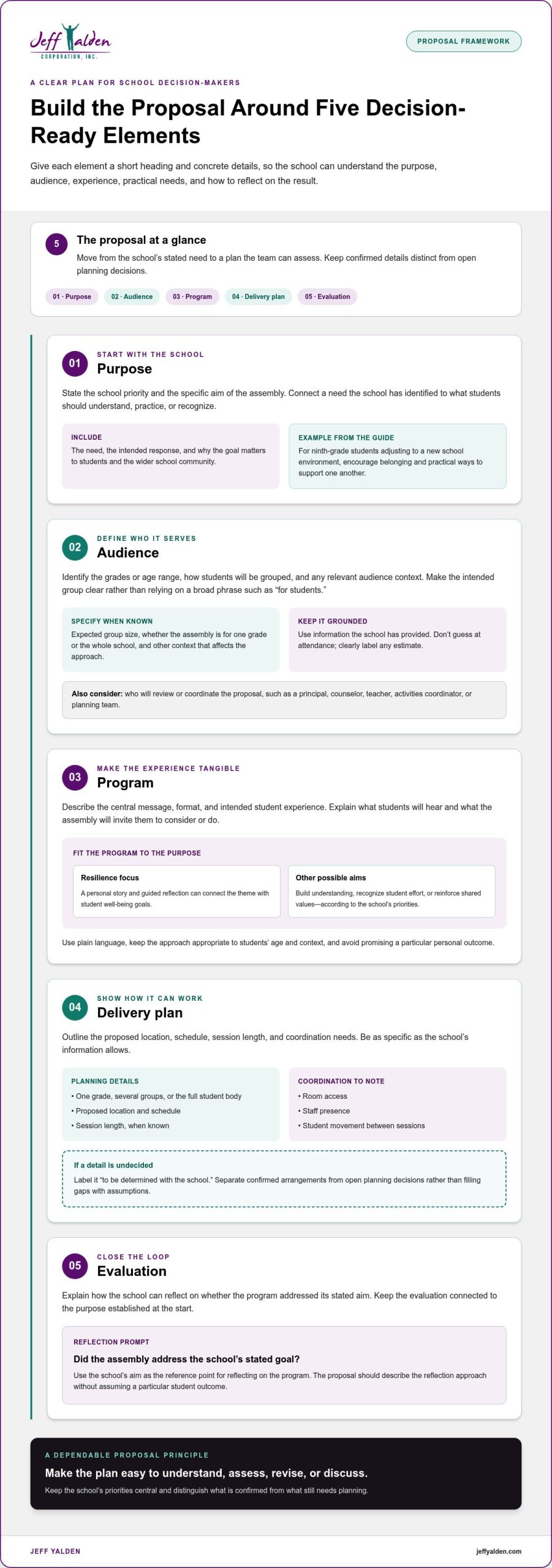
- Organize your proposal around five decision-ready elements: purpose, audience, program, delivery plan, and evaluation.
- Show why the assembly fits by connecting its format and logistics to details the school has shared.
- When presenting a proposal for a school assembly, lead with its value to students and staff before discussing the speaker’s background.
- Close with clear next steps by summarizing agreed goals, open questions, responsibilities, and the next decision point.
Start a School Assembly Proposal With the School’s Real Need
A proposal earns attention when it begins with the school, not the presenter. Start with a need or goal the school has identified, such as strengthening belonging, recognizing student contributions, or giving students practical ways to think about resilience. Then name the students the assembly is intended to serve and explain what the program will help them learn, consider, or experience.
This opening gives decision-makers a reason to keep reading and keeps the proposal grounded. Broad promises such as “inspiring every student” are difficult to assess. A focused purpose tied to a school priority gives the team something specific to discuss.
Write a clear purpose statement for the assembly
In one or two sentences, connect the school’s stated need to the assembly’s intended response. For example: “Because ninth-grade students are adjusting to a new school environment, this assembly will encourage belonging and help students identify practical ways to support one another.” Choose an aim that fits the school’s priorities. A motivational objective might focus on resilience; an educational one might build understanding; a recognition assembly might celebrate student effort; and a community-building objective might reinforce shared values.
Explain why the purpose matters beyond the event itself. Connect it to learning, relationships, student well-being, or the culture the school wants to nurture. School assemblies can serve different educational and community purposes, as outlined in School Assembly Wikipedia. Make clear which purpose matters to this school and how the proposed assembly supports it.
- Need: What challenge or opportunity has the school described?
- Purpose: What should the assembly help students understand, practice, or recognize?
- Relevance: Why does that goal matter to students and the wider school community?
Define the students and decision-makers the proposal serves
“For students” is too broad to guide a useful plan. Identify the grade levels or age range, the expected group size if known, and any audience context that affects the approach, such as whether the assembly is for one grade or the whole school. Don’t guess at attendance. Use information the school has provided, and label any estimate clearly so the proposed format can be assessed realistically.
Also identify who will review or coordinate the proposal. A principal may weigh school priorities, while a counselor, teacher, activities coordinator, or planning team may offer important insight about students and event logistics. Address their needs without losing sight of the audience in the room: the students.
That balance matters in presenting a proposal for a school assembly. A school-specific plan connects decision-makers’ goals with an experience that feels relevant to young people. For more context on how programs can support campus culture, explore high school assemblies. Start with the school’s need, define who the program serves, and let those details shape the proposal.
Build the School Assembly Proposal Around Five Decision-Ready Elements
A decision-maker should be able to scan your proposal and understand what the assembly is meant to do, who it serves, and what the school would need to arrange. Present the information in a consistent order. Keep confirmed details distinct from open planning decisions, so a draft plan doesn’t read like a final commitment.
Use these five elements as the proposal’s backbone:
- Purpose: State the school priority and the assembly’s specific aim.
- Audience: Identify the grades or age range, audience grouping, and relevant context.
- Program: Describe the central message, format, and intended student experience.
- Delivery plan: Outline the proposed location, schedule, session length, and coordination needs.
- Evaluation: Explain how the school can reflect on whether the program addressed its stated aim.
Give each element a short heading and a few concrete details. If something is undecided, label it “to be determined with the school” rather than filling the gap with an assumption. This distinction builds trust and makes the proposal easier to approve, revise, or discuss.
Describe the program and its fit for students
Explain the message students will hear and what the experience will invite them to consider or do. For example, a resilience-focused assembly might use a personal story and guided reflection to connect the theme with the school’s student well-being goals. Keep the description appropriate to the audience’s age and context. A topic label alone doesn’t show why the program fits.
For a mental health focus, a teen mental health speaker program can connect education with resilience while keeping the school’s purpose central. Describe the approach in plain language and explain what students can expect, without promising a particular personal outcome.
Make delivery requirements easy to review
Share logistics as specifically as the school’s information allows. State whether the plan is for one grade, several groups, or the full student body. Name a proposed location, schedule, and session length when known. If those details are still being shaped, list them as planning decisions.
Help the team picture the event by noting coordination items such as room access, staff presence, and student movement between sessions. Separate agreed arrangements from questions that need discussion. For example, “Location: school auditorium, proposed” is clearer than presenting the venue as booked when it hasn’t been confirmed.
Close with a brief decision-ready summary: the school priority, intended audience, program approach, key logistics, and open choices. This gives the planning team a quick overview before they review the details. If you’re shaping a proposal around a student-focused assembly, explore Jeff Yalden’s school assembly work as an example of connecting program goals with student needs.
Show Why the Proposal Fits This School Better Than a Generic Pitch
A generic pitch says what the presenter usually does. A school-specific proposal shows why this program makes sense for these students, in this setting, at this time. Make that difference visible throughout the plan: the purpose reflects a priority the school shared, the audience matches the students who’ll attend, the format serves the goal, and the logistics fit the school day.
Make the connection explicit. If the school has raised belonging as a priority, explain how the assembly will address connection and respect among students. If the goal is recognition, describe how the program will celebrate student contributions. Don’t simply repeat the school’s words. Show how they shape the content and delivery.
| Proposal element | Generic pitch | School-specific proposal |
|---|---|---|
| Purpose | “An inspiring message for students.” | Names the school’s stated goal and explains the assembly’s focus. |
| Audience | “Suitable for all ages.” | Identifies the grades or age group and relevant audience context. |
| Format | Describes the usual presentation. | Explains how the format supports this audience and purpose. |
| Logistics | Leaves timing and setup vague. | States known arrangements and flags details that still need a decision. |
This comparison helps decision-makers see the reasoning behind the proposal, not just its promises. It also gives them concrete details to respond to, such as the audience grouping, program approach, or an open scheduling question.
Demonstrate relevant experience without making the proposal a résumé
Include experience when it helps the school assess fit. Jeff Yalden has delivered over 4,500 high-school assemblies since 1992. That experience offers context for a school considering a high-school program, but it doesn’t replace an explanation of how the proposed assembly addresses students’ needs.
If relevant, note that Jeff reached 70 million viewers as the Life Coach on MTV’s MADE. Keep the context exact, and don’t suggest either fact guarantees an outcome for a particular school.
Address concerns about sensitive or high-stakes topics
For a mental health or suicide prevention focus, describe the assembly’s educational purpose in clear, age-appropriate language. Explain the focus and intended student experience without presenting a school assembly as clinical treatment. Thoughtful boundaries matter, as does coordination with school staff, who can align event planning with the school’s context and communication needs.
That’s the heart of presenting a proposal for a school assembly: make each choice traceable to something the school has shared, while being clear about what’s settled and what still needs discussion. Relevant experience can strengthen the case. A specific connection to the school’s needs makes it persuasive.
Present the Proposal Clearly and Handle Questions With Confidence
A strong proposal meeting isn’t a speech delivered to the planning team. It’s a focused conversation that helps the school understand the idea, assess its fit, and decide what should happen next. Keep the sequence simple: name the school’s need, explain how the program responds, walk through delivery, invite questions, then agree on a decision or next step.
Lead with the value to students and staff. The presenter’s background can support the case, but it shouldn’t replace a clear reason for holding the assembly. Be transparent about what’s settled and what the school can still shape. This makes it easier for people to raise questions about audience fit, scheduling, space, participation, and staff coordination.
Prepare a concise presentation for a school meeting
Bring a one-page summary or a few simple slides organized around purpose, audience, program, delivery plan, and evaluation. Rehearse a brief opening that connects the school’s stated goal to the proposed assembly. Keep supporting details available for questions rather than crowding the opening with every possible logistical note.
For example: “You’ve identified student belonging as a priority. This assembly is designed to give students an engaging opportunity to reflect on connection and how they can contribute to a supportive school community.” Then move into the format and delivery plan. Keep it direct and specific, with room for the team to respond.
Answer practical objections directly
Listen to the concern before answering. If a decision-maker asks whether the program fits a particular grade, refer to the intended audience and explain how the approach aligns with that age group. If the issue is schedule or space, describe the proposed plan and identify what still needs the school’s input. Don’t present an open detail as a confirmed arrangement.
Questions about sensitive subjects deserve care, not defensiveness. Explain the assembly’s educational focus in clear language and describe how school staff can coordinate around the event. Jeff Yalden’s school assembly programs include a focus on suicide prevention and building resilience.
To close the meeting, reflect back what you heard: which goals the team supports, what details need adjustment, and who will take the next step. If a decision isn’t ready, agree on the specific question or information that will move it forward. That’s what presenting a proposal for a school assembly looks like at its best: confident, prepared, and open to shaping the plan with the school.
Explore Jeff Yalden’s school assembly programs as you prepare a proposal that puts students and the school’s goals at the center.
Turn an Approved School Assembly Proposal Into Clear Next Steps
Approval is a strong start, not the finish line. Before the meeting ends, make sure everyone shares the same understanding of what’s agreed, what remains open, and who will move each item forward. A clear close helps prevent good intentions from turning into crossed wires.
Summarize the decisions out loud, then identify the next decision point. Confirm the assembly’s purpose and audience, along with the agreed format, schedule, location, and school coordination plan. If a detail is still being worked out, say so plainly. Don’t turn a discussion or suggestion into a commitment the team hasn’t approved.
- Agreed: Goals, audience, program format, and any settled event details.
- Open: Questions that need follow-up or decisions from the school.
- Responsibilities: Who will handle each next step, on both sides.
- Decision point: What needs to happen next, and when the team will revisit it.
Create a simple post-meeting follow-up
Send a concise recap that reflects the conversation, not a new sales pitch. Restate the school’s priorities and the proposed program in plain language, then separate agreed responsibilities from unresolved details. For example, list the audience and purpose as agreed while marking the schedule or room assignment as pending if those decisions are still open.
Keep the tone warm and professional. Invite the team to correct any misunderstanding and make the next action easy to identify. This written record gives everyone a shared reference without adding claims or arrangements that weren’t approved.
Connect the proposal to Jeff Yalden’s assembly experience
When the school’s goals align, Jeff Yalden’s high school and middle school assembly programs can address students’ needs through motivational presentations and mental health education. Jeff has delivered over 4,500 high-school assemblies since 1992. That experience provides useful context, while the proposal should remain centered on the school’s priorities and intended audience.
If the goal extends beyond a student assembly, staff professional development or school-culture consulting may also fit the conversation. Tie those options to the school’s stated aims rather than adding them automatically.
For anyone presenting a proposal for a school assembly, a thoughtful follow-up turns approval into shared momentum. Confirm what’s agreed, assign the next steps, and keep communication grounded in the school’s decisions. If Jeff’s assembly work fits your students and goals, bring Jeff Yalden to your school.
Take the Next Step Toward an Assembly That Fits
The proposal you bring forward can do more than fill a spot on the school calendar. It can open a focused conversation about what students need and how the school wants to support them. Keep that purpose at the center as you move from planning to a decision. A clear, school-specific approach helps the team shape an assembly that feels relevant to its community.
Jeff Yalden’s experience spans all 50 U.S. states, every Canadian province, and 49 additional countries. If his assembly experience aligns with your school’s goals, take the next step and bring Jeff Yalden’s assembly experience to your school.
Presenting a proposal for a school assembly takes care, clarity, and a willingness to listen. You don’t have to make the pitch perfect. Make it honest, make it specific, and keep students at the heart of the conversation. That’s where a meaningful next step begins.
Frequently Asked Questions
How do you write a proposal for a school assembly?
Start by naming the school’s need and what the assembly is designed to support. When presenting a proposal for a school assembly, connect that purpose to a defined student group, then describe the program, practical arrangements, and relevant experience. Mark unsettled items as “to decide” rather than implying they’re confirmed. Finish with a clear request, such as approval to refine the proposed format with the planning team.
What should a school assembly proposal include?
Include a purpose statement, audience description, program overview, school-specific rationale, delivery plan, and follow-up steps. Add a short opening summary so a busy reader can understand the request before reviewing the details. For example, if the assembly supports a transition to a new grade, explain how the content relates to that transition and what staff can discuss with students afterward.
How do you present an assembly proposal to a principal?
Lead with the school’s goal, then explain how the proposed program relates to its students. Focus first on audience fit, format, and key arrangements, then share relevant background. Invite questions about timing, space, student participation, and staff coordination. If the principal raises a concern, answer it directly or record it as an open item. Close by confirming what the team will decide next, without pushing for an immediate yes.
How long should a school assembly proposal be?
Make it as brief as possible while still answering the school’s main questions. A concise summary with clearly labeled sections is often easier to review than a long narrative or speaker biography. The right length depends on the school’s review process and how much coordination the event needs. Remove repeated claims and general promotional language, but keep details that help the team assess relevance, planning needs, or the next decision.
What makes a school assembly proposal persuasive?
A persuasive proposal makes a clear connection between a school priority, its students, and the assembly’s purpose. Support that connection with relevant examples and enough practical detail for the team to assess the idea. Avoid sweeping promises. For instance, describe an assembly as designed to encourage reflection on resilience rather than claiming it will change student behavior. Honest boundaries and a credible plan make the proposal easier to evaluate.
Should a school assembly proposal include logistics?
Yes. Include the practical information the school needs to picture the event, such as the intended audience grouping, proposed location, schedule, and coordination needs. If the school day or venue hasn’t been settled, identify it as a planning question. For example, note whether the plan assumes one combined audience or separate grade-level sessions. This helps staff spot conflicts early and discuss workable options without mistaking a proposal for a confirmed arrangement.
Planning a student-centered assembly? Explore Jeff Yalden’s school assembly programs.
