
What if the behavior disrupting your lesson is also a signal about what a student needs next? Repeated interruptions can wear down a classroom, frustrate staff, and pull everyone’s attention away from learning. When adults respond differently or jump straight to punishment, conflict can grow while trust takes a hit. Reducing student behavioral issues starts with a steady approach: notice what’s happening, stay curious, and respond in ways that protect dignity and keep learning on track.
You need more than a quick fix. You need a process your team can use consistently, without labeling students or excusing harm. Challenging behavior can have different causes, so the right support depends on the pattern, the setting, and the student. Review the approach over time, and adjust it when the results show it isn’t helping.
This guide covers practical ways to prevent common triggers, respond calmly in the moment, look for patterns, and choose proportionate support that helps students repair harm and reengage with learning. The goal is a clear one: more consistent responses, stronger relationships, and a school culture where students can find a way back.
Key Takeaways
- Look for patterns across situations before deciding what a student’s behavior means. Neutral observations help your team respond with curiosity instead of labels.
- Make expectations easier to meet by teaching and practicing the behavior you want to see, not just stating the rule.
- Choose a response that fits the moment, from a quiet reminder or structured choice to a break and follow-up conversation.
- Use a repeatable cycle of observing, connecting, teaching, coordinating, and reviewing to make reducing student behavioral issues a shared effort.
- Build more consistent support across classrooms with shared language, educator professional development, and school culture efforts that strengthen belonging.
Reducing Student Behavioral Issues Starts with Understanding the Pattern
A student calls out during independent work. The easy response is to label the student disruptive and move straight to consequences. But one moment doesn’t tell you whether this is a recurring pattern, what happened just before it, or what support might help. Start with what you can observe, then look for context. That gives educators a stronger basis for responding without reducing a student to one behavior.
“Behavior support means reducing barriers to learning by understanding what’s happening and choosing a response that helps the student reengage.” It isn’t simply enforcing compliance, and it doesn’t mean ignoring behavior that affects others. Clear expectations still matter. So does understanding what might help a student meet them. For broader context, explore these classroom management techniques.
What should educators observe before choosing a response?
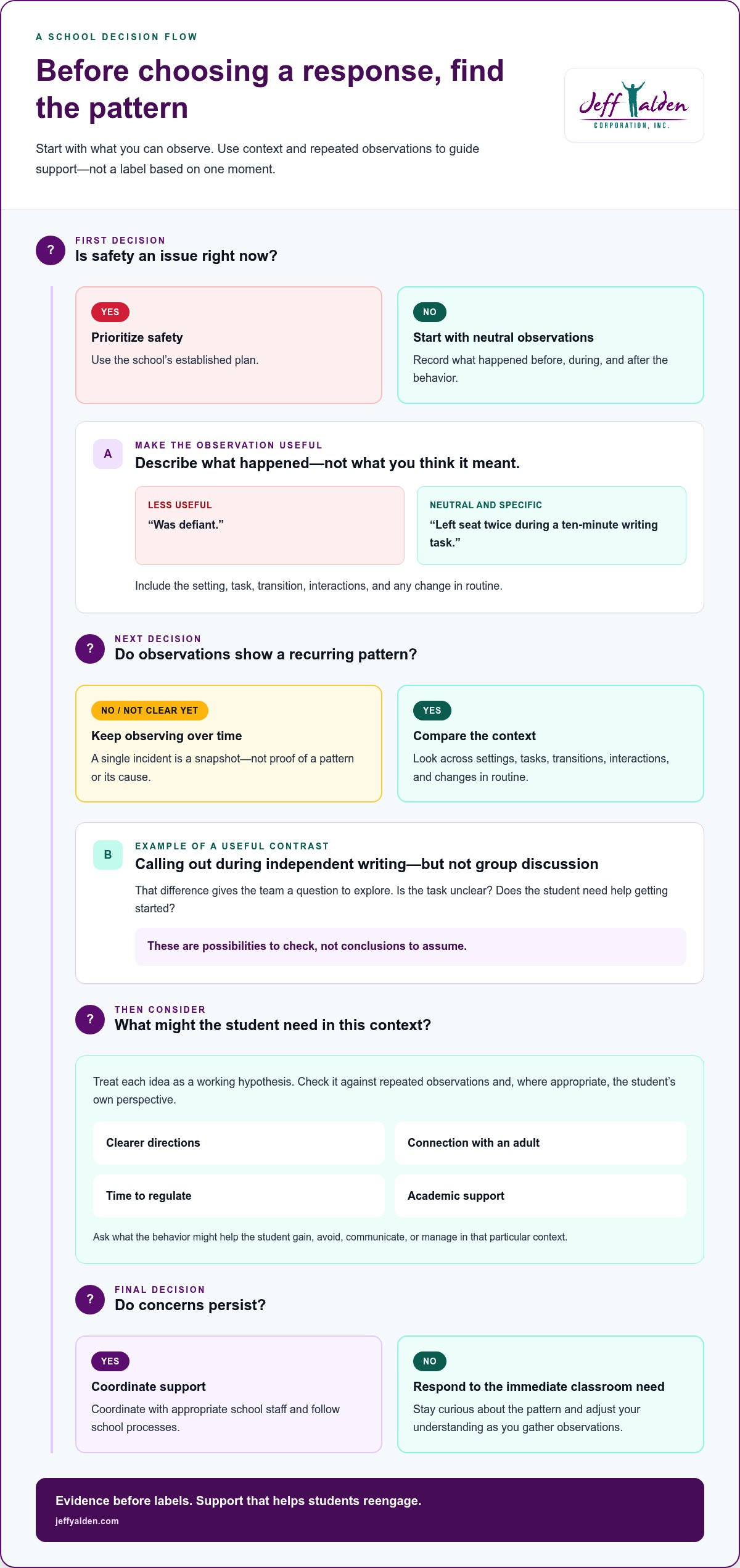
Record what happened before, during, and after the behavior. Keep notes neutral and specific: “left seat twice during a ten-minute writing task” is more useful than “was defiant.” Include the setting, task, transition, interactions, and any change in routine. Then compare observations over time. A single incident is a snapshot, not proof of a pattern or its cause.
For example, if calling out happens during independent writing but not during group discussion, that contrast gives the team a question to explore. Is the task unclear? Does the student need help getting started? These are possibilities to check, not conclusions to assume. Document what you see, not what you think the student intended.
How can schools distinguish a disruption from an unmet support need?
Consider whether the student may need clearer directions, connection with an adult, time to regulate, or academic support. Ask what the behavior might help the student gain, avoid, communicate, or manage in that particular context. Treat each answer as a working hypothesis. Check it against repeated observations and, where appropriate, the student’s own perspective.
A student who puts their head down might be avoiding a difficult task, feeling overwhelmed, or simply having a hard moment. The same action can mean different things in different settings. Respond to immediate classroom needs, but stay curious about the pattern. When concerns persist, coordinate with appropriate school staff and follow school processes. If safety becomes an issue, prioritize safety and use the school’s established plan. Understanding the pattern won’t answer every question, but it can help your team choose a response based on evidence rather than a label.
Why Student Behavior Changes: Connection, Expectations, and Skills
Understanding a behavior gives you a starting point. The next step is to make the expected behavior easier to understand and practice. Students are more likely to engage when routines feel predictable and they experience belonging, not just correction. Warmth and clear boundaries belong together: a student can feel respected while being held to an expectation.
How do relationships and clear expectations work together?
Use direct language students can act on. “Be respectful” may be well meant, but it doesn’t show what to do. “Wait until your classmate finishes, then respond” gives students something they can picture and rehearse. Where appropriate, invite students to help shape a few positively worded routines, such as “Let’s listen while someone is speaking.” Co-creating routines can build shared understanding. Adults still need to model and apply expectations consistently while accounting for individual support needs.
Stating a rule is only the beginning. Teach the action: model it, give students a chance to try it, and revisit it when the class needs a reminder. Then notice the specific behavior you want to encourage. “You asked for clarification before starting, that helped you get going” is more useful than a general “Good job.” The Evidence-Based Classroom Strategies for Teachers from the Center on PBIS offers additional practical guidance for supporting and responding to classroom behavior.
Which skills can students practice instead of disruptive behavior?
A student needs a workable alternative, not only a reminder to stop. Match the skill to the situation: raising a help card when directions are confusing, asking for a short break when overwhelmed, requesting clarification before beginning, or using an agreed signal to contribute. Model and rehearse the skill when the student is calm, so the words or action are familiar in a harder moment.
A consequence responds to what happened; a replacement skill teaches the student what to do next time. Both may have a place, but they serve different purposes. When a student attempts the new skill, recognize it specifically, even if the timing or delivery isn’t perfect. That feedback makes the alternative visible and worth repeating. Consistent adult language and shared expectations can help students encounter the same support across settings. Schools looking to strengthen that shared approach may find educator professional development focused on student well-being a useful complement to classroom practice.
Which Responses Reduce Student Behavioral Issues Without Escalating Conflict?
The best response depends on what’s happening right now. A quiet reminder may be enough for a brief interruption; the same response may fall short if a student is overwhelmed or someone’s safety is at risk. Calm doesn’t mean passive. It means responding with purpose, protecting dignity, and keeping the learning environment safe without adding heat to the moment.
When should a teacher redirect, offer a choice, or pause a conversation?
Match the response to the intensity and context. A brief, neutral redirect can work when a lower-level interruption occurs and the class can keep learning: “Please return to the first question.” If the student is stuck but able to engage, offer two acceptable choices that preserve the learning goal: “Would you like to start with question one or question two?” A choice should be genuine, not a disguised threat.
If the student is visibly escalating, more words or repeated demands can intensify the moment. Use a calm voice, reduce verbal demands, allow physical space, and pause problem-solving until the student is ready to talk. A planned break may help when it’s part of the student’s support approach and classroom safety can be maintained. Keep directions simple. Avoid public arguments, sarcasm, and power struggles.
What does calm follow-through look like?
After the immediate disruption, follow up privately when the student is settled. Briefly name what happened, hear the student’s perspective, clarify any impact on others, and agree on a next step or repair where appropriate. This isn’t a free pass. Harmful behavior still needs a clear response. Accountability can be firm without shaming or escalating conflict.
Use the moment to ask what support or skill might help next time. If a student interrupted repeatedly, for example, the follow-up might include practicing a signal for contributing, then checking whether it helps during the next discussion. A single strategy won’t fit every student or situation. Notice how the student responds and adjust rather than treating one approach as a guaranteed fix.
When does a classroom concern call for coordinated support?
Bring in the appropriate school team when behavior persists, intensifies, or repeatedly blocks the student’s or classmates’ access to learning. Share neutral observations, responses tried, and what happened afterward. Follow any existing student plans and established school safety procedures. If there’s immediate danger or a mental health crisis, use school protocols and qualified emergency support. Classroom strategies can support students, but they don’t replace an individual safety plan or qualified care.
For reducing student behavioral issues, the goal isn’t to find one perfect reaction. It’s to choose a proportionate response, protect safety, and use what happens next to guide the next step.
How to Reduce Student Behavioral Issues: A Repeatable School Action Plan
Consistency doesn’t mean using the same consequence every time. It means following a clear process, so staff can learn from what happens and adjust support instead of starting over after every difficult moment. A practical cycle is simple: observe, connect, teach, coordinate, and review. This gives reducing student behavioral issues a shared direction while keeping the student’s needs and classroom safety in view.
- Observe: Describe the behavior and the situations where it occurs, using neutral, specific notes.
- Connect: Check in respectfully and consider what might make the situation easier to manage.
- Teach: Identify a prevention step and practice a useful alternative skill.
- Coordinate: Clarify which educators or support staff will use the approach and follow up.
- Review: At an agreed check-in, discuss what changed, what didn’t, and what to adjust.
Keep documentation focused on what happened, what support was tried, and what followed. For example: “During the transition to group work, the student left the assigned area; a visual reminder was offered, and the student returned after checking in with the teacher.” Follow school privacy practices, use approved systems, and share information only through appropriate channels. A short, factual record is more useful than a judgment about attitude or intent.
What should a practical behavior-support plan include?
A workable plan names the observable behavior and common situations, then sets out a prevention step, a skill to teach, and a calm response. It also identifies who will follow up and when the team will review progress. Agree on a realistic review point with the relevant educator or support team, based on the student’s needs and school procedures. The aim is to see whether the support helps, not to rush to a verdict.
How can teachers support student reentry after a difficult moment?
Make the return to learning steady and low-key. Welcome the student back without a public lecture or a replay of the incident. Reconnect briefly, point to the next task, and use the agreed reentry routine. If harm needs repair, address it appropriately and involve relevant staff when more support is needed. Reentry isn’t the same as ignoring what happened. It helps the student take the next step while the team follows through.
Schools strengthening this approach may find the trauma-informed teaching professional development guide useful for thinking about supportive, consistent practice. To build educator confidence around student well-being, explore educator professional development as a complement to individualized school support.
Build a School Culture That Supports Students and Reduces Behavioral Issues
Students notice when expectations change from room to room, or when one adult responds calmly and another turns the same moment into a confrontation. Shared language gives staff and students a steadier foundation. Agree on clear phrases for reminders, breaks, help-seeking, and reentry, then use them consistently while honoring individual support needs. These everyday signals make belonging and accountability part of school culture, not just words on a poster.
How can professional development help staff respond more consistently?
Professional development can give educators space to practice practical communication, strengthen student connection, and build confidence in supportive responses. It can also prompt honest reflection: How does my tone affect this interaction? Am I giving a student a clear next step, or adding pressure in a difficult moment? Staff can use those conversations to align classroom approaches with existing school support practices, so students experience greater consistency without expecting every situation to be handled identically.
This work is most useful when it connects to real school routines. Teams can discuss common language for redirection, ways to reinforce student efforts, and how to reconnect after conflict. Educator learning focused on student mental health and well-being can support a broader culture of open communication and resilience. It complements individualized student support; it doesn’t replace it.
When can an assembly complement ongoing student support?
An assembly can create a shared, age-appropriate conversation about resilience, well-being, and asking for help. It gives students and adults a chance to hear common themes together and carry them into everyday interactions. An assembly isn’t an individual behavior intervention, and it can’t guarantee that behavior will change. Its value is in reinforcing the supportive messages students encounter through classroom relationships and school practices.
For schools exploring how a shared event can contribute to campus culture, learn more about high school assemblies and campus culture. Connect the conversation to what students can actually do next: seek support, name a challenge, or take a step toward repairing a relationship. That follow-through helps make reducing student behavioral issues a shared commitment rather than a one-time message.
For a supportive conversation about school programs focused on student well-being, resilience, and mental health, explore Jeff Yalden’s school programs.
Make Support Consistent, One Step at a Time
Reducing student behavioral issues isn’t about finding one response that works for every student. It’s about building a steady cycle: notice patterns without judgment, teach clear expectations and useful skills, respond calmly, then review whether the support is helping. When staff share language and coordinate their approach, students have a clearer path back to learning.
That work grows through everyday interactions, and schools can reinforce it with broader conversations about belonging, resilience, and well-being. High school and middle school assembly programs can open those conversations, while educator professional development focused on student mental health and well-being can help staff strengthen confidence and common practice. These are culture-building supports, not substitutes for individualized student support.
Small, consistent steps matter. Keep observing, stay connected, and adjust with care. Explore Jeff Yalden’s school programs to bring conversations about connection, resilience, and well-being to your school.
Frequently Asked Questions
What is the most effective way to reduce student behavioral issues?
Start by identifying when a behavior occurs and what’s happening around it. Teach a practical replacement skill, set predictable expectations, and respond calmly and consistently. Then review whether the approach helps instead of assuming it will work immediately. If concerns persist, collaborate with the appropriate school support team, especially when safety or access to learning is affected. This steady process helps staff adapt support to the student and situation.
How can teachers manage disruptive behavior without escalating it?
Keep your tone steady, use brief and neutral language, and avoid turning the moment into a public argument. When appropriate, redirect privately or offer a clear choice. If the student is escalating, reduce verbal demands, create space when safe, and follow school procedures. Once the student is ready, reconnect without a lecture and make the next step back into learning clear. Calm follow-through can be firm without adding pressure.
Why do students act out in class?
There’s no single explanation for why a student acts out. A behavior may relate to a difficult task, unclear expectations, a transition, a need for connection, or other circumstances. Observe what happens before and after instead of guessing at intent or assigning a label. If the pattern continues, share objective observations with relevant school staff and consider what support may help. Treat possible explanations as questions to explore, not conclusions.
Do consequences reduce student behavioral issues?
Consequences alone may not teach a student what to do differently next time. Schools can set clear boundaries while also teaching replacement skills and considering the context around the behavior. Responses should be proportionate, consistent with school policy, and focused on restoring access to learning. Review the effect of the approach over time. If it isn’t helping, the team can adjust support rather than relying on punishment as the only tool.
How do you create a behavior plan for a student?
Begin with specific, neutral observations about the behavior and the situations in which it occurs. Agree on a prevention step, a skill to teach, and a consistent adult response. Clarify who will follow up and when the team will review the plan. Coordinate with appropriate school staff, and follow existing student plans, school privacy practices, and safety procedures. Keep records factual so the team can assess what support was tried and what followed.
What should a teacher do when a student refuses to participate?
Avoid assuming the reason or escalating through repeated public demands. Give a brief, calm direction, then consider whether the task, transition, or support needs clarification. Where appropriate, offer a limited choice or a clear way to request help. Follow up privately when the student is calm. If refusal keeps happening or affects learning, share your observations with the appropriate school support staff and coordinate a response.
When should a school seek additional support for student behavior?
Seek additional support when a behavior pattern continues, intensifies, affects learning or relationships, or raises safety concerns. Share observable information with the appropriate school team, and follow existing plans and school procedures. If there’s immediate danger or a mental health crisis, use established emergency and crisis protocols and seek qualified support. Classroom strategies can help, but they shouldn’t replace individualized support when it’s needed.
