
What if the behavior disrupting class is also a sign that a student doesn’t feel safe or settled? A sudden change in participation, focus, or reactions can leave you searching for answers. But recognizing student trauma in the classroom isn’t about treating a behavior as proof. Stress, unmet needs, and many other factors can look similar, so a teacher’s role is to notice patterns, not diagnose.
You may already know a student needs support, yet still wonder what to say without putting them on the spot, or when to bring in someone else. That uncertainty is real. A calm, respectful response can protect a student’s dignity and keep the door open for connection.
This article will help you notice patterns that may warrant a compassionate check-in, respond in ways that support safety and belonging, and follow your school’s safeguarding and referral procedures when concerns arise. You’ll also find practical ways to use predictable routines, thoughtful choices, and strong relationships to support students without taking on the role of a counselor. The goal is clear: notice, respond with care, and connect students with appropriate support.
Key Takeaways
- Recognizing student trauma in the classroom means noticing patterns over time, not treating one behavior as proof.
- Stress may affect learning and relationships, but similar changes can have many different causes.
- Keep objective notes about what you observe and the support you offer, without labeling or trying to diagnose the student.
- Use predictable routines, respectful correction, and meaningful choices to help make the classroom feel safer and more supportive.
- When concerns arise, follow school safeguarding and referral procedures so students can connect with appropriate support.
Recognizing Student Trauma in the Classroom: Start With Patterns, Not Labels
Start with what you can observe, not a story about what you think happened. In plain language, trauma can describe the lasting effects of an experience that overwhelms a person’s ability to cope or feel safe. The broad concept of psychological trauma is complex, and students may experience and respond to difficult events in very different ways. A classroom behavior can signal distress, but it can’t tell you its cause on its own.
That distinction matters. A student who snaps at a classmate, seems distracted, or avoids a task may be having a hard day, responding to a challenge unrelated to trauma, or experiencing a broader change. One moment isn’t a diagnosis. A noticeable shift that continues or appears across situations may be a reason to check in gently and consult the appropriate school support staff.
Teachers observe and support; qualified professionals assess and diagnose. Your care matters, but you don’t have to solve the mystery behind a student’s behavior. Recognizing student trauma in the classroom means staying curious, grounded in what you’ve seen, and focused on the student’s immediate needs.
What might change when a student is struggling?
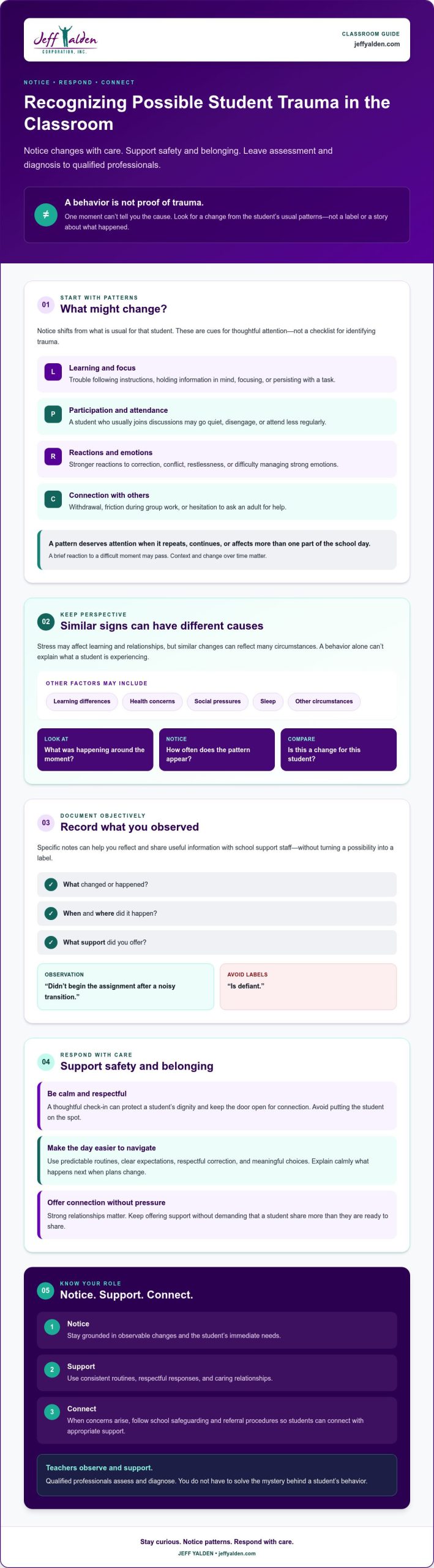
Look for changes from the student’s usual patterns. A student who typically joins discussions may go quiet; another may have more trouble focusing, persisting with tasks, managing strong emotions, attending regularly, or connecting with peers. These examples aren’t a checklist for identifying trauma. They’re cues to notice, especially when a change repeats, lasts, or affects more than one part of the school day. A brief reaction to a difficult moment may pass; a continuing shift deserves thoughtful attention.
Why trauma can look different from one student to another
Some students show distress outwardly through conflict or restlessness. Others pull back, and some appear unchanged at school. There’s no single response to a difficult event. A student’s developmental stage, culture, relationships, sense of belonging, and the context around a situation can all shape what you see and what they feel comfortable showing. Resist comparing students or assuming you know their story. Notice the individual, not a stereotype.
When you’re concerned, make your observations specific: what changed, when it happened, where it occurred, and what support you offered. “Didn’t begin the assignment after a noisy transition” gives a clearer starting point than “is defiant.” Careful observation helps you approach the student with respect and share useful information with school support staff, without turning a possibility into a label.
How Trauma Can Affect Learning, Behavior, and Classroom Connection
Stress can take up a student’s attention. When a young person is focused on what feels uncertain or unsafe, following instructions, holding information in mind, or sticking with a challenging task may become harder. That doesn’t mean every missed assignment or distracted moment is trauma-related. Learning differences, health concerns, social pressures, sleep, and other circumstances can affect schoolwork too.
Picture a student who starts a worksheet, then loses track after a loud hallway interruption. Or someone who usually contributes to group work but goes quiet during a week of changing routines. These are observations, not explanations. Look at what was happening around the moment, how often the pattern appears, and whether it’s a change for that student over time.
Possible effects on attention and participation
A student may seem unusually alert to noise or movement, disengage suddenly, or struggle to return to a task after an interruption. Another may participate confidently in one class and barely speak in another. Rather than drawing a conclusion from one lesson, note the context and frequency, then consider what classroom adjustments may help, such as making directions clear or offering a quiet moment to reset.
Possible effects on relationships and emotional regulation
Stress may also affect how a student connects with peers and adults. You might notice withdrawal, friction during group work, a strong reaction to correction, or hesitation to ask an adult for help. These moments don’t make a student manipulative or difficult. They can have many explanations, and trust may take time to build.
Consistency helps. Clear expectations, predictable routines, and respectful correction can make the classroom easier to navigate. If a student reacts strongly to a change, calmly explain what happens next. If a student pulls away, keep offering connection without demanding disclosure. The same student may respond differently depending on the day, the setting, the people present, or how safe they feel in that moment.
Observable behavior calls for curiosity, not conclusions. That mindset gives you room to respond with care while avoiding assumptions about a student’s history. Shared staff learning can also help teachers build consistent, supportive responses. Teacher professional development focused on student mental health and well-being can support school-wide conversations about how to meet students with respect.
Trauma Signs or Something Else? Avoid Assumptions and Diagnose Less
A change in behavior can have many explanations. Difficulty concentrating, missed classes, conflict with peers, or a strong reaction to feedback may relate to learning needs, health, social pressures, changes at home, classroom conditions, or other factors. Trauma is one possibility, not a conclusion you can draw from behavior alone.
Classroom signs are prompts for support, not diagnostic evidence. Recognizing student trauma in the classroom means responding thoughtfully while staying honest about what you don’t know. You can take a concern seriously without deciding why it’s happening.
How to separate what you observed from what you assume
Write down what you saw and heard, along with the context and support you offered. Keep the wording factual. For example, “During group work, Maya moved to a separate desk after two classmates raised their voices; I checked in quietly” is more useful than “Maya is antisocial and overreacts.” The first describes an event. The second assigns a motive and label.
- Record: what happened, when and where it happened, and who was present, following school privacy practices.
- Describe: the student’s observable words or actions, rather than guessing what they meant.
- Include: what you did to offer support and what happened next.
Share relevant observations with designated school staff through your school’s established process. Keep information private and limited to those who need it to support the student. Don’t investigate, press a student for details about difficult experiences, or promise to keep a disclosure secret. If a student chooses to share, listen calmly and follow school procedures for passing the concern to the appropriate person.
When a concern needs support beyond the classroom
If a concern persists, escalates, or falls outside what you can appropriately support in class, consult school professionals and follow your school’s safeguarding, counseling, and referral procedures. You don’t have to conduct an informal assessment first. If there’s immediate danger, follow school emergency procedures and contact local emergency support as those procedures direct.
The next step may be a check-in from designated staff, a referral through the school process, or another response guided by the student’s needs and school protocols. Your role is to share clear observations, maintain a respectful connection, and act promptly within your responsibilities. Careful notes and a timely handoff help the right people decide what support is appropriate, without turning uncertainty into a diagnosis.
How to Respond When You Notice Possible Student Trauma
A steady response can make a hard moment feel less exposing. You don’t need to know what caused a student’s behavior to offer respect and connect them with help. When recognizing student trauma in the classroom, focus on a simple sequence: notice, steady yourself, check in privately, listen, and connect the student with support.
- Notice: Hold to what you’ve observed, not an assumption about the student’s history.
- Regulate your own response: Pause, lower your voice, and approach without blame or visible alarm.
- Check in privately: Choose a suitable moment and place where the student won’t feel put on display.
- Listen: Let the student choose how much to share. A pause or “I don’t want to talk” is an answer you can respect.
- Connect support: Follow your school’s procedures and involve the appropriate staff when needed.
What to say in a private, low-pressure check-in
Keep it simple and specific: “I’ve noticed you’ve seemed quieter than usual this week. How are you doing?” Then offer a practical opening: “Is there anything that would help you feel more supported in class today?” Avoid pressing for details or asking leading questions about painful experiences. The student may not want to talk, and you can still show care by listening without judgment and leaving the door open.
Be honest about privacy before a student shares more. You might say, “I’ll respect your privacy, but if I’m worried you or someone else may be unsafe, I’ll need to involve someone who can help.” Don’t promise secrecy. Clear, calm boundaries protect trust because the student knows what to expect.
What to do after the conversation
Agree on one manageable next step, such as checking in again or speaking with a designated school staff member together, if appropriate. Follow school procedures, share only relevant information with the appropriate people, and check back without asking the student to disclose more. If you believe the student may be unsafe, act promptly through established safeguarding and emergency pathways.
These conversations are easier to handle when staff share a common, supportive approach. For broader school practice, explore the trauma-informed teaching professional development guide. Schools looking to strengthen staff learning around student mental health can also explore teacher professional development.
Build a Classroom Where Students Can Find Safety and Support
Support isn’t one perfect conversation. It’s the steady message students receive in ordinary moments: expectations are clear, adults respond respectfully, and asking for help won’t mean being shamed. These foundations can benefit the whole class, without singling out a student or assuming what they’ve experienced.
Small classroom practices that support predictability and belonging
Keep routines and transitions as consistent as you can. If plans change, explain what’s different and what students can expect next. Clear directions and calm reminders reduce guesswork. When correction is needed, address the behavior without humiliating the student. A quiet word may protect their dignity better than a public reprimand.
Offer reasonable choices while keeping expectations steady. A student might choose whether to start an assignment independently or with a partner, or share an idea aloud or in writing. Choices don’t remove boundaries. They give students a manageable way to participate within them.
Trust grows through follow-through. A familiar adult who checks in as promised can make support feel more accessible. If a student signals they need help, respond consistently and connect them with the appropriate school staff. Coordinate with teachers, counselors, families, and school leaders as appropriate, sharing information only through school processes and in keeping with privacy expectations.
When staff learning and school-wide support can help
Students move through a community, not just one classroom. Shared staff practices can help reduce confusing or inconsistent responses when a student is struggling. Teacher professional development focused on student mental health and well-being can support common language and coordinated educational approaches. This is staff learning, not a substitute for qualified assessment or clinical care.
Building resilience can help teens develop ways to face challenges, but resilience doesn’t mean handling hardship alone or replace needed support. Explore building resilience in teens as one part of a wider conversation about connection and help-seeking. Recognizing student trauma in the classroom is only a starting point; a predictable, caring school environment helps turn awareness into day-to-day support. Schools interested in educational programs that encourage conversations about mental health and resilience can explore Jeff Yalden’s school programs.
Make Your Next Step One of Care and Connection
Recognizing student trauma in the classroom isn’t about finding a label or uncovering a student’s private story. It’s about noticing meaningful changes, staying curious about what they may mean, and responding with respect. A calm check-in can help, as can clear routines, treating students with dignity, and following school procedures when concerns need more support.
You don’t have to carry that responsibility alone. Work with the appropriate school staff, protect student privacy, and keep the focus on connection rather than conclusions. When teachers and school teams share a thoughtful approach, students can encounter more consistent messages of care across their day.
Jeff Yalden offers teacher professional development focused on student mental health and well-being, along with school programs that address mental health conversations and resilience. These are educational opportunities for schools, not clinical assessment or treatment. Explore Jeff Yalden’s school programs to learn more.
Your steady presence matters. You can’t control everything a student is facing, but you can help make your classroom a place where they’re treated with dignity and know support is within reach.
Frequently Asked Questions
Can teachers recognize trauma in a student?
Teachers can notice changes or repeated patterns that suggest a student may need support, but they can’t confirm trauma from behavior alone. Recognizing student trauma in the classroom means staying attentive without assigning a diagnosis. Changes in attention, attendance, mood, or relationships can have many causes. Record objective observations, avoid labels, and consult the appropriate school professional. Your role is to respond with care and help connect the student with suitable support.
What are signs of trauma in the classroom?
Possible observations include changes in participation, concentration, attendance, emotional reactions, or peer relationships. None proves trauma, and the same behavior can have different explanations. Look for changes from the student’s usual patterns and consider when and where they occur. If a concern continues or escalates, follow school procedures and consult designated student-support staff. A checklist can’t tell you what a student has experienced or what kind of help they need.
How should a teacher talk to a student who may be experiencing trauma?
Choose a calm, private moment and describe what you’ve noticed without judgment, such as, “You’ve seemed quieter than usual. How are you doing?” Ask what might help them feel supported today, then give them space to answer or decline. Don’t press for personal details. Be clear that you’ll respect their privacy, but may need to involve designated staff if you’re concerned about safety. Follow your school’s procedures afterward.
Can a teacher ask a student what happened to them?
A teacher should avoid pressing a student to recount a potentially traumatic experience. You can check in gently, listen if the student chooses to speak, and ask what support would help now. Don’t investigate, ask leading questions, or request unnecessary details. If the student shares a safety concern, stay calm and follow your school’s safeguarding procedures. Involve the appropriate trained professional so the student can receive support through the right channels.
What should I do if a student discloses trauma or abuse?
Stay calm, listen without judgment, and let the student speak without probing for details. Don’t promise secrecy. Explain simply that you may need to share what they’ve told you with people who can help keep them safe. Follow your school’s safeguarding and reporting procedures promptly, including its guidance on recording the disclosure. If you believe there’s immediate danger, use the school’s emergency process and contact local emergency support as directed by school procedures.
Can trauma affect a student’s learning and behavior?
Stressful experiences may affect concentration, participation, a student’s sense of safety, or interactions with peers and adults, but responses vary. A change in schoolwork or behavior doesn’t establish its cause. Consider other possible factors, note what you observe, and consult designated school-support staff if concerns persist. In class, keep expectations clear and respond with compassion. Consistent support can help without requiring you to know or make assumptions about the student’s history.
How can schools create a trauma-informed classroom?
Schools can build supportive classrooms with predictable routines, clear expectations, respectful communication, and reliable ways for students to ask for help. Staff can coordinate through privacy-conscious school procedures so students receive thoughtful, consistent responses. Collaboration with counselors, families, school leaders, and other relevant professionals can help connect students with appropriate support. These classroom practices and staff learning are educational supports; they don’t replace individualized assessment or treatment by qualified professionals.
