
What if the most powerful tool in your mental health toolkit isn’t a new screening or a clinical referral, but a radical shift in how you talk to parents? The “them versus us” mentality between home and school is more than just an administrative headache. It is a barrier that is literally costing lives. You know the weight of this. You see the 40% of students who feel hopeless every single day. You’re tired of parents only showing up when there’s a crisis at the door. It’s time to stop settling for “involvement” and start demanding real connection.
I’ve been in the trenches, and I know that bridging this gap is the only way forward. You’ll discover actionable, high-impact parent engagement strategies for high school mental health designed to save lives and build lasting resilience. We’re moving past the clinical jargon to find what actually works in 2026. We will look at how radical transparency and shared vulnerability can create a unified front between staff and families, ensuring that student well-being becomes a shared mission rather than a solo struggle.
Key Takeaways
- Shift your mindset from administrative checkboxes to active mental health advocacy by building a foundation of radical transparency with families.
- Implement high-impact parent engagement strategies for high school mental health that bridge the “Silent Gap” and dismantle the “them vs. us” mentality.
- Master the four key pillars of Trust, Transparency, Vulnerability, and Consistency to transform parents from passive observers into life-saving partners.
- Identify and dismantle the “Trust Deficit” and cultural barriers that often prevent families from engaging with school-based mental health initiatives.
- Learn how high-energy community seminars and visceral storytelling act as the ultimate catalysts for creating a unified, resilient school culture.
The Crisis in the Hallways: Why Parent Engagement is the Missing Link
The hallways of our high schools are screaming, even if you can’t hear them. We’ve spent years building clinical walls inside our schools, thinking we could “fix” kids between the first and last bell. We were wrong. In 2026, parent engagement isn’t about bake sales or showing up for a PTA meeting to complain about the lunch menu. It’s about active, life-saving mental health advocacy. Parent engagement is a proactive, collaborative partnership where school and home act as a unified nervous system for student wellness. Without the “village” approach, we are just managing symptoms while the root cause continues to fester at home.
The “Silent Gap” is where our teens are getting lost. It’s that disconnect where a student is struggling at school, but the parents have no idea until a crisis hits. Or the parents see the warning signs at 2:00 AM, but the school is left in the dark. This isolation fuels the fire. We cannot solve this crisis in a vacuum. Effective parent engagement strategies for high school mental health require us to tear down the “them vs. us” mentality and start looking at the family unit as the primary site of healing. By implementing radical parent engagement strategies for high school mental health, we create a safety net that actually holds.
The Reality of Teen Mental Health in 2026
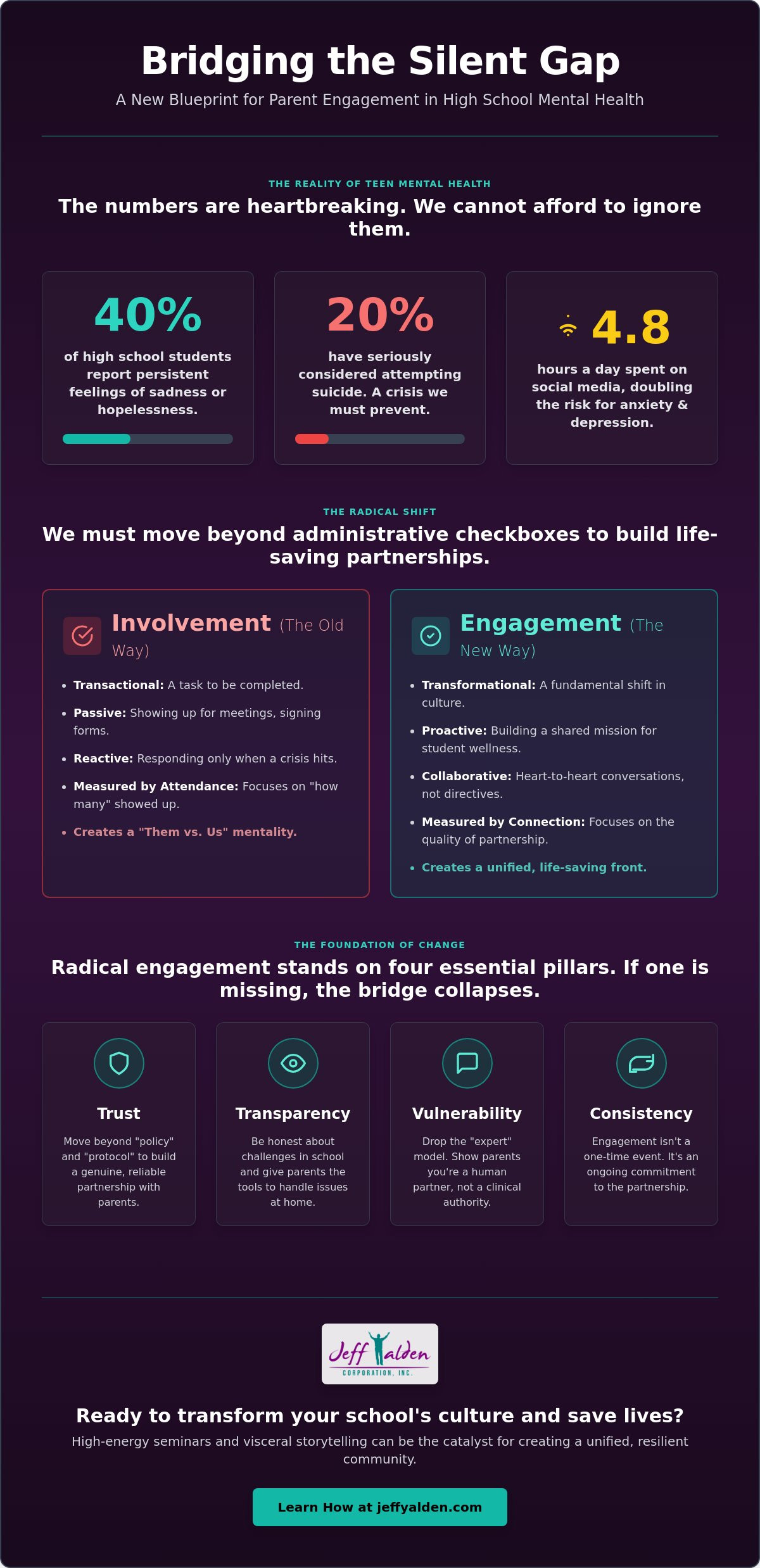
Look at the numbers; they don’t lie, and they are heartbreaking. Right now, 40% of high school students report persistent feelings of sadness or hopelessness. About 20% have seriously considered attempting suicide. These aren’t just statistics; they’re our kids. The digital age has accelerated this isolation. The average teenager is spending 4.8 hours a day on social media, doubling their risk for anxiety and depression. Traditional “school-only” interventions can’t compete with that kind of 24/7 digital pressure. We need a strategy that follows them home. We need a way to reach parents before the damage is irreparable.
From Crisis Management to Proactive Partnership
We have to stop “fixing students” and start supporting families. This requires radical transparency. It means being honest about what’s happening in the building and giving parents the tools to handle what’s happening at the kitchen table. Research often highlights the role of family therapy and parent training in successful outcomes. Bringing in a professional teen mental health speaker can jumpstart this conversation, breaking the ice so real work can begin. When we move from reactive crisis management to proactive partnership, parent engagement becomes a powerful protective factor. It’s the difference between responding to a tragedy and preventing one from ever happening. We are building a bridge, and it has to be strong enough to carry the weight of a child’s life.
Involvement vs. Engagement: Making the Radical Shift
Involvement is a transaction. Engagement is a transformation. For too long, we’ve settled for involvement because it’s easy to measure. We count the signatures on a consent form. We track the number of bodies in seats at a back-to-school night. But let’s be real. Signing a form isn’t the same as leaning into the struggle. To save lives, we need parent engagement strategies for high school mental health that demand more than just a “sign off.” We need parents who are willing to get into the trenches with us. We need a partnership built on heart-to-heart conversations, not just administrative checkboxes.
Radical engagement stands on four pillars: Trust, Transparency, Vulnerability, and Consistency. If you’re missing one, the bridge collapses. You can’t expect a parent to trust the school with their child’s deepest pain if the school is hiding behind “policy” or “protocol.” We have to move away from the clinical “expert” model. Parents don’t want a doctor talking down to them from a pedestal. They want a lived-experience partner who says, “I see you. I’ve been there. Let’s do this together.” This is how we move from a “them vs. us” battle to a unified front.
Deconstructing the Expert Barrier
Clinical jargon is a wall. When educators use words like “affective dysregulation” or “maladaptive coping,” parents check out. They feel small. They feel judged. We need to use “raw” language that speaks to the soul. It’s okay to say, “Your kid is hurting, and we are worried.” It’s powerful when a principal says, “I don’t have all the answers, but I’m here.” Research into the barriers to parent engagement shows that stigma and communication gaps are the biggest hurdles. By dropping the “expert” act, you dismantle the stigma. You create a culture where parents feel like partners in a shared mission rather than patients in a waiting room.
The Engagement Framework for Schools
Stop making engagement feel like “extra work.” If it feels like a chore, parents won’t do it. We need multiple touchpoints that fit into their lives. Use digital platforms for “Real Talk” updates that focus on student wins and emotional health, not just grades and absences. Measure your success through student sentiment and qualitative feedback. Are the kids feeling supported? Are the parents feeling heard? If you want to ignite this shift, sometimes you need a teen motivational speaker to break the ice and start the raw conversations that policy can’t reach. It’s about creating a visceral connection that makes parents want to show up before a crisis hits.
5 Tactical Strategies to Ignite Parent Engagement Today
The time for theory is over. You need boots-on-the-ground action. If you want to move the needle, you have to disrupt the status quo. These five parent engagement strategies for high school mental health are designed to break through the noise and create immediate, visceral impact. We are moving past the “invite and hope” model into a “connect and transform” reality.
- Strategy 1: The ‘Raw’ Community Night. Stop hosting boring lectures. Bring in high-energy speakers who can break the ice and speak the truth about the teen experience.
- Strategy 2: The Transparency Loop. Establish a weekly “Real Talk” update. Share the emotional “vibe” of the campus, not just the academic calendar.
- Strategy 3: Vulnerability Modeling. When staff share their own stories of resilience, they give parents permission to be human. It bridges the gap between expert and caregiver.
- Strategy 4: Peer-to-Peer Parent Networks. Facilitate safe spaces where parents can connect without judgment. Let them realize they aren’t alone in this fight.
- Strategy 5: Integrated Resilience Training. Align your student high school assembly programs with your parent seminars. When the same message hits the gym and the kitchen table on the same day, you create a shared language for healing.
Implementing these parent engagement strategies for high school mental health requires a shift in leadership. It’s about being brave enough to be real. You aren’t just managing a school; you’re leading a community toward wellness.
Hosting High-Impact Community Events
The standard “PowerPoint in the gym” is dead. It’s clinical. It’s forgettable. It’s why nobody shows up. To get parents in the door, you must promise a transformation. The “Jeff Yalden” method focuses on high-energy, emotionally resonant presentations that demand attention and spark immediate change. Market these events by focusing on the “Why.” Don’t tell them they’ll learn about anxiety. Tell them they’ll learn how to save their child’s life.
Creating the ‘Transparency Loop’
Communication shouldn’t only happen during a crisis. A true transparency loop keeps families informed about the collective mental health of the student body. This starts with your team. Investing in trauma-informed teaching professional development ensures that every staff member can communicate with families from a place of empathy and radical honesty. Use postvention strategies to keep the conversation going long after a crisis occurs, ensuring no family feels abandoned when the dust settles.
Breaking Down Barriers: Trust, Culture, and Resistance
Even the most brilliant parent engagement strategies for high school mental health will fail if you don’t address the elephant in the room: the Trust Deficit. Many parents aren’t just busy; they’re terrified. They’re afraid of being judged. They’re afraid of being labeled as “bad” parents. They’re afraid that if they open up about their child’s struggle, the school will use it against them. This fear creates a wall of resistance that no flyer or email can penetrate. We have to stop acting like clinical observers and start acting like allies in the trenches.
The “Busy Parent” hurdle is often a mask for this emotional exhaustion. When we meet them where they are, digitally and emotionally, we prove that we value their time and their heart. This means moving beyond the school walls. It means text updates that offer hope, not just reminders. It means acknowledging that their life is a whirlwind and showing them that we are here to lighten the load, not add to it. Resistance isn’t a dead end. It’s a signal that more trust needs to be built.
Cultural Competency in Mental Health Engagement
You cannot use a one-size-fits-all message in a multicultural world. Cultural context shapes how families perceive mental health. In some communities, these topics are strictly private. In others, there is a deep-seated suspicion of authority figures in the school system. To build a true “village,” we must adapt our message without losing its raw impact. This isn’t about being “politically correct.” It’s about being human. Respect different family structures. Listen more than you talk. When parents see that you respect their heritage and their values, the door to engagement finally swings open.
Winning Over the Skeptics
The hardest barrier to break is the parent who insists, “My kid is fine, we don’t need this.” It’s a defense mechanism. But with 60% of American youth with major depression receiving zero treatment, “fine” is a dangerous word. We win these skeptics over by reframing the conversation. We aren’t just talking about illness; we are talking about building resilience in teens. This is a universal need. Every student, no matter how “fine” they seem, needs the tools to bounce back from the pressures of 2026. If you want to break through the skepticism and start these vital conversations, you need to invite a mental health speaker who can speak the truth with love and authority.
The Jeff Yalden Approach: Transforming Schools Through Parent Seminars
You’ve tried the flyers. You’ve sent the emails. You’ve probably even tried the automated calls that everyone ignores. If you want to see a change, it’s time for a pattern interrupt. A professional teen mental health speaker isn’t just another guest on the calendar. They are the catalyst that turns a passive audience into a movement. Jeff Yalden’s “Community Night” model is built on one thing: visceral connection. It’s not a lecture. It’s a shared experience. When parents see a speaker being raw and vulnerable, it gives them permission to do the same. This is where real parent engagement strategies for high school mental health finally take root and grow.
The magic happens when you integrate student assemblies with parent seminars. Imagine the impact. Your students hear a message of hope and resilience in the morning. Your staff gets trained in the afternoon. Then, that evening, the parents hear the same core message tailored specifically for them. You create a 360-degree impact that surrounds the student. You provide a shared vocabulary for the entire community. This isn’t just about “awareness.” It’s about a “Radical Transparency” promise that restores hope and saves lives. It’s about looking parents in the eye and telling them the truth they’ve been too afraid to voice. By using these parent engagement strategies for high school mental health, you bridge the gap between the school’s mission and the home’s reality.
Why a Speaker is the ‘Pattern Interrupt’ You Need
Breaking the cycle of administrative noise is hard. Most school communications feel like “business as usual,” and parents have learned to tune it out. Jeff Yalden bridges the gap between clinical jargon and the “real world.” He doesn’t talk down to parents. He talks with them as a peer who has walked through the fire. In 90 minutes, he can move a room from skeptical silence to active advocacy. It’s about making mental health a kitchen table conversation again. He provides the “real talk” that cuts through the stigma and makes parents realize they are the most important part of the solution.
Taking the Next Step for Your School
Ready to move? Booking a teen suicide prevention program that includes a dedicated parent engagement component is the most significant investment you can make for your campus culture. It’s not just a one-day event. It’s the start of a radical shift in how your community functions. The long-term ROI isn’t just better attendance or fewer crises. It’s a community that knows how to fight for its kids. Prepare your staff and your families for a new reality where parents are your strongest allies. Let’s stop managing the problem and start solving it together. The lives of your students are worth the radical shift.
Ignite the Partnership That Saves Lives
The time for theory has passed. You’ve seen how the “Silent Gap” fuels teen isolation and why moving from administrative involvement to radical engagement is the only way forward. By dismantling trust deficits and building a transparent, multicultural village, you create a safety net that actually holds. Implementing these parent engagement strategies for high school mental health is a bold commitment to your community’s future. It’s about deciding that “good enough” is no longer an option when our students’ lives are on the line.
You don’t have to navigate this radical shift alone. Founded in 1992, I bring over 30 years of experience as a specialist in suicide postvention and crisis intervention. My high-energy, “real” and “raw” approach is designed to break through the noise and get parents to finally respond. It’s time to transform your campus culture from the inside out. Bring Jeff Yalden to your school for a Radical Parent Engagement Seminar and let’s start the conversation that restores hope. Your students are worth the effort. Let’s do this together.
Frequently Asked Questions
How do you engage parents in high school mental health?
You engage parents by ditching the clinical jargon and building a foundation of radical transparency. It’s about moving away from “school hours” and into “life hours.” Successful parent engagement strategies for high school mental health require constant, honest communication that doesn’t just happen during a crisis. It’s about showing parents that you’re their partner in the trenches, not just an administrative body that only calls when something is wrong.
What is the difference between parent involvement and parent engagement?
Parent involvement is a transaction, while parent engagement is a deep, transformative partnership. Involvement looks like signing a permission slip or attending a bake sale. Engagement looks like a parent and a teacher having a raw conversation about a student’s emotional well-being. It’s the difference between “checking a box” and “leaning into the struggle.” Engagement requires vulnerability from both sides to create real change and a unified front for the student.
Why do parents resist mental health programs in schools?
Parents often resist these programs because they feel judged or terrified that their child’s struggle is a reflection of their parenting. Stigma is a massive wall. Some families view mental health as a private matter or a sign of weakness. Others are simply exhausted by the “them vs. us” mentality they’ve experienced with schools in the past. Breaking this resistance requires a radical shift toward empathy and shared vulnerability.
How can schools build trust with parents regarding sensitive topics like suicide?
Building trust on topics like suicide requires schools to lead with heart instead of liability. You have to be willing to be “real” and “raw” about the dangers our teens face in 2026. Stop hiding behind policy. When parents see that you care more about their child’s life than the school’s reputation, the walls come down. Trust is earned through consistent, honest, and proactive communication before a tragedy occurs.
What are the best topics for a parent mental health seminar?
The best topics focus on the immediate pressures teens face, such as social media isolation and the “always-on” digital culture. Seminars should cover practical resilience building and how to spot early warning signs of depression. Don’t just talk about the problem. Give parents tactical communication skills they can use at the dinner table tonight. Focus on the “Why” behind teen behavior to foster deeper understanding and connection at home.
How does parent engagement impact student academic success?
Effective parent engagement strategies for high school mental health directly correlate with higher academic focus and lower absenteeism. When a student feels supported by a unified front at home and school, their cognitive load decreases. They aren’t just surviving; they’re learning. Mental health is the foundation of academic success. A student who feels safe and heard is a student who can actually perform and excel in the classroom.
Can a school assembly speaker really improve parent engagement?
A high-energy school assembly speaker acts as a powerful pattern interrupt that breaks the cycle of administrative noise. They bridge the gap between the clinical world and the real world. By sharing lived experience and imperfections, a speaker makes the topic of mental health accessible and urgent. They move parents from passive listeners to active advocates by creating a visceral connection that a standard PowerPoint or academic lecture simply cannot achieve.
What should a school do if parent attendance at events is low?
If attendance is low, you need to change your marketing from the “What” to the “Why.” Stop inviting parents to a “mental health seminar” and start inviting them to learn “how to save your teen’s life.” Use digital touchpoints like short, punchy video updates to build interest. Meet them where they are emotionally. If they aren’t coming to the gym, find ways to bring the “real talk” to their screens first.
