
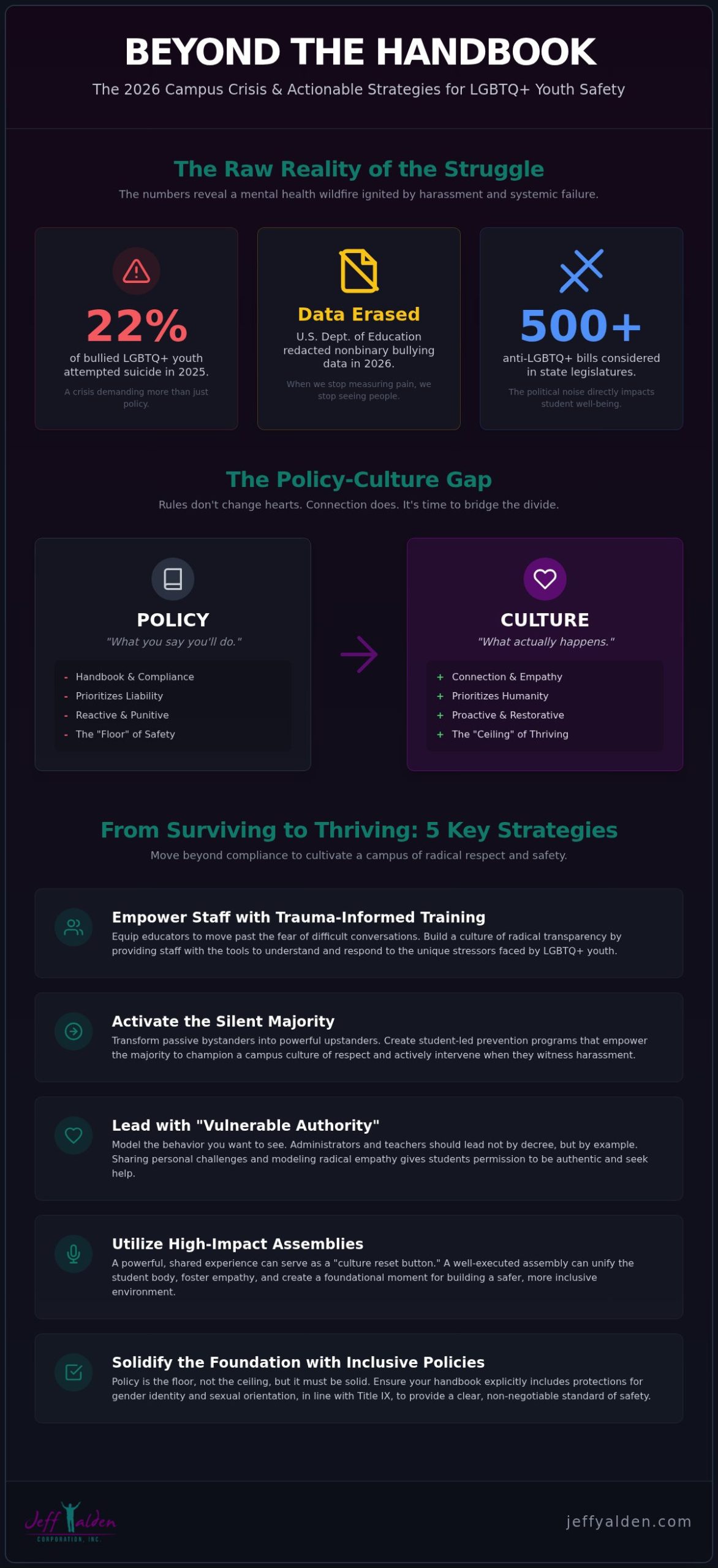
In 2025, 22% of LGBTQ+ youth who were bullied attempted suicide. That isn’t just a statistic; it’s a heartbeat stopped, a family shattered, and a school community left searching for answers. With the U.S. Department of Education redacting nonbinary bullying data in 2026, the burden of protection has shifted entirely onto your shoulders. You know that generic, “box-ticking” policies aren’t enough to stop the hallway whispers or the bathroom stalls filled with tears. You’re exhausted from managing constant social friction, and you’re terrified for the students who are fading away right in front of you.
I’ve been in those trenches, and I know that culture heals where policy only protects. This article delivers actionable, high-impact bullying prevention strategies for LGBTQ youth designed for the specific challenges we face in 2026. We’re moving beyond the handbook updates to build a campus where your students don’t just survive, they thrive. You’ll discover practical tools to lower suicide risk immediately, alleviate teacher burnout, and create a unified culture of radical respect. It’s time to stop reacting to the crisis and start building a sanctuary where every student feels seen, safe, and supported.
Key Takeaways
- Understand why the 2026 campus climate demands a move beyond “box-ticking” policies to address the deep connection between harassment and mental health crises.
- Discover actionable bullying prevention strategies for LGBTQ youth that bridge the gap between your school handbook and the raw reality of hallway slurs.
- Empower your staff with trauma-informed professional development to replace the fear of difficult conversations with a culture of radical transparency.
- Activate the silent majority of your student body by turning passive bystanders into powerful upstanders who lead the charge for campus respect.
- Learn how a high-impact high school assembly can serve as a culture “reset button” to foster a sanctuary where every student thrives.
The Raw Reality of LGBTQ Bullying in 2026
The campus climate in 2026 is a battlefield. While we talk about inclusion in faculty meetings, our students are fighting for their lives in the hallways. The U.S. Department of Education recently redacted nonbinary bullying data from its civil rights collection. That is a tactical erasure of identity that hits harder than any fist. When we stop measuring the pain, we stop seeing the person. Verbal harassment isn’t “just kids being kids.” It’s the spark that ignites a mental health wildfire. It’s the precursor to a crisis that no school handbook can solve on its own.
LGBTQ youth carry a heavy burden called minority stress. It’s a constant, low-level hum of anxiety that comes from living in a world that constantly debates your right to exist. For these kids, the school building isn’t always a place of learning. Often, it’s a place of hyper-vigilance. With over 500 anti-LGBTQ+ bills considered in state legislatures by May 2026, the political noise is deafening. Our kids are listening. They hear the debates, and they feel the rejection. “Business as usual” administrative policies are failing because they prioritize liability over humanity. We need radical, heart-centered bullying prevention strategies for LGBTQ youth that prioritize human connection over paperwork.
The Statistics of the Struggle
The numbers are a gut punch. In 2025, 22% of bullied LGBTQ+ youth attempted suicide. That is nearly one in four kids who see no other way out because of the environment we’ve allowed to persist. This pain translates directly to the classroom. When a student is afraid of being outed or harassed, their GPA is the last thing on their mind. Academic decline is a symptom of a soul in survival mode. To truly understand the scope, looking at an LGBTQ bullying overview reveals a cycle of trauma that starts with a single word in a locker room and ends in a hospital room. Cyberbullying has only intensified this, following gender-diverse youth into the one place they should feel safe: their own homes.
From Survival to Flourishing
We have to stop aiming for “not dying.” That’s the floor, not the ceiling. Our goal must be a campus where every student flourishes. This transformation starts with radical transparency from the adults in the room. Kids can smell a fake from a mile away. If you aren’t willing to be real about the struggle, they won’t be real about their pain. Resilience isn’t something kids are just born with; it’s built through authentic connection. We must implement bullying prevention strategies for LGBTQ youth that foster genuine relationships and safe spaces. When students see adults standing up with courage, they find the strength to do the same. We are moving from a culture of survival to a culture of victory.
Policy vs. Culture: Why Rules Aren’t Enough for Prevention
You have the handbook. It’s thick. It’s compliant. It sits on a shelf or lives in a PDF on the school website. But does it stop the slur thrown in the hallway between second and third period? No. It doesn’t. That’s the “Policy-Culture Gap.” Policy is what you say you’ll do; culture is what actually happens when no one is looking. Effective bullying prevention strategies for LGBTQ youth require us to stop hiding behind legal jargon and start looking our students in the eye. We’ve spent years updating the wording of our conduct codes while the campus climate remains frozen in fear. Rules don’t change hearts. Connection does.
I advocate for the “vulnerable authority” model. It means leading by example, not by decree. If you want a culture of respect, you have to model radical empathy. You have to be the adult who isn’t afraid to be real about life’s challenges. When we show up as our authentic selves, we give our students permission to do the same. This isn’t about being their friend. It’s about being a mentor who has “been there” and isn’t afraid to show the scars. Radical empathy outpaces regulation every single time because it builds a community where bullying isn’t just “against the rules,” it’s against the very fiber of who you are as a school.
The Foundation: LGBTQ-Inclusive Policies
In 2026, your policy must be explicit. General “anti-bullying” language is a sieve that lets the most vulnerable students fall through. Your documentation needs specific protections for gender identity and sexual orientation to be effective. Title IX compliance isn’t just a suggestion; it’s a legal necessity that firmly includes gender identity. However, we must recognize that policy is the floor, not the ceiling. It keeps you from falling into a lawsuit, but it doesn’t help your students soar. It’s the bare minimum requirement for a functioning, safe school environment.
The Ceiling: Campus Culture Transformation
To reach the ceiling, you have to break the ice. Sometimes, the most powerful move is bringing in a teen mental health speaker to say the things your staff is too nervous to whisper. We need to move from “tolerance” to “active affirmation.” Tolerance is just putting up with someone’s presence. Active affirmation is celebrating it. It shows up in visible allyship in the front office and teachers who aren’t afraid to correct a pronoun. If you want to see a real shift in your students’ eyes, you have to show them that they belong, not just that they are allowed. If you’re ready to start this journey, consider how motivational school assemblies can serve as the catalyst for this radical shift.
Radical Transparency: Strategies for Educators and Staff
Teachers, I see you. You’re walking a tightrope every single day. The fear of saying the wrong thing, facing parental backlash, or navigating the 2026 political minefield is exhausting. It’s easier to look down at your grading than to look up and address the tension in the room. But silence is a message. When we ignore the “casual” slur or the pointed eye-roll, we tell our LGBTQ students that their safety is negotiable. We have to move past the fear. Effective bullying prevention strategies for LGBTQ youth start with adults who are willing to be radically transparent about their own values of respect and inclusion. You don’t need to be an expert in every identity; you just need to be an expert in human decency.
You can’t lead where you won’t go. This is why trauma-informed teaching professional development is the backbone of a safe campus. It equips you to see the “why” behind the “what.” Most bullying is a misplaced attempt at connection or a projection of internal pain. When you understand trauma, you stop reacting to the behavior and start responding to the student. This shift allows you to handle microaggressions in real-time without turning the classroom into a courtroom. You create a safe harbor by being the most honest person in the room.
Equipping the Front Lines
You need tools, not just theories. When you hear a slur, the “don’t say that” approach is dead. It doesn’t teach; it just silences. Try a script that focuses on impact: “That word carries a weight of pain that doesn’t belong in this community. We’re better than that.” It’s short. It’s punchy. It sets a boundary without a lecture. Building staff resilience is about knowing you have the administration’s back when these difficult community conversations happen. In 2026, the school counselor’s role has shifted. They aren’t just schedule-makers anymore. They are the tactical anchors for crisis intervention, providing the deep-dive support that follows your initial classroom intervention.
The Power of Vulnerable Leadership
Gen Z can smell a fake from a mile away. If you want their trust, you have to earn it with your own vulnerability. Share your struggles. Talk about times you felt like an outsider or when you had to find the courage to stand up for someone else. Normalizing the conversation around mental health and identity happens when we stop being “clinical” and start being personal. These bullying prevention strategies for LGBTQ youth only work when students see you as a “vulnerable authority”—a mentor who has navigated the dark and is now holding the flashlight for them. When you lead with your heart, the culture follows.
Empowering the Silent Majority: Student-Led Prevention
Look at your student body. You see the loud bullies. You see the kids who are hurting. But do you see the 80% in the middle? That’s the Silent Majority. They aren’t the ones throwing the slurs, but they’re the ones looking at their shoes when it happens. They’re uncomfortable. They’re conflicted. And mostly, they’re scared that if they speak up, they’ll be the next target. If we want real change, we have to activate this middle ground. Activating the silent majority is one of the most effective bullying prevention strategies for LGBTQ youth because it shifts the social cost from the victim to the aggressor.
This shift doesn’t happen through a memo or a poster in the cafeteria. It starts with high-impact high school assemblies that strip away the BS and speak directly to the heart. We have to build resilience in teens so they have the courage to lead. Courage isn’t the absence of fear; it’s the decision that something else is more important. We teach them a 5-step framework for advocacy: 1. Self-education on LGBTQ identities. 2. Identifying safe adult allies. 3. Building a coalition of peers. 4. Creating visible symbols of support. 5. Safe, tactical intervention. When students lead, the culture follows.
Activating Student Leadership
Your GSA club shouldn’t just be a support group meeting in a basement classroom. It needs to be an engine room for campus influence. Empower these students to be the “culture-builders” of your school. We need peer-to-peer mental health advocacy models where students look out for one another’s emotional well-being. Reward the behaviors you want to see. When a student stands up for a peer, recognize that bravery. Make “being a good human” the highest status a student can achieve on your campus. It’s about making kindness louder than the hate.
The Upstander Protocol
We can’t just tell kids to “stand up.” We have to give them a tactical protocol. Step 1 is direct intervention. If it’s safe, they say, “We don’t do that here.” It’s short and it sets a boundary. Step 2 is the distraction technique. If a student sees a peer being harassed, they can interrupt by asking the victim a random question about homework or a game. It breaks the momentum of the bully. Step 3 is delegation. They report the incident to a trusted adult. We have to kill the “snitching” stigma by framing reporting as a heroic act of protection. If you’re ready to transform your campus culture from the inside out, book a youth motivational speaker who can spark this fire today.
Transforming Your Campus with Jeff Yalden’s Radical Approach
Sometimes, the air in a school building gets too heavy to breathe. The tension between students, the fear among staff, and the silent cries of your LGBTQ youth create a pressure cooker that policy cannot vent. You need a reset button. A high-impact school assembly is that moment of collective exhale. Since 1992, I’ve stood on stages across the globe, not as a clinical expert, but as a lived-experience guide who knows exactly what it’s like to feel invisible. I don’t just deliver a speech; I ignite a transformation. When we implement these bullying prevention strategies for LGBTQ youth through a live, raw experience, the impact is immediate and undeniable.
In 2026, our bullying prevention strategies for LGBTQ youth must be inseparable from our teen suicide prevention programs. We aren’t just trying to stop mean words; we are fighting to keep kids alive. My approach is real, and it’s designed to bridge the gap between the administrative handbook and the reality of the locker room. We bring the energy, the heart, and the radical transparency that Gen Z demands. We stop the “box-ticking” and start the heart-beating.
The Assembly Experience
Walls don’t come down through lectures. They come down through humor and heart. I use laughter to disarm the room, then I lead the student body into a space of collective vulnerability. It’s a moment where the “cool” kids and the “outsiders” realize they’re breathing the same air and carrying the same burdens. This shared experience breaks the cycle of isolation that fuels bullying. After the assembly, we don’t just walk away. I provide school leaders with immediate steps to capitalize on that breakthrough, ensuring the “reset” sticks and the culture continues to evolve.
Long-Term Impact and Coaching
A single day can spark a fire, but you need a roadmap to keep it burning. This is why I offer academic life coaching for high school students to help them navigate the social and emotional hurdles that block their success. We work together to build a sustainable mental health roadmap for your district that supports every student. This isn’t about a one-time event; it’s about a lifetime of resilience. We are building a sanctuary where every student feels seen and safe. Let’s stop talking about change and start making it. Let’s save lives together.
Lead the Change Your Students Deserve
Policy protects, but culture heals. You’ve seen the raw reality of 2026 and why the silent majority holds the key to a safer campus. It’s about moving past the handbook to build a sanctuary where every student thrives. These bullying prevention strategies for LGBTQ youth only work when we lead with our hearts and our scars. We must activate our students to create an environment where respect is the standard, not just a suggestion.
Since 1992, I’ve spent 30 years in the trenches. I specialize in suicide prevention and crisis postvention, bringing the high-energy, “real” talk that Gen Z actually listens to. We don’t just check boxes; we save lives by building authentic connections. If you’re ready to stop managing social friction and start building a culture of radical respect, I’m ready to stand with you on that stage.
Bring Jeff Yalden to your school to transform your campus culture today.
The future of your school starts with a single choice. You have the power to change the narrative. Let’s make your school a place where every child feels seen, safe, and supported.
Frequently Asked Questions
What are the most effective bullying prevention strategies for LGBTQ youth in 2026?
The most effective bullying prevention strategies for LGBTQ youth in 2026 center on radical transparency and student-led empathy. We have to move past handbook updates that just check a legal box. True prevention happens when you activate the silent majority and build a culture where respect is the only status that matters. It requires adults who lead with vulnerability and students who are empowered to be upstanders instead of passive bystanders in the hallways.
How can teachers support LGBTQ students who are being bullied?
Teachers support LGBTQ students by providing immediate, impact-focused intervention. When you hear a slur, address it instantly by focusing on community values rather than just rules. Providing a “safe harbor” means being the adult who listens without judgment. You should also seek out trauma-informed professional development. This training helps you understand the “why” behind the behavior, allowing you to respond with heart-centered leadership instead of just administrative discipline.
Does Title IX protect LGBTQ students from bullying in schools?
Yes, Title IX firmly protects LGBTQ students from discrimination and harassment based on gender identity in 2026. While the legal landscape is shifting at the state level, federal protections remain a critical shield for your students. However, remember that legal compliance is just the floor. It keeps you out of court, but it doesn’t build a thriving campus. You need to combine these legal protections with proactive bullying prevention strategies for LGBTQ youth to succeed.
What is the difference between an anti-bullying policy and a campus culture?
An anti-bullying policy is a document that lives in your handbook for legal compliance. Campus culture is the living, breathing reality of how students treat one another in the locker rooms and on social media. You can have the best policy in the world and still have a toxic culture. Culture is built through human connection, radical honesty, and the shared decision that every student belongs. It’s what happens when the adults aren’t watching.
How can a motivational speaker help with LGBTQ bullying prevention?
A motivational speaker acts as a powerful “reset button” for your school’s emotional climate. By using humor, heart, and radical transparency, a speaker can break the ice on topics that staff might feel too nervous to address. This creates a moment of collective vulnerability where students can finally lower their guards. It serves as the catalyst for a long-term culture shift, moving the entire student body from a state of survival to one of flourishing.
What should a school do immediately after an LGBTQ-related bullying crisis?
Immediately after a crisis, you must prioritize crisis postvention and transparent communication. Your first step is ensuring the safety and mental health of the impacted students. Avoid the “clinical” approach that feels cold and detached. Instead, acknowledge the pain openly and bring in a specialist to help the student body process the event. This is the time for “vulnerable authority,” where school leaders show they are both resilient and deeply committed to change.
How do we involve parents in LGBTQ bullying prevention without causing conflict?
Involve parents by centering every conversation on student safety and mental health. Avoid the political noise and academic jargon that often sparks friction. Most parents want their children to be safe, respected, and successful. When you frame LGBTQ bullying prevention as a mission to save lives and reduce student anxiety, you build a bridge of shared values. It’s about the human being in the classroom, not the debate in the news cycle.
Can student-led clubs like GSAs actually reduce bullying rates?
Absolutely. Student-led clubs like GSAs are influence engines that reduce bullying by normalizing diversity. They shouldn’t just be support groups meeting in secret; they should be campus leaders that foster visible allyship. Research consistently shows that schools with active, inclusive clubs have lower rates of harassment and suicide attempts. When students see their peers leading with courage, the social cost of bullying becomes too high for aggressors to maintain their behavior.
