
Stop acting like a truancy officer. Your teachers didn’t enter this profession to be security guards or data entry clerks. If you feel like your campus is a pressure cooker of state metrics and safety requirements, you aren’t alone. Improving school climate and culture in 2026 requires more than a new policy handbook or a flashy incentive program. It requires a total reset. It demands that we stop hiding behind our titles and start showing up as real people. It is about being raw, being honest, and being present.
You’ve seen the burnout and felt the heavy energy in the hallways. It’s exhausting to fight for engagement when the foundation is cracked. I’ve been in those trenches, and I know that the only way out is through radical transparency. This guide will show you how to transform your school from a place of compliance to a place of deep, human connection. We will dive into the framework of Radical Belonging and show you how vulnerable authority can lower absenteeism and breathe life back into your mission. It is time to lead with heart and finally reclaim your campus.
Key Takeaways
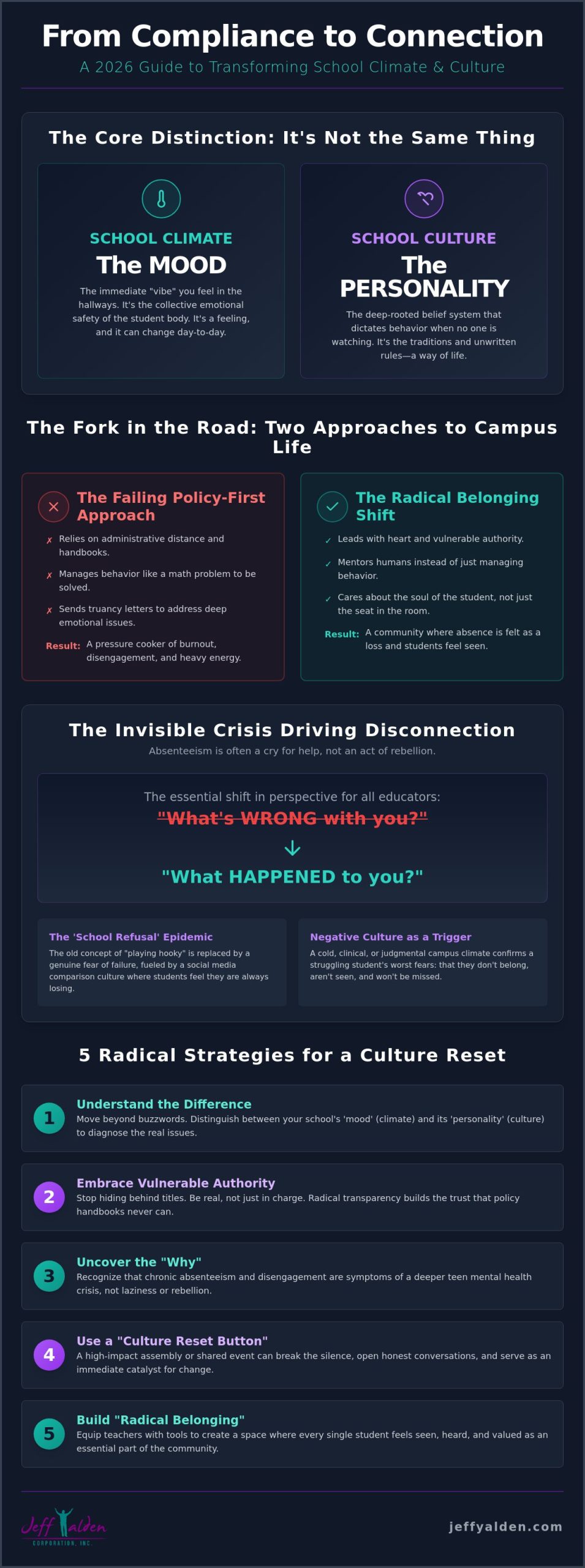
- Understand the critical difference between campus mood and personality to move your school from “compliance” to “connection.”
- Discover why improving school climate and culture in 2026 requires a radical shift toward vulnerable authority; it is about being real, not just being in charge.
- Identify how chronic absenteeism is often a cry for help and learn the emotional “why” behind the modern teen mental health crisis.
- See how a high-impact assembly program can serve as an immediate “culture reset button” for your students and staff.
- Learn to equip your teachers with the tools to build “Radical Belonging,” turning your campus into a place where every student feels seen and heard.
What is School Climate vs. Culture in 2026? Beyond the Data
Let’s get real about your hallways. If you walk into your building and it feels like a heavy, silent hospital waiting room, that’s your climate. If your students walk past each other without making eye contact because they’re terrified of being judged, that’s your culture. In the work of improving school climate and culture, we have to stop treating these as interchangeable buzzwords. They aren’t the same thing. One is a feeling; the other is a way of life.
Think of it this way. Climate is the mood. It’s the immediate “vibe” you feel when you step through the front doors on a Monday morning. Culture is the personality. It’s the deep-rooted belief system that dictates how students and staff treat one another when the principal isn’t looking. To truly transform your campus, you have to understand the foundation. You have to ask: What is School Climate? It’s more than just a survey score or a line on a state report. It’s the lifeblood of your campus. It’s the collective heartbeat of every person in that building.
We are moving toward a concept I call Radical Belonging. This isn’t just some “inclusion” initiative that looks good on a poster. Radical Belonging is the state where a student’s absence is felt as a community loss. It’s the shift from worrying about the seat in the room to caring about the soul of the student. In 2026, if we don’t make this shift, we lose them. We lose the heart of our mission. We lose the kids who are already one foot out the door.
The 2026 Connection Crisis
Our kids are drowning in digital noise. They’re exhausted by a social contract that feels broken. Digital fatigue and post-pandemic isolation haven’t just changed how they learn; they’ve rewritten how they exist. When students check out, it isn’t because they’re lazy. It’s because your culture lacks the transparency they crave. They can smell “fake” from a mile away. School climate is the collective emotional safety of the student body. If they don’t feel safe to be themselves, they won’t show up. Not really.
Why Policy-First Approaches are Failing
You can’t mail a truancy letter to a broken heart. You can’t suspend your way out of a trauma-impacted reality. Policy-first approaches fail because they rely on administrative distance. They treat behavior like a math problem to be solved rather than a person to be mentored. We have to stop managing behavior and start mentoring humans. Improving school climate and culture requires us to trade clinical distance for radical connection. It means being a vulnerable authority who isn’t afraid to be real. It’s time to stop hiding behind the handbook and start leading with heart.
The Invisible Barriers: Mental Health as a Culture Driver
Let’s stop the blame game. When students don’t show up, we often reach for the policy manual. We label them as lazy. We send out automated truancy letters. We threaten detention. But for most of these kids, that’s a lie. They aren’t avoiding work; they are avoiding a feeling. They are navigating a teen mental health crisis that is invisible to the naked eye. If your building feels cold or clinical, that internal anxiety only grows. Improving school climate and culture isn’t just about aesthetics. It is about recognizing the internal battles your students are fighting every single day.
A negative culture acts like a trigger for a student who is already on the edge. It confirms their worst fears: that they don’t belong, that they aren’t seen, and that no one cares if they disappear. To effectively Build a Positive K-12 School Climate, you have to create a safe harbor. Trauma-informed teaching isn’t just a professional development buzzword. It is a survival strategy for your campus. It is the practice of moving from “what is wrong with you?” to “what happened to you?” and “how can I help?”
Anxiety and the ‘School Refusal’ Epidemic
In 2026, the old concept of “playing hooky” is practically extinct. It has been replaced by a genuine epidemic of school refusal. This isn’t about rebellion. It’s about a crushing fear of failure. Social media has turned every hallway into a battlefield of comparison culture. Students feel like they are losing a game they never signed up to play. We have to empower them through transparency. When we give them the language to explain their struggle, the shame begins to evaporate. If you want to see a shift, consider how a teen mental health speaker can break that silence and open the floodgates of honest conversation.
The Resilience Gap on Campus
There is a massive resilience gap in our schools right now. Students lack the “bounce back” factor. They hit a small wall and they crumble because they haven’t been taught how to process discomfort. Building resilience in teens serves as the bedrock of a positive culture. Real talk: life is hard. It is supposed to be. But your students can be harder. They can be stronger. They just need the right tools and a trusted adult who is brave enough to be real with them. Improving school climate and culture happens when we stop protecting kids from struggle and start preparing them to conquer it.
5 Radical Strategies for Improving School Climate and Culture
You can’t wait for a committee meeting to save a kid’s life. You can’t wait for next year’s budget to fix a broken spirit. Real change happens now. It happens in the messy, unscripted moments between the bells. If you are serious about improving school climate and culture, you have to be willing to tear down the old walls of “professional distance” and build something real. It is time to stop playing it safe.
- Adopt Vulnerable Authority: Stop being the “perfect” leader. When you admit your own struggles, you give your students and staff permission to be human.
- The Assembly Reset: Use high-energy high school assemblies to hit the “reset button” on your campus vibe. One hour of radical honesty can do more than a year of policy memos.
- Practice Radical Transparency: Be open about the “why” behind every decision. Trust is the currency of culture; transparency is how you earn it.
- Shift Your PD Focus: Prioritize trauma-informed teaching professional development over content-only training. If your teachers aren’t emotionally equipped, they can’t lead.
- Forge Magnetic Belonging: Make your school a place where students feel more seen and valued than they do anywhere else, including their own homes.
Before jumping into these strategies, it helps to have a baseline. You can use a step-by-step approach to assessing school climate to see exactly where the cracks are. But don’t get stuck in the assessment phase. Data is just a map. You still have to drive the car.
The Power of Radical Transparency
The “expert” facade is dead. Students in 2026 don’t trust titles; they trust truth. Radical Transparency is the intentional act of being real to build trust. When an adult says, “I’m having a hard day too,” the power dynamic shifts from control to connection. You are creating brave spaces. These are rooms where students can speak their truth without fear of a referral. When they know you aren’t judging them, they start listening to you.
Teacher PD: The Front Line of Culture
Your teachers are exhausted. They are the anchors of the building, but they are dragging. Improving school climate and culture is impossible if your staff is operating on empty. We have to move from “Where were you?” to “I’m glad you’re here.” This shift in daily interactions changes everything. We prevent burnout by fostering a staff culture of mutual support. Your teachers need to know that their mental health matters just as much as the students’ scores. When the adults feel supported, that energy trickles down to every desk in the room.
Absenteeism and Crisis: The Warning Signs of a Cultural Collapse
When your attendance numbers plummet, you aren’t just looking at a logistical data problem. You are looking at a cultural collapse in real time. Chronic absenteeism is the smoke before the fire. It is often the first visible sign that a student is spiraling toward a deeper mental health crisis. If you are serious about improving school climate and culture, you have to stop looking at attendance as a checkbox. You have to see the human being who has decided that your building is no longer a safe or valuable place to exist. You can’t fix a broken heart with a truancy letter.
This is why teen suicide prevention programs are not optional add-ons; they are the structural beams of a healthy campus. You cannot have a “positive vibe” in a building where students feel like their presence doesn’t matter. We need to build a safety net culture that catches them before they drop out. How you handle a crisis determines if your students feel safe enough to return. Postvention is a culture tool. It is the bridge that leads your community from tragedy back to a sense of stability and hope.
Absenteeism as a Crisis Signal
The data doesn’t lie. Sudden drops in attendance almost always precede self-harm or total disengagement. We have to train our staff to see the “Why” behind the “Where” for at-risk students. It isn’t just about “Where were you?” It is about “What is happening that makes being here feel impossible?” We also have to empower our students to look out for one another. When we foster peer-to-peer resilience, we turn the student body into the first line of defense. They see the warning signs in their friends long before the office notices a pattern of missed classes.
The Role of the Postvention Speaker
Sometimes, the trauma is too loud for your staff to be heard. That is where an outside voice becomes essential. A postvention speaker can say the raw, difficult things that teachers and administrators can’t. They break the silence that often follows a campus crisis. By re-establishing the “Safe School” narrative after a traumatic event, we help the entire community move from a “victim” to a “victor” mentality. We don’t just survive the struggle; we grow because of it. Improving school climate and culture means proving to your students that even in the darkest times, your school remains a place of connection and strength.
If your campus is struggling with chronic absenteeism or the aftermath of a crisis, it is time for a radical reset. Book a teen suicide prevention program to provide your students with the tools they need to choose life and stay engaged.
Transforming Your Campus with Jeff Yalden: The Assembly Effect
Policy manuals are safe. They sit on shelves. They gather dust. They don’t look a struggling student in the eye and say, “I see you.” Improving school climate and culture isn’t a paperwork exercise. It’s a human one. Jeff Yalden doesn’t bring a binder; he brings a heartbeat. His “Real, Raw, Results” model is built on the truth that you can’t reach a kid’s head until you’ve captured their heart. In just 60 minutes, a high-impact assembly can ignite a fire that a 60-page manual couldn’t even spark in a decade. We are talking about immediate, visceral change.
Modern high schoolers have a world-class “fake” detector. They’ve been marketed to since they could crawl. They don’t want fluff. They don’t want a lecture. They want the truth. When Jeff stands on that stage and shares his own imperfections, the walls come down. This is how we break through to the students who have completely checked out. We don’t talk at them; we talk with them. We acknowledge their pain, celebrate their resilience, and give them a reason to believe in the person staring back at them in the mirror.
Creating a Shared Emotional Experience
This is the “Assembly Effect.” It’s about bonding a thousand different stories into one shared moment of vulnerability and hope. It is the moment the “cool” kids and the “invisible” kids realize they are fighting the same battles. Radical transparency is the only way to reach this generation. By the time the assembly ends, your campus energy has shifted from defensive to receptive. It’s a total reset. It’s the spark that makes improving school climate and culture possible because the students finally feel like they belong to something bigger than themselves.
A Partnership for Resilience
Transformation doesn’t end when the assembly lights go out. It’s just the beginning. To sustain this momentum, the adults need to be in the game too. Jeff provides customized workshops for staff that align with your specific campus needs. We move your school from being just a “place of work” to a “place of life.” For students who need that extra layer of support, the role of an academic life coach for high school students becomes the bridge to long-term success. It’s about building a foundation of resilience that doesn’t crack when the pressure of the 2026 school year turns up.
While this focus is on the classroom, the principles of high-performance leadership are universal. For instance, an executive coach for entrepreneurs montreal works with founders to build the same kind of resilient, trust-based cultures that are essential for any successful organization, including schools.
Whether it is preparing a young child for their first day of school at Jumpstart Learning Academy or supporting a teenager through a mental health crisis, the ultimate goal is the same: fostering a culture of resilience and belonging from the very beginning of the educational journey.
The 2026 season is filling up fast. Don’t let another semester slip by in a fog of compliance and teacher burnout. It’s time for a radical change. It’s time to be real. Bring Jeff Yalden to your school and start the transformation today.
Reclaim Your Campus Heart and Mission
The time for hiding behind policy manuals is over. You’ve seen that improving school climate and culture isn’t about better paperwork; it’s about deeper connections. It’s about being brave enough to lead with your heart and real enough to let your students see the human behind the title. When we move from compliance to connection, we don’t just lower absenteeism. We save lives.
I’ve spent over 30 years in the trenches of high school life. I’ve been a specialist in crisis intervention and student resilience for decades, and I’ve been trusted by thousands of schools across North America to spark a change that lasts. You have the power to turn your building into a safe harbor where every absence is felt and every student is seen. It is time to hit the reset button and breathe life back into your hallways. Let’s do this together.
Book Jeff Yalden for Your High School Assembly Today and start the radical transformation your campus deserves.
Frequently Asked Questions
What is the difference between school climate and school culture?
School climate is the immediate mood or “vibe” of your building, while school culture is the deep-seated personality and belief system of the campus. Think of climate as the daily weather and culture as the actual climate of the region. To start improving school climate and culture, you must address both the daily energy in the hallways and the underlying values that dictate how people treat each other.
How does chronic absenteeism impact school culture in 2026?
Chronic absenteeism acts as a loud warning signal that your school’s culture is losing its grip on student connection. In 2026, when students stop showing up, it’s rarely about laziness; it’s about a lack of “Radical Belonging.” This absence creates a vacuum that drains the energy from the remaining student body. It makes improving school climate and culture nearly impossible until you address the emotional “why” behind the empty seats.
Can a school assembly really change a negative campus climate?
A high-impact school assembly acts as a “culture reset button” by creating a shared emotional experience that bonds the student body instantly. While one hour can’t fix every deep-seated issue, it breaks the silence and shatters the “fake” barriers that keep students isolated. It provides the spark of radical transparency needed to shift the campus energy from defensive to receptive in a single morning. It is the start of the fire.
What are the most effective strategies for improving school culture?
The most effective strategies involve moving from a model of compliance to one of deep, human connection. This includes adopting “vulnerable authority” where leaders lead by example, prioritizing trauma-informed professional development for staff, and creating spaces where student voices are heard without judgment. Improving school climate and culture requires consistent honesty and a commitment to making every student feel that their presence is a genuine community necessity, not just a data point.
How do teacher-student relationships affect school climate?
Teacher-student relationships are the primary drivers of emotional safety on any campus. When students feel seen and valued by the adults in the building, the overall school climate shifts toward trust and engagement. If these relationships are purely transactional or focused only on compliance, the climate becomes heavy and clinical. This leads to higher rates of student burnout and staff exhaustion. Connection is the only thing that sustains the work.
What is ‘Radical Transparency’ in an educational setting?
Radical transparency is the intentional act of being real and honest about your own struggles to build genuine trust with students. It means dropping the “perfect expert” facade and showing up as a lived-experience guide. In a school setting, this transparency creates “brave spaces.” These are rooms where students feel safe to admit they are struggling because they see the adults around them doing the same. It is the end of faking it.
Why are traditional attendance incentives no longer working?
Traditional attendance incentives like pizza parties or certificates fail because they don’t address the underlying mental health crisis or the “why” behind school refusal. Modern students are navigating intense anxiety and digital fatigue; a free lunch isn’t enough to overcome a feeling of not belonging. Real attendance is driven by genuine engagement. You need a culture that makes students feel that their absence is a true loss to the community.
How should administrators handle a culture crisis after a student tragedy?
Administrators must handle a tragedy with immediate transparency and a focus on “postvention” as a culture tool. Bringing in an outside voice can help re-establish a “Safe School” narrative that internal staff might be too traumatized to lead. The goal is to move the community from a “victim” mentality to a “victor” mentality. You must ensure students feel safe enough to return and process their grief together rather than suffering in isolation.
