
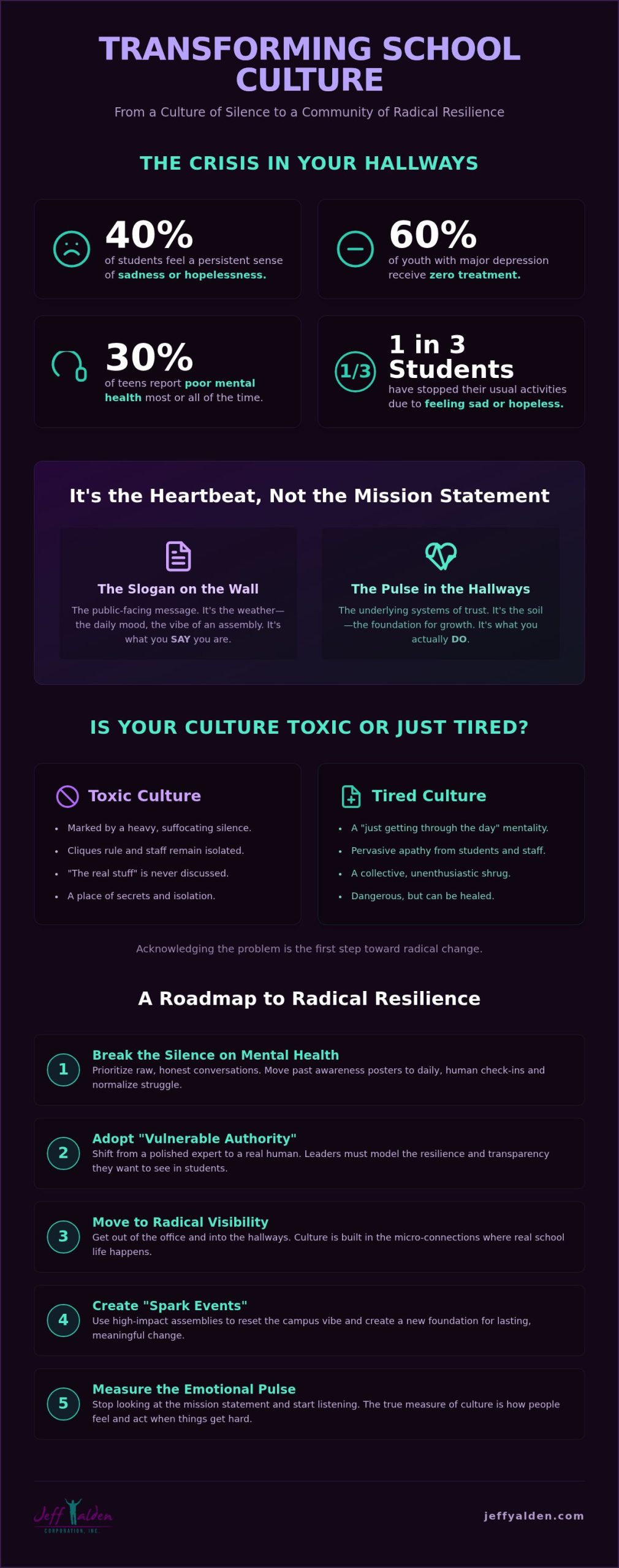
Nearly 40 percent of your students are walking through those hallways right now feeling a persistent sense of sadness or hopelessness. That is not just a statistic. It is a crisis. If you are searching for how to improve school culture in high school, you have to start by breaking the silence that is suffocating your campus. The old ways of “pep talk” motivation are dead. Gen Z and Gen Alpha can smell a script from a mile away. They don’t want polished. They want real.
You see the burnout in your staff’s eyes every Monday morning. You feel the weight of student apathy and the rising tide of mental health crises that no one seems to have the right words for. It’s exhausting. But here is the truth: school culture isn’t a policy you implement; it’s a heartbeat you sustain through radical transparency and vulnerability. You know the “vibe” needs to change, but you’re tired of temporary fixes that don’t stick.
This guide will show you how to transform your campus from a place of passive attendance to a community of radical resilience. Discover how to move from a culture of silence to one where every person feels seen, heard, and supported. We’ll explore the shift toward “vulnerable authority” and provide a roadmap to reduce disciplinary issues while re-energizing your entire staff.
Key Takeaways
- Stop staring at the mission statement on the wall and start measuring the emotional pulse of your students to find the true heartbeat of your campus.
- You can’t truly master how to improve school culture in high school without first breaking the silence and prioritizing raw, honest conversations about mental health.
- Shift from passive policy to radical visibility by getting out of the office and into the hallways where the real life of your school happens every day.
- Leverage high-impact school assemblies as “Spark Events” to reset the campus vibe and create a foundation for lasting, meaningful micro-connections.
- Adopt a “vulnerable authority” leadership style that builds trust through transparency, showing students that resilience is born from acknowledging our shared struggles.
Defining High School Culture: It’s the Heartbeat, Not the Mission Statement
You can paint your mission statement in six-foot letters on the gym wall, but that doesn’t mean your students believe a word of it. Most schools confuse a marketing slogan with a lived reality. If you want to know how to improve school culture in high school, you have to stop looking at the posters and start listening to the hallways. Culture isn’t what you say you are. It’s what people actually do when no one is watching.
Think of it this way: school climate is the weather. It’s the daily mood, the temperature of a specific assembly, or the vibe of a Friday afternoon. But school culture? That’s the soil. If the soil is packed with toxins or drained of nutrients, nothing healthy can grow, no matter how much “sunshine” you try to force into the room. Defining High School Culture means looking at the deep, underlying systems of trust and vulnerability that dictate how people treat each other when things get hard. We call this the heartbeat. It’s the emotional pulse of your building. Is it racing with anxiety? Is it flatlining with apathy? Or is it steady, strong, and resilient? You can’t fix what you aren’t brave enough to measure.
The 2026 Reality: Social-Emotional Gaps in Teens
We are living in a post-digital-first era where connection is curated but rarely felt. Our teens are starving for something real. They are navigating a world where nearly 30 percent of their peers report poor mental health most or all of the time. You cannot expect a student to master calculus if they don’t feel like they belong in the seat. Modern school culture is the collective sense of psychological safety. Without that foundation, every academic initiative is just noise. We have to close the connection deficit before we can close the achievement gap.
Identifying a ‘Toxic’ vs. ‘Tired’ School Culture
Is your school toxic or just tired? A toxic culture is marked by a heavy, suffocating silence. It’s where cliques rule, staff members hide in their rooms during lunch, and “the real stuff” is never discussed. It’s a place of secrets and isolation. A tired culture looks different. It’s the “just getting through the day” mentality. It is apathy. It’s a collective shrug from both students and staff. Both are dangerous, but both can be healed. Acknowledging that your current culture is failing is the first step toward radical change. You have to be willing to see the cracks before you can fill them with something better.
Prioritizing Mental Health as the Foundation of a Healthy Campus
You can’t build a thriving community on top of a mental health crisis. It just doesn’t work. If you’re searching for how to improve school culture in high school, you have to realize that mental health is the foundation, not an elective. When 60 percent of American youth experiencing major depressive episodes receive zero treatment, the school building becomes the front line. We can’t ignore the pain and expect school spirit to flourish. Nearly 1 in 3 students feels so sad or hopeless they’ve stopped their usual activities; it’s time to stop treating wellness as a “nice to have” and start treating it as the prerequisite for everything else.
Real change starts with what I call “Vulnerable Authority.” This means leaders, teachers, and staff have to stop pretending they have it all together. Students don’t need another polished expert; they need a human being who has navigated the storm. Following the guidelines for shaping school culture involves modeling the very behavior you want to see. This isn’t a clinical exercise; it’s a human one. If you want students to be honest about their struggles, you have to be honest about yours. This radical transparency creates a campus where wellness reduces disciplinary issues because students feel seen rather than just managed.
Normalizing the Conversation Around Struggle
We have to move past the “Awareness Month” posters that get ignored in the cafeteria. Real culture shift happens in the daily, raw check-ins. If you want to know how to improve school culture in high school, look at how you handle the “not okay” moments. It’s about creating a space where vulnerability isn’t a weakness. This isn’t about lowering standards; it’s about raising the level of support. When you bring in a teen mental health speaker who speaks their language, you break the seal of silence. You give them permission to breathe.
The Link Between Resilience and Campus Vibe
Resilience isn’t just about an individual “toughing it out.” It is a collective effort. It’s the vibe of a campus that says, “We fall down, but we get back up together.” Teaching building resilience in teens requires a shift from just “getting by” to truly bouncing back. A resilient culture sees a setback not as a failure, but as a shared learning moment. This collective strength is what transforms a tired school into a powerhouse of hope. If you’re ready to start this shift, a high school motivational speaker can be the catalyst that turns your campus heartbeat back on.
Leadership Actions: Moving from Passive Policy to Radical Visibility
Leadership isn’t a title you wear. It’s a choice you make every single morning. If you’re stuck in your office answering emails while your students are navigating the chaos of the hallways, you aren’t leading. You’re just managing. Real leadership requires radical visibility. You have to be where the kids are. You have to be the first person they see and the last person they hear. When you’re trying to figure out how to improve school culture in high school, the answer is rarely found in a spreadsheet. It’s found in the cafeteria, the locker bays, and the parking lots.
The benefits of a positive school culture aren’t just theoretical concepts for a board meeting. We’re talking about higher engagement and actual academic outcomes that you can see and feel. But those benefits only show up when the leadership stops hiding behind policies. You have to model the behavior you want to see in your most difficult students. If you want them to be respectful, you show them respect even when they’re pushing every button you have. If you want them to be honest, you start being honest with them about the challenges the school is facing. Stop the corporate-speak. Start the real conversation.
The Principal as the Cultural Architect
Every interaction you have is a brick. You’re either building a wall or a bridge. When a crisis hits, don’t retreat into a shell of legal jargon. Be transparent. Tell your staff and your students the truth about what is happening. This is especially critical when implementing teen suicide prevention programs. You can’t save lives with a memo. You save lives by being a present, vulnerable authority figure who isn’t afraid to look a student in the eye and say, “I’m here, and I see you.”
Supporting the Supporters: Staff Wellness First
You cannot pour from an empty cup. It’s a cliché because it’s true. A burnt-out staff cannot build a thriving culture. If your teachers are drowning, your students will too. We need to stop giving them more work and start giving them more support. This means providing real, actionable trauma-informed teaching professional development. We have to empower our educators to handle the emotional weight of 2026. For those who want to broaden their horizons through CityJS Athens and other external industry events, you can explore Event Registration and Sponsorship Fees for specialized training opportunities. Give them the agency to drive change instead of just following orders. When the staff feels supported and energized, the energy on campus shifts instantly. That’s how to improve school culture in high school from the inside out.
Small Wins and Big Moments: Catalyzing Change on Campus
Culture change isn’t always a slow burn. Sometimes, it’s a lightning strike. If you’re struggling with how to improve school culture in high school, you need to understand the power of the “Spark Event.” You can implement all the micro-connections in the world, but if the overall vibe is one of apathy or silence, those small wins will get swallowed up. You need a moment that stops everyone in their tracks. You need a shared experience that resets the emotional baseline of the entire building. This is the catalyst that makes the daily work possible.
There is a specific reason why an outside voice is often more effective than the most beloved principal. Your staff members are the “parents” of the school. Students see them every day; they know their routines, their rules, and their expectations. An outside speaker is the “vulnerable authority” who walks in with no baggage. They can say the hard things that staff can’t. They can talk about the “real stuff”—the mental health crises, the suicidal ideation, and the crushing pressure—in a way that feels raw and authentic rather than clinical. This outside perspective provides the radical transparency needed to break through the walls Gen Z has built to protect themselves.
High School Assemblies as Cultural Catalysts
We have to move beyond the traditional “sit and listen” model. High-impact High School Assemblies are designed to be “engage and transform” moments. When a thousand students and staff members all experience the same emotional breakthrough at once, it creates a new campus vocabulary. It gives everyone a common language to discuss struggle and resilience. This shared experience is what turns a collection of individuals into a community. It’s the ignition switch for long-term transformation.
The Follow-Through: Turning Inspiration into Habit
Inspiration is a feeling, but culture is a habit. What happens the day after the assembly is just as important as the event itself. You need a 90-day culture roadmap to keep the momentum alive. This involves integrating the themes of the assembly into daily classroom discussions and empowering your student leaders to drive the narrative. Don’t let the energy fizzle out. Use the “Edutopia” approach of micro-connections—the high-fives in the hall, the authentic check-ins, and the “I see you” moments—to reinforce the new heartbeat of your school. If you’re ready to ignite this change, booking a High School Motivational Speaker is the first step toward a radical campus reset.
Bringing Radical Transparency to Your School: The Jeff Yalden Approach
You have seen the statistics. You have felt the heavy silence in your hallways. If you are serious about how to improve school culture in high school, you have to stop looking for a manual and start looking for a spark. Jeff Yalden doesn’t arrive as a distant expert with a PowerPoint. He arrives as a “vulnerable authority.” This is about radical transparency. It is about an expert who leads by example by sharing personal imperfections. Since 1992, Jeff has been the catalyst that starts the culture shift schools desperately need. He doesn’t just talk at students; he bridges the connection gap by being the most real person in the room.
The impact of a single assembly can be felt for years. When you move from a policy-driven approach to a heartbeat-driven approach, everything changes. Jeff works with both staff and students to ensure the message sticks. This isn’t a one-off pep talk. It is a fundamental reset of your campus vibe. By linking culture directly to mental health outcomes, Jeff helps you build a community where students feel seen and heard. This is the radical shift required for the 2026 school year and beyond. It is time to stop managing apathy and start leading with heart.
A Message of Hope and Realness
Teens today are skeptical of anything polished. They can spot a script in seconds. They respond to “real” and “raw” because that is the world they live in. Jeff’s lived experience creates an immediate bond that no clinical counselor can replicate in a gym setting. He speaks the language of resilience. The goal is to move students from a victim mentality to a “victor” mentality. It is about showing them that their struggles don’t define them; their response does. This is how to improve school culture in high school at its most visceral level. When students see an authority figure be transparent about life’s challenges, they finally feel safe enough to do the same.
- Move beyond clinical jargon to emotive, heart-centered language that resonates.
- Focus on transformation rather than just “getting through the day” with a tired staff.
- Empower students to take ownership of their mental health journey through radical honesty.
Book Your Cultural Transformation
The 2026 season is about more than just attendance. It is about radical resilience. You can bring a high school motivational speaker to your campus who understands the unique pressures of the current teen mental health crisis. Jeff tailors every message to your school’s specific cultural needs. Whether you are dealing with staff burnout, student apathy, or a recent crisis, the approach is always grounded in transparency and hope. Take the first step toward a radically transparent campus today. Your students are waiting to be heard. Your staff is waiting to be energized. Let’s turn that heartbeat back on and build a school culture that actually saves lives.
Ignite the Heartbeat of Your Campus Today
You’ve seen the data. You’ve felt the heavy silence in the halls. Now you have the roadmap. True transformation happens when you stop managing policies and start sustaining the heartbeat of your building. It’s about moving from a mission statement on the wall to a lived reality of radical transparency. You can’t build a resilient community without first addressing the mental health crisis head-on. The soil must be healthy before anything can grow.
Understanding how to improve school culture in high school starts with a single choice to be real. It requires leaders who are visible, staff who feel supported, and students who finally feel seen. But sometimes, you need a lightning strike to jumpstart the engine. You need a catalyst who can say the hard things and break through the apathy that has settled over your campus. You need someone who has been in the trenches and knows the way out.
With over 30 years of experience and a specialist focus on teen mental health and crisis intervention, Jeff Yalden brings the radically transparent approach that students actually trust. He doesn’t just deliver a speech; he resets the vibe of the entire school. It’s time to move from passive attendance to radical resilience. Bring Jeff Yalden to Your School for a Cultural Reset and let’s start the healing together. You’ve got this. Your students are worth it.
Frequently Asked Questions
How long does it take to actually change a high school culture?
You can shift the energy in twenty-four hours, but deep transformation takes two to three years of relentless consistency. When you are learning how to improve school culture in high school, remember that a Spark Event resets the vibe overnight. After that, it’s about the micro-connections you make every single day. Real change is a marathon, but you need that initial burst of speed.
Can one school assembly really make a difference in campus vibe?
Absolutely, but only if it’s more than a “sit and listen” lecture. A high-impact assembly acts as a cultural catalyst that breaks the seal of silence. It provides a common language for struggle and resilience. It’s the moment everyone realizes they aren’t alone. This shared emotional breakthrough creates the momentum your staff needs to keep the conversation going in the classroom every day.
What is the biggest mistake principals make when trying to improve culture?
The biggest failure is trying to manage culture from behind a desk. You can’t fix a campus heartbeat with a memo or a new set of rules. Principals often hide in offices instead of being present where it matters. If you aren’t in the hallways modeling vulnerability, your students won’t buy what you’re selling. Culture is built in the cafeteria, not the conference room; for additional inspiration on leading with presence and purpose, visit Alfredo Bala (The Motivation Guy).
How do you involve students in the culture-building process?
You have to stop talking at them and start listening to them. Give your students real agency to drive the narrative on campus. When you empower student leaders to lead the “vibe check,” the rest of the student body follows. They don’t want a polished program from adults. They want a community they helped build with their own hands and their own hearts.
Is school culture the same as school climate?
Climate is the daily mood, while culture is the long-term foundation. Think of climate as the weather you feel each morning. Culture is the deep, underlying trust that dictates how people treat each other when things get difficult. You can change the climate with a fun event, but changing the culture requires digging into the roots of how your school actually functions and thrives.
How do we maintain culture when we have high staff turnover?
You maintain it by making the culture the “way we do things here” regardless of who is on the payroll. This means prioritizing staff wellness and trauma-informed training from day one. When your culture is strong, it acts as a magnetic force. It pulls new hires into the rhythm instead of letting the turnover drain the school’s energy and life before they even start.
What role does mental health play in school culture?
Mental health is the foundation of a healthy campus. You won’t find a way for how to improve school culture in high school without first addressing the pain your students are carrying. When nearly 1 in 3 teens feels persistently sad or hopeless, wellness becomes the priority. A culture of radical transparency makes it safe for students to be “not okay” while they heal.
